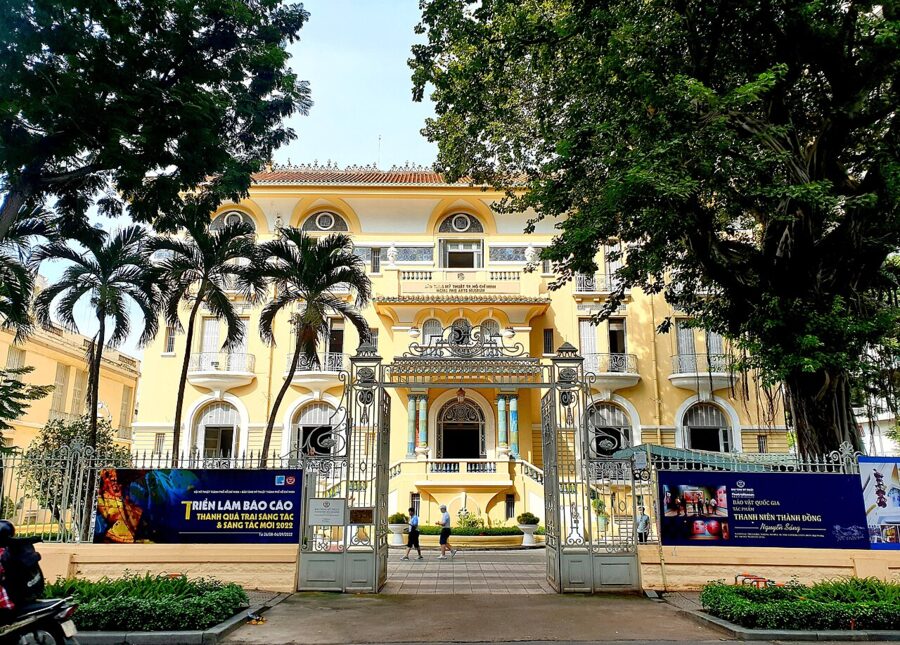
At 8am, when the gates on Phó Đức Chính open, the sun is still low on the yellow front of the main house. Inside, look up the well of the staircase and you will see a lift car made of carved wood, shaped like a Chinese sedan chair, that once rose on two rails from the first floor to the roof. Above the front door, worked into the iron of the fanlight, are three letters: H.B.H. They stand for Hui Bon Hoa, the merchant Saigon called Chú Hỏa, who died in 1901, decades before this house was finished.
The house is now the Ho Chi Minh City Fine Arts Museum (Bảo tàng Mỹ thuật Thành phố Hồ Chí Minh), a short walk from Bến Thành Market. It holds more than 22,000 objects across three buildings: lacquer and silk paintings by the first generation of Vietnamese modern artists, thousands of sketches drawn in the war, Cham and Óc Eo stone, Biên Hòa ceramics, and a garden of bronze statues. Two of its paintings are national treasures.
Allow two hours, start in the main house, and keep your head up: the tiles, the glass and the ironwork are as much a part of the collection as anything on the walls.


On this page
The merchant whose house it was
Huỳnh Văn Hoa was born in 1845 near Xiamen in Fujian and reached Saigon around 1863. Hui Bon Hoa is the same name spoken in Hokkien and spelled the way colonial clerks wrote Chinese names at the time. He became a Catholic and a French citizen, took the baptismal name Jean-Baptiste, and the family kept Hui Bon Hoa as their surname for generations. Saigon called him Chú Hỏa, “Uncle Hỏa”.
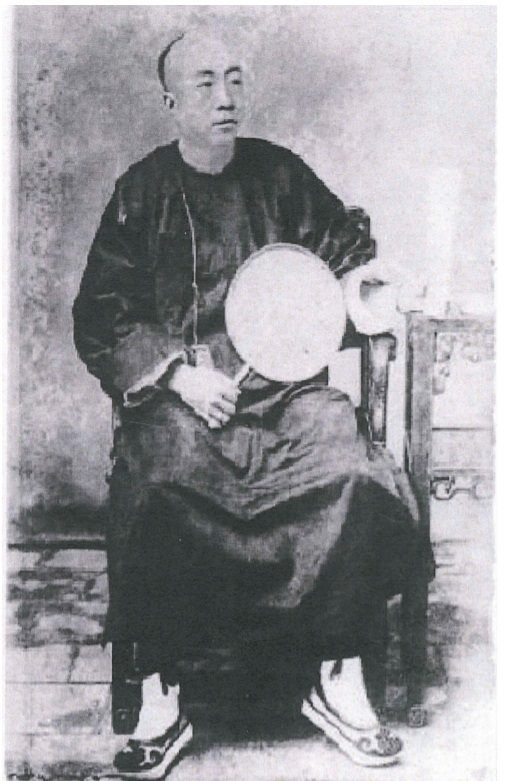
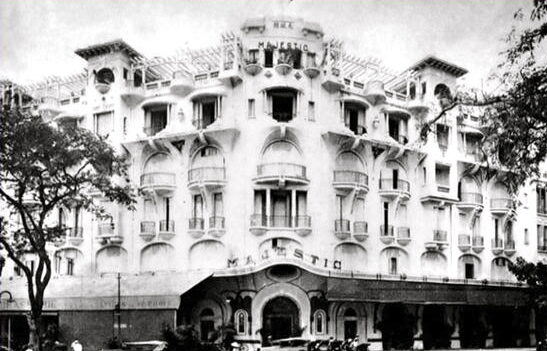
The story everyone tells is that he started out buying and selling scrap, bottles and old metal, and ended up as Saigon’s greatest landlord. Accounts credit the family company with more than 20,000 street-front houses at its height, and with buildings that still stand: the Majestic Hotel on the river, Từ Dũ maternity hospital and a pavilion of the Saigon General Hospital. An old Saigon saying ranked the city’s richest men as “Nhất Sĩ, nhì Phương, tam Xường, tứ Hỏa”. Chú Hỏa came fourth on the list and first in the stories.
The Saigon scholar and collector Vương Hồng Sển wrote that he made himself rich but did a great deal to open up the southern economy, and that he never squeezed his tenants. In 1901, on a visit to China with his wife, he died suddenly and was buried in Quanzhou, aged 56.

Who built the house, and when
Chú Hỏa wanted a single house where all his descendants could live together, and never built it. His children did, after his death, partly to honor him. The date most often given for the main house is 1929 to 1934, on plans by a French architect recorded only as Rivera.
That is the tidy version. An architecture journal gives 1925, a 2025 report in Thanh Niên puts the main house in the late 1930s, and the city’s Department of Culture and Sports describes a family compound that grew over nearly half a century. Enthusiasts quoted in the same report count four family houses on the block, built between about 1910 and 1950, of which three survive.

Documented, and legend
Some things are well recorded. The family left Vietnam after 1975, and on 5 September 1987 the city’s People’s Committee signed decision 194/QĐ-UB creating a fine arts museum in the house. The museum’s own history says it opened to visitors at the end of May 1989 after two years of gathering a collection; other accounts give 28 March 1989, 1991 or 1992. In 2012 the city listed the three buildings as an architectural and artistic heritage site.
Other things belong to the guides. The house is said to have 99 doors, each different, with a hundredth main door left out because it would have clashed, in feng shui terms, with the Governor-General’s palace. Nobody has published a count. The lift is called the first in Saigon, which is repeated everywhere and proven nowhere.
Then there is the ghost. In 1973 the director Lê Hoàng Hoa released Con ma nhà họ Hứa (The Ghost of the Hứa House), a horror film about a daughter of Chú Hỏa who caught leprosy, was shut away in a sealed room and haunted the house after her death. It drew on an older Chợ Lớn tale and filled Saigon’s cinemas.
A museum guide told VnExpress in 2015 that the story was “only an embroidered tale”, and staff said relatives who visited had told them Chú Hỏa had no such daughter. The film made the house famous all the same, and the story still follows it.
Reading the building
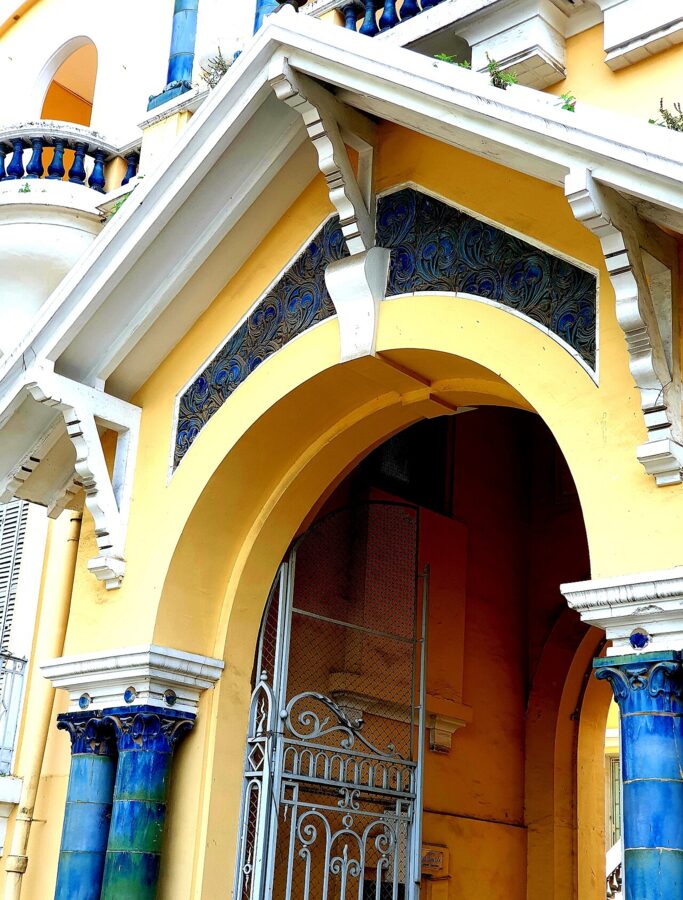
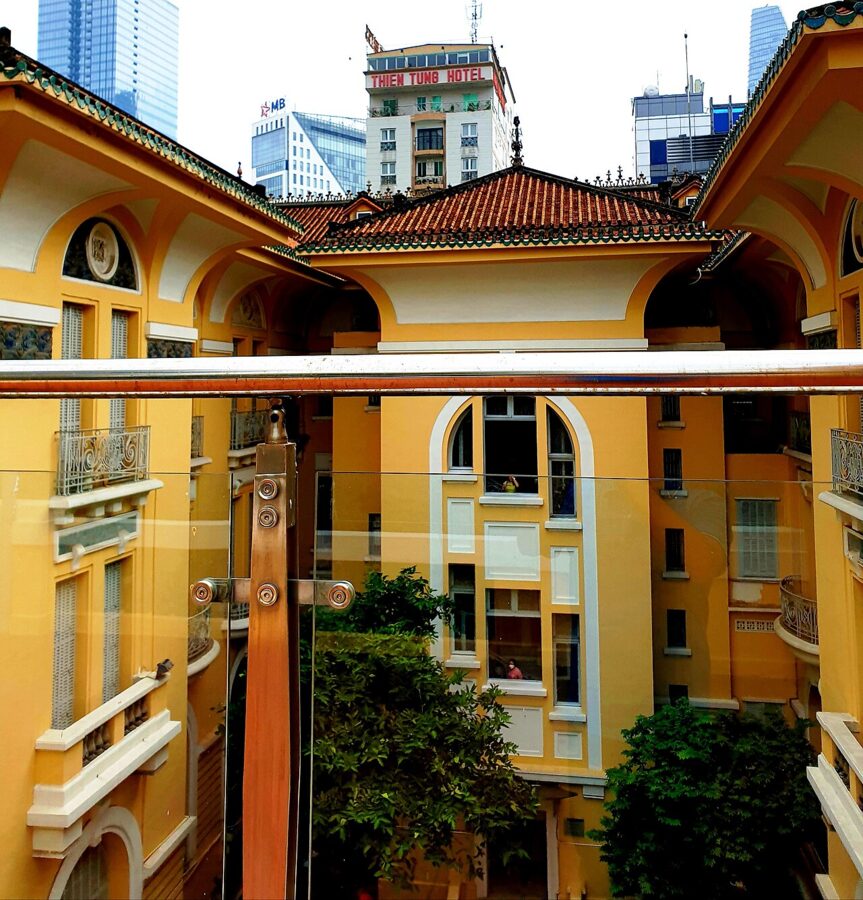
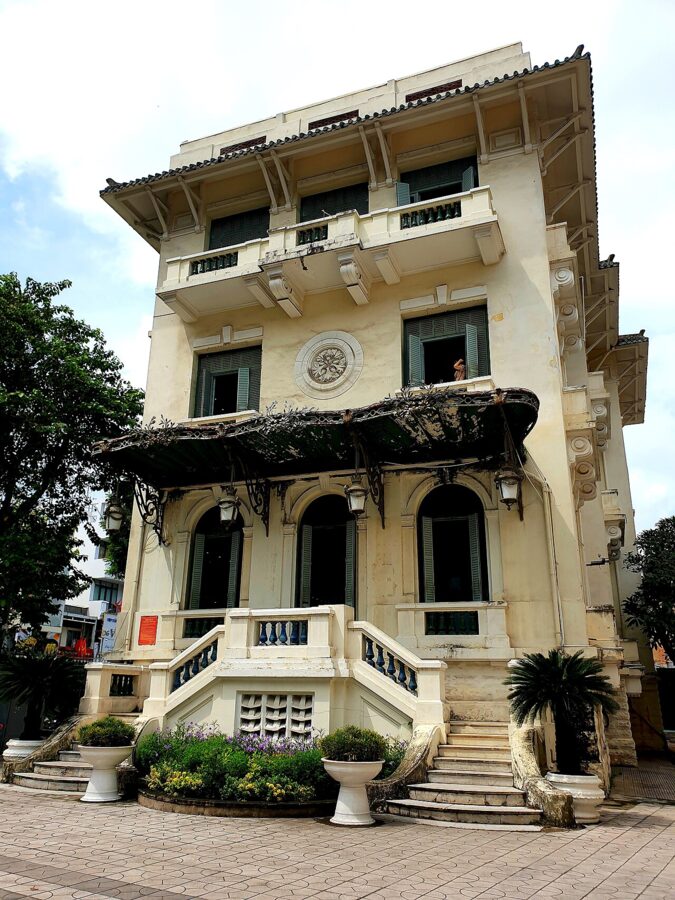
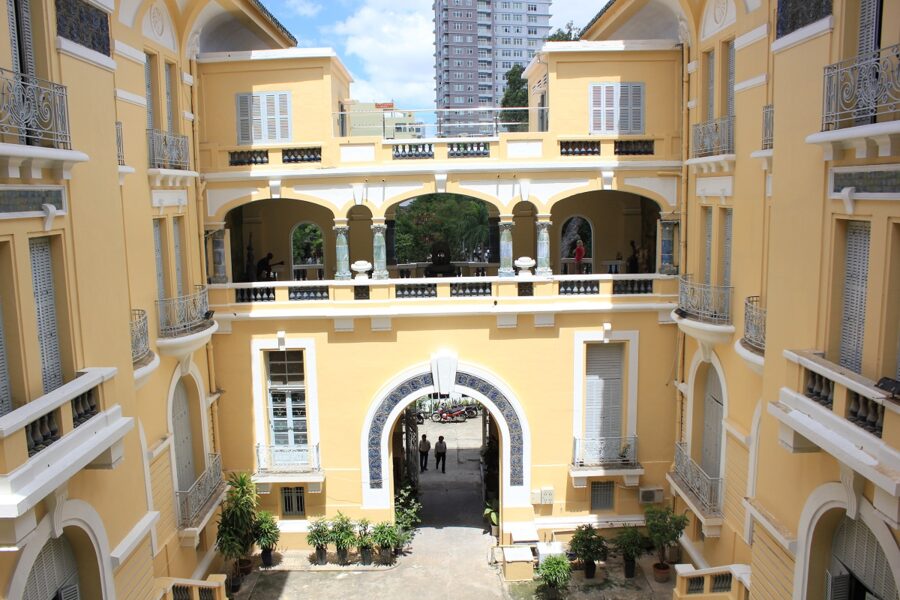
The main house has four floors, a basement and three above, in reinforced concrete with walls 40 to 60 cm thick. Four wings close around an inner courtyard, so air moves through the building and light comes in from both sides. The style is usually called Art Deco, though it is more of a mix: French classical proportions, Chinese roof tiles and couplets, and Vietnamese glazed ceramics, all on one facade.

Couplets, roof tiles and the monogram
The main door is an arched steel-and-glass frame in the European manner, with H.B.H. in stylized iron flowers above it. Just inside, Chinese couplets in gold characters hang on either side, as they would at the door of a merchant’s house in Chợ Lớn.
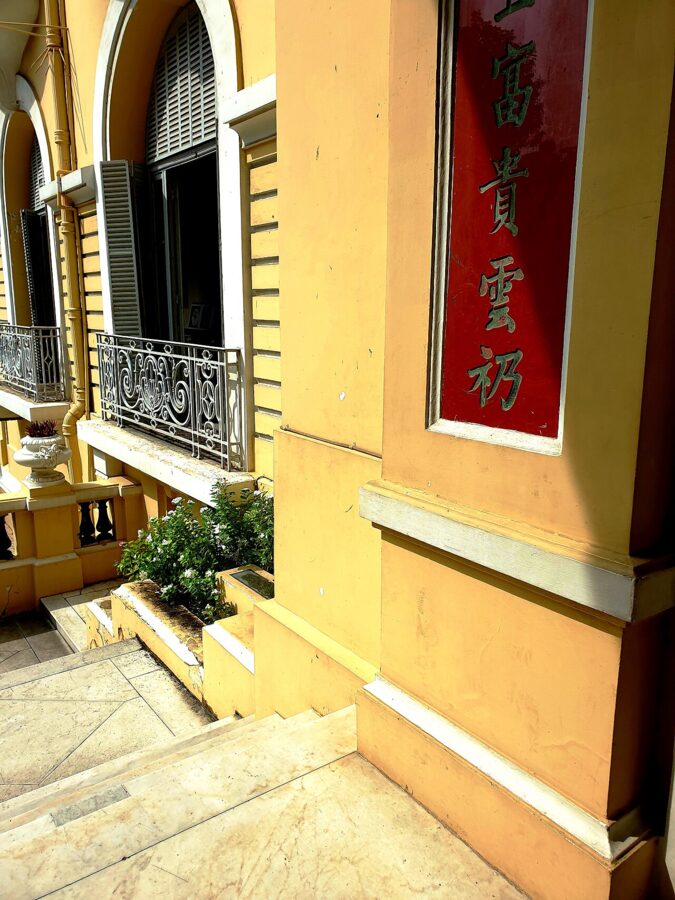

Look up from the courtyard for the rest. The roofs are covered in red yin-yang tiles, the curved, interlocking kind used on temples, finished along the eaves with tiles in green glaze. Blue glazed tiles cover balusters and column bases. Drain spouts are shaped like fish, and the small round vents carry the character Vạn, a Buddhist sign of good fortune.
Floors, glass and iron
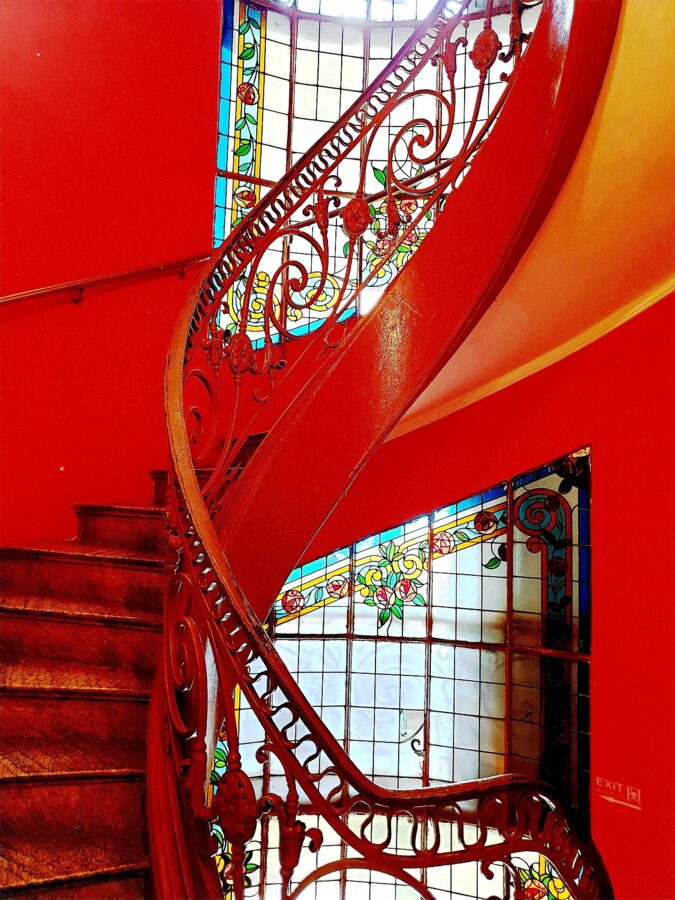
Every zone and every floor has its own pattern of cement tiles, the gạch bông that once floored every good house in Saigon. The main stair has marble treads and a wrought-iron rail, and the stair windows are filled with colored glass. With its red walls and colored glass, the stairwell is the museum’s favorite photo spot.
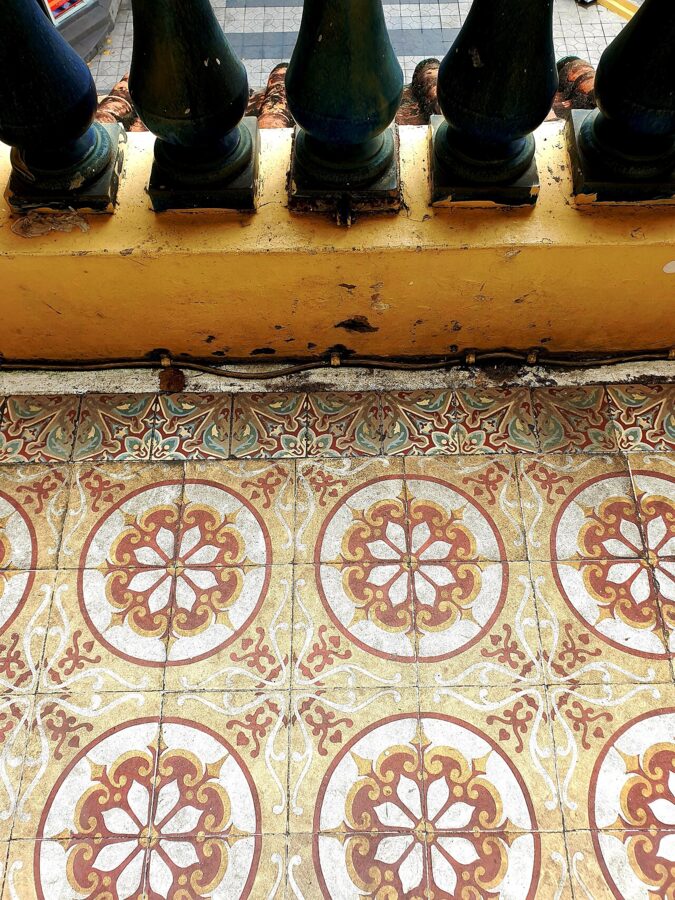

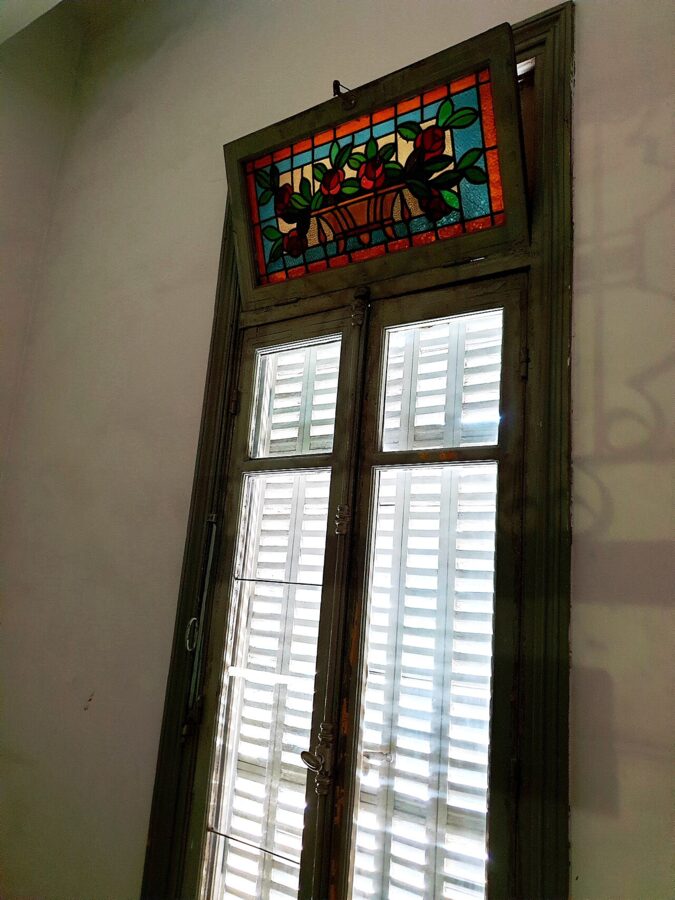

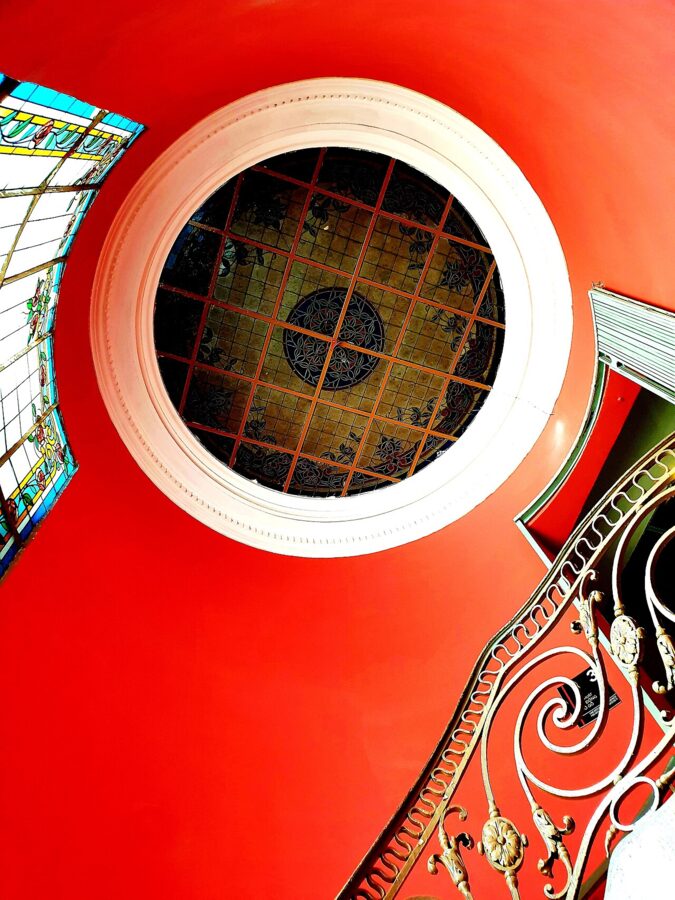

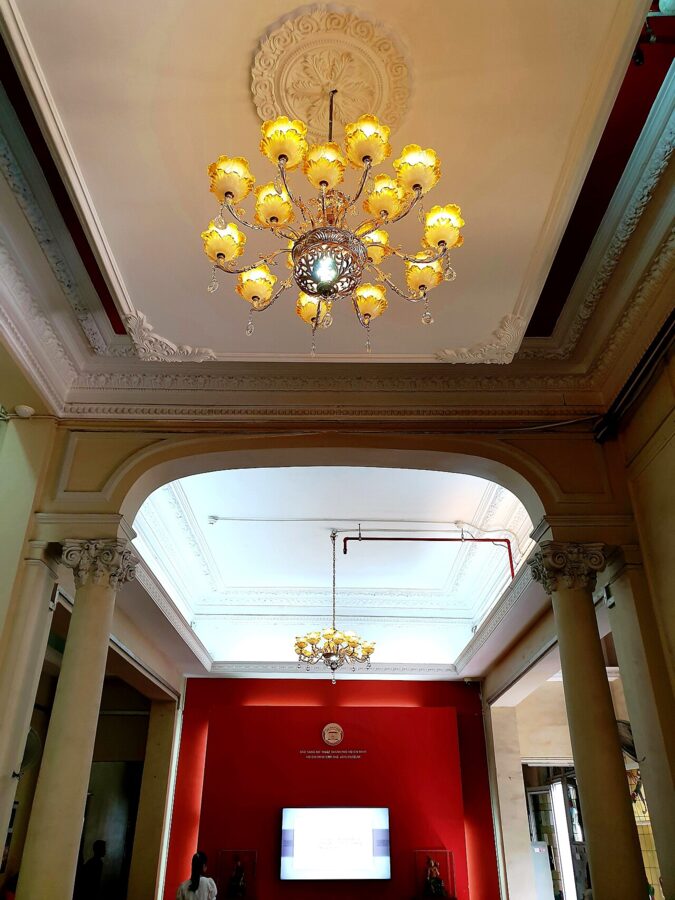

The lift is in the center of the stairwell. Its wooden cabin is carved like a sedan chair and left open to view, and it ran on two rails from the roof down to the first floor. It is kept as part of the house, so look at it from the stairs rather than expecting a ride.
Three buildings: where everything is
Building 1, the main house, holds the modern collection: twentieth-century painting and sculpture, including both national treasures. Building 2 holds temporary exhibitions, between ten and twenty-five a year. Building 3 holds the older art, from Óc Eo and Champa stone to the ceramics, bronzes and woodwork of the south.

If you only have an hour, spend it in Building 1, where the paintings and the house are both at their best. If you have two, add Building 3. Check the banners for Building 2 at the gate: some shows are worth a detour and some are small group shows you can skip.

Groups of five or more can ask for a guided talk at the ticket office or from the guide on duty in Building 1.
Lacquer, silk and oil: the modern rooms
Building 1 tells the story of Vietnamese painting in the twentieth century, and the story starts in Hanoi. In October 1924 a decree created the Indochina College of Fine Arts (École des Beaux-Arts de l’Indochine), with the French painter Victor Tardieu as its first director. In twenty years it produced 128 graduates, and among them were most of the names that matter in Vietnamese modern art.
The college pushed its students to take old Vietnamese crafts and make them into fine art. Silk painting, which had been used for portraits and court scenes, became a medium for soft, light-filled pictures of daily life. Lacquer, sơn mài, went further. Builders and craftsmen had used it for centuries on temple furniture; the college’s painters began polishing layer on layer of lacquer, gold, silver and crushed eggshell into pictures with a depth that oil cannot match.
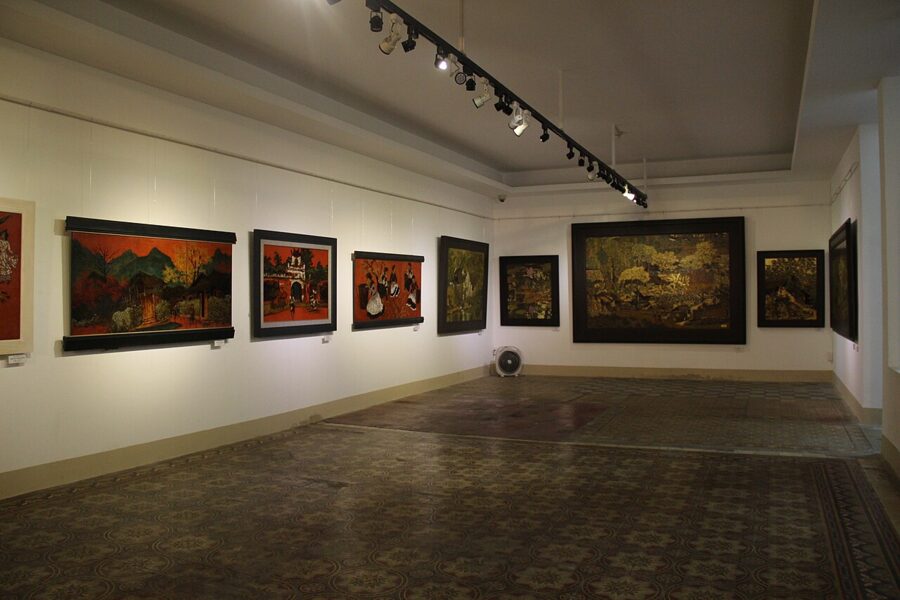
The south had its own school. The Gia Định school of applied arts, founded in 1913, trained craftsmen and later painters, and the museum collects its graduates alongside the Hanoi generation. The museum names the Indochina College painters it holds as Tú Duyên, Nguyễn Khang, Tạ Tỵ, Lê Thị Lựu, Nguyễn Gia Trí, Ủ Văn An and Nguyễn Văn Mậu, and the Gia Định painters as Lưu Đình Khải, Đỗ Đình Hiệp, Nguyễn Hiêm, Nguyễn Siên, Trương Văn Ý, Hoàng Trầm and Mai Chửng.
Nguyễn Gia Trí’s spring garden
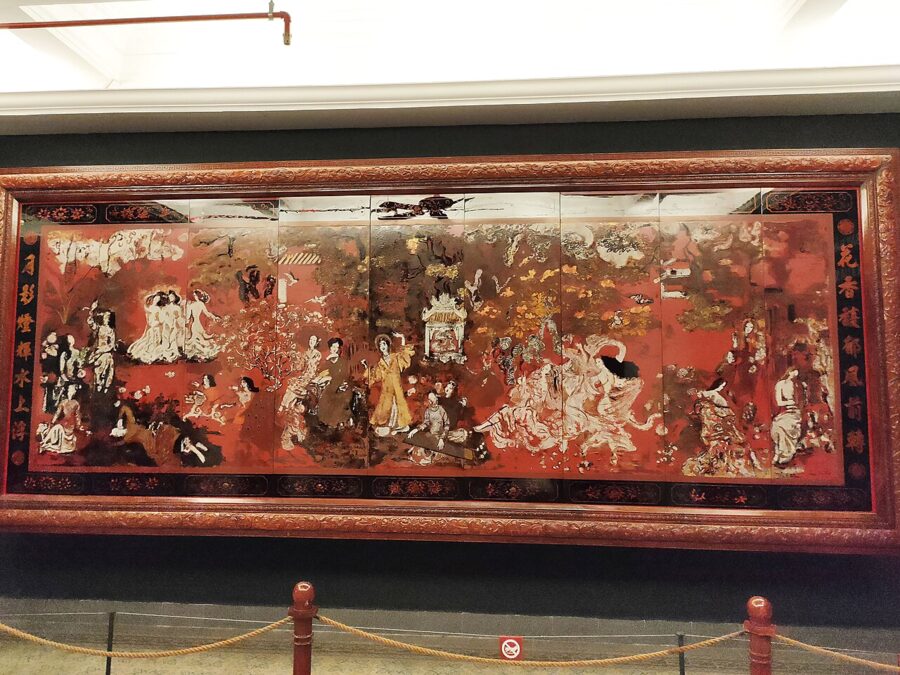
Nguyễn Gia Trí (1908 to 1993) graduated from the Indochina College in 1936 and is usually called the father of modern Vietnamese lacquer. He was also a cartoonist who mocked the colonial government in the Hanoi press of the 1930s, and the French sent him to prison in Sơn La for his part in a nationalist party. He moved south in 1954 and worked in Saigon for the rest of his life.
Vườn xuân Trung Nam Bắc (Spring Garden of the Center, South and North; often listed as Vườn xuân Bắc Trung Nam) is his last and largest statement. He worked on it from 1969 to 1989. Young women move through a garden of flowers in red, gold and black, and a border carries lines by the seventeenth-century poet Đào Duy Từ about moonlight on water and the scent of flowers on the wind.
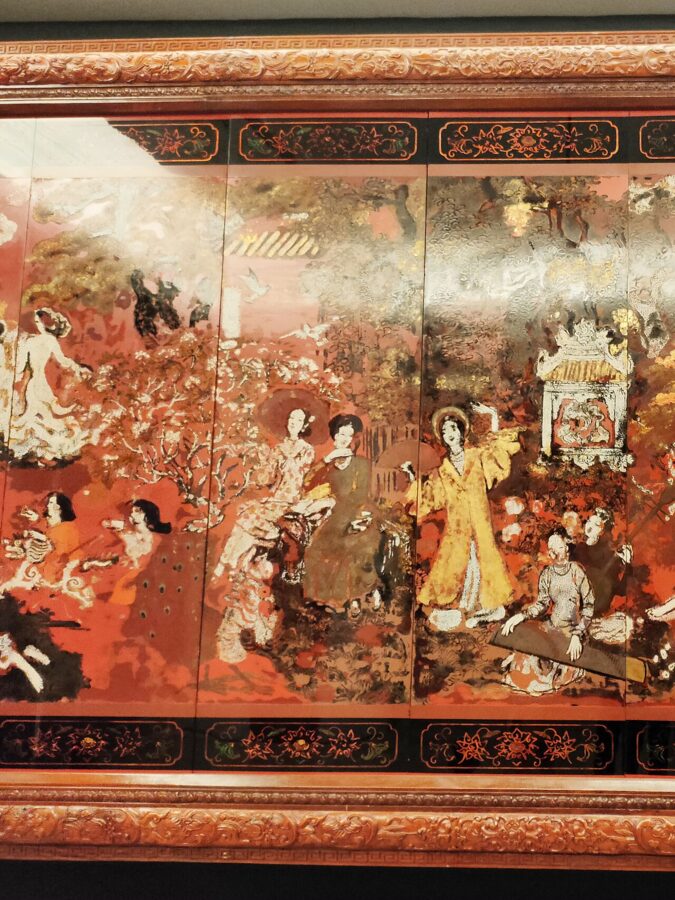

Nguyễn Gia Trí was a slow worker who priced his paintings by the length and kept clients waiting for years. His national treasures cannot leave the country. Here you can stand in front of it for as long as you like, and in the morning you may have it to yourself.
Nguyễn Sáng and the young people of Saigon
The museum’s second national treasure is Thanh niên Thành đồng (The Youth of the Bronze Citadel) by Nguyễn Sáng (1923 to 1988), lacquer, painted between 1967 and 1978. It shows Saigon students in the 1960s facing two armed American soldiers with bare hands. The title echoes the wartime phrase “thành đồng Tổ quốc”, the bronze citadel of the fatherland, used for the South.
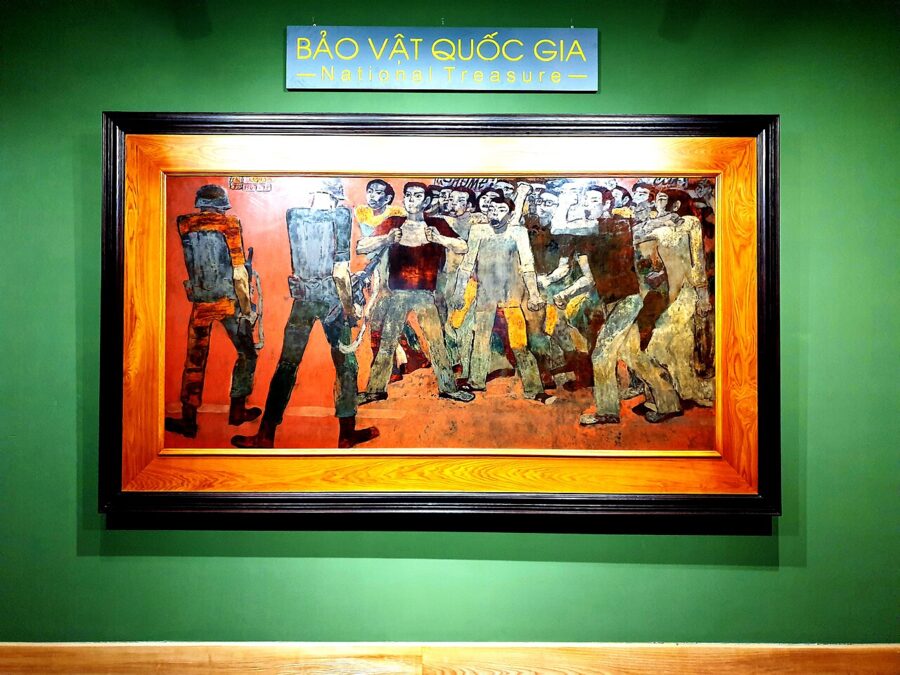

It is the work of a Hanoi painter, made during and after the war, about a city on the other side of the front, and its figures are symbols more than people. Look past the message at the handling of lacquer: Nguyễn Sáng made it harder, flatter and more graphic than the painters who trained him.
Silk: Lê Thị Lựu and Kim Bạch
Lê Thị Lựu (1911 to 1988) entered the Indochina College in 1927, graduated first in her year in 1932 and is usually counted the first woman of Vietnamese modern art. She moved to France in 1940 and spent most of her life there, painting mothers, children and young women on silk. In 2018 and 2019 her relatives Lê Tất Luyện and Thụy Khuê gave 26 of her works and papers to the museum.
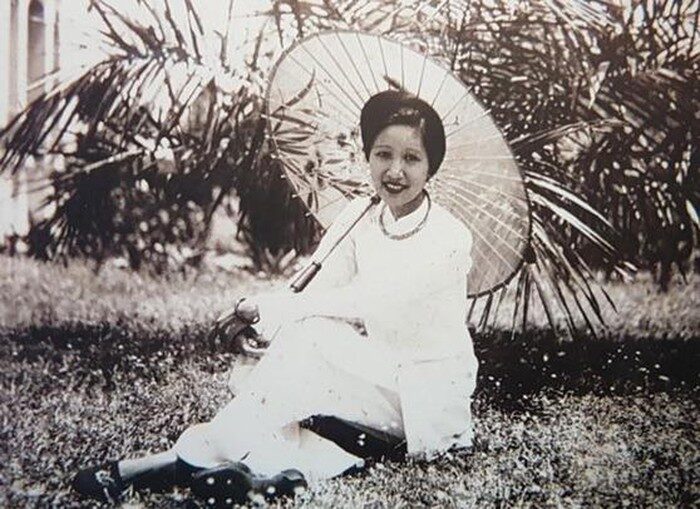
Look for Thiếu nữ đeo kiềng (Young Woman with a Necklace, 1959) and Chị dạy em viết chữ Nho (A Girl Teaching Her Sister to Write Chinese Characters, 1946). They are small, about the size of a book page, and reward slow looking.
Lê Thị Kim Bạch, born in 1938 near Tân An and trained in Hanoi and Kiev, is represented by the silk Tuổi mười bốn (Fourteen, 1983).
Lê Bá Đảng
In 2023 the same couple gave the museum 236 works and documents by Lê Bá Đảng (1921 to 2015), a painter, sculptor and printmaker from Quảng Trị who spent his working life in France. In November 2024 the museum opened a permanent Lê Bá Đảng space with 27 works: works on paper from his “Spaces” series, hollow stainless-steel figures and prints. It is a quiet and rewarding room, far from the lacquer gardens next door.
Drawn under fire: sketches and posters
The collection the museum is proudest of is not on any poster. It holds more than 3,000 sketches drawn in the field in the south during the American War, by artists who went with the soldiers and the porters. The museum counts it among its most important collections.
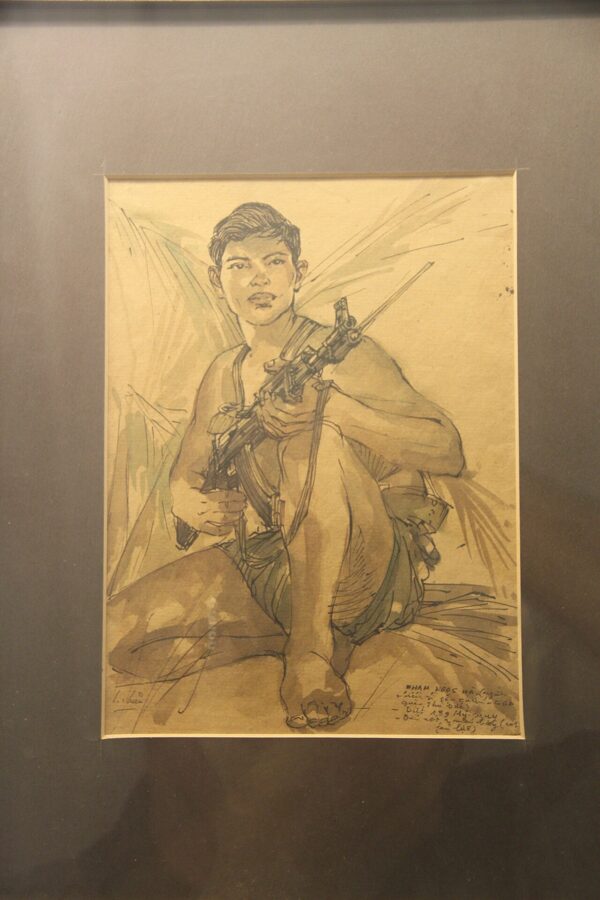
The museum’s own account makes two points. First, they are mostly calm. Soldiers at the front, villagers supporting them, men shouldering a rocket launcher and the flat country of the south: there is little gore and few heroics. Second, the museum presents them as evidence that the Party’s line on culture was right, and says so in its own published account.
Both things are true. The sketches are records made by people with very little time, and they are also art made inside a political system that decided what art was for. Names to look for include Nguyễn Hiêm (Cây súng, The Gun, in gouache), Lê Lam (Vác DKB, Carrying the Rocket Launcher, in watercolor), Thái Hà, Nguyễn Thanh Châu, Trần Hoàng Sơn and Nhất Tâm (Những đôi vai, Shoulders, in pen).
How to read a wartime poster
The posters are louder, made to be read from across a street: one slogan, a few colors, figures in outline. The posters on show speak in the voice of the time and use its vocabulary, with Americans as the enemy and the Saigon government as a puppet.
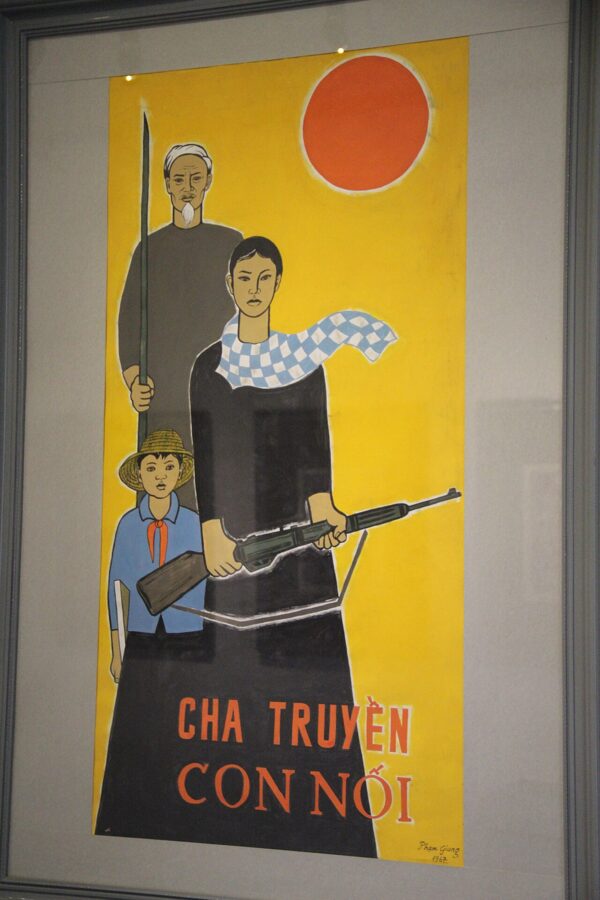
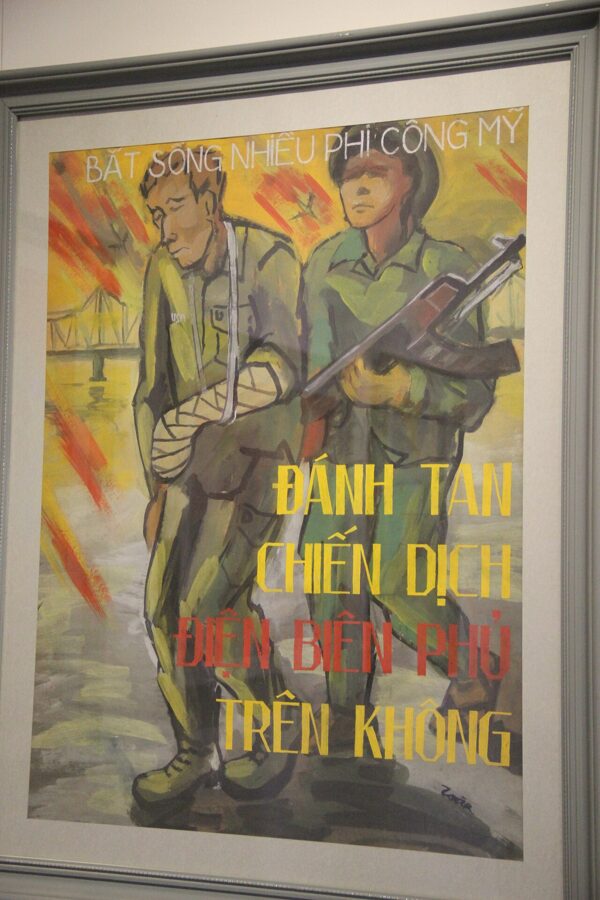
Look at the date and place on each one, because a poster from Hanoi in 1967 and one from the delta in 1972 had different readers and different jobs. Then visit the War Remnants Museum, which tells the same war through photographs, and the Reunification Hall (Dinh Độc Lập), where it ended.
Building 3: stone, clay, bronze and wood
Building 3 holds the old art. The stone gallery has three groups: sculpture from the ancient Mekong Delta, Champa sculpture and objects from the Óc Eo culture.
Óc Eo and the ancient delta
Óc Eo is the name archaeologists give to the culture of the delta between about the fourth and seventh centuries, when trading ports there linked India, China and Southeast Asia. Its sculptors carved Vishnu and the Buddha in a style learned from India and changed into something local. The museum shows Hindu and Buddhist figures from the fourth to the twelfth century, and Óc Eo tools, pots, clay earrings and bronze bracelets that probably came from An Giang.
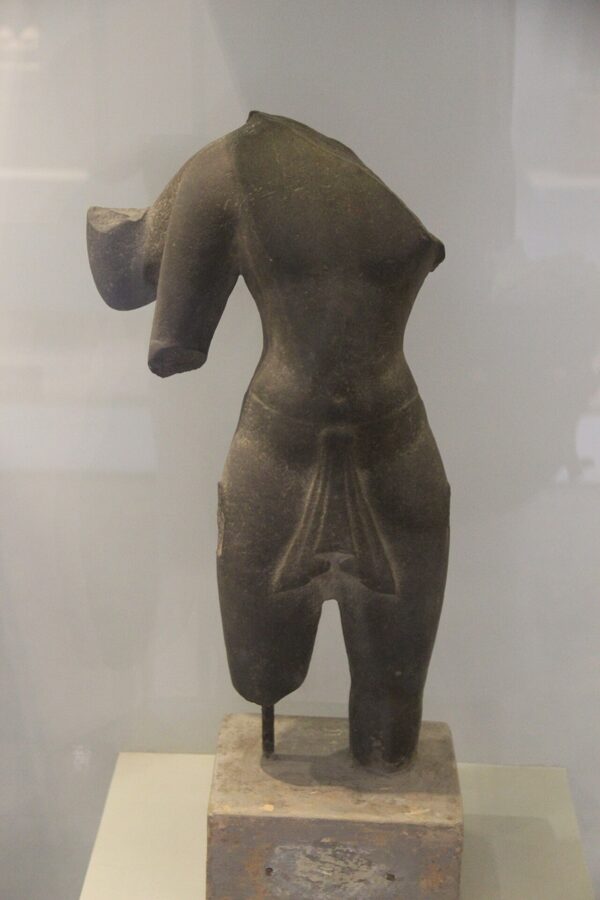
The Museum of Vietnamese History beside the zoo has a larger Óc Eo collection. If you can see both, start there and finish here. The site of Óc Eo itself is in An Giang Province, near Ba Thê mountain.
Champa
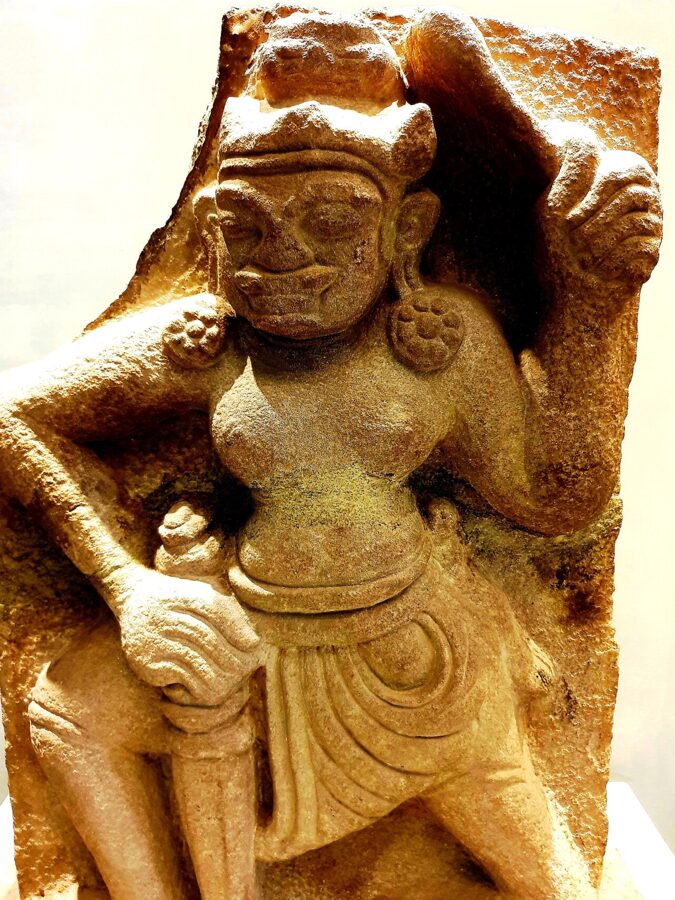
The Cham pieces run from the seventh to the seventeenth century and come from Quảng Nam, Bình Định and Ninh Thuận. The museum sorts them by style: Mỹ Sơn E1, Đồng Dương, Trà Kiệu, Mỹ Sơn G8, Tháp Mẫm and Po Klaung Garai. You will find reliefs of male gods, door guardians (dvarapala), praying figures and hermits, elephants, lions, parts of altars and temple walls in sandstone, and the terracotta face of Kala, the god of time.
Wood: Khmer Buddhas and folk gods
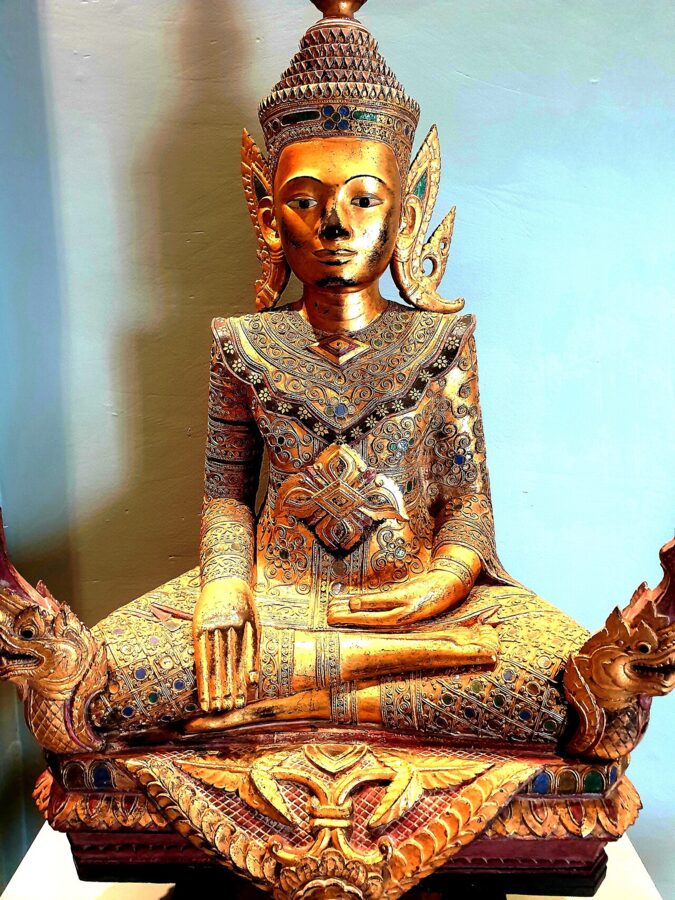
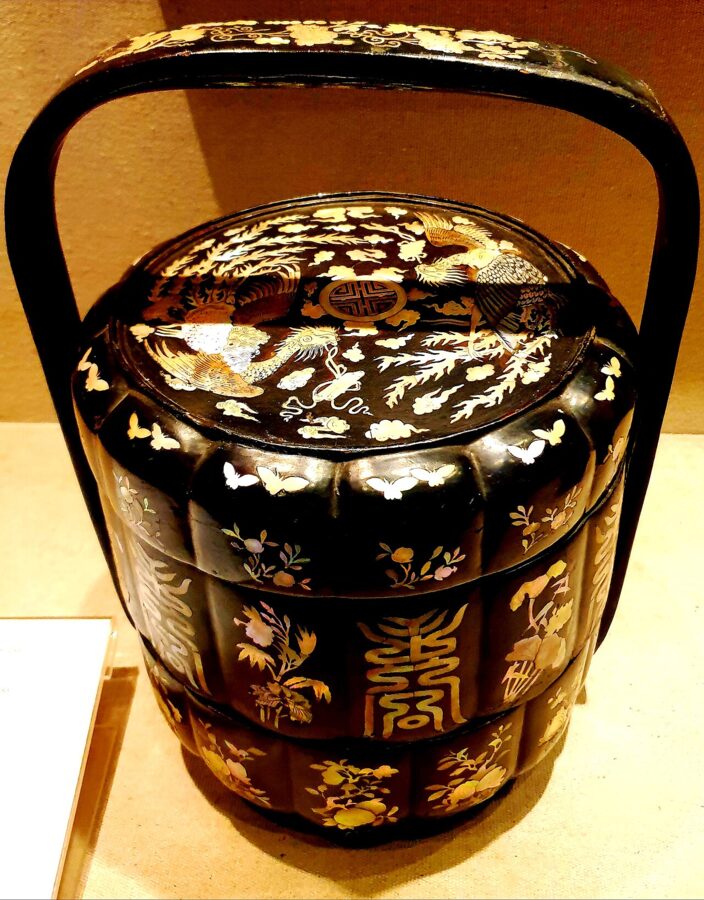
The wood gallery begins with Buddhas carved by the Khmer of the southern delta, showing scenes from the Buddha’s life: birth, fasting, meditation, teaching and death. Then come carved and painted statues from Vietnamese homes, village halls and temples, including the Mother Goddess, the Kitchen God and the god of the soil, and finally the domestic arts: altar tables, carved boards with calligraphy and boxes inlaid with mother-of-pearl.


Clay and bronze
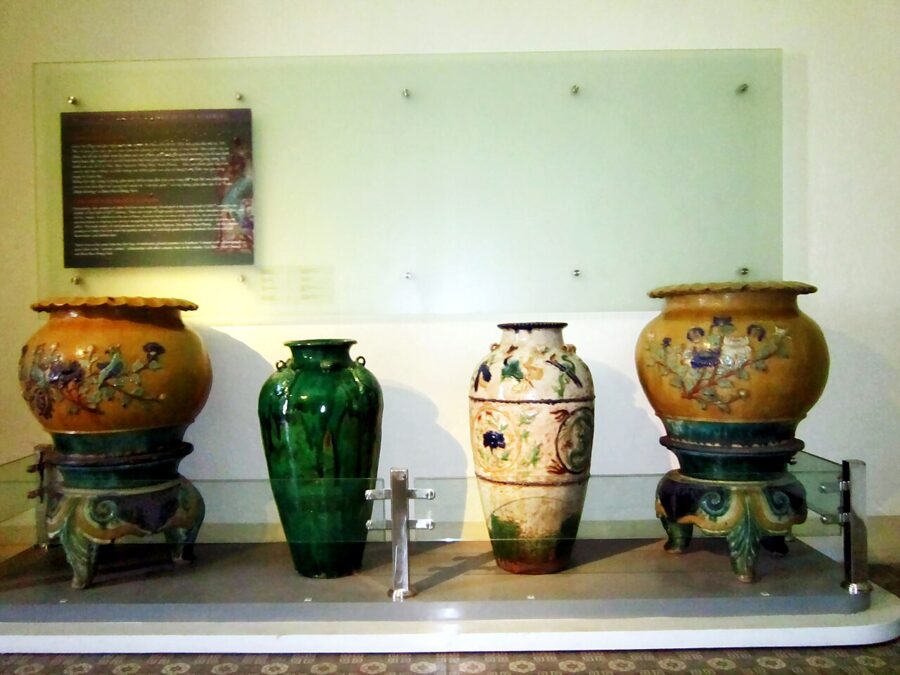
The ceramics are the most local thing in the building. Saigon’s own kilns at Cây Mai made glazed figures and jars in moss green, blue and yellow for temples and homes in the late nineteenth and early twentieth century. As the city grew, potters moved out to Lái Thiêu in Bình Dương and turned to household wares. The Biên Hòa school, founded in 1903, mixed Vietnamese, Chinese and French technique into an art pottery with incised designs and many-colored glazes that was famous by the 1950s.

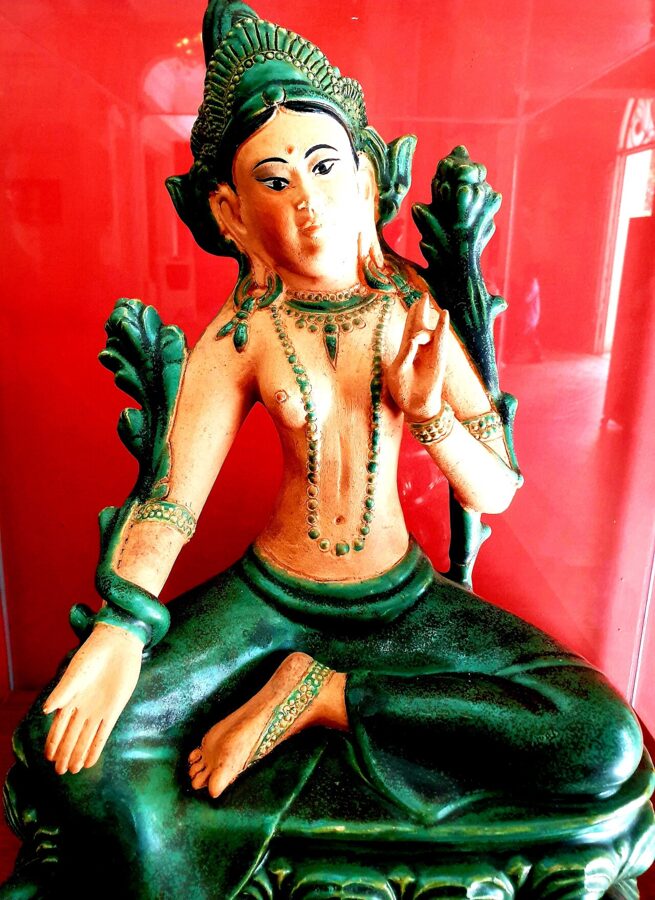
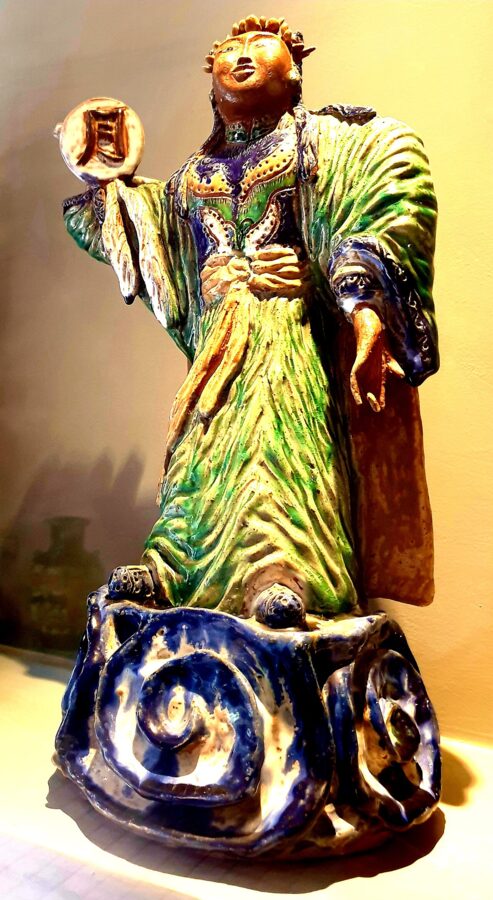
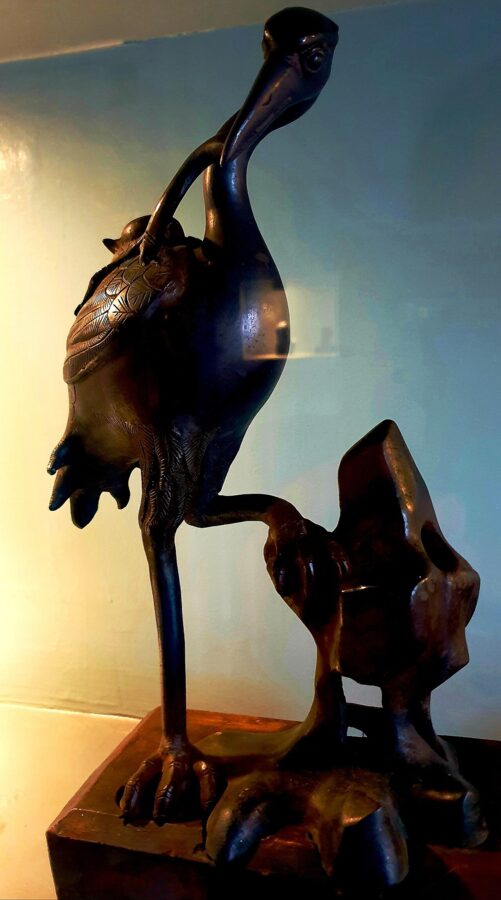
The bronze rooms show work from the casting villages of old Saigon, Tân Hòa Đông and An Hội, and portrait busts made at the Biên Hòa school in the early twentieth century. Temple pieces include Buddhas, Bodhisattvas and pairs of cranes standing on tortoises, a symbol of long life found on altars all over the country.

The sculpture garden
The garden around the houses is a second museum. Bronzes stand in the courtyard and along the side of the main house, some of them works of art and some of them monuments that lost their places in the city.
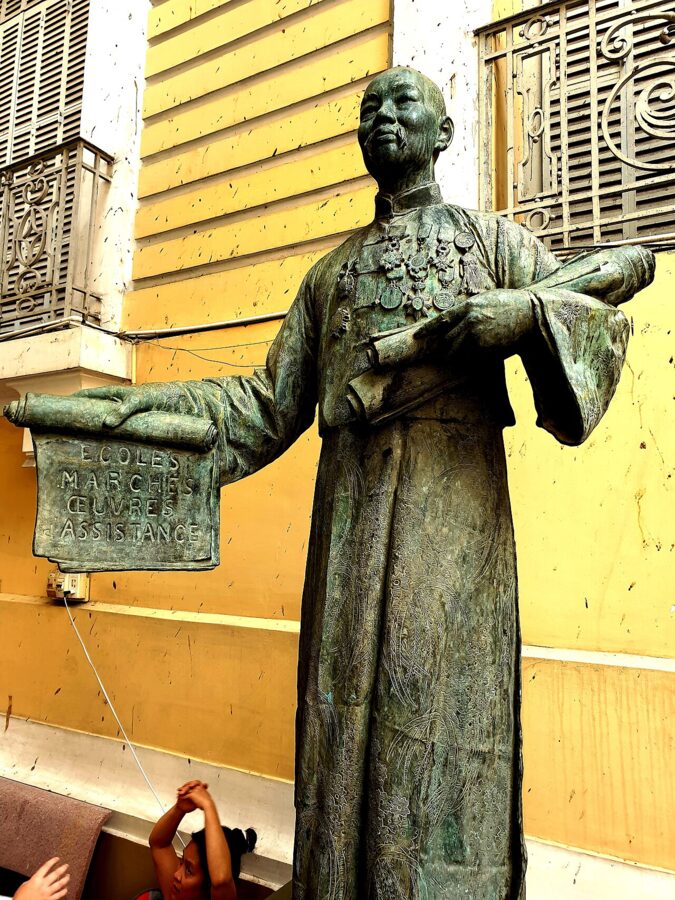
The best known is Quách Đàm, the Chinese rice merchant who paid for Bình Tây Market in Chợ Lớn. His life-size bronze stood in the market courtyard until 1975, and since 1992 it has stood here, holding the deed to a market six kilometers away. Nearby is the nineteenth-century scholar Trương Vĩnh Ký in a long robe, and in the main garden a heroic An Dương Vương, the legendary king of Âu Lạc, drawing his magic crossbow.

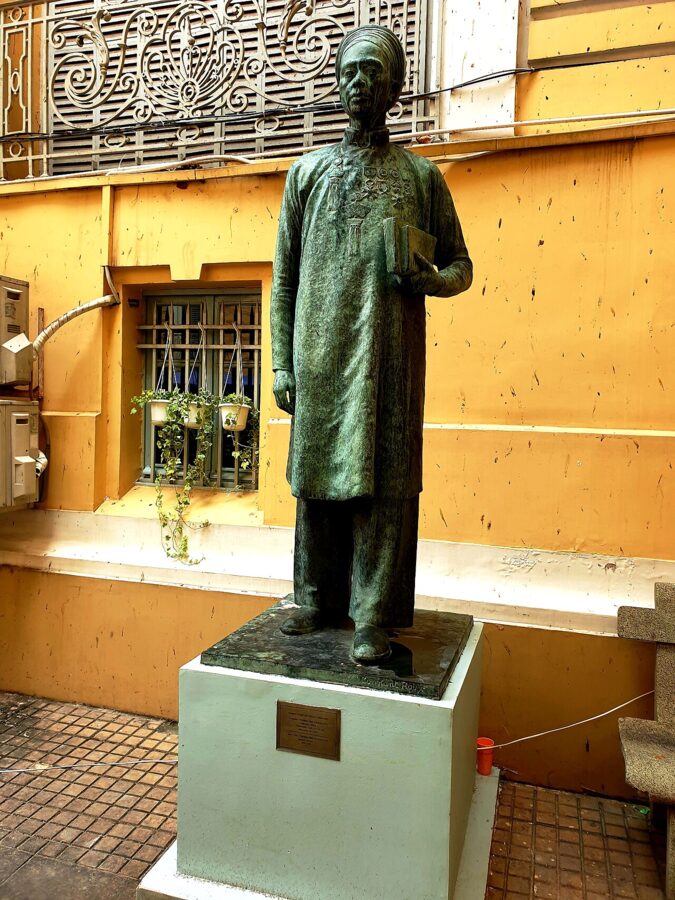

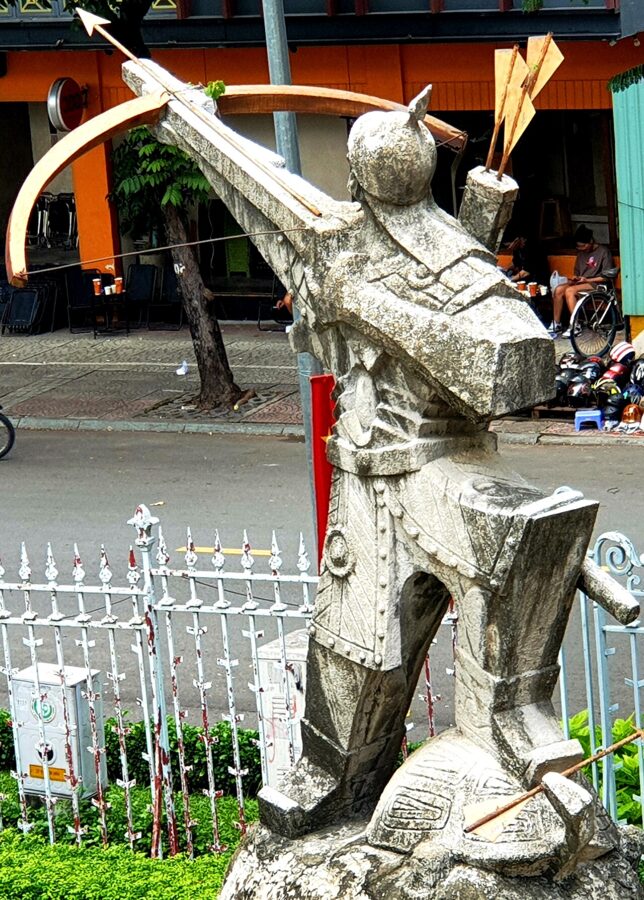

Other statues show revolutionary heroes, among them Võ Thị Sáu, Nguyễn Văn Trỗi and Lý Tự Trọng, and works with titles like Phú Lợi căm thù (The Hatred of Phú Lợi), about the Phú Lợi detention camp in Bình Dương, where the North said hundreds of prisoners were poisoned in 1958 and the Saigon government denied it. They are the official memory of the war set in a family garden, which is a strange and very Saigon thing to see.
Temporary shows, the shop and buying art
The temporary calendar is busy. In 2025 and 2026 the museum showed Trở về (Return), 42 works by Lê Phổ, Vũ Cao Đàm, Tạ Tỵ, Phạm Tăng and painters of the Saigon school of the 1950s to 1970s such as Thái Tuấn and Đinh Cường, all given by Lê Tất Luyện and Thụy Khuê; Miền lưu dấu, 77 woodcuts, etchings and lithographs from the collection, including Lê Bá Đảng’s horses; and from 24 October to 1 November 2026 Vietnam Art Space, 130 works by 111 Vietnamese and six Indonesian artists. Shows run for one to six weeks, so check the banners on the fence before you buy your ticket.
The temporary shows are also where you see work that is rarely on view in the city. Shows like Trở về, built from gifts by Vietnamese families abroad, bring back painters who worked in Paris or in Saigon before 1975, and they are worth planning a visit around.
The souvenir counter and the galleries
The museum has a souvenir counter, and for years rooms on the ground floor of the main house have sold paintings. In October 2026 the museum put a basement room in Building 3 out to auction for art classes and workshops, so expect the mix of tenants to keep changing. Anything for sale here is not part of the collection, and the museum’s name on the gate is not a certificate.
Buying art in Saigon without being fooled
Saigon has many workshops that copy famous paintings to order and sell them openly as copies. The trouble starts when a copy is sold as something else.
- If the name is famous (Nguyễn Gia Trí, Lê Phổ, Bùi Xuân Phái, Nguyễn Sáng) and the price is in the millions of dong, it is a copy. Their real work sells at auction for far more, and Nguyễn Gia Trí’s best work cannot legally leave the country.
- Buy living painters from galleries that name the painter and give you a signed invoice with title, size and medium.
- Real lacquer is heavy and hard, with depth you can see when you tilt it; printed imitations look flat from the side.
- Anything sold as antique needs export paperwork. Keep the invoice, and if you cannot get one, do not buy.
A good copy is fine if you know that is what you are buying. The shopping guide has more on where Saigon sells what, and the money guide covers cash and cards.
How to visit
| Address | 97A Phó Đức Chính, Bến Thành ward (old District 1), Ho Chi Minh City |
|---|---|
| Hours | 8am to 5pm, Monday to Sunday |
| Adult ticket | 60,000₫ (about US$2.30) per visit, from 1 October 2026 |
| Free | Children, pupils and students, people with very severe disabilities, poor and near-poor households (bring documents) |
| Half price | Older people and other groups under the city’s cultural policy |
| Time needed | 1 hour for the main house, 2 hours for all three buildings and the garden |
The ticket price comes from the city council resolution on museum fees passed on 27 August 2026, in force since 1 October 2026, which also made the city’s museums free for children and students. The museum’s own rules have tied student and senior discounts to Vietnamese schools and Vietnamese citizens, so whether a foreign student card counts is up to the ticket desk; try it, but expect to pay. The rules say nothing about a lunch closure, and the museum lists the same hours every day of the week.
Getting there
The museum is about 350 meters from Bến Thành Market, five or six minutes on foot. From the clock tower, cross the square to the start of Hàm Nghi, turn right almost at once into Phó Đức Chính, and the yellow house is on your right after about 200 meters, before Nguyễn Thái Bình.
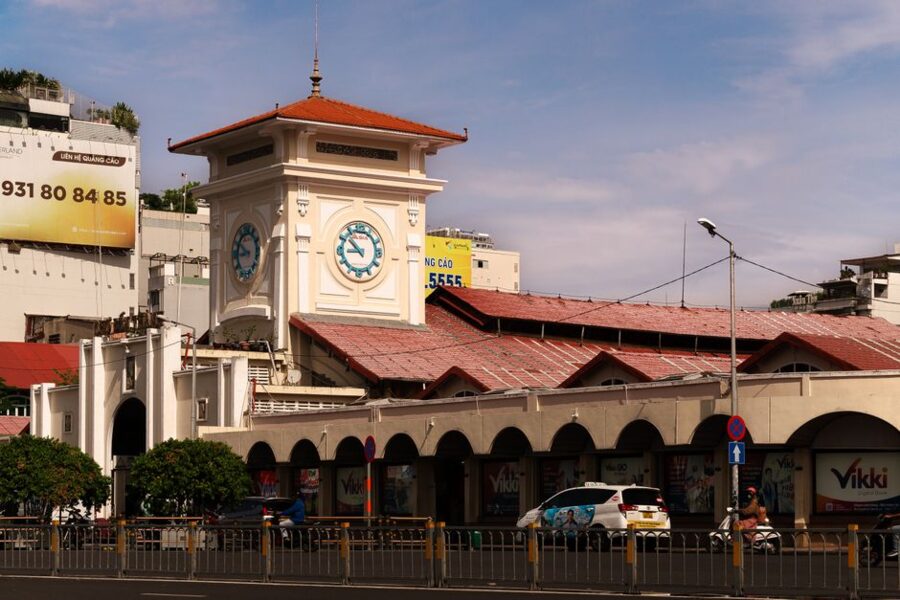
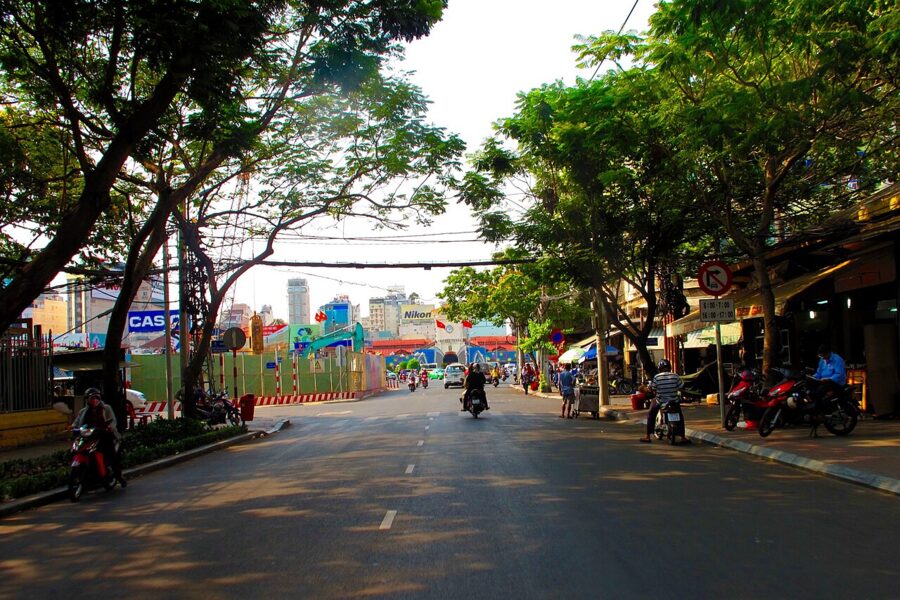

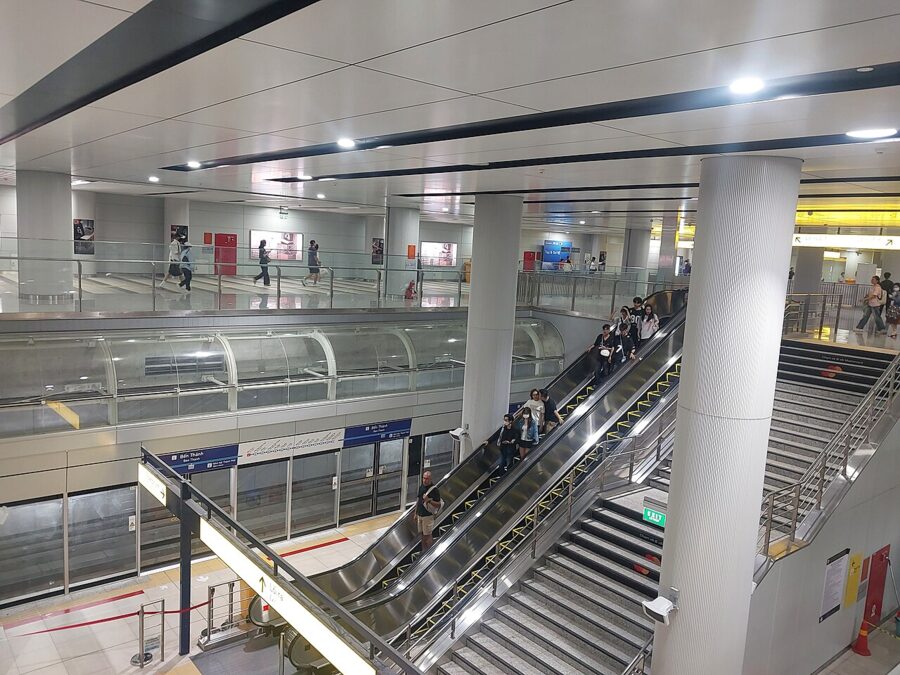
Metro Line 1 ends at Bến Thành station, under the square in front of the market, about 450 meters from the museum gate. It opened on 22 December 2024 and runs out to Suối Tiên. If you are staying in Thảo Điền or near the Opera House, it beats any taxi at rush hour. For the airport, the bus stations and the rest of the city’s transport, see getting to Ho Chi Minh City.

By Grab or Be, ask for “Bảo tàng Mỹ thuật, 97A Phó Đức Chính”. A car from Phạm Ngũ Lão or the cathedral takes ten minutes outside rush hour, and a motorbike taxi costs far less. The many city buses that stop at the Bến Thành hub on Hàm Nghi also put you a few minutes away.
Rules: bags, photos and dress
The rules ask for neat, respectful dress. This is a museum, not a temple, but leave beachwear for another day. Large backpacks, suitcases and bulky bags go into the storage area, and you should not leave cash or valuables in them. Small bags can come in if you carry them in front of you.
You can take photos and video on your phone for personal use, without flash. Selfie sticks, tripods and gimbals are not allowed in the galleries. The rules mention only phones, so ask at the ticket desk before using a larger camera; commercial or fashion shoots, which are popular on the staircase, need to be registered in advance.
Do not touch the works, sit on plinths or ledges, or eat in the galleries. Colored pencils, paints, drawing boards and easels are also banned in the exhibition rooms, which surprises art students.
When to go
Go at 8am. The main house faces east, so the morning sun lights the facade, and the galleries are at their coolest. In the wet season, afternoon downpours are common; the weather guide has the details, and the museum is one of the best places in the center to wait out a storm.
The staircase is a favorite backdrop for photo shoots, and at busy times you may wait your turn to climb it. A weekday morning is the safest bet.
What to combine it with
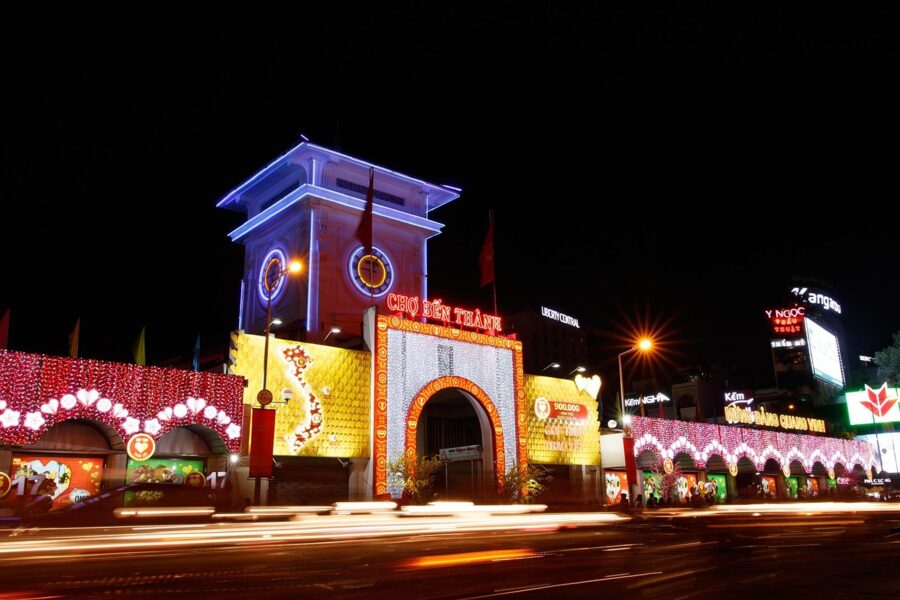
Bến Thành Market is the obvious pair: leave the museum at 10am and eat at the market’s food stalls before the lunch crowd.
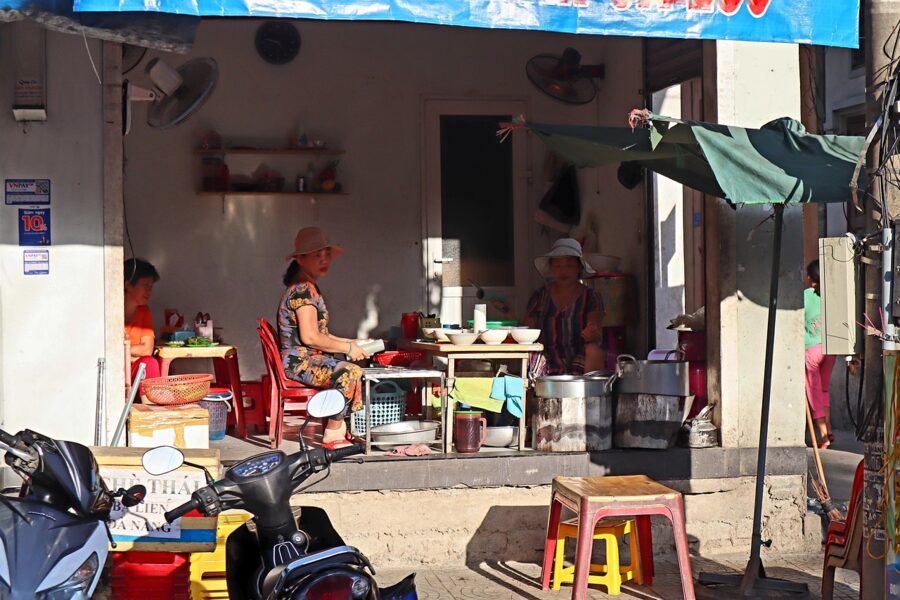
The other direction is east, five or six minutes along Hàm Nghi to Tôn Thất Đạm. The street has an old apartment block and a small street market that locals call chợ quê, the country market, or chợ nhà giàu, the rich people’s market. It is a good place for coffee and a bowl of something before the walk back.
For a full art day, start at the Museum of Vietnamese History at 8am for the ancient collections, cross the city by Grab, and finish here after lunch with the modern rooms. For dinner nearby, the restaurants guide covers the center. For how this part of the city grew from a river port into the French grid and on to today, see the history of Ho Chi Minh City.
Before you leave, go back to the main door and look up once more. Three iron letters, a fanlight and a pair of Chinese couplets: the house was built for a family that left, and named for a man who never lived in it. Then walk out past the trees on Phó Đức Chính toward the market.