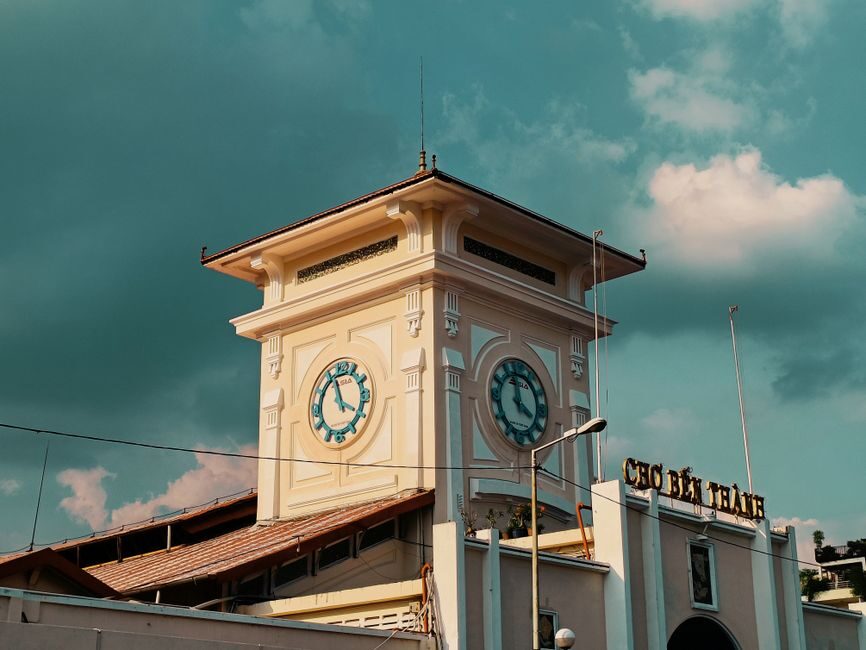
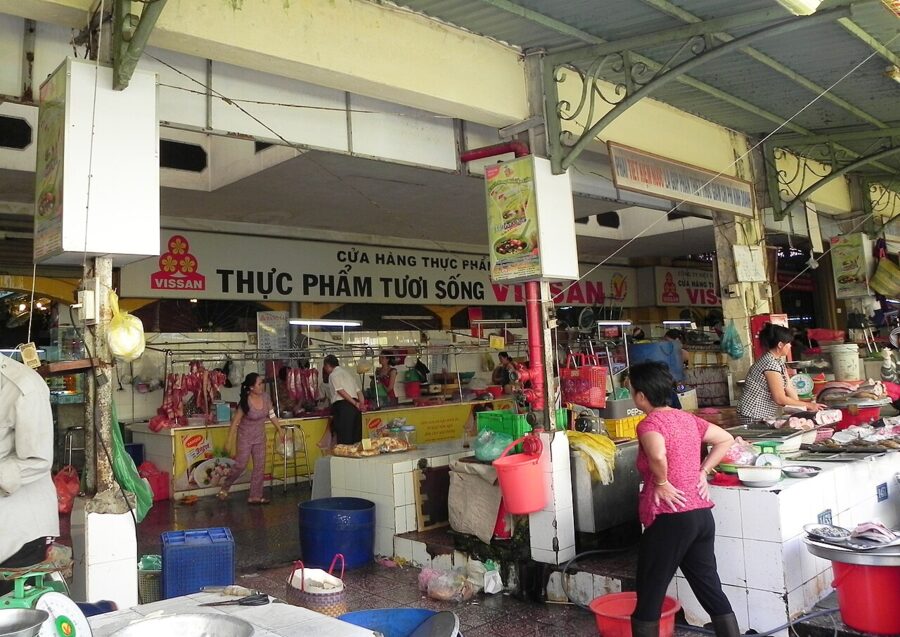
At four in the morning, while the rest of Bến Thành Market (Chợ Bến Thành) is still shuttered, the fresh-food traders behind the north gate and the cooked-food stalls inside are already allowed to open. The market’s rules give them a three-hour start on everyone else. By seven the shutters on the other three sides are rolling up, and by mid-morning the south gate, under the clock tower, has its first tour group standing in the road for a photograph.
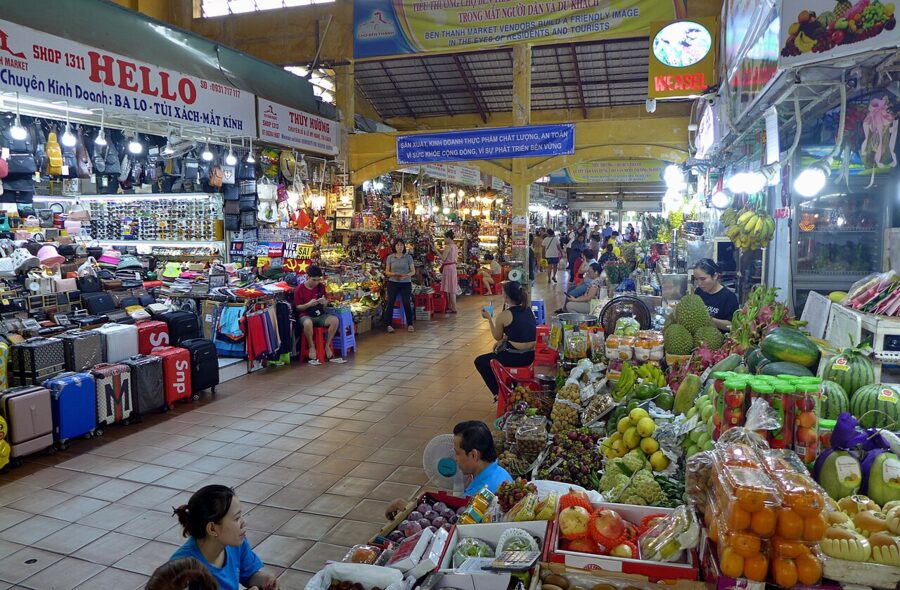
Most of them leave within the hour, which is a shame. The building is a hundred and twelve years old and has been threatened, renovated, repainted and almost demolished; the square in front of it has seen a student shot dead, a monk burn himself in protest and a decade of metro digging. Inside, under an iron roof, roughly 1,500 stalls still sell what a Saigon market has always sold: fabric, coffee, dried shrimp, fruit, flowers and a hot lunch on a plastic stool.
It also has a reputation, earned, for overcharging foreigners. That is easier to handle once you know how the place works, and the building is more interesting once you know what it has lived through.

On this page
A market that moved twice
The name explains where the market started, and it was not here. Bến is a landing or wharf, thành a citadel. When Nguyễn Phúc Ánh, the future Emperor Gia Long, took back Gia Định from the Tây Sơn in 1788, he built an octagonal citadel beside the Bến Nghé river, finished in 1790 with the help of the French engineers Théodore Lebrun and Victor Olivier de Puymanel. Soldiers and travellers came ashore at a landing below its walls, and the market that grew beside that landing took its name from it.
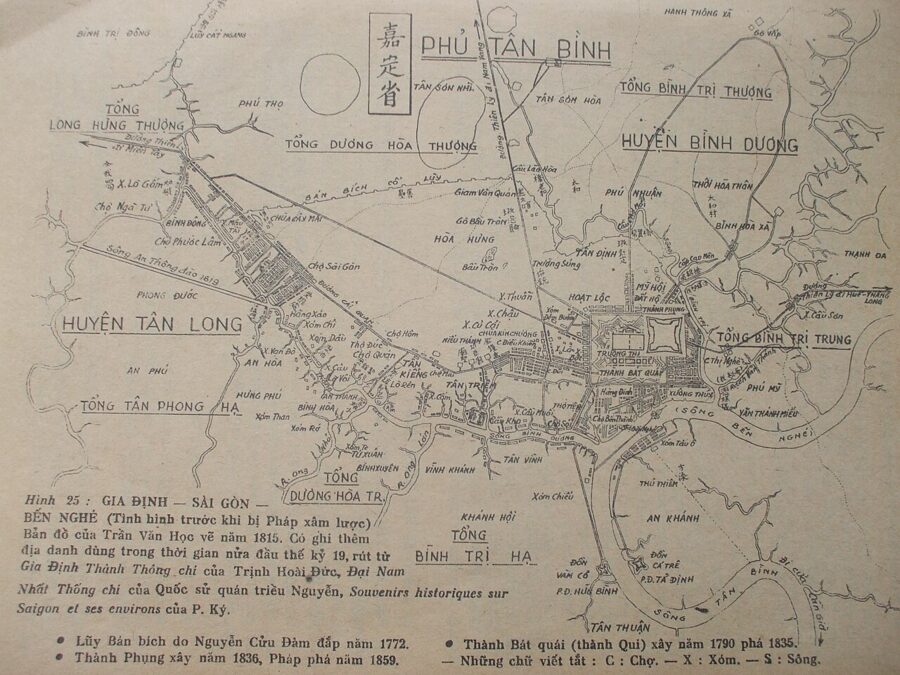
That first market was brick and timber under a thatch roof, crowded with boats from up and down the coast. Its fortunes followed the citadel’s. After Lê Văn Khôi used the fortress as his base in a revolt against the court from 1833 to 1835, Emperor Minh Mạng had it razed and built a smaller one further northeast, and trade at the landing thinned out. In February 1859 a French and Spanish force took Gia Định, and the market burned with much of the town.
The canal market, 1860 to 1912
Around 1860 the French put up a new market a little back from the river, beside a creek that the nineteenth-century historian Trịnh Hoài Đức called the Sa Ngư, later known as the Grand Canal (Kinh Lớn). It stood on what is now Nguyễn Huệ boulevard. In July 1870 fire destroyed one of its halls, and because the colonial government had banned thatch inside the city, the council voted 70,000 francs to rebuild in brick and tile.
The rebuilt market had five halls: dry goods, fish, meat, cooked food and sundries. Four had tiled roofs; the meat hall alone was roofed in corrugated iron, a detail that matters later.
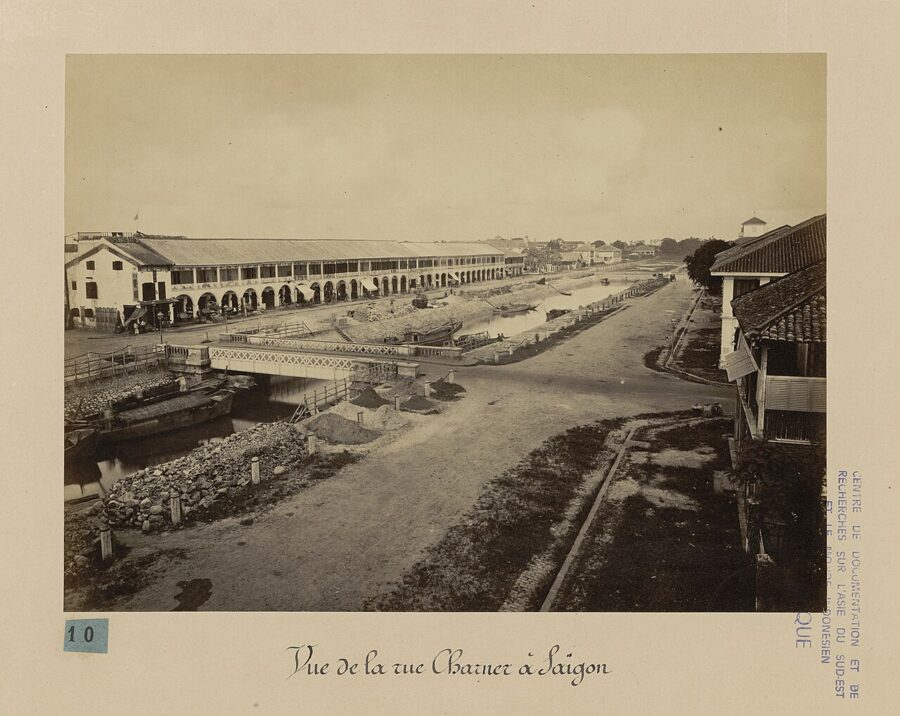
The canal silted up, and in 1887 the city filled it to make boulevard Charner, today’s Nguyễn Huệ. By 1894 the market itself was failing, and the council discussed replacing it alongside a theater, budgeted at 800,000 francs, and a city hall at 600,000; the market got 400,000. Shortage of money delayed all three. The Municipal Theatre opened first, on New Year’s Day 1900, and the city hall in 1909.
Filling the Boresse marsh
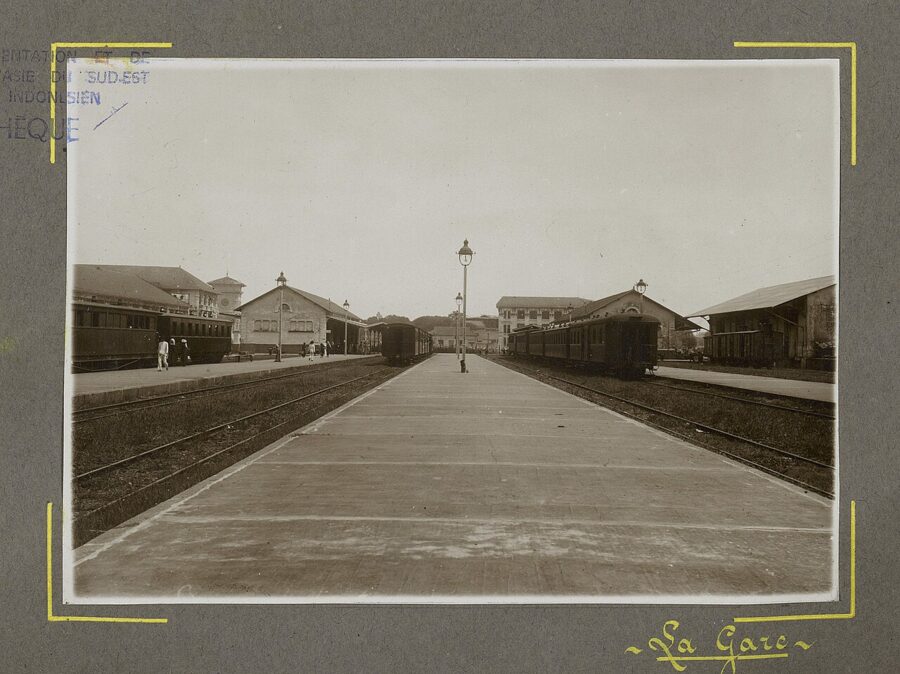
On 21 May 1908 the council finally chose a site for the market: a swampy pond the French called the Marais Boresse and the Vietnamese the ao Bồ Rệt, next to the station for the Saigon to Mỹ Tho railway. Eugène Cuniac, then mayor, proposed filling it in. Most of the old canal market was then pulled down, except the iron-roofed meat hall, which was light enough to leave standing. It carried on as a market of its own, and Saigon still calls that area the Old Market, Chợ Cũ.
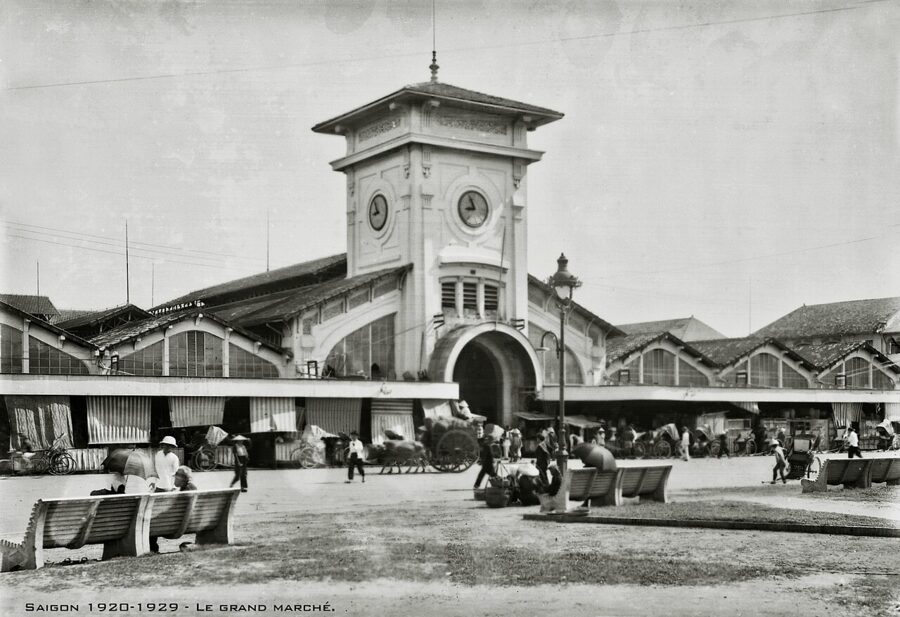
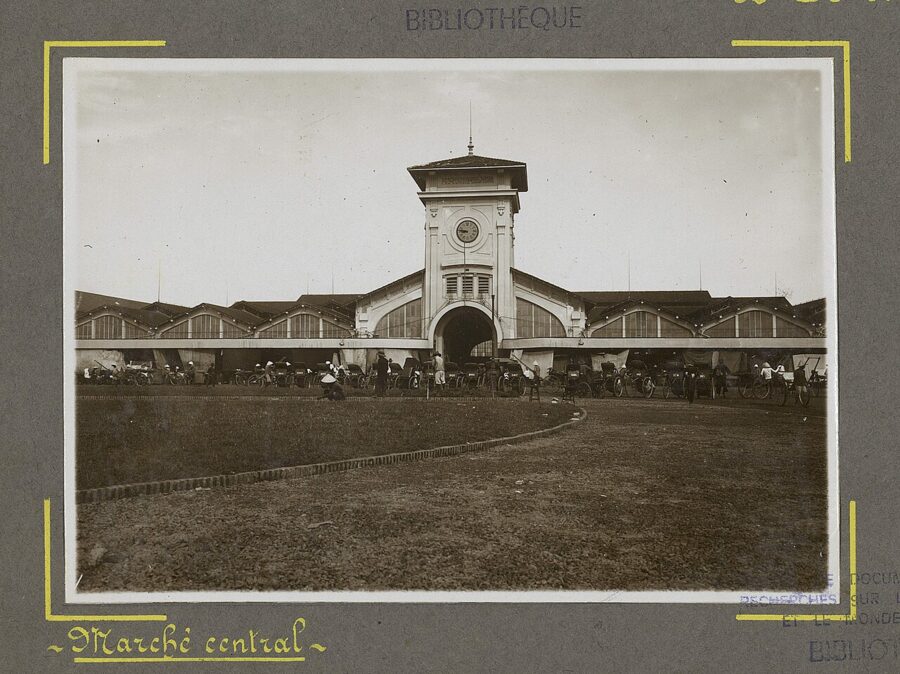
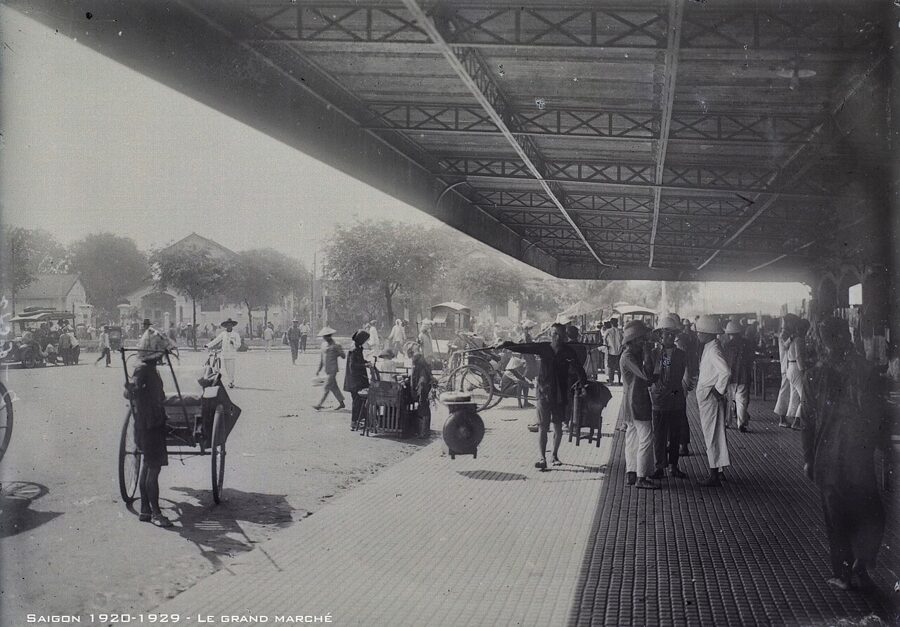
The contractors Brossard et Mopin built the new steel-framed hall. Sources give the start as 1912 or 1913; the market’s own history says 1913, and most accounts settle on 1912. It was finished in March 1914 on just over 13,000 square meters, and the opening ran for three days, 28 to 30 March, with fireworks, decorated carriages and a crowd put at 100,000 people from Saigon and the provinces. One account of the opening has a young woman named Võ Thị Vuông fighting a tiger captured near Thủ Dầu Một; whatever the details, it was that kind of party.
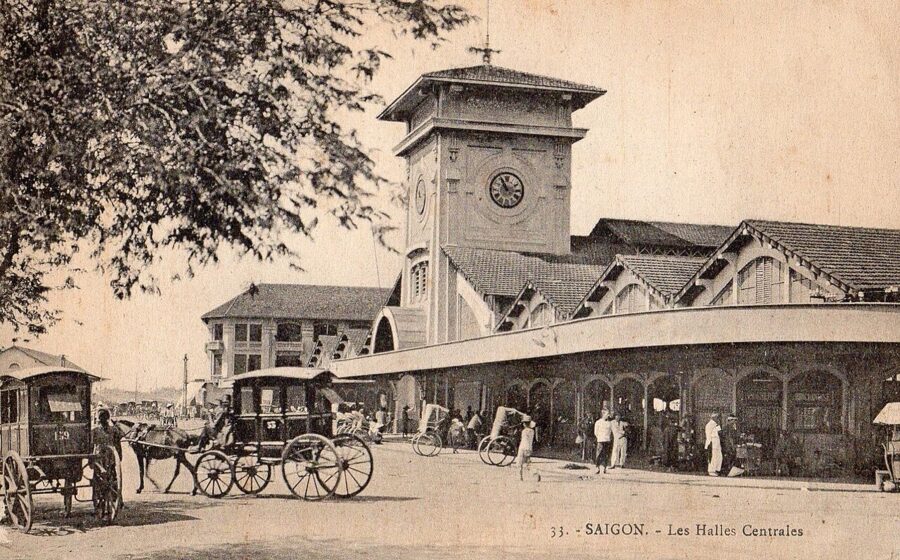
The four streets around the new building were renamed in 1955: rue d’Espagne became Lê Thánh Tôn, rue Viénot became Phan Bội Châu and rue Schroeder became Phan Chu Trinh. Until 1975 most Saigonese called the market chợ Mới or chợ Sài Gòn, to tell it apart from the Old Market down the road.
The clock tower and the reliefs above the gates
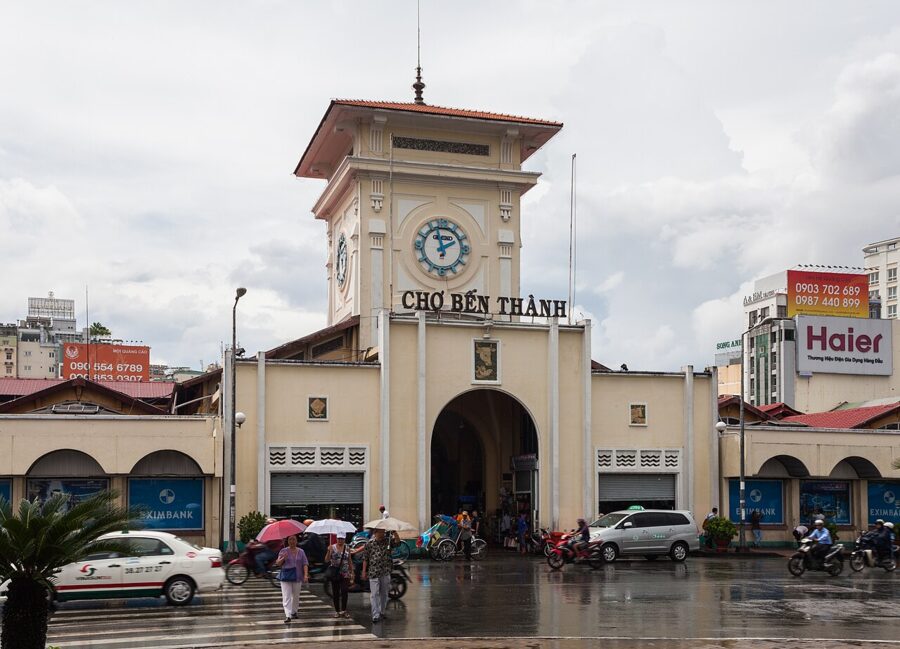
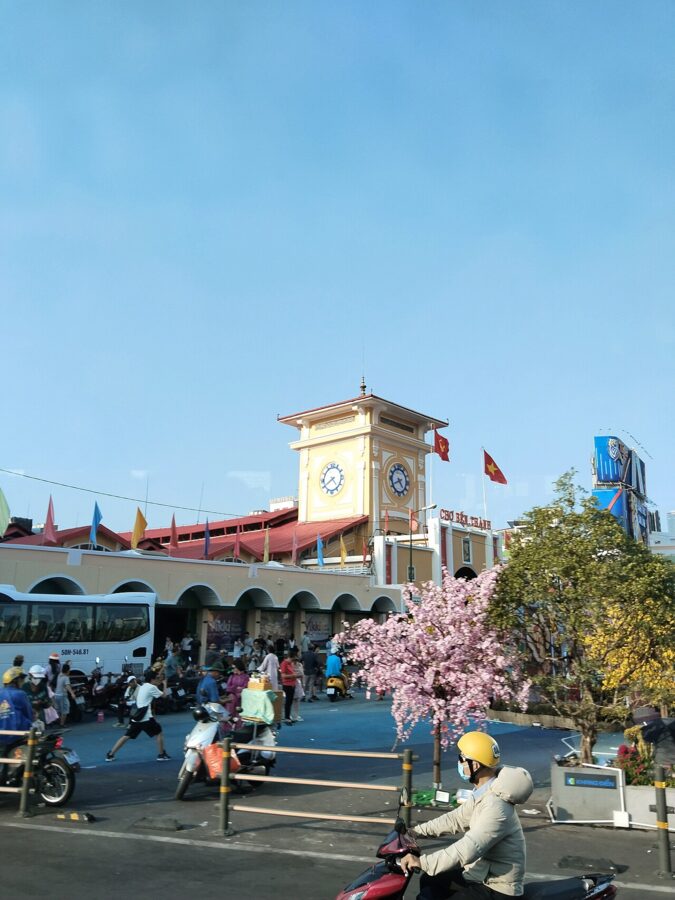
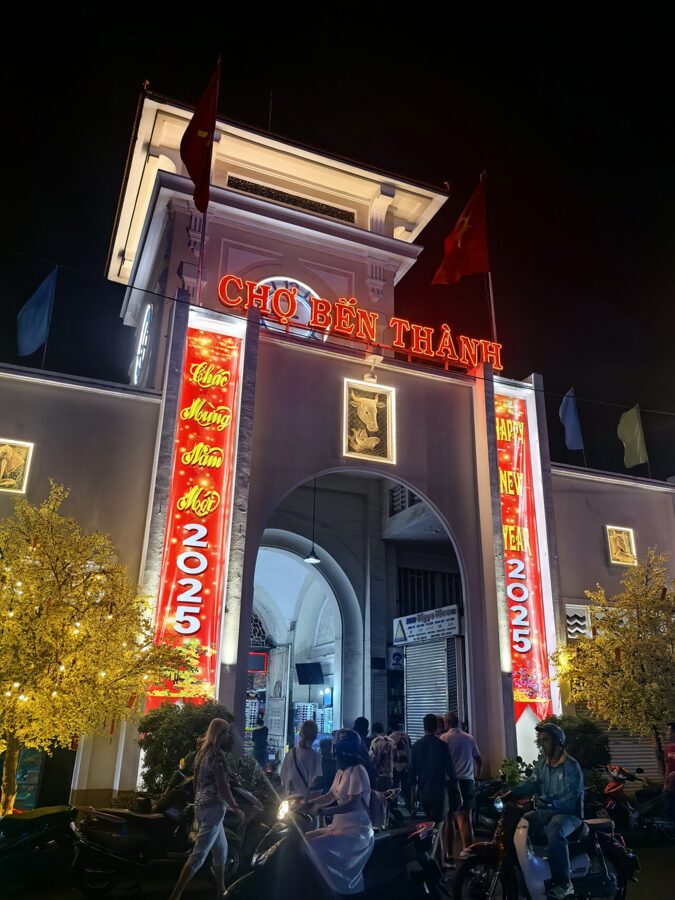
The building is a long low hall with four main gates, one on each side, and a dozen smaller doors between them. The south gate is the formal one, set under a square clock tower with a face on three sides, and it is the image on postcards and tourist maps. Look up as you pass under any of the four main gates, though, and you will see something most visitors miss.
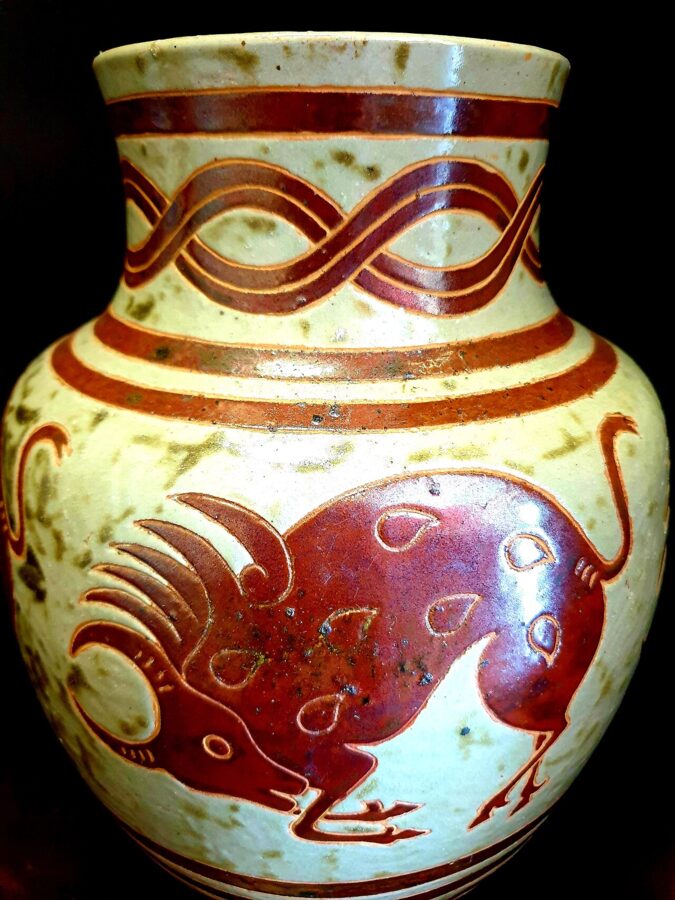
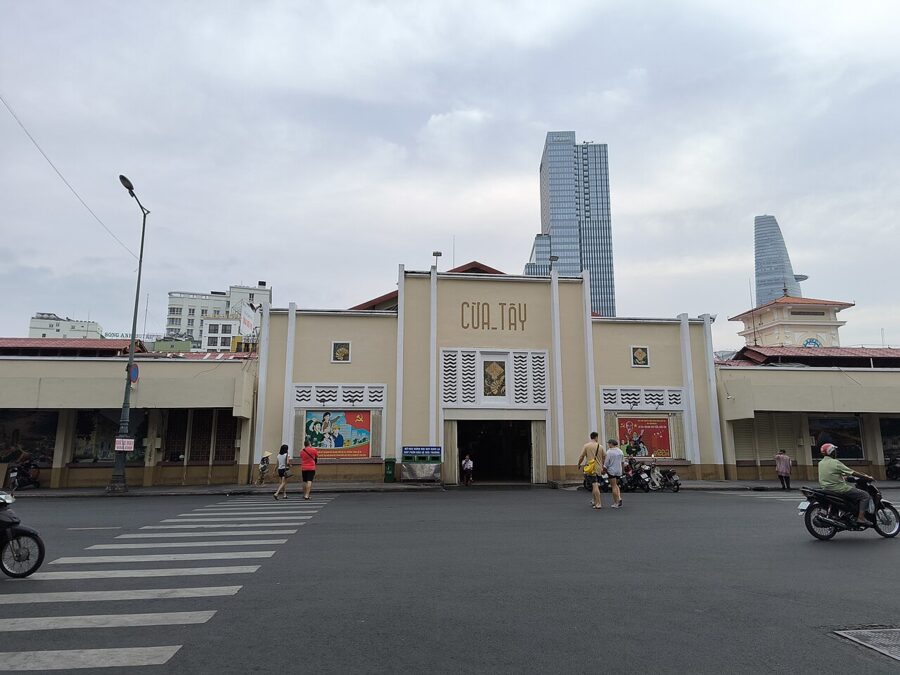
In 1952 the market’s contractor commissioned twelve ceramic reliefs from the Biên Hòa art pottery school, three for each gate: one large panel above and two smaller ones below. The painter Lê Văn Mậu designed them, with advice from the school’s master potters, and three craftsmen spent about two and a half months fixing them in place. According to Vietnamese accounts each gate got its own motif: an ox head and a carp on the south gate, a Muscovy duck with bananas on the north, an ox and a duck on the east, and a stingray with bananas on the west. The motifs are the farm and river produce of the south, made with the glazes that made Biên Hòa ware known across Indochina.

1971: the market Saigon nearly rebuilt
By the 1960s the building looked tired to the city’s planners. In 1964 the architect Lê Văn Lắm wrote that its design was out of date for the volume of trade it carried. The Saigon city government agreed, and at the end of October 1970 it announced an architectural competition for a new market on the same footprint. Eight entries came in by the deadline of 21 April 1971.
On 10 September 1971 first prize, 1.5 million đồng, went to the architect Huỳnh Kim Mãng. His market had three floors, a basement car park for 150 cars, a children’s floor with toys and books, rooftop restaurants, a cinema and a 50-meter tower with a restaurant at the top.
Construction was meant to start in 1972. It never did. The Republic of Vietnam ran a large budget deficit that year, and public opinion was against losing the building people knew, so the plan quietly died.

Since 1975
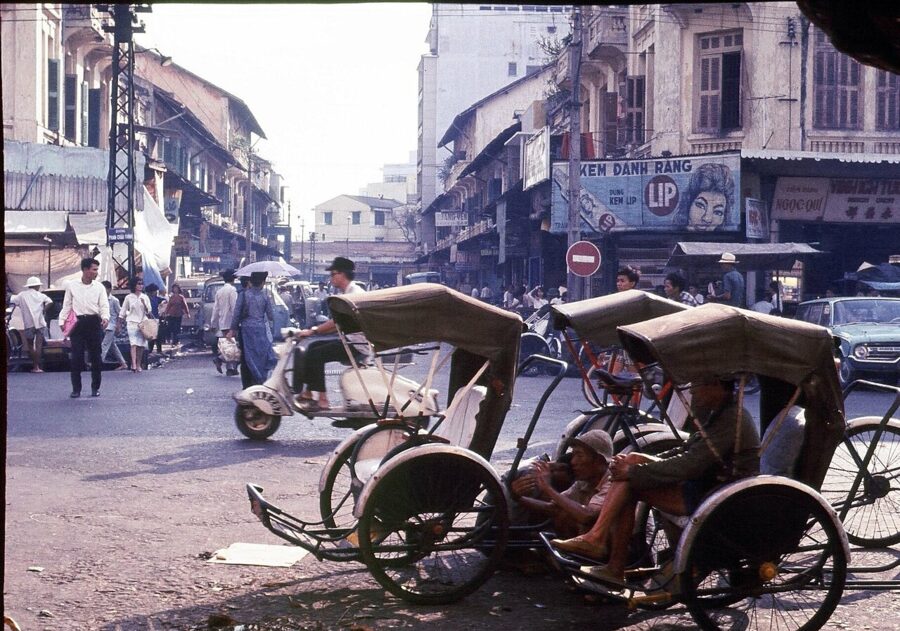
The building that survived the war got its biggest renovation between 1 July and 25 August 1985. The hall and stalls were rebuilt; only the shape of the front and the clock tower were kept as they were. In 1992 the electrics were redone and the wooden stalls replaced with steel ones. In 1999 the drains were rebuilt, the tiled roof gave way to metal sheeting and the floor was laid with ceramic tiles.
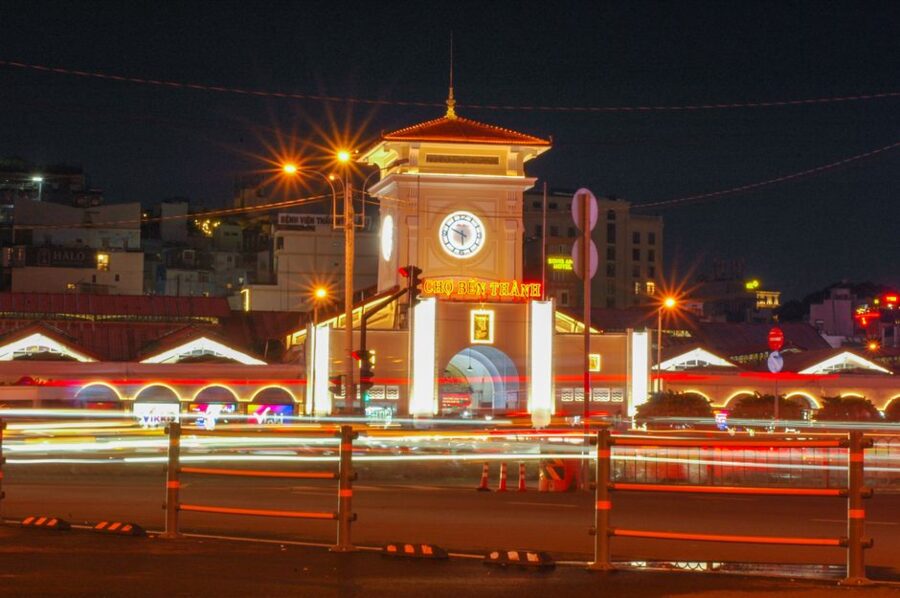
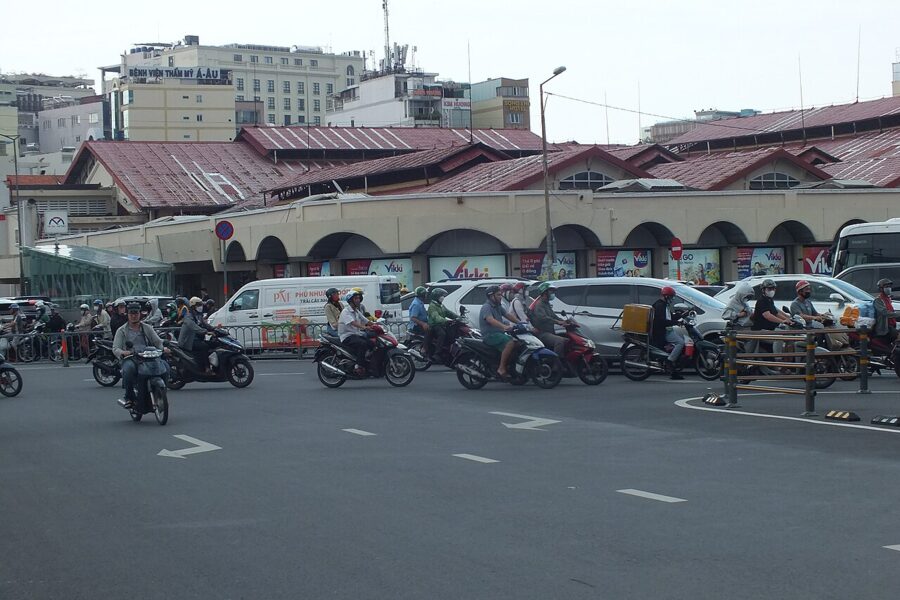
In 2023 the market’s management repainted all four frontages and added the decorative lighting you see at night. On 20 November 2024 the city listed the building as an architectural and artistic monument at city level, which means any work on it now has to follow conservation rules. That listing became the center of an argument barely a year later, when the roof turned red.

Inside: how the hall is laid out
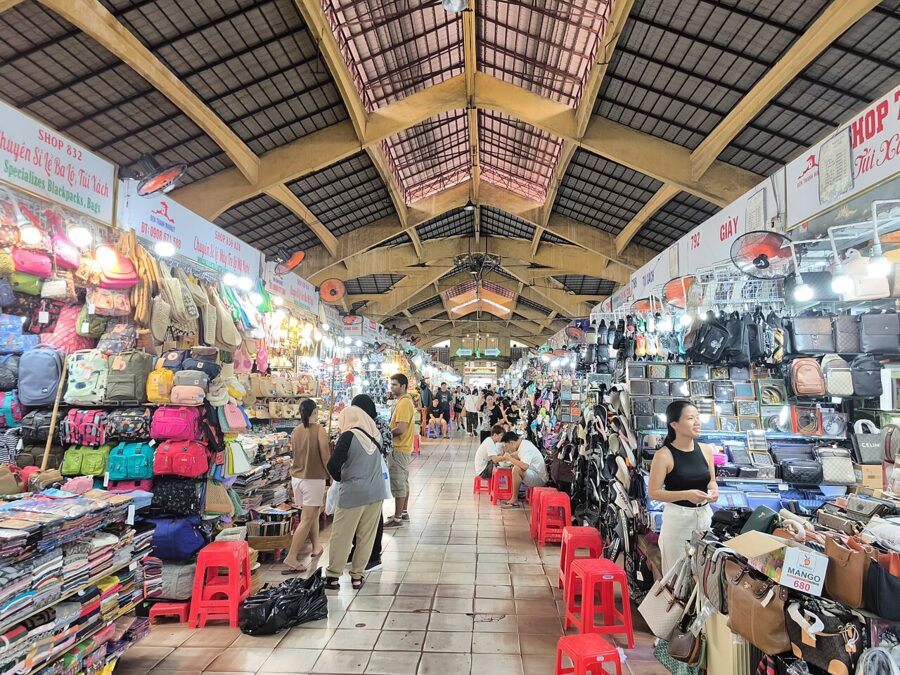
There is no official map of who sells what, and stalls change hands, but the broad pattern has held for decades and the gates are the easiest way to find your way around. Every stall carries a number on a small sign, which helps when you want to find one again.
South gate (Cửa Nam), on the roundabout. The busiest entrance and the one with the most persistent sellers. Fabric, ready-made clothing, áo dài and textiles fill the aisles nearest the clock tower, and souvenir stalls crowd in close to the door. The market management’s office is here too.
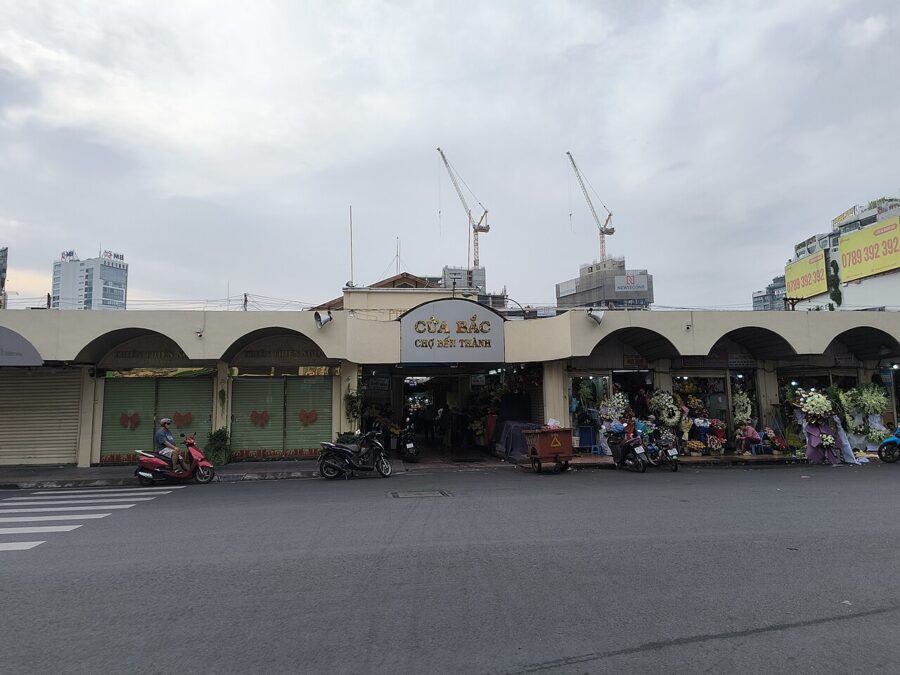
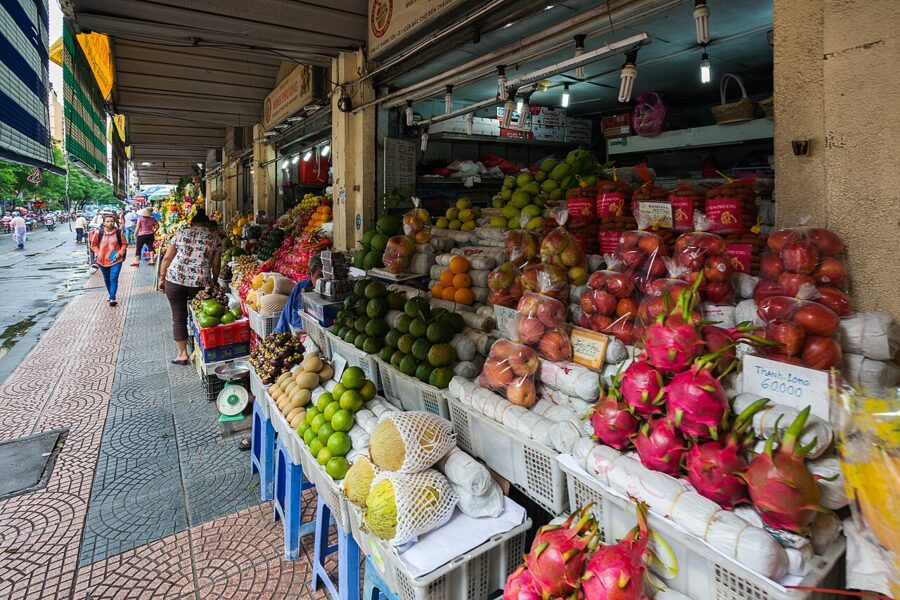
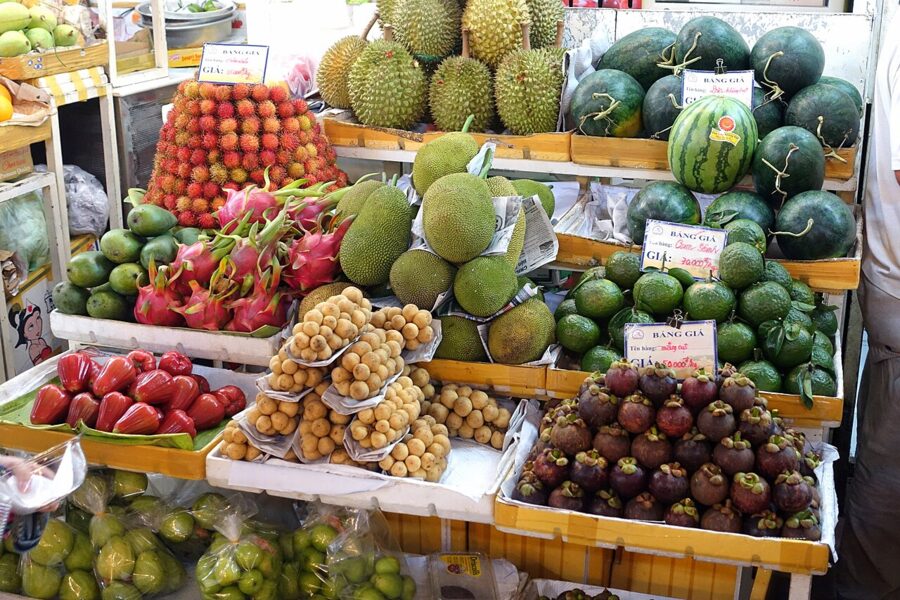
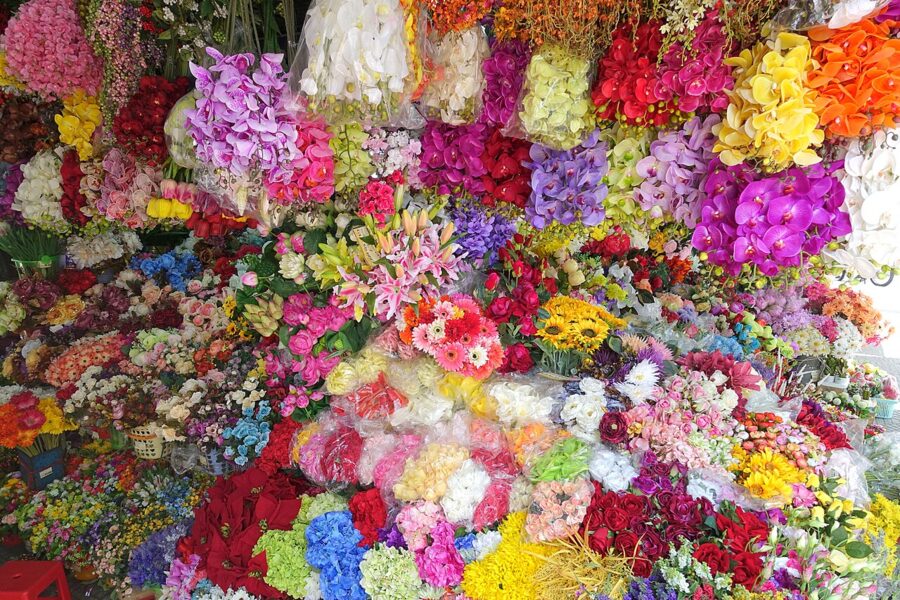
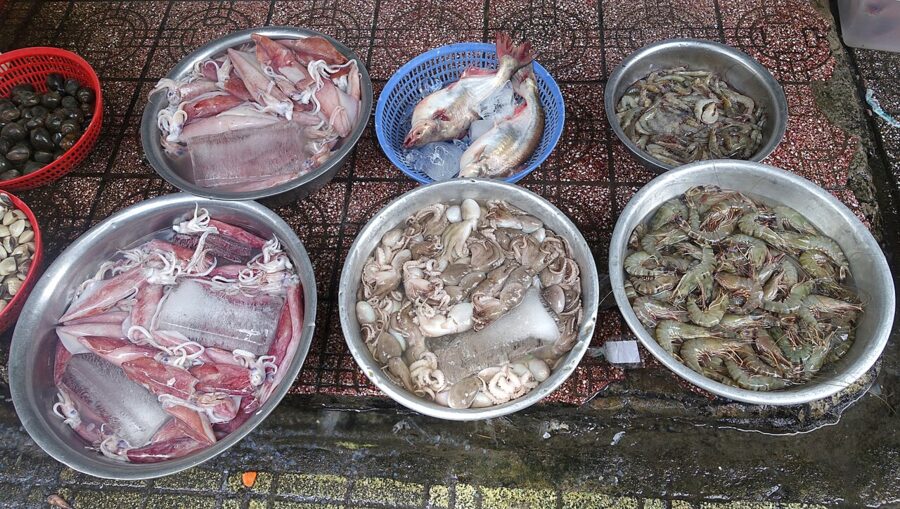
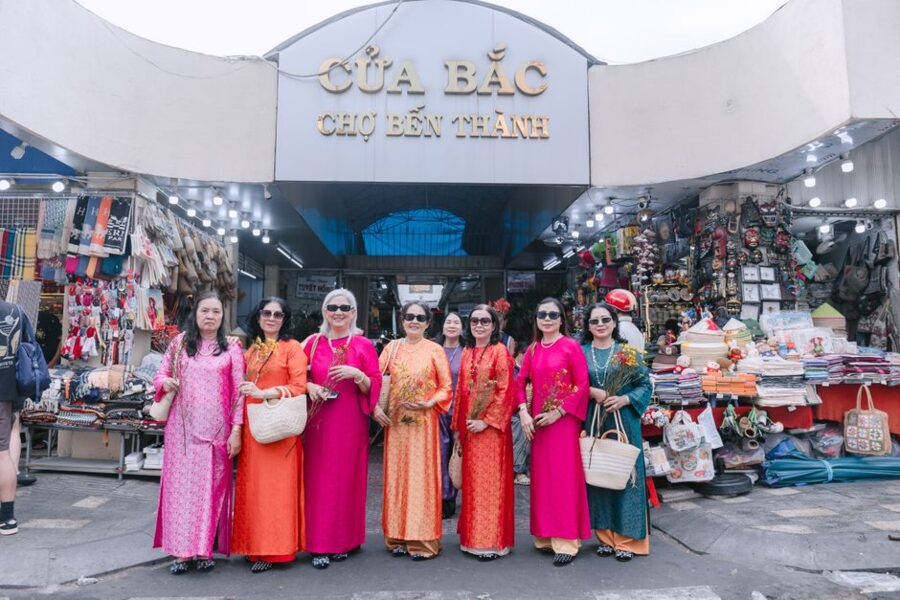
North gate (Cửa Bắc), on Lê Thánh Tôn. The working end of the market. Fresh fruit, flowers and the wet market (meat, fish and vegetables) are on this side, and this is where the 4am start happens. Several well-known eateries are on the street outside.

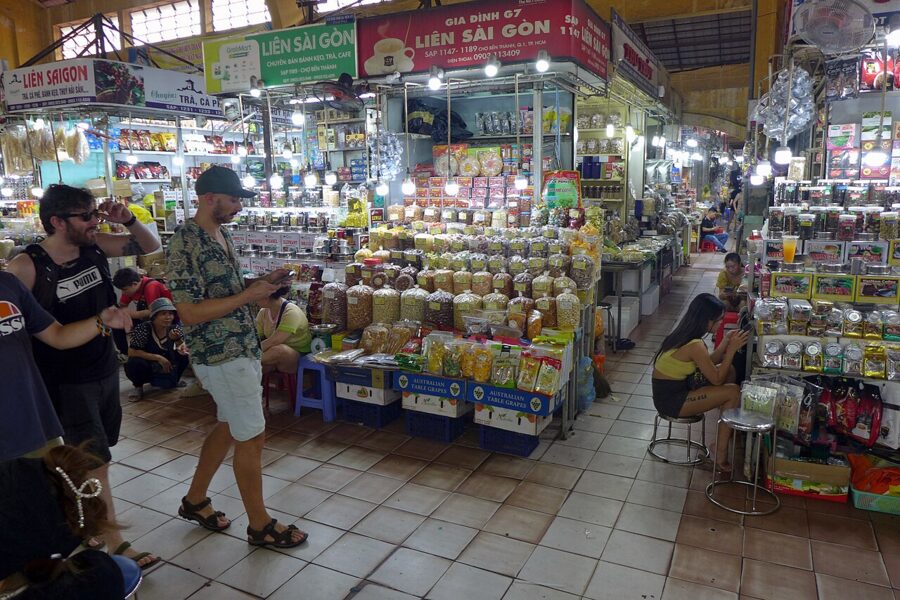
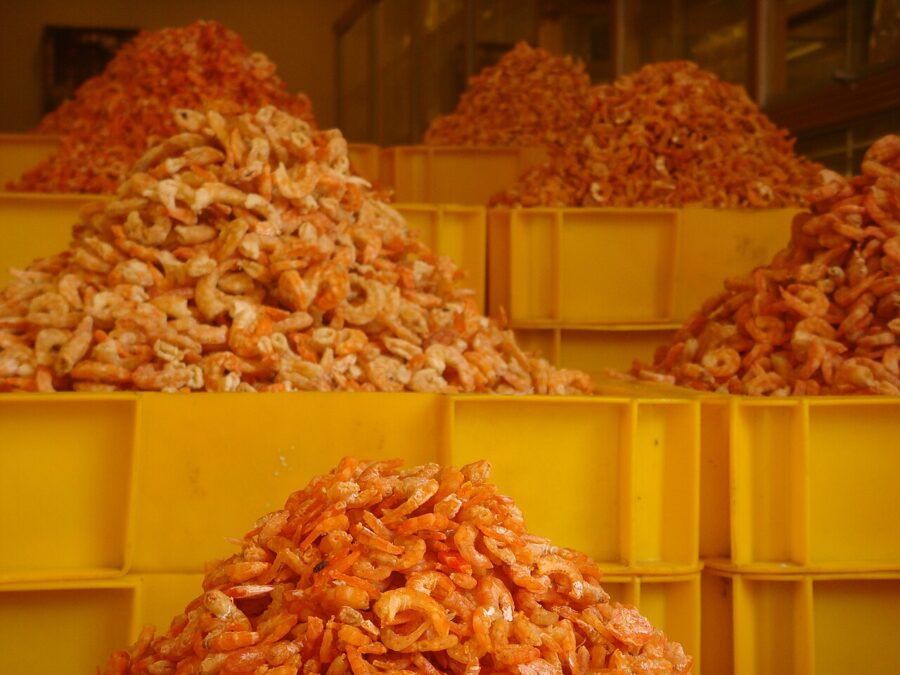
East gate (Cửa Đông), on Phan Bội Châu. Packaged and dried food: coffee, tea, candied fruit, dried shrimp and squid, fish sauce, spices and cashews, along with cosmetics. This is the gate to use if you are shopping for things to take home.
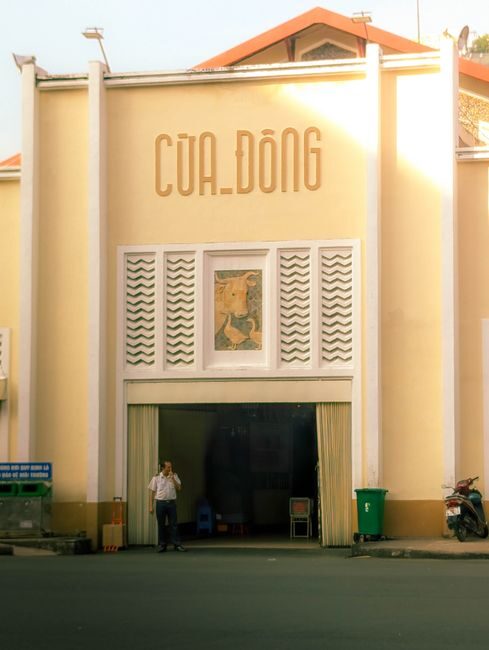
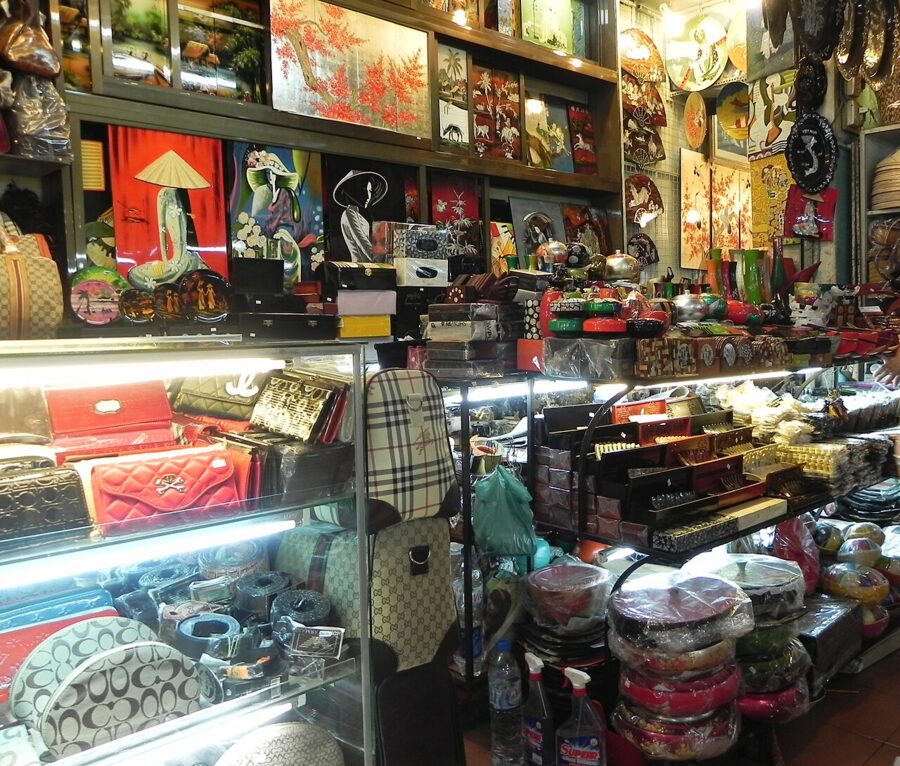
West gate (Cửa Tây), on Phan Chu Trinh. Handicrafts, lacquerware, ceramics, wood carving, bags and shoes, and some of the more patient sellers in the building.

The cooked-food stalls sit toward the middle of the hall, in a block of their own with low tables and stools, and dessert and drink stalls are scattered around its edges. Along the outside of the building, under the arcades, fruit sellers stack pyramids of dragon fruit, mangosteen and mango.

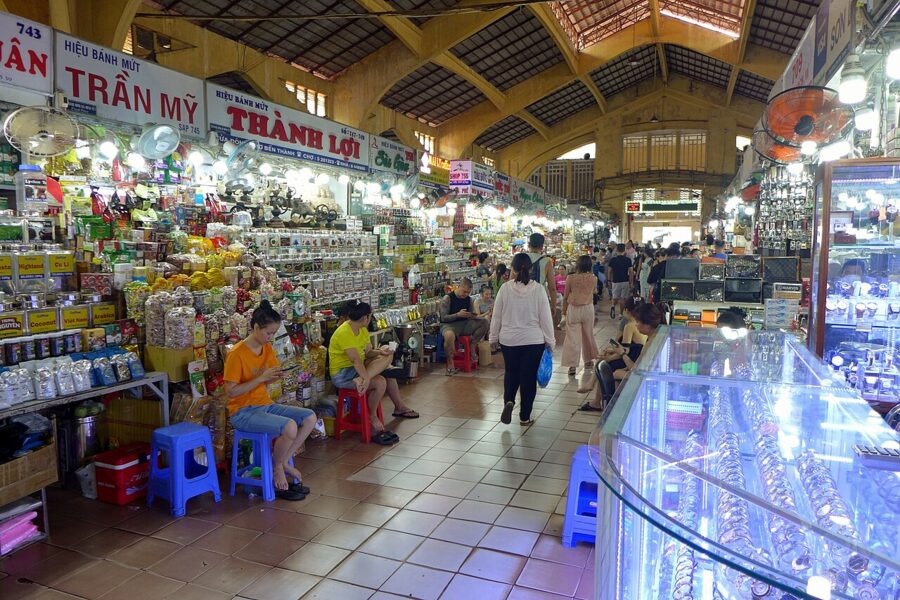


When each part is busy
The wet market and the fruit sellers do most of their trade early, when Saigon households and restaurants shop. Between about 7am and 9am the clothing and souvenir aisles are half asleep, which makes them the easiest time to browse, though some traders treat the first sale of the day as a matter of luck and may be keener to close it. Tour groups arrive from mid-morning, and by midday the south gate and the food block are at their most crowded and the hall at its hottest. Late afternoon is calmer again.

Eating at Bến Thành
The food block is the best reason for many Saigonese to come here at all. It works like a food court without the court: dozens of small family stalls, each with a counter, a few stools and a menu board, packed so close that you sit at one and order from the next. You point, you sit, the bowl arrives, you pay when you leave.
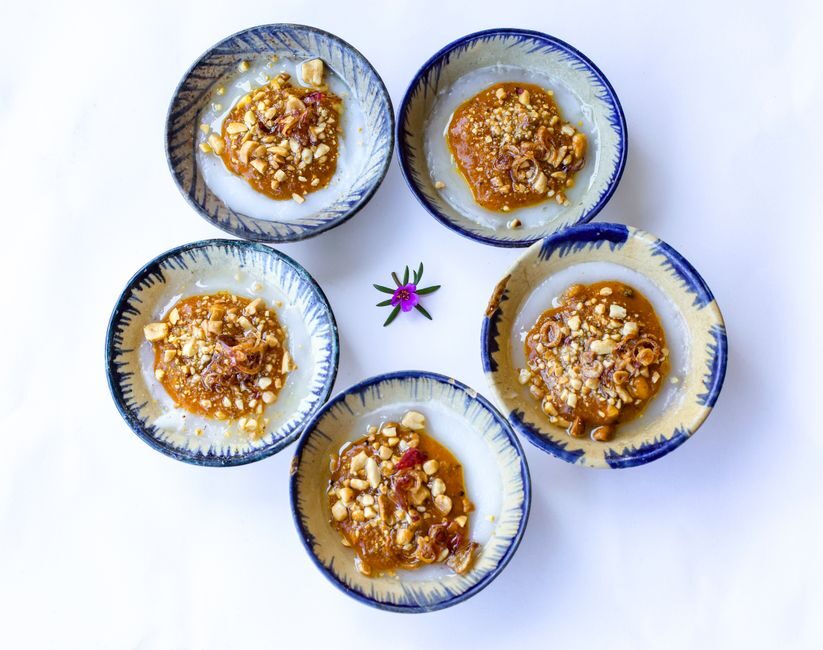
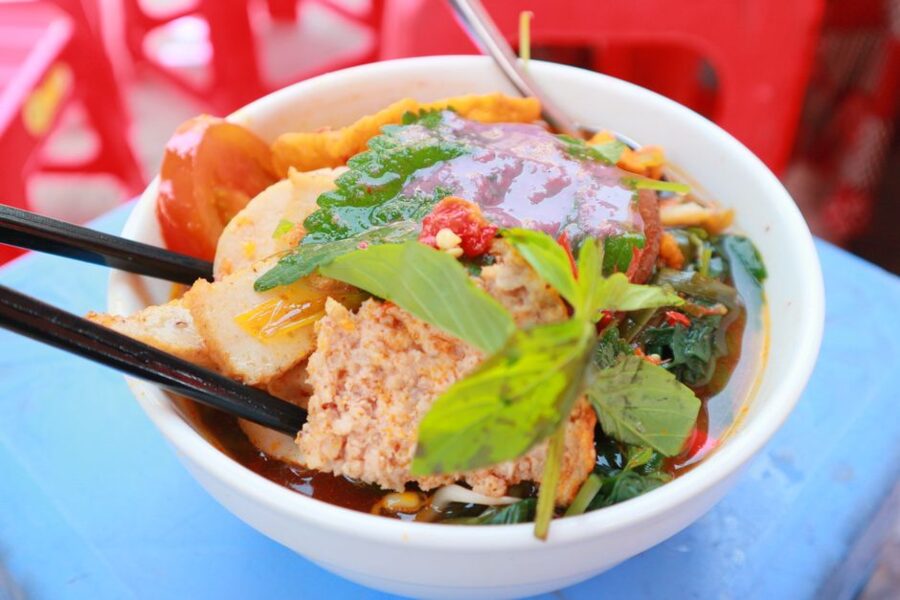
The dishes are southern and central Vietnamese standards. Bánh bèo, small steamed rice cakes from Huế topped with shrimp floss and crisp pork skin, come by the plate. Bún riêu, a tomato and crab broth with crab paste and tofu, is a lunch staple.
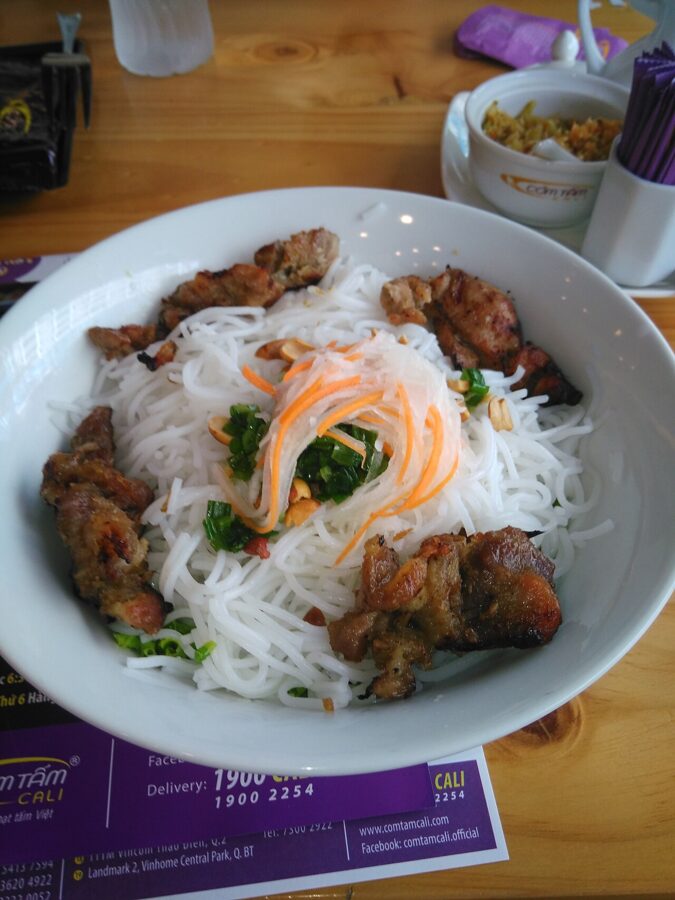
Bún mắm, the fermented fish noodle soup of the Mekong Delta, is the one to try if you like strong flavors, and bún thịt nướng, grilled pork over cold rice noodles, is the safe choice if you don’t. Chè, sweet soups of beans, jelly and coconut milk, fills the dessert stalls, and cơm tấm, broken rice with a grilled pork chop, is what half of Saigon eats for breakfast.
Prices here are higher than at a street corner and lower than in a restaurant. A recent newspaper report put a bowl of grilled prawn noodles at the Bà Tám stall, number 1028 inside the market, at over 100,000₫ (about US$3.85), its most expensive dish; the family has run the stall for about fifty years. On the pavement of Nguyễn Trung Trực street, just outside, a couple from Bến Tre sell a full bowl of bún thịt nướng for 70,000₫ (about US$2.70). Ask the price before you order anything sold by weight, especially seafood.
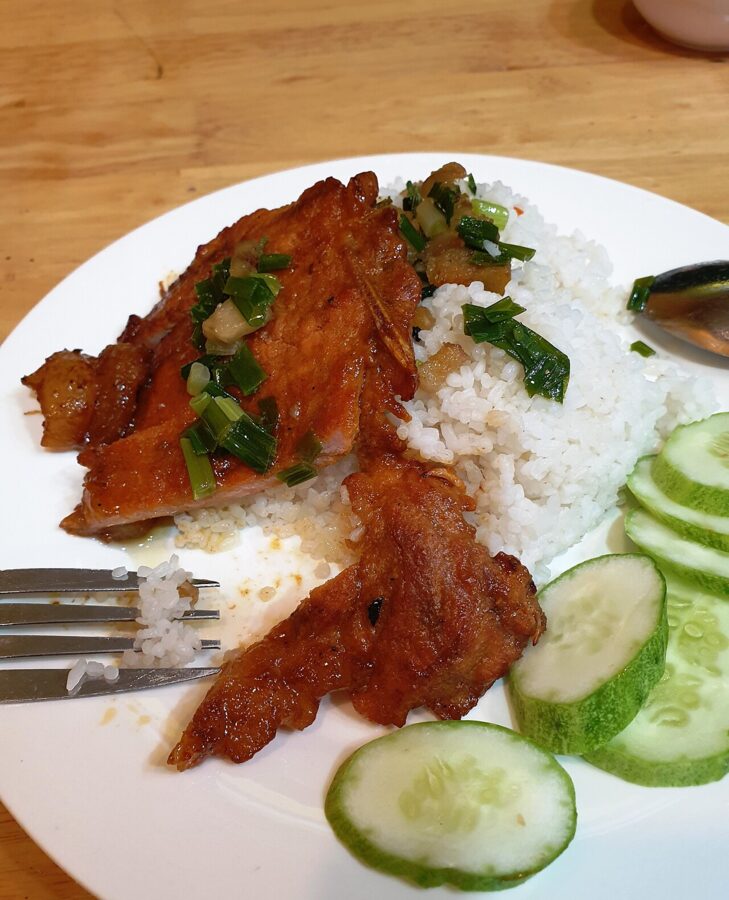
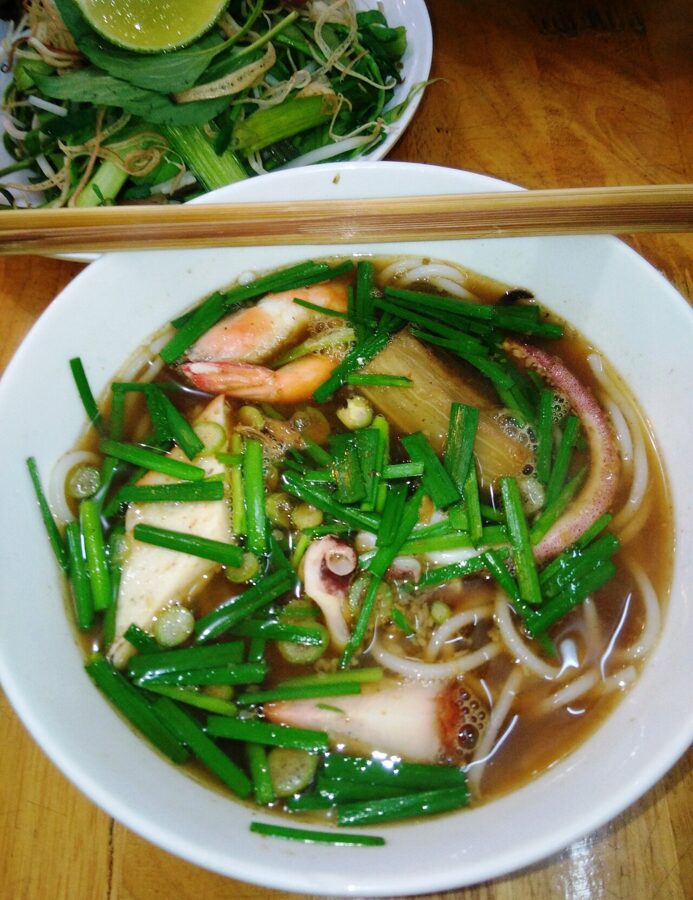
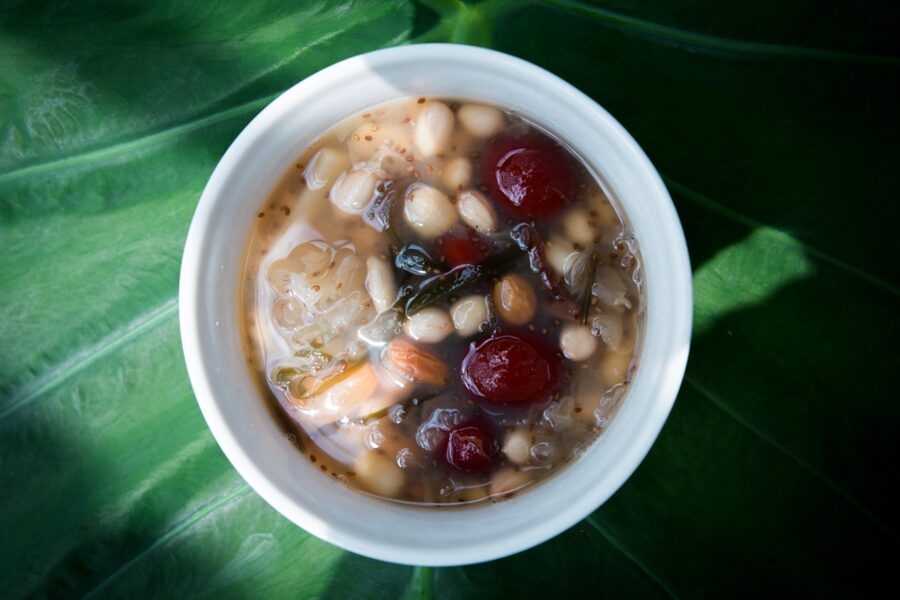
Some of the most famous names are just outside. A bún riêu business that began as a street vendor’s shoulder pole about half a century ago now trades at 163 Lê Thánh Tôn. Phở 2000, opened in 1999 and visited by Bill Clinton in November 2000 when it was still at 1-3 Phan Chu Trinh near the north gate, has moved to Lê Thánh Tôn street. Thanh Bình, a family eatery on Lê Thánh Tôn that had served noodle soups and broken rice since 1984, announced in October 2026 that it was closing as its owner retired.
A note on hygiene, since it made the news. In late September 2026 a visitor posted video of cockroaches on uncovered food at a stall, and the management suspended it. The board said heavy rain on 23 September had flooded the hall and driven insects up from drains that connect to the city sewer. Eat where the food is covered and the turnover is high.
After dark: the street stalls outside
For years, as the hall closed, stalls selling grilled seafood, beer, clothes and souvenirs set up along Phan Bội Châu and Phan Chu Trinh, and the “Bến Thành night market” became a fixture of guidebooks. It is now the least predictable part of a visit. Recent accounts disagree on whether, how often and how late the stalls trade, and the market publishes no schedule for them. Treat a night market as a bonus if you find one, not a dinner plan.
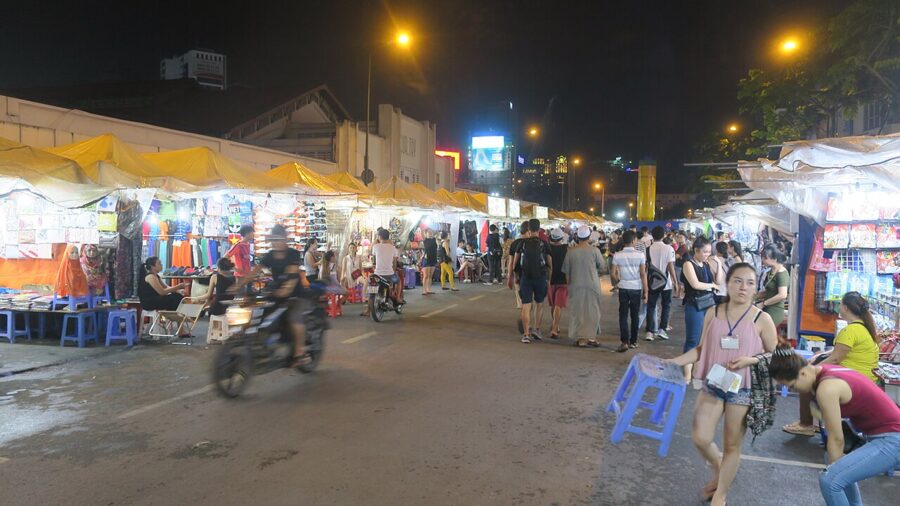

The lit facade is worth seeing after dark whatever the stalls are doing. For an evening meal, the eateries on Lê Thánh Tôn and the streets toward Nguyễn Huệ are more reliable than the street.
Buying: what is worth carrying home
Bến Thành is not the cheapest place in the city to buy anything, and nobody in Saigon pretends it is. What it offers is range under one roof, close to your hotel, and a few things that are good value even at tourist prices.
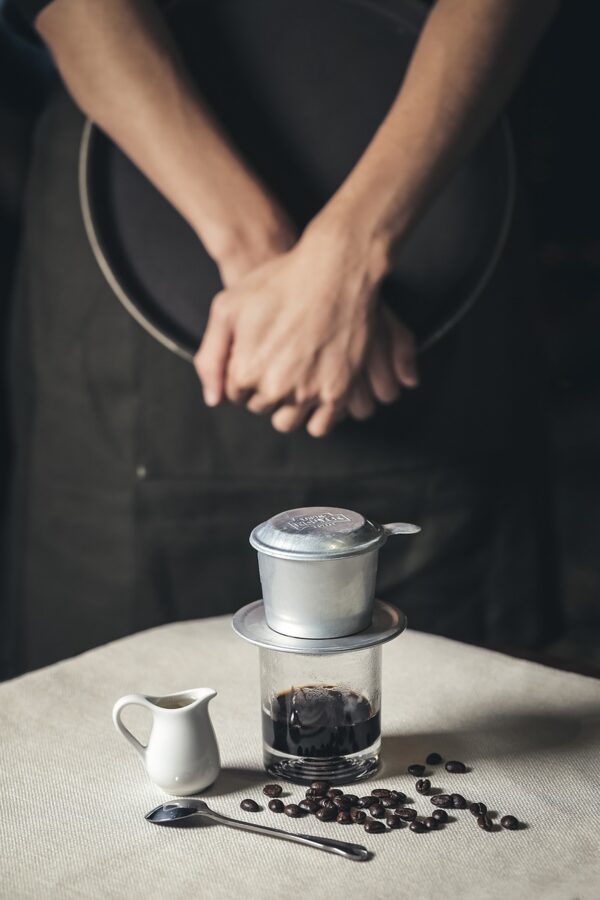
Coffee and the things that go with it. Vietnamese coffee, sold as beans or ground, in bags or by the kilo, is the most popular purchase in the market, and the dried-goods stalls near the east gate stock it in quantity. Ask about the roast and the weight, buy sealed packs if you are flying, and pick up an aluminum phin filter; they cost little and weigh nothing.

Dried and packaged food. Cashews, dried mango and jackfruit chips, candied ginger, lotus seeds, tea, peppercorns and dried shrimp. Check the expiry dates and the seals, and be aware that some countries restrict what you can bring in, dried meat and fish especially.

Crafts. Lacquer boxes and trays, mother-of-pearl inlay, embroidered textiles and ceramics are on the west side. Quality varies widely; the best pieces are heavy, smooth on the underside and finished inside as carefully as outside.

Tailoring. Fabric stalls near the south gate will sell you silk or synthetic by the meter, and some offer to make up an áo dài or a shirt in a day or two. Agree the price, the fabric and the collection date in writing, and allow time for a second fitting.
What is fake
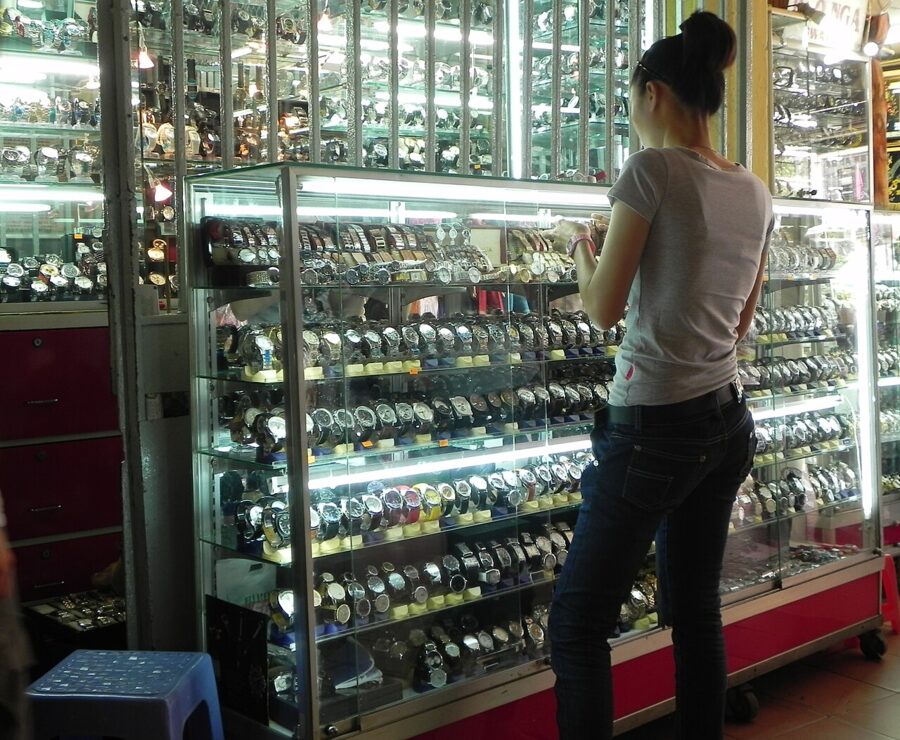
The watches, designer handbags, sports shirts and branded backpacks are, almost without exception, copies. If a stall tells you a famous-brand bag is genuine at a fraction of the shop price, it is not. In May 2026 the city’s market inspectors ran a campaign in the hall against counterfeit and unlabelled goods, and reminded traders that prices must be displayed and goods sold at the displayed price.

How bargaining actually works
The market’s rules, issued by the old District 1 government, forbid traders from quoting inflated prices and require them to post prices and sell at them. In practice many stalls in the clothing and souvenir aisles post nothing, and the first figure you hear can be several times what a local would pay. Where a price is marked, at the food stalls and the bigger dried-goods counters, pay it. Where it is not, the conversation begins.
Ask two or three stalls the price of the same thing before you buy, since the aisles are full of near-identical stock. Offer well under the asking price, smile, and expect to meet somewhere in the middle; if you can’t agree, say thank you (cảm ơn) and walk on, and you will often be called back. Get the final figure typed into a calculator before you hand over money, and don’t start bargaining for something you don’t want.
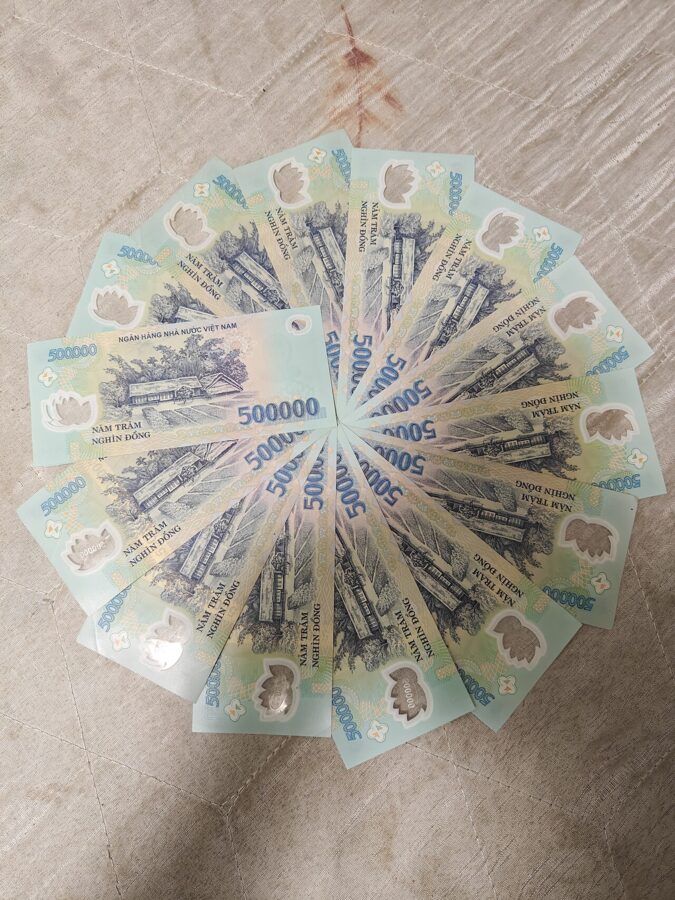
The rules also spell out your side of the deal: you are free to buy or not, to refuse pressure, and to check labels, prices, quality and weight. In 2023 the management suspended a stall for seven days after a Japanese visitor filmed it asking 700,000₫ for three pairs of socks, and warned that repeat overcharging could cost a trader the lease. The management office is at the south gate.
The square, the roundabout and the metro
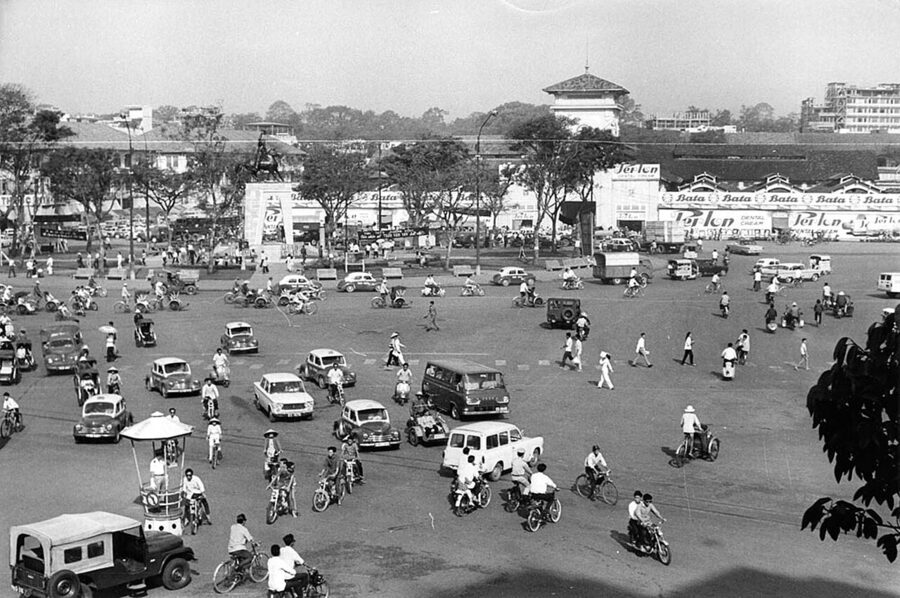
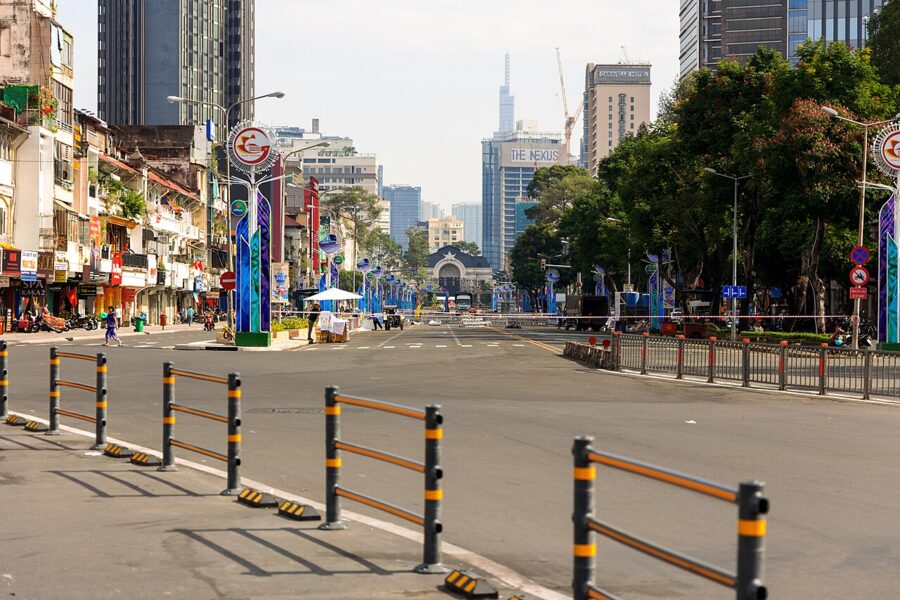
The space in front of the south gate has carried a string of names: Place du Marché, Place Eugène-Cuniac from 1916, Diên Hồng from 1955, and since the 1960s Quách Thị Trang, though to most of the city it was simply the market roundabout, bùng binh chợ Bến Thành. Seven streets meet here, including Lê Lợi and Hàm Nghi boulevards and Trần Hưng Đạo, and before 1929 it was open ground.
Its history is not only commercial. On 25 August 1963, during the protests against Ngô Đình Diệm’s government, police fired on a demonstration of students in the square and killed Quách Thị Trang, a fifteen-year-old schoolgirl. Students raised money for a bust where she fell, and the square took her name. Six weeks later, on 5 October 1963, a Buddhist monk set himself on fire in front of the market in protest at the same government.
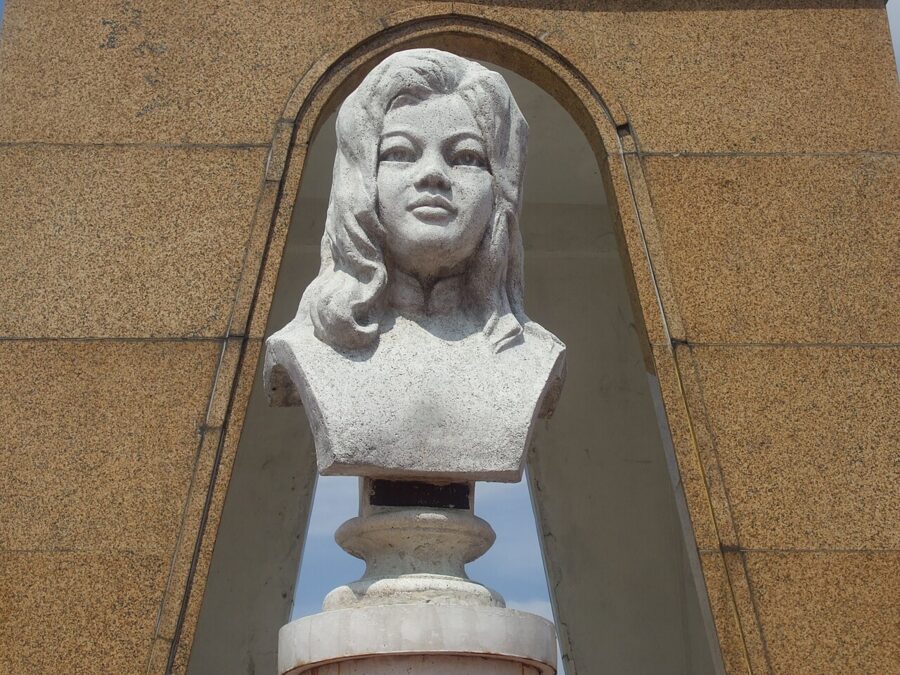

About two years later an equestrian statue of Trần Nguyên Hãn, a general of Lê Lợi’s fifteenth-century war against the Ming, went up in the middle of the roundabout. The Republic of Vietnam’s signal corps honored him as its patron, and the statue shows him on horseback releasing a bird. Both monuments were removed in 2014, when the whole area in front of the market was dug up for the underground station of Metro Line 1.
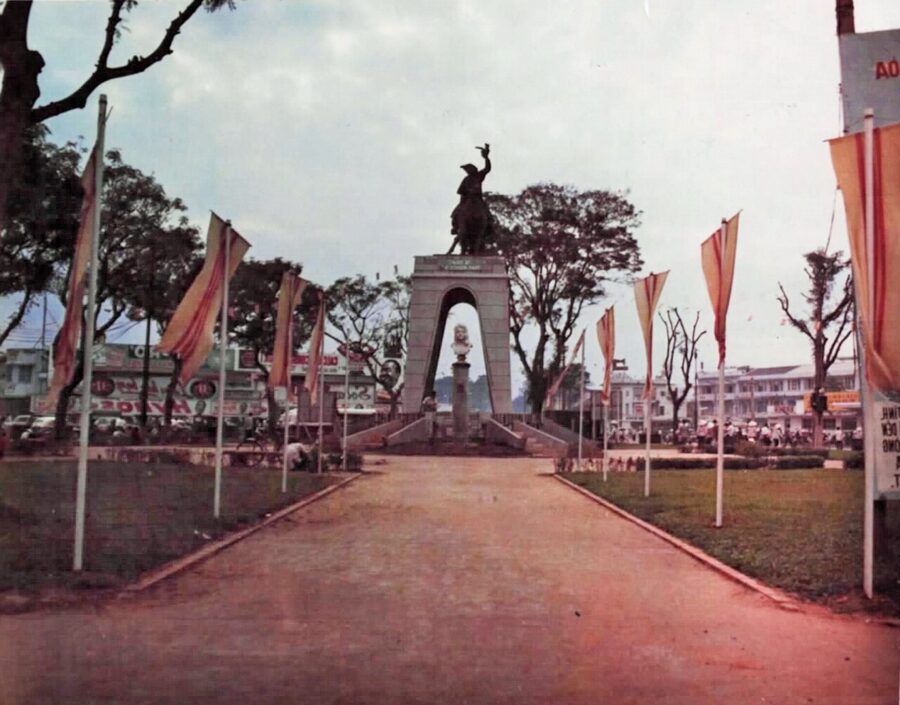
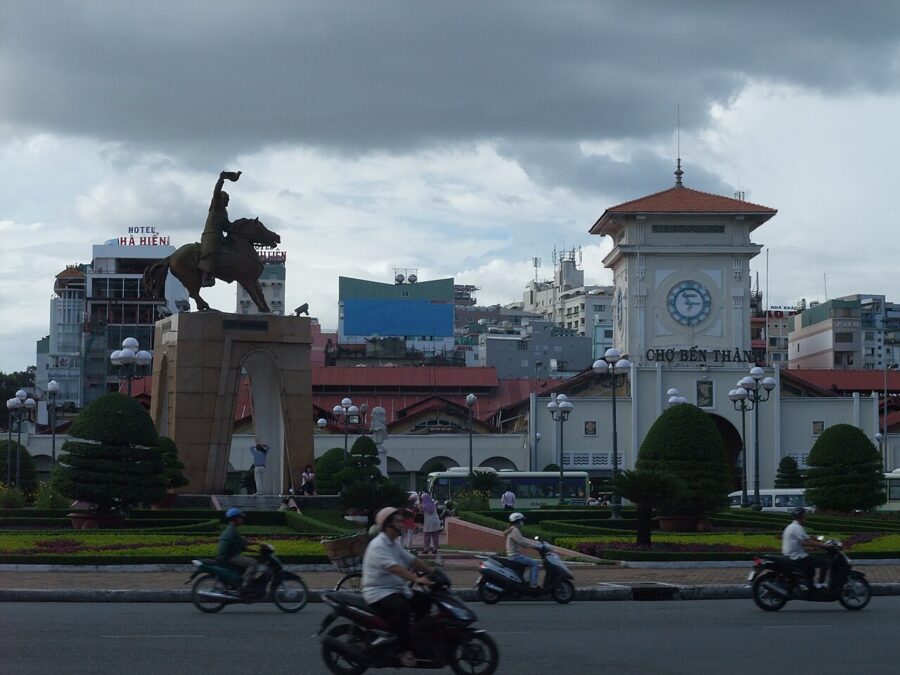

The city has since approved a plan to recast the Trần Nguyên Hãn statue in bronze and return it to the front of the market, with Quách Thị Trang’s bust nearby, as part of a square redesign budgeted at about 145 billion đồng for 2025 and 2026. At Tết in early 2026, though, the traffic islands still carried temporary decorations, which the city called placeholders until an overall plan for the square and the space beneath it is settled. Don’t expect to see either statue yet.
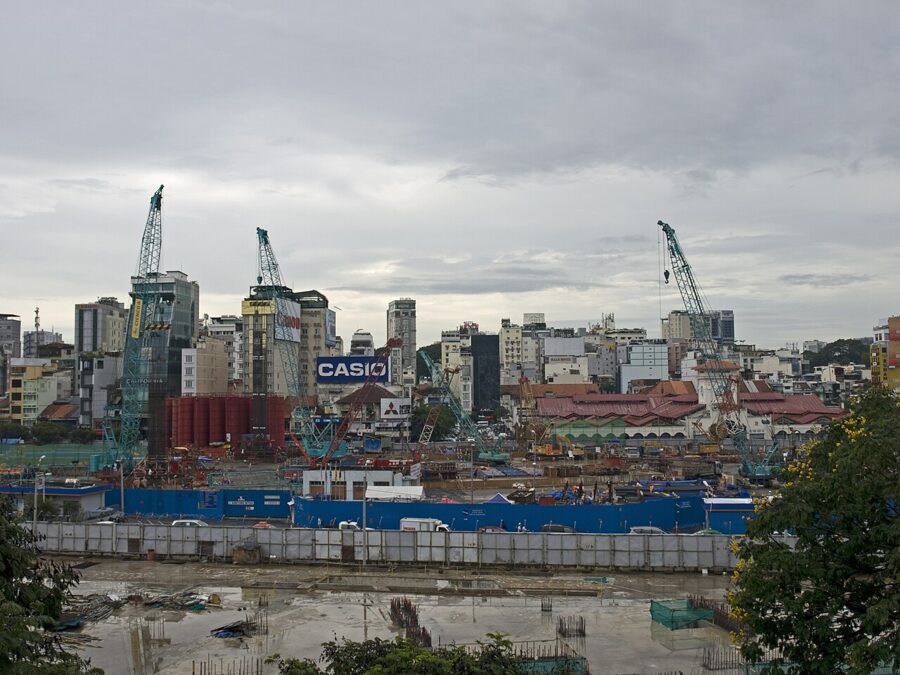

Bến Thành station
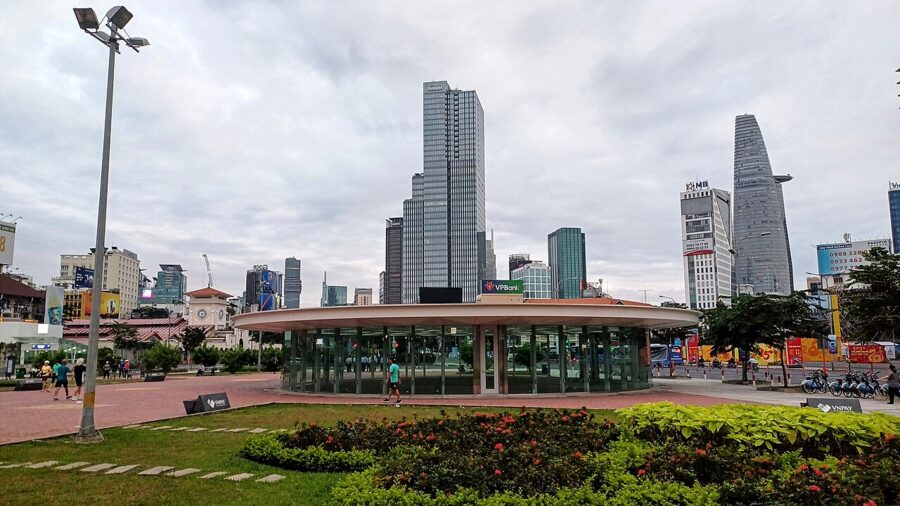
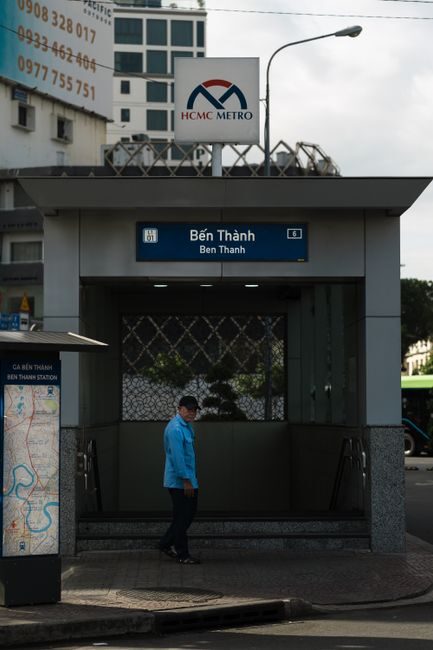
Metro Line 1 opened on 22 December 2024, running nearly 20 kilometers from Bến Thành to the Suối Tiên bus terminal in Thủ Đức. Bến Thành is the terminus and one of three underground stations, and it is designed as the interchange for future lines. In its first year the line carried nearly 19 million passengers, and a full trip to Suối Tiên takes about 29 minutes.
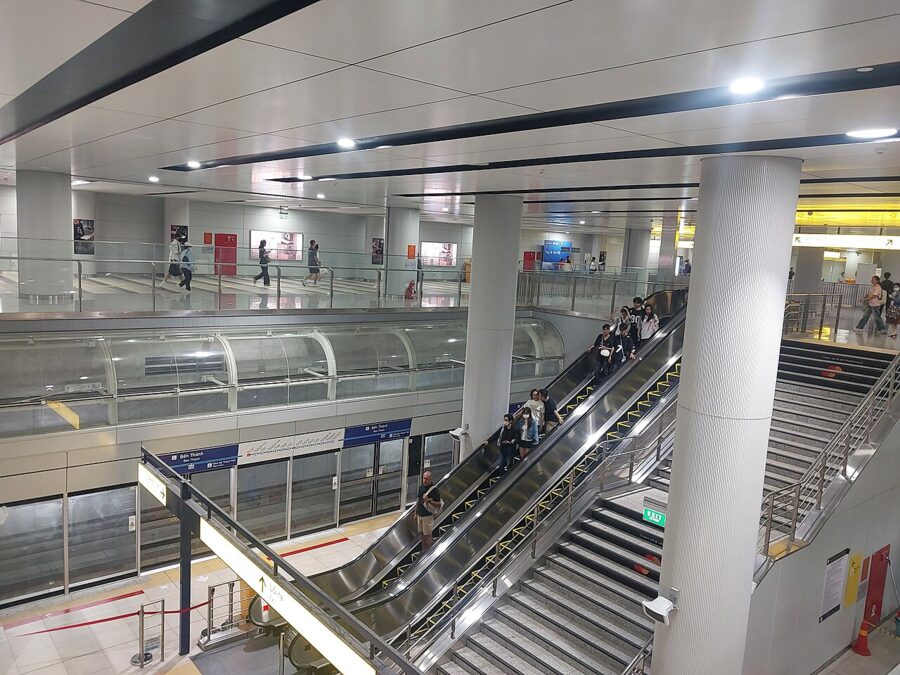

Fares run from 7,000₫ to 20,000₫ in cash, a little less by card, (about US$0.25 to US$0.75) depending on distance; older people, children under six and people with disabilities travel free. The next stop is Opera House (Nhà hát Thành phố) station, by the Municipal Theatre at the far end of Lê Lợi.
Two bigger changes are coming. A second line, from Bến Thành to Cần Giờ on the coast, broke ground on 19 December 2025. And in August 2026 the city put out for public comment a proposal by VinSpeed, a Vingroup rail company, for a four-level shopping and parking complex under the September 23rd Park, linked to Bến Thành station.
Red roof, wave paint and a cockroach video: the market lately
When Hồ Chí Minh City abolished its districts on 1 July 2025, the market’s management was merged into a single board for the markets of the new Bến Thành ward, with its headquarters at the south gate. The address is now Bến Thành ward, though signs and taxi drivers still say Quận 1.
In January 2026 the city approved a pre-Tết facelift for seven central sites, paid for by the developer Khang Điền. At the market, cranes washed the walls back to their original colors, the roof was painted bright red, and the square was covered in large blue wave patterns that the sponsor said recalled the canals of the south. On 2 February the city’s planning department asked for the work on the square to be halted over departures from the approved design and the colors. The construction department refused, calling the colored structures temporary.
The market reopened before Tết, which fell on 17 February, and drew crowds of young people photographing themselves in áo dài. Behind the photographs, traders have complained for years that visitors come to look rather than buy; in early 2025 one clothing seller of thirty years said her revenue had more than halved since 2019. The management has tried livestreams, influencers and subsidies for sales terminals that issue electronic invoices.
Planning your visit
| Address | Quách Thị Trang square, between Lê Lợi, Phan Bội Châu, Phan Chu Trinh and Lê Thánh Tôn streets, Bến Thành ward (formerly District 1) |
|---|---|
| Hours | 7am to 10pm daily under the market’s rules; fresh food and cooked-food stalls may open from 4am. Holiday and Tết hours are announced separately. Individual stalls keep their own hours within that window. |
| Entry | Free; the market’s rules say visitors pay nothing to enter |
| Metro | Line 1, Bến Thành station (terminus); fares 7,000₫ to 20,000₫ in cash |
| Time needed | An hour to browse; two hours with a meal and some shopping |
| Best time | 7am to 9am for quiet aisles; late morning for the food block in full swing |
Getting there
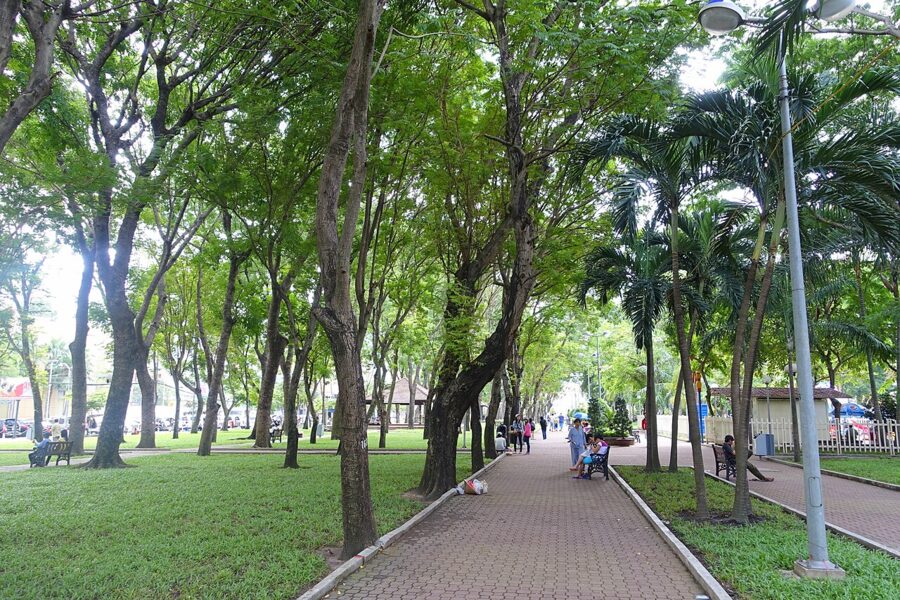
From most hotels in the old District 1 you can walk. From the Municipal Theatre it is about a kilometer straight down Lê Lợi boulevard, twelve to fifteen minutes on foot, and from Nguyễn Huệ walking street, where it crosses Lê Lợi, about eight. From the Phạm Ngũ Lão and Bùi Viện backpacker streets it is ten to fifteen minutes north, past the September 23rd Park.
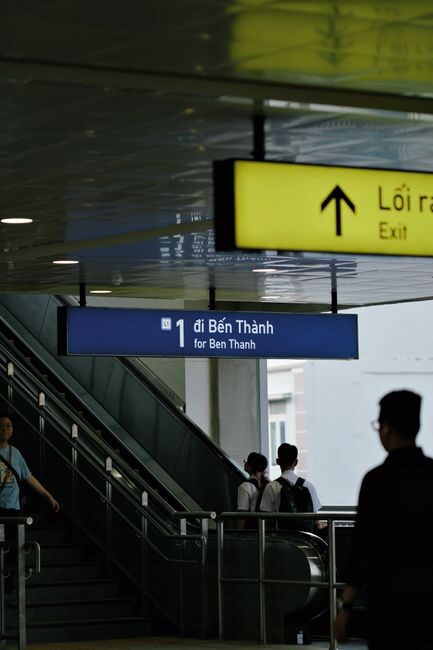
In a Grab or Be car or motorbike taxi, type “Chợ Bến Thành” as your destination and you will be dropped on the roundabout by the south gate; if you want a quieter gate, name the street instead, Lê Thánh Tôn for the north or Phan Chu Trinh for the west. By metro, take Line 1 to its Bến Thành terminus and follow the exit signs for the market; the exits come up around the square in front of the south gate.

Rules, safety and touts
There is no dress code; it is a working market, not a temple, and closed shoes suit the slippery floors of the wet section. Ask before you point a camera at a trader up close.
Pickpockets work the crowd at the south gate and in the narrow aisles. Carry your bag in front and keep your phone in a zipped pocket. Outside, be wary of anyone offering a “metered” taxi or a cyclo ride without an agreed price; use a ride-hailing app or an established taxi company, and decline anything handed to you unasked.
What to combine it with
The market is the natural start or end of a walk through the old French center. Head northeast up Lê Lợi to the Municipal Theatre, then along Đồng Khởi to the Notre-Dame Cathedral (Nhà thờ Đức Bà) and the Central Post Office beside it, about fifteen minutes from the market. The Reunification Hall (Dinh Độc Lập) is about a kilometer northwest, and the War Remnants Museum a few blocks beyond it; together they make a long morning.
If Bến Thành leaves you wanting a market that still trades mostly with locals, go to Chợ Lớn, the old Chinese city to the west, where the wholesale halls of Bình Tây market sell to traders by the sack. Combine it with the Thiên Hậu Pagoda, a short ride from Bình Tây; a Grab from Bến Thành takes twenty to thirty minutes depending on traffic.
The best order for the market itself is the one the traders keep. Come in through the north gate around seven, while the fish are still being laid out and the fruit stacked, walk the dry-goods aisles before the tour buses arrive, and eat lunch in the food block once the noodle stalls are going full tilt. Then go out through the south gate and look up at the clock, and at the ceramic ox head above the arch that has been watching the roundabout since 1952.