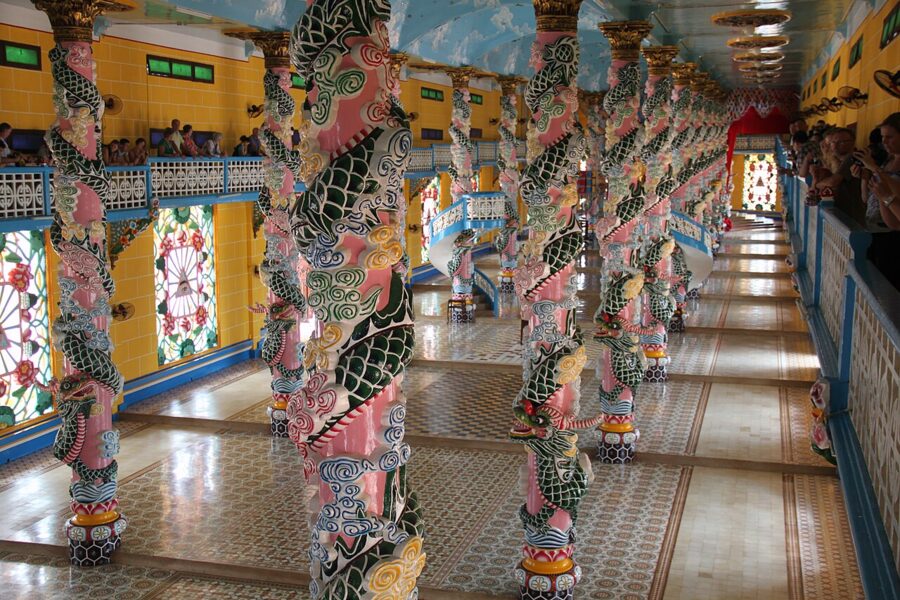
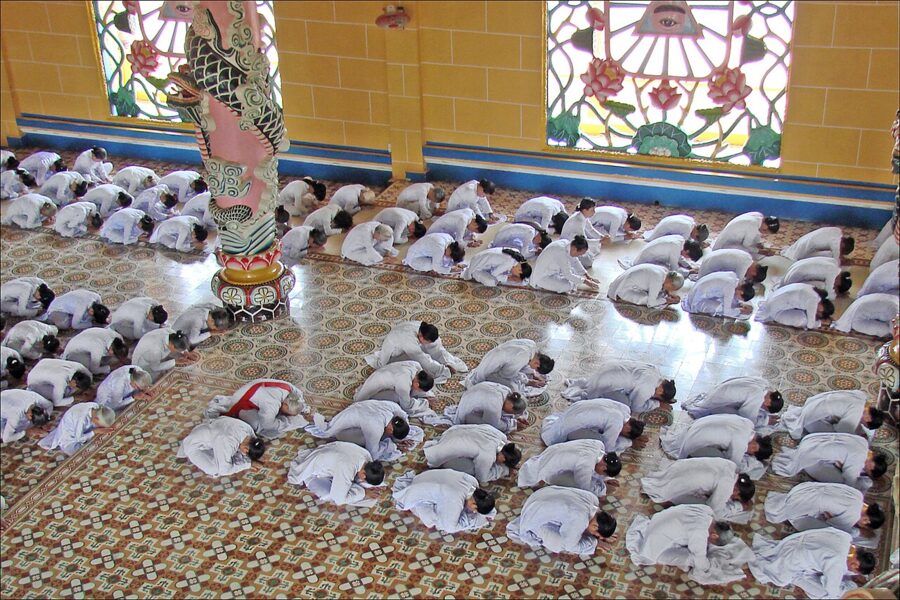
At ten to twelve the gallery above the nave is already two deep in visitors, shoes in hand, phones held low. Below them the floor is empty: pale tiles, pink columns wrapped in green dragons, a blue ceiling scattered with stars. Then a gong sounds from the back of the hall, strings and a drum start up, and lines of men and women in white walk in from opposite sides, one slow step at a time, until the floor between the dragons fills with kneeling figures facing a giant painted eye.
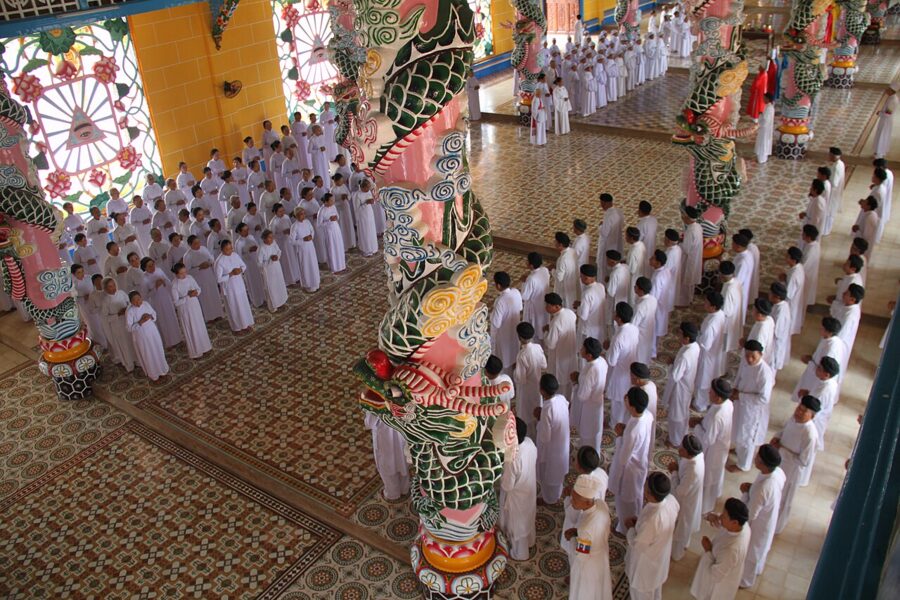
This is the noon service at the Cao Đài Holy See, the Tòa Thánh Tây Ninh, mother temple of a religion that is barely a hundred years old. It stands in Long Hoa ward, about 5 km from the old center of Tây Ninh and roughly 100 km northwest of Saigon, and it has been the headquarters of Caodaism since the faith bought a patch of forest here in 1927.
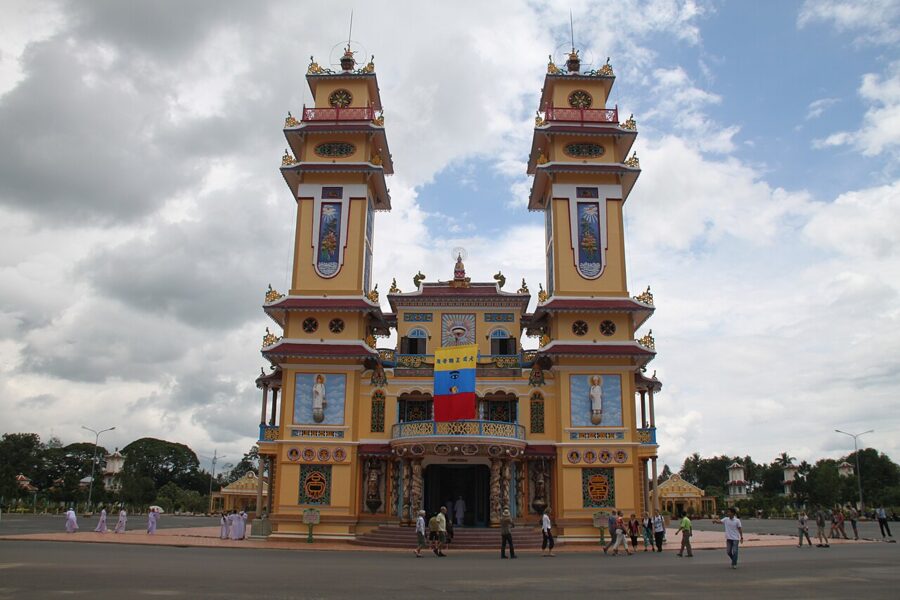
Most people arrive on a day trip, watch the noon ceremony from the gallery, take a picture of the facade and leave for the Củ Chi Tunnels. That works. But the building rewards a slower look, and the faith behind it, assembled at séance tables in 1920s Saigon out of Confucian ethics, Taoist ritual, Buddhist rebirth, Catholic hierarchy and a dash of French spiritualism, has a history that runs through every war Vietnam fought in the twentieth century.
On this page
A religion revealed at a séance table
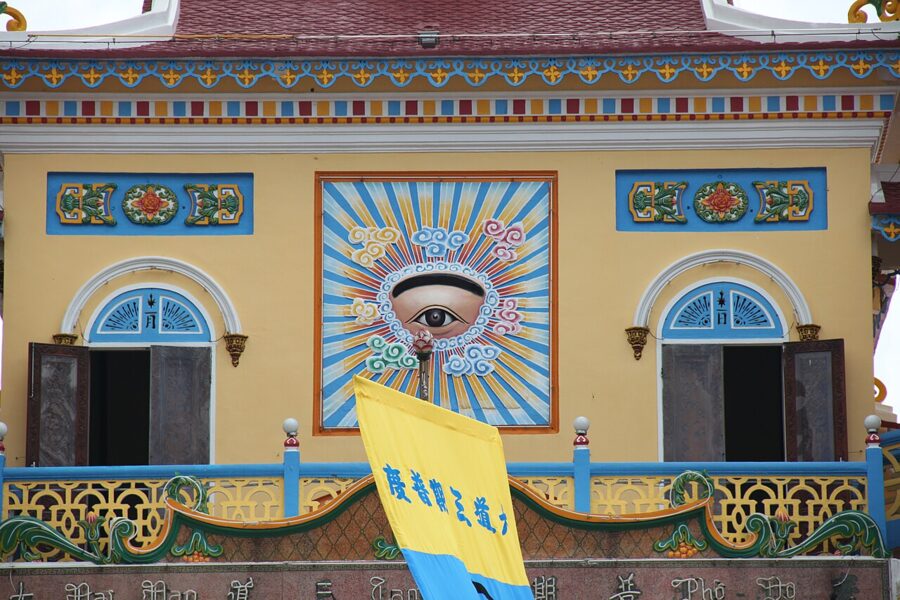
The story begins with a colonial civil servant. Ngô Văn Chiêu (1878 to 1932), a district official educated at the Collège Chasseloup-Laubat in Saigon, had practiced spirit writing since his youth, and around 1920 the sessions he joined produced a spirit that called itself Cao Đài, “High Tower”, a Taoist-flavored name for the Supreme Being. Posted to Phú Quốc island later that year, Chiêu kept up the sessions, and by the faith’s own account it was there, in 1921, that he was shown the left eye that became its symbol.
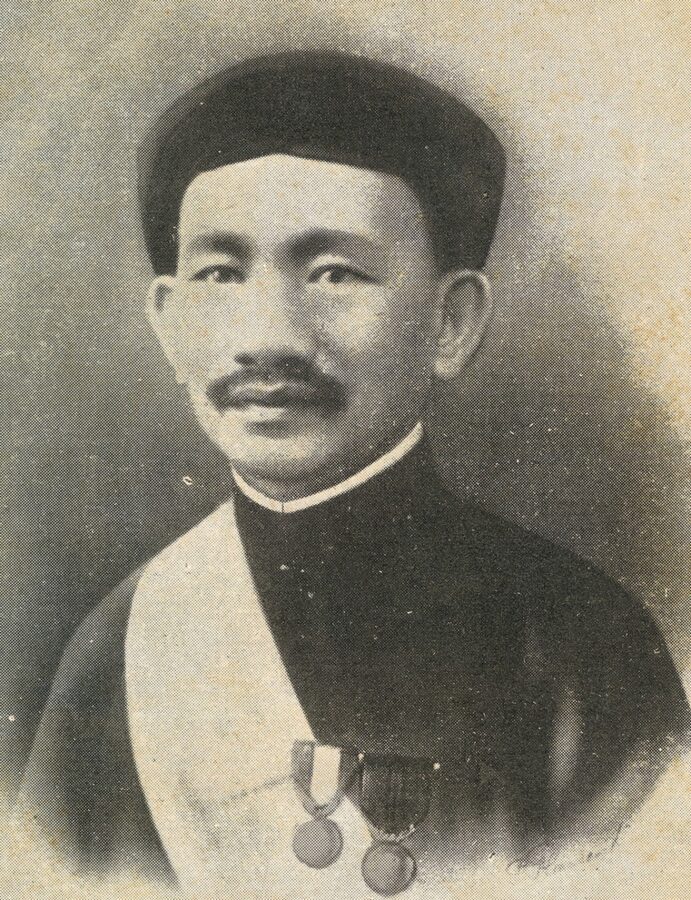
In Saigon a second circle of young clerks, among them Cao Quỳnh Cư, Cao Hoài Sang and a customs secretary called Phạm Công Tắc, had taken up table turning, the fashionable French pastime, and found themselves receiving messages from the same spirit. On Christmas Eve 1925 a séance announced a new faith. The full name it took, Đại Đạo Tam Kỳ Phổ Độ, means the Great Way of the Third Period of Universal Salvation: God had spoken twice before, through the founders of the old religions, and was now speaking a third time, directly.
Lê Văn Trung, a former colonial councillor, brought the movement money and contacts. A declaration signed by its leading followers went to the French governor of Cochinchina on 7 October 1926, and the founding ceremony was held on 19 November 1926, the full moon of the tenth lunar month, at Từ Lâm pagoda (Gò Kén) outside Tây Ninh town. Soon afterward the pagoda’s abbot asked for his building back, and in February 1927 the new church bought a forest plot owned by a Frenchman called Aspar for 25,000 piastres. The Holy See stands on it now.
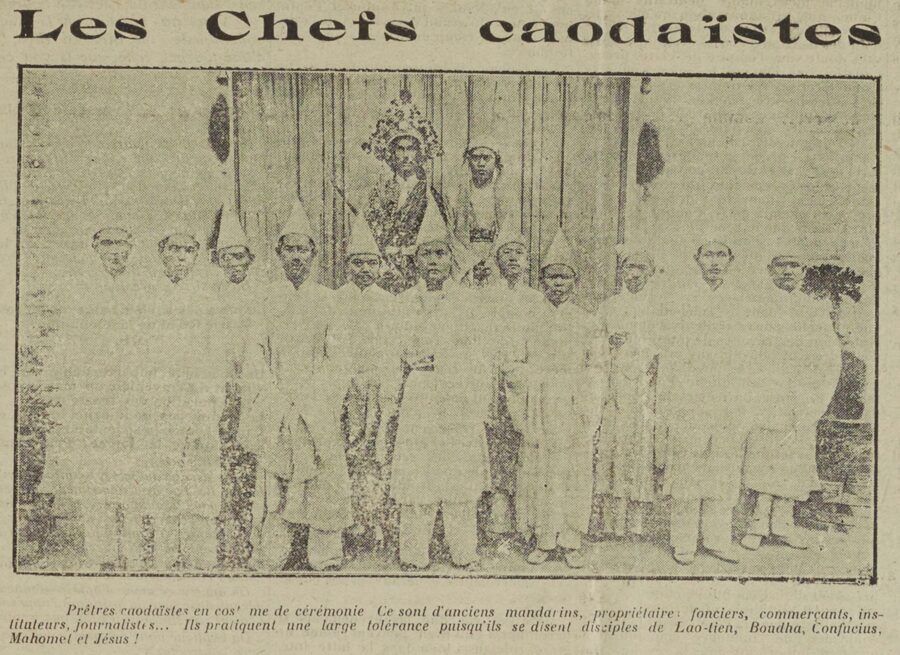
The growth was fast. Chiêu, who wanted a quiet circle of adepts rather than a church, declined the role of pope and withdrew. Trung became acting pope (Quyền Giáo Tông), and after his death in 1934 the leadership passed in practice to Phạm Công Tắc, who held the title of Hộ Pháp, Defender of the Dharma. By 1940 the faith counted over a million followers across Cochinchina.
What they believe is easier to state than it sounds. One God, the Jade Emperor or Đức Chí Tôn, paired with a Mother Goddess, Diêu Trì Kim Mẫu, who gives form to living things. The three great teachings of East Asia, Buddhism, Taoism and Confucianism, return to a single root (tam giáo quy nguyên), and five paths of practice, from the way of humanity to the way of the Buddhas, merge into one (ngũ chi phục nhất). Followers pray four times a day, keep a set number of vegetarian days each month (many keep it permanently), avoid killing, and hope through merit to escape the cycle of rebirth.

Counting them today is harder. Caodaism has split many times, and ten or more branches now hold legal recognition, with Tây Ninh by far the largest. A United Nations estimate in 2015 put all Caodaists in Vietnam at around 2.5 million, and other figures run higher. A 2019 report from Tây Ninh province, before its 2025 merger with Long An, counted 563,225 followers there alone, roughly half the province’s population, served by 2,340 dignitaries and 133 places of worship.
The Divine Eye, and the saints at the door
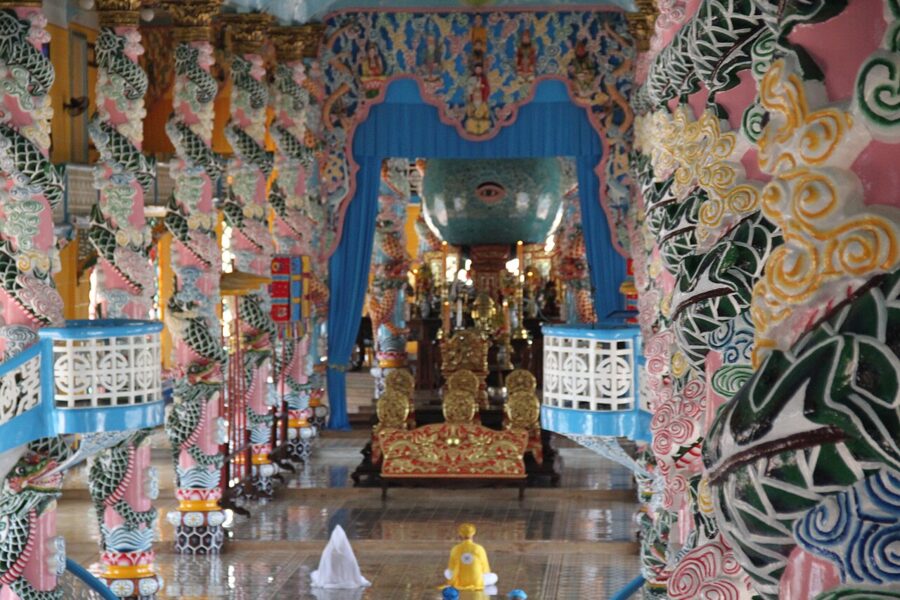
There are no statues of God at the Holy See. The faith teaches that the Supreme Being has no human form, so what is shown is his gaze: a left eye, the left standing for yang, inside a triangle or on a globe, with rays around it. It is a reminder that every act is seen, and once you start looking it is everywhere: above the door, in the windows down both flanks, on the great globe at the far end.
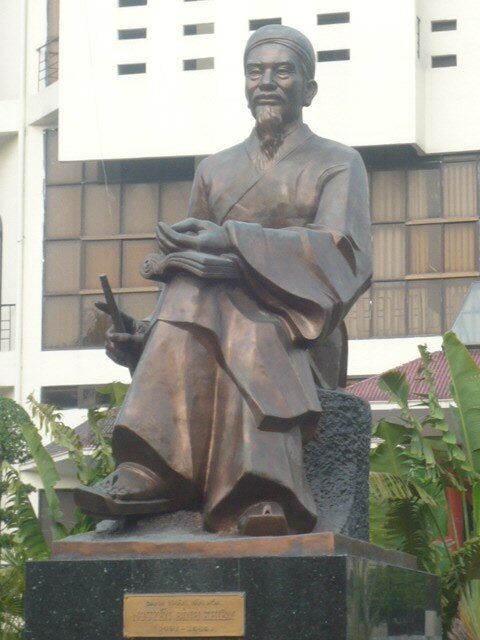
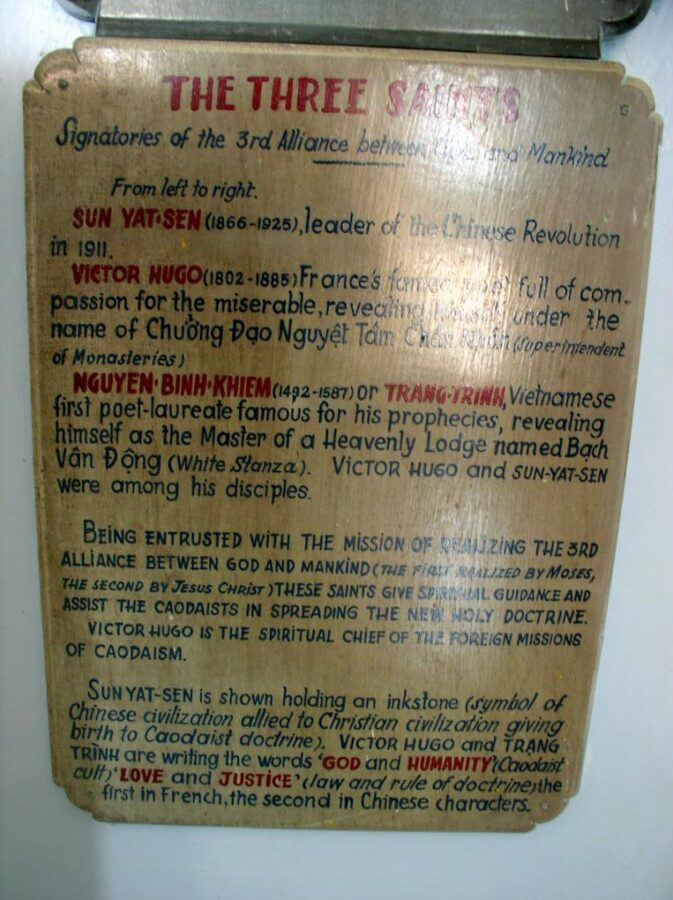
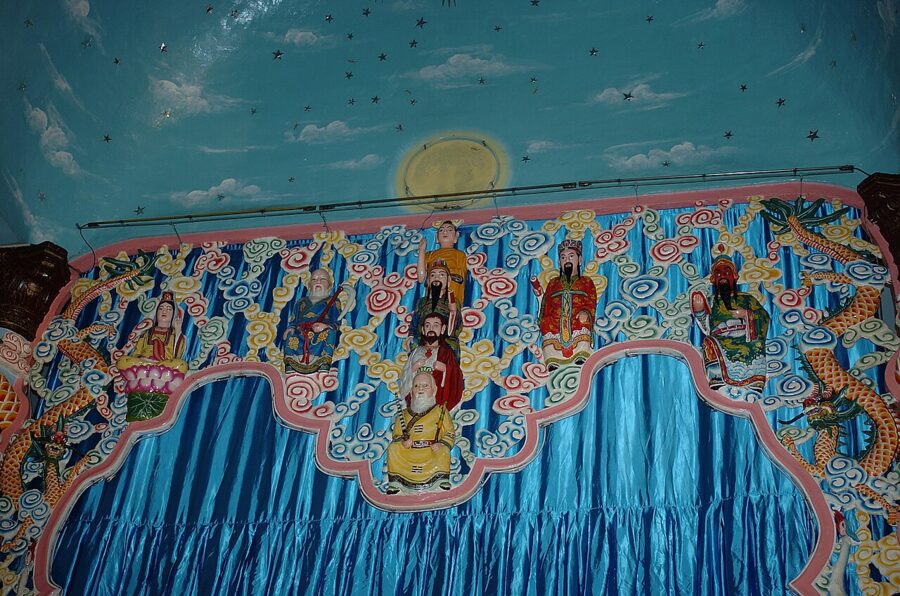
The image visitors photograph most is not the eye but a painting in the entrance hall. It shows three figures writing on a tablet among clouds: Sun Yat-sen, founder of the Chinese Republic, holding an inkstone; the French poet Victor Hugo, in the embroidered coat of an academician, with a quill; and the Vietnamese poet and prophet Nguyễn Bỉnh Khiêm (1491 to 1585), better known as Trạng Trình. The words on the tablet, in Chinese and French, read “God and Humanity, Love and Justice”.
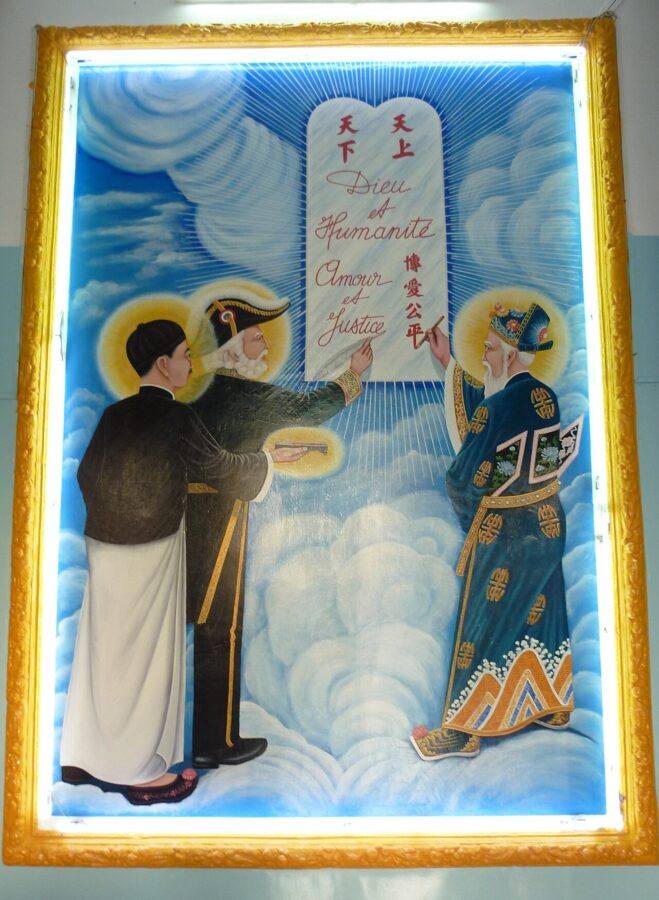

This is where the famous story starts to drift. Tour patter tends to say that Victor Hugo is worshipped in Vietnam, and some lists add Joan of Arc, Shakespeare, Lenin or Churchill to the Cao Đài saints. The building names none of the last four. Hugo is real enough as a figure of the faith, but as a saint and a spirit guide, not as a god: he never appears on the altars, which are reserved for God, the founders of the great religions and the faith’s own patron spirits.
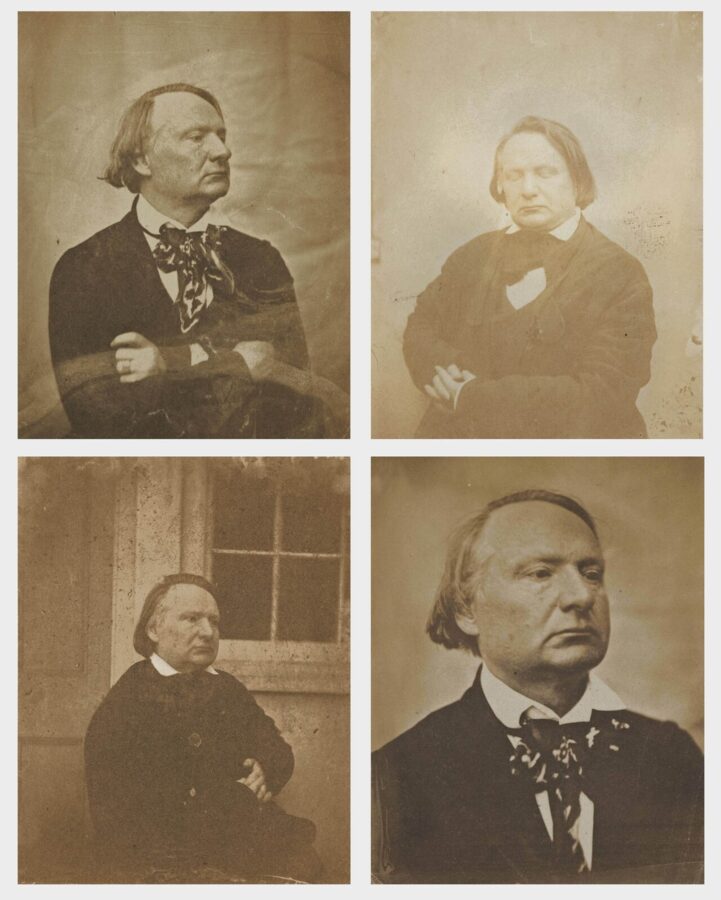
The Hugo connection has a paper trail. On Jersey in the 1850s Hugo held séances and predicted their transcripts would found a religion; they were published in Paris in 1923, just as Vietnamese clerks schooled in French literature were turning tables in Saigon. When Phạm Công Tắc was transferred to Phnom Penh in 1927 he set up an overseas mission there, and Hugo, under the spirit name Nguyệt Tâm Chơn Nhơn, became its spiritual head. Tắc and Trần Quang Vinh, held by the faithful to be a reincarnation of Hugo’s son, recorded long messages from him.
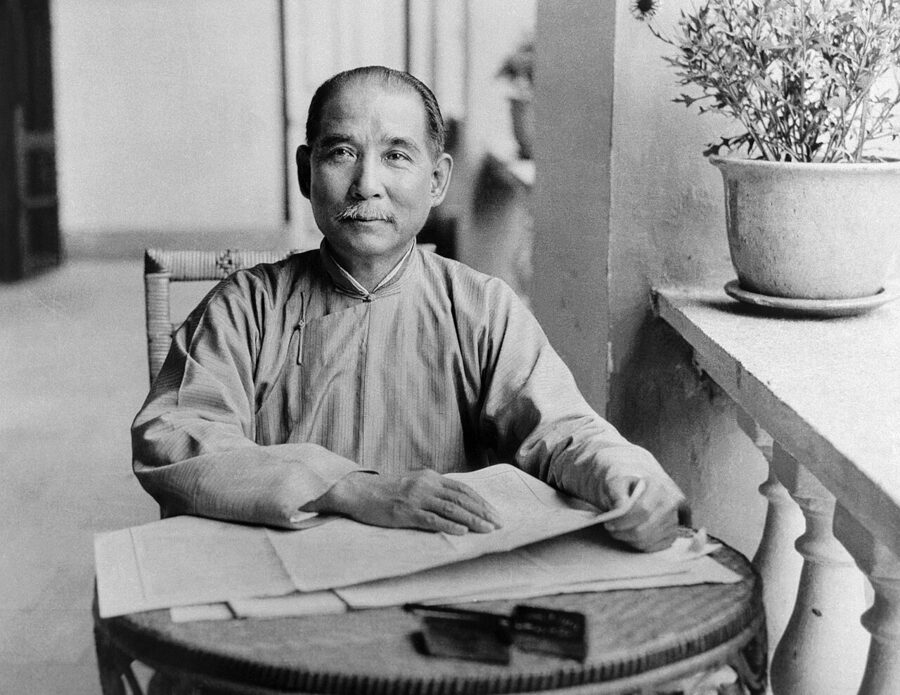
The anthropologist Janet Hoskins, who has written most fully on the faith in English, argues that the choice was not flattery of the French. Hugo was the republican exile who had attacked tyranny, and putting him beside Sun Yat-sen and Trạng Trình turned a colonial school author into a patron of Vietnamese hopes. Graham Greene saw the temple in the early 1950s and gave it a famous sneer in The Quiet American, where his narrator calls it “a Walt Disney fantasia of the East”. The faithful would say he missed the point, and the painting is a good place to see why.

Reading the building, from the gate to the globe
The Holy See is the centerpiece of an enclosed precinct of about a square kilometer, which the faithful call the nội ô. A wall runs around it with twelve gates; the largest, the Chánh Môn, faces west down a long avenue and stays shut except for heads of state and religious leaders. Visitors come in through the numbered side gates.
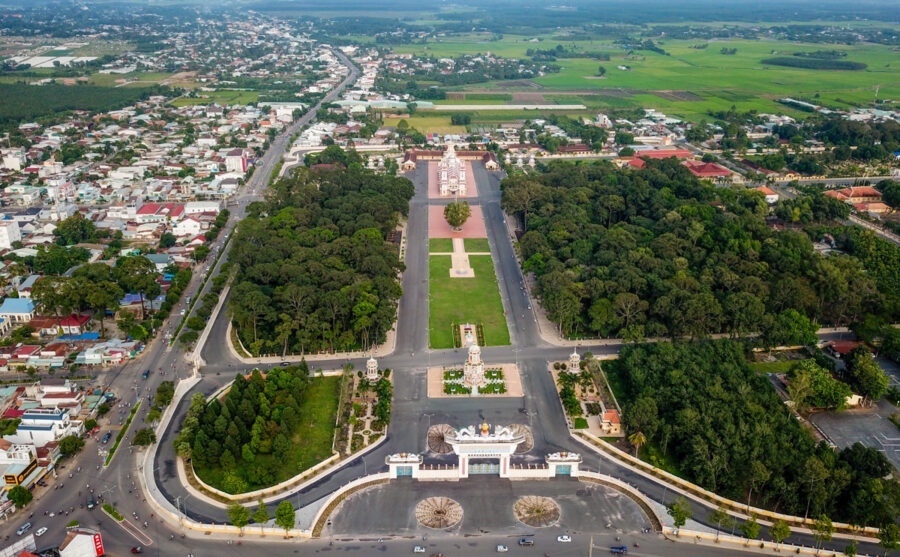
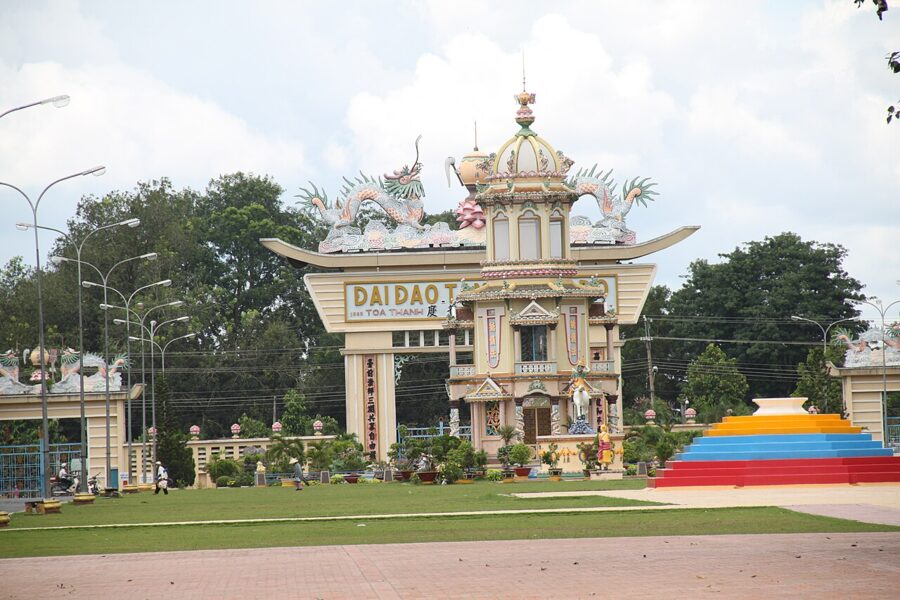
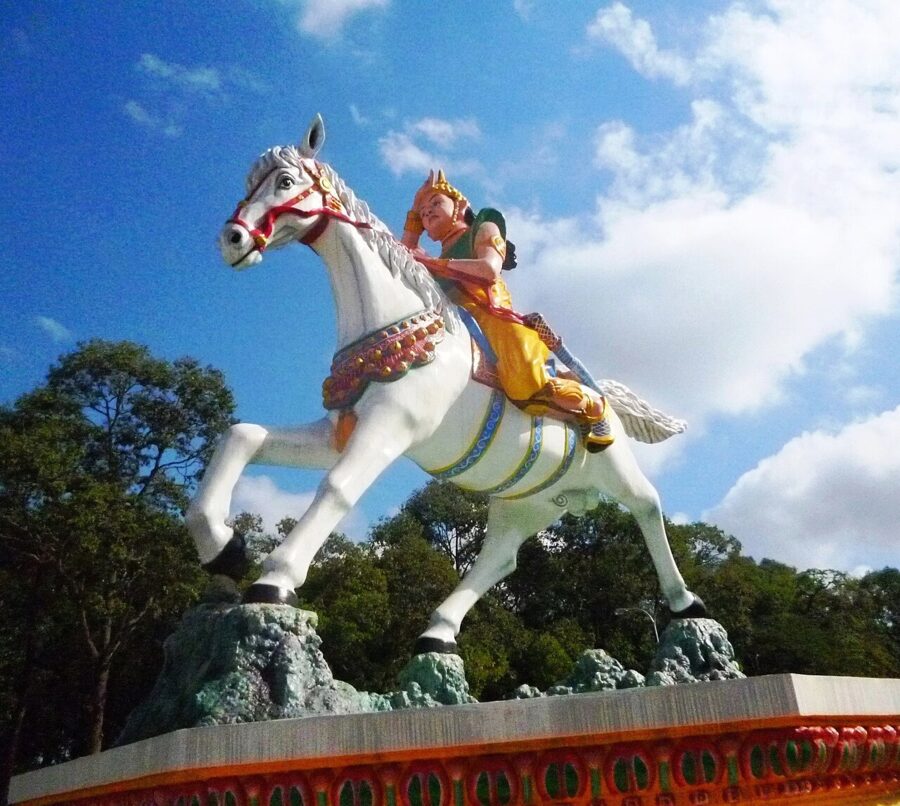
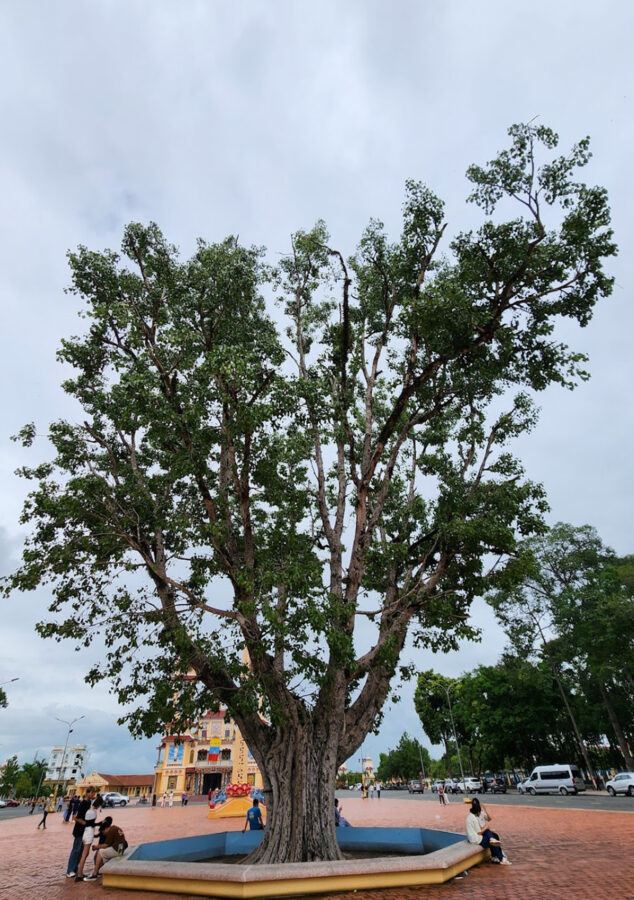
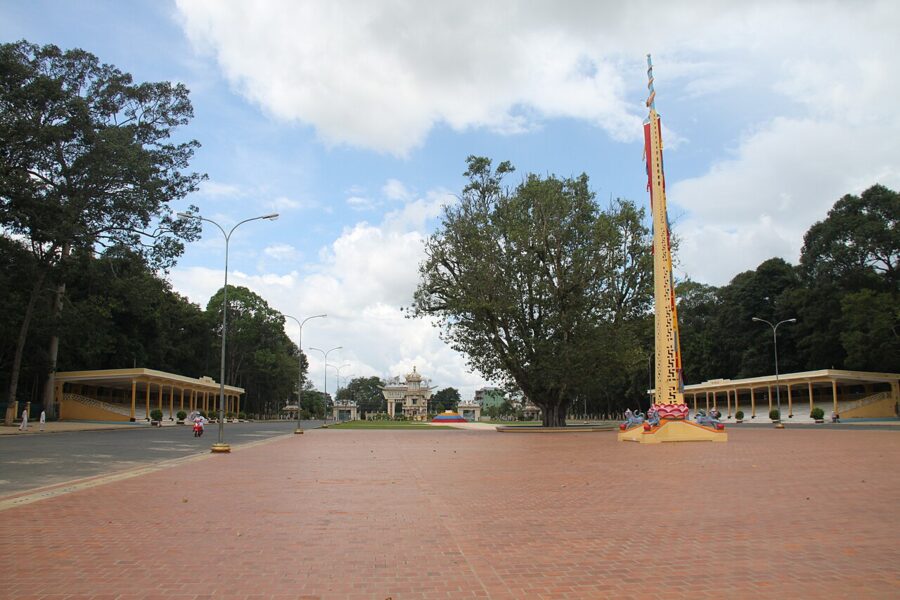
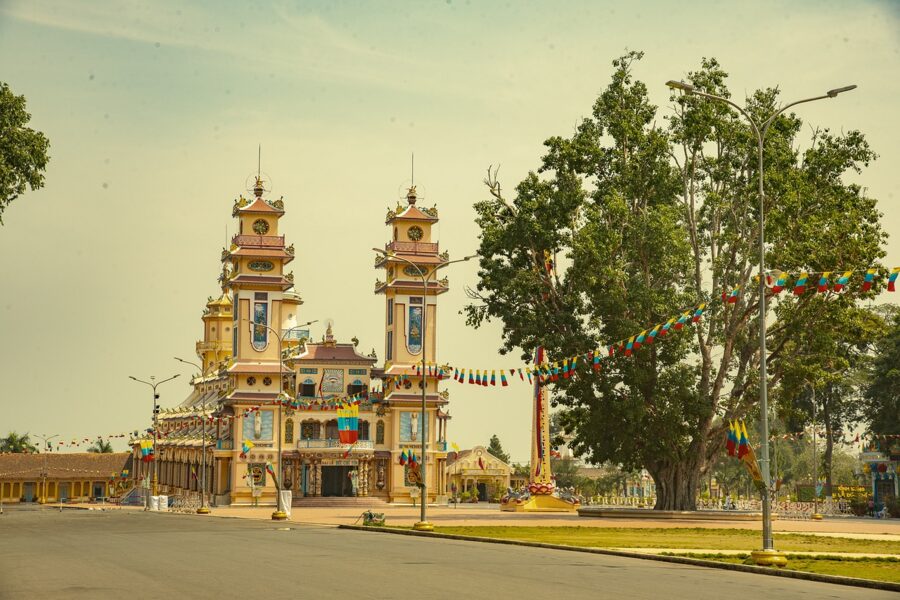
The square in front of the temple, the Đại Đồng Xã, is 300 m long and was laid out for the processions of the two great festivals, with a grandstand down each side. On it stand a statue of Prince Siddhartha riding out on his horse in search of enlightenment, an 18 m flagpole, and a bodhi tree grown from a cutting of the tree at Bodh Gaya, given in 1953 by a Sri Lankan monk.


Built without architects
Work started in 1931, when the first foundations were dug, and stopped for lack of money. It restarted officially in 1933 under Lê Văn Trung and stalled again. In 1936 Phạm Công Tắc took it over with about 500 volunteers who worked without pay, ate vegetarian food and, according to the Holy See’s own history, vowed not to marry until the temple was finished.
The same history says no architect or engineer was involved and no drawings existed: dimensions and details came through séance messages, and Tắc passed them to the builders a section at a time. The plan called for a temple 135 m long and 27 m wide; shortage of funds cut it to the 97.5 m by 22 m that stands today. Some guides quote 140 m by 40 m instead; the smaller figure is the one in the church’s own histories.
The French arrested Tắc in June 1941, exiled him to Madagascar and turned the unfinished temple into a garage and barracks. He came back in 1946, the builders repaired the damage, and the temple was handed over to the church in January 1947. War delayed the formal dedication for eight years, until 1 February 1955, the ninth day of the first lunar month and the feast of the Supreme Being.
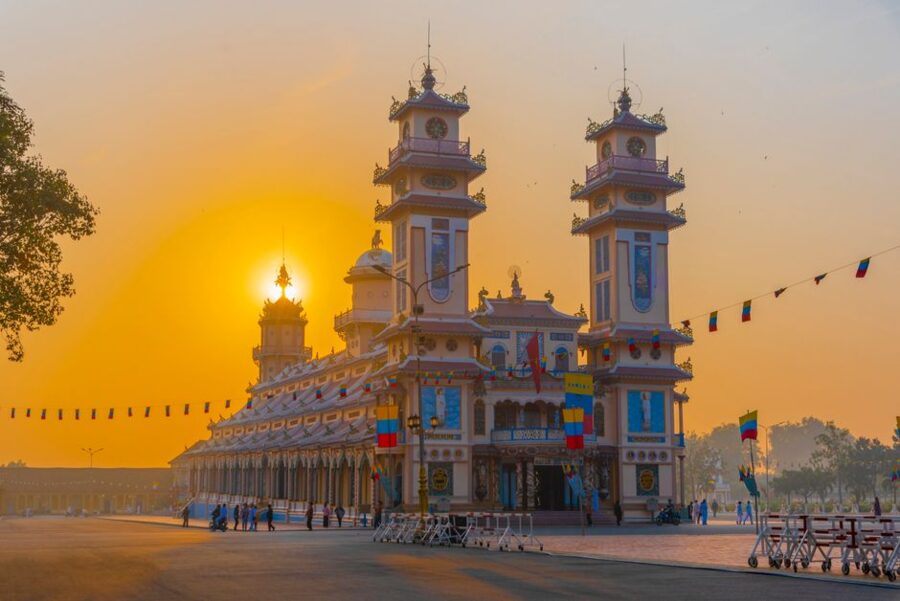
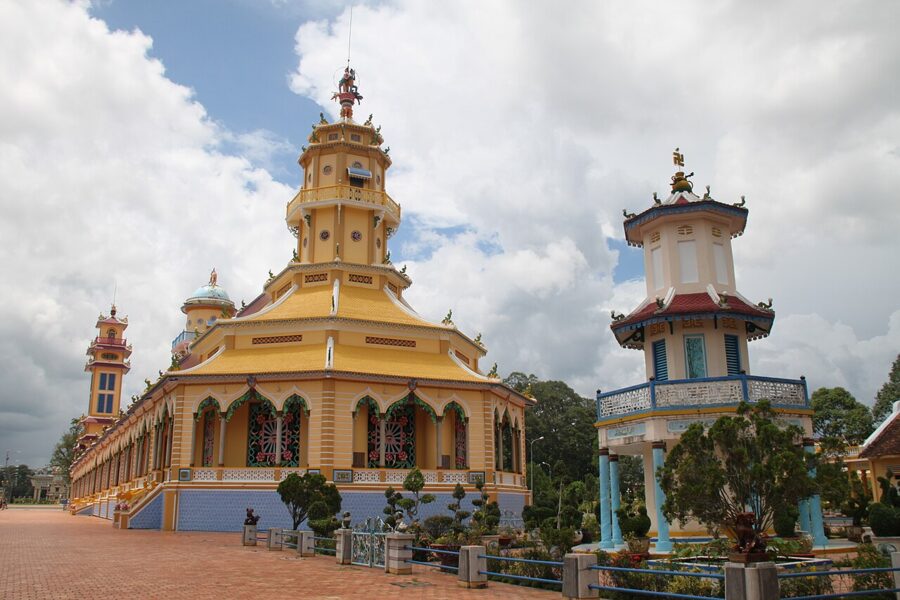
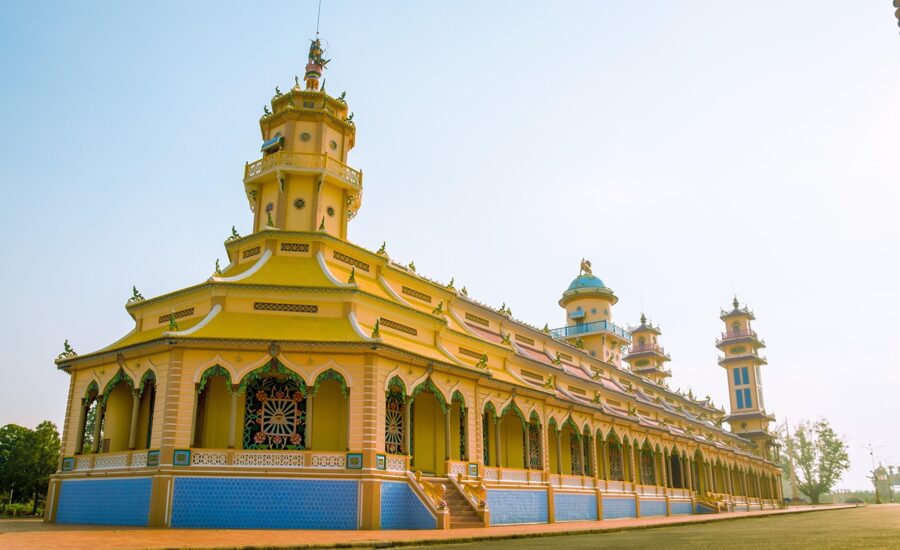
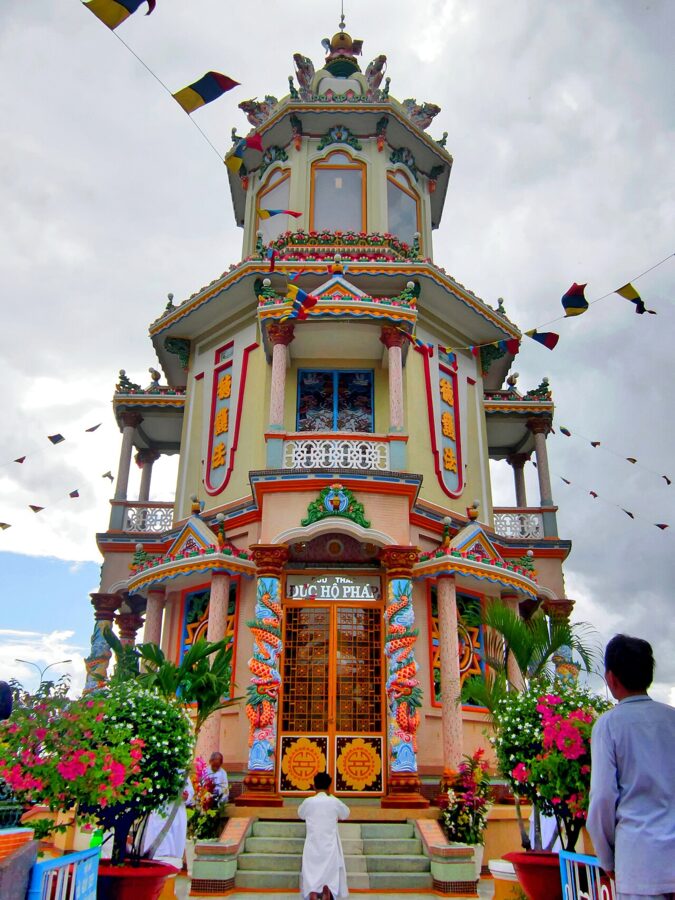
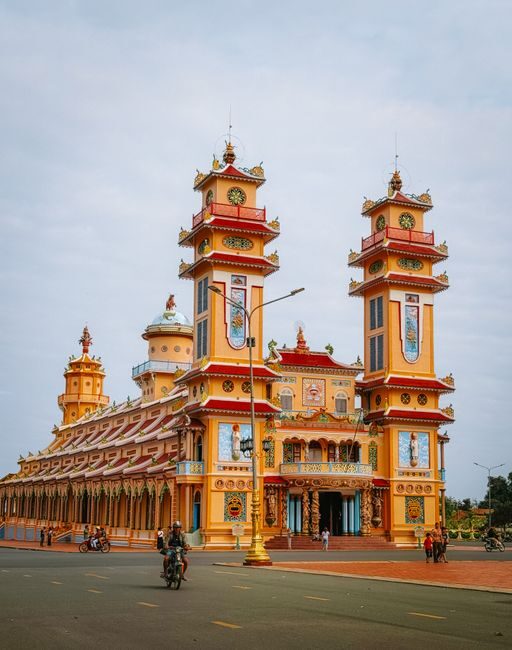
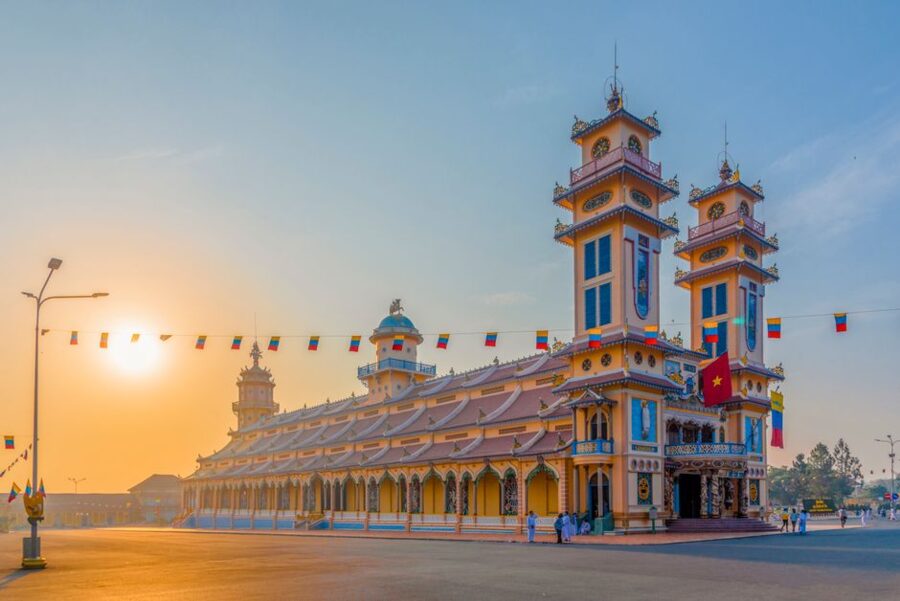
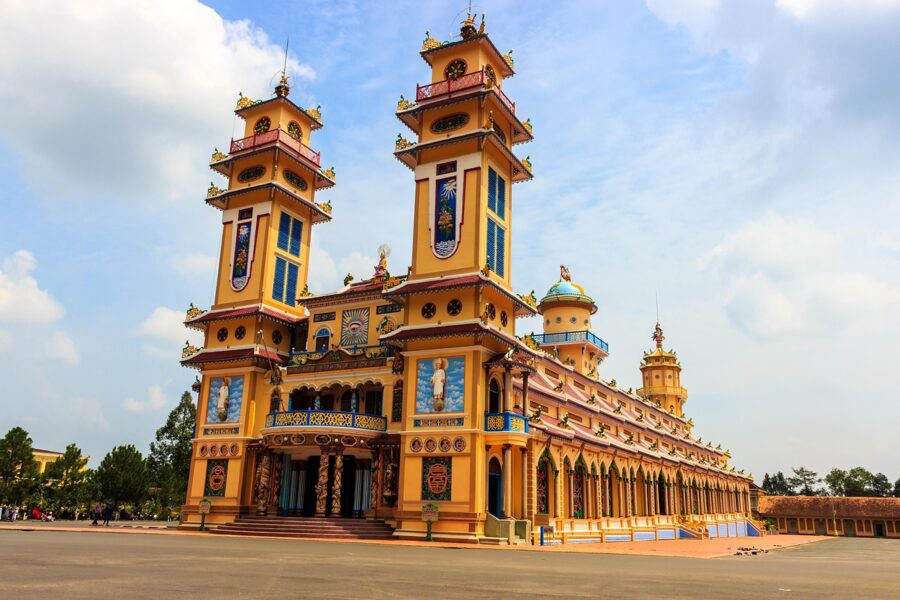
Seen from above, the temple is meant to be a Long Mã, the dragon-horse that carried the first diagrams of creation out of the Yellow River in Chinese legend. Its head is the facade, its horns the two towers, its body the long nave and its tail the octagonal sanctuary at the east end. Inside, the same body divides into three parts, which match the three branches of the church.
Hiệp Thiên Đài: the towers and the guardians
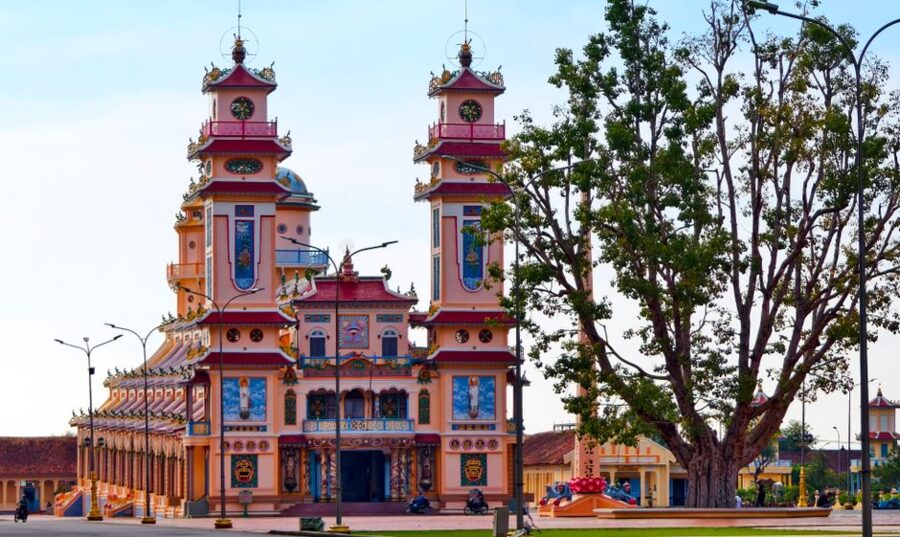
The front section, the Hiệp Thiên Đài, belongs to the branch that speaks with the spirit world and guards the faith’s laws. Its towers are 27 m tall: the bell tower on the left, Bạch Ngọc Chung Đài, carries a statue of Lê Văn Trung, and the drum tower on the right, Lôi Âm Cổ Đài, one of the woman cardinal Lâm Hương Thanh. Above the balcony between them sits Maitreya, the Buddha of the future, on a tiger, for 1926, the Year of the Tiger.
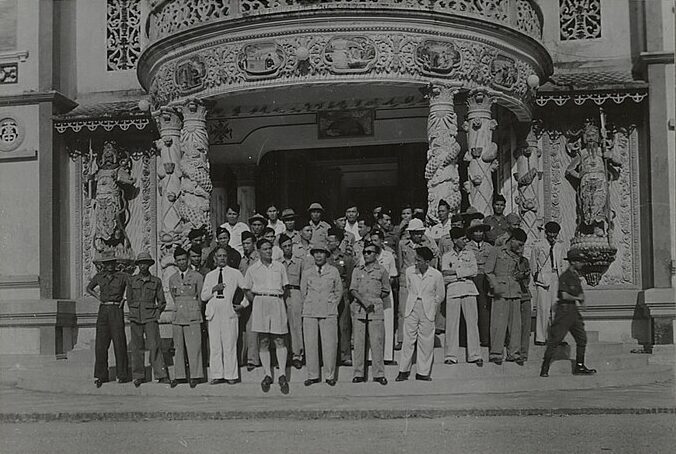
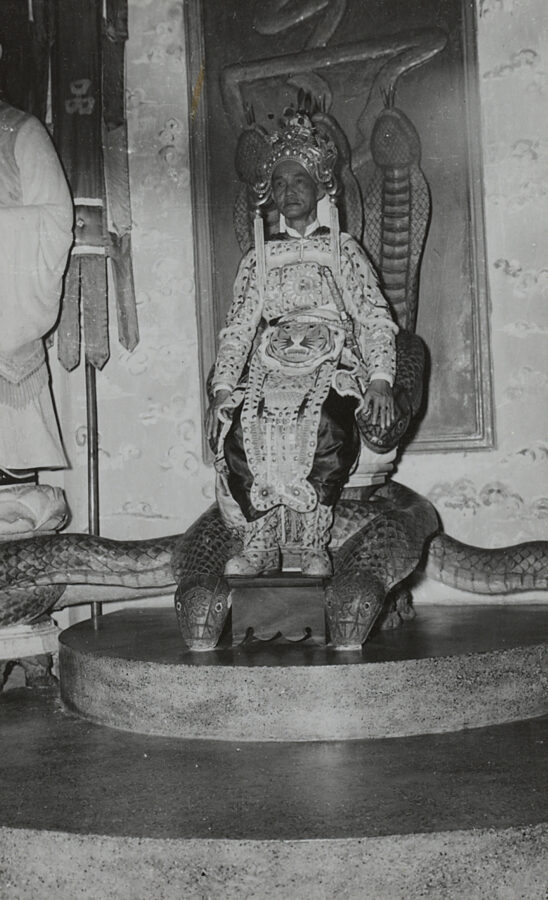
At the door those two guardians face each other: Ông Thiện, armored but mild, holding a halberd, and Ông Ác, the same armor and a scowl. Men enter on the right and women on the left. Just inside, in the entrance hall, is the Three Saints painting, and behind it, looking down the nave toward the altar, stand statues of the three heads of the Hiệp Thiên Đài, Phạm Công Tắc in armor at the center, on a base coiled with a seven-headed serpent whose heads stand for the seven passions.
Cửu Trùng Đài: nine steps and eighteen dragons
The nave, the Cửu Trùng Đài, belongs to the executive branch that runs the church, and its floor rises in nine levels toward the altar, one for each of the nine ranks from student priest up to pope. Each step is 18 cm higher than the last. During a ceremony every dignitary kneels on the level of his or her rank, so the whole hierarchy is laid out in front of you like a diagram.
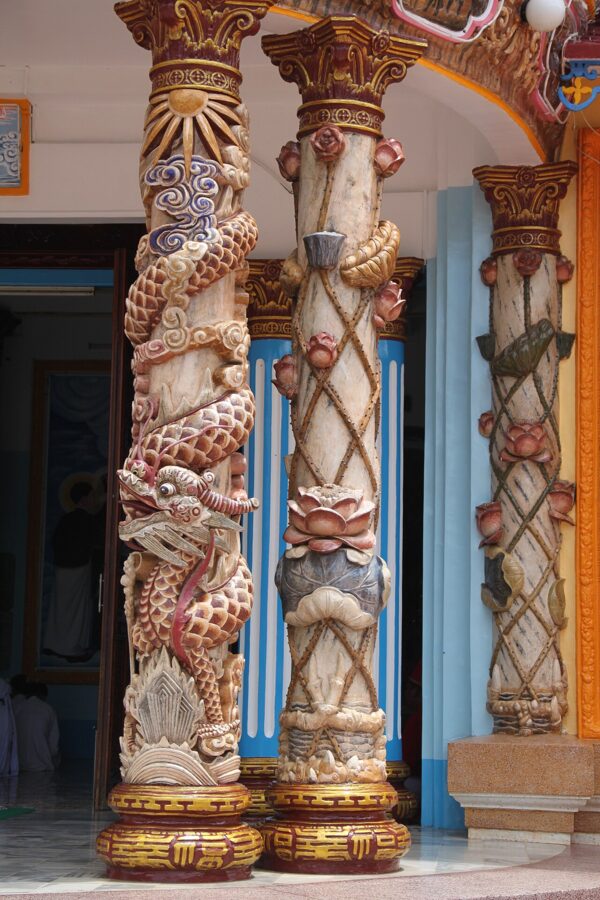
Eighteen columns in two rows split the nave into nine bays, each wrapped by a sculpted dragon. The ceiling is painted as a sky of clouds and stars. Halfway along, at the fifth pair of columns, two small pulpits on spiral stairs serve the dignitaries who conduct the larger services, one calling out the order of the rite and one cueing the musicians with a lotus flower or a set of red lights.
The colors of the robes follow the three teachings. Dignitaries of the Buddhist branch wear yellow, those of the Taoist branch azure, those of the Confucian branch red, and the rank shows in the headdress and the cut. Lay adepts wear white, and so do women dignitaries. At the top of the nave stand seven gilded thrones: the highest, carved with dragons, for the pope; three carved with phoenixes for the censor cardinals (chưởng pháp); three with unicorns for the cardinals (đầu sư).
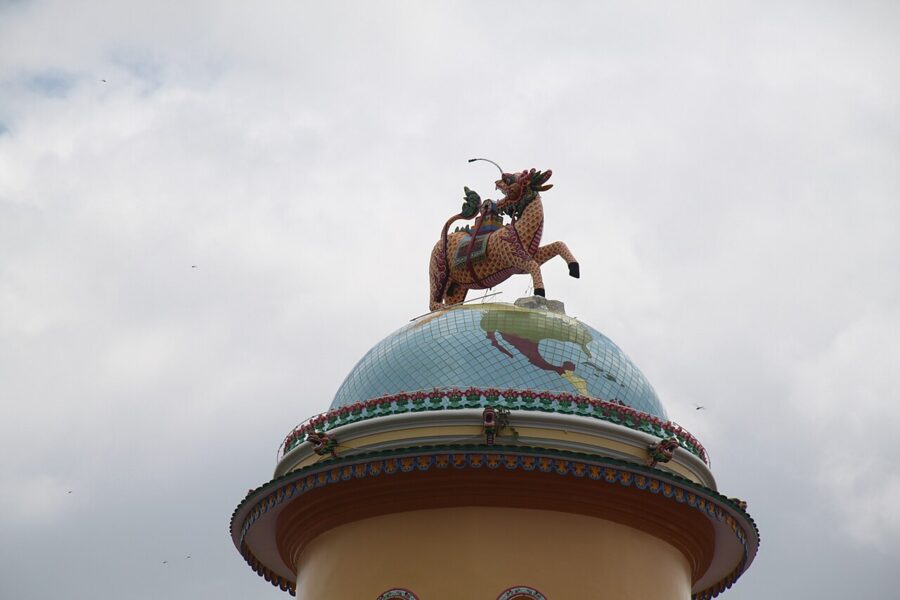
The pope’s throne has been empty since 1934. After Lê Văn Trung died, the church held that only a spirit message could name his successor, and the spirit Lý Thái Bạch, the Tang poet Li Bai, is regarded as the faith’s invisible pope. Above the end of the nave, the dome of the Cung Đạo is carved with the tools of the séance: the planchette, the alphabet board and a three-legged table.

Bát Quái Đài and the globe
The east end, the Bát Quái Đài, is the sanctuary of the invisible: an octagon with eight dragon columns, a twelve-step platform for the twelve heavens and, on top of it, the Càn Khôn globe. The sphere is 3.3 m across, painted sky blue, with the Divine Eye placed over the North Star and 3,072 painted stars around it for the worlds of Cao Đài cosmology. A lamp burns inside it day and night.
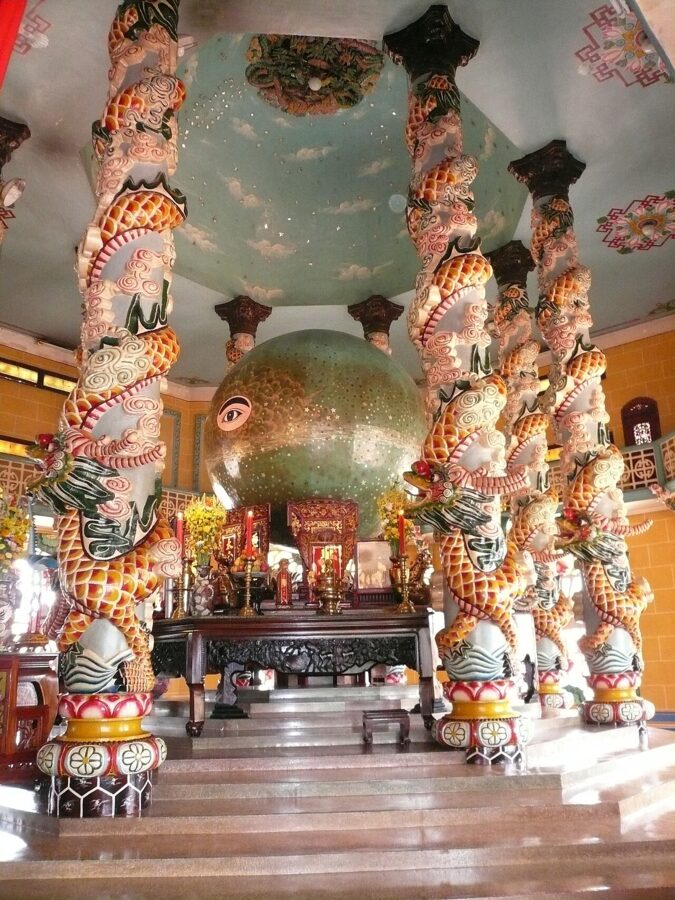

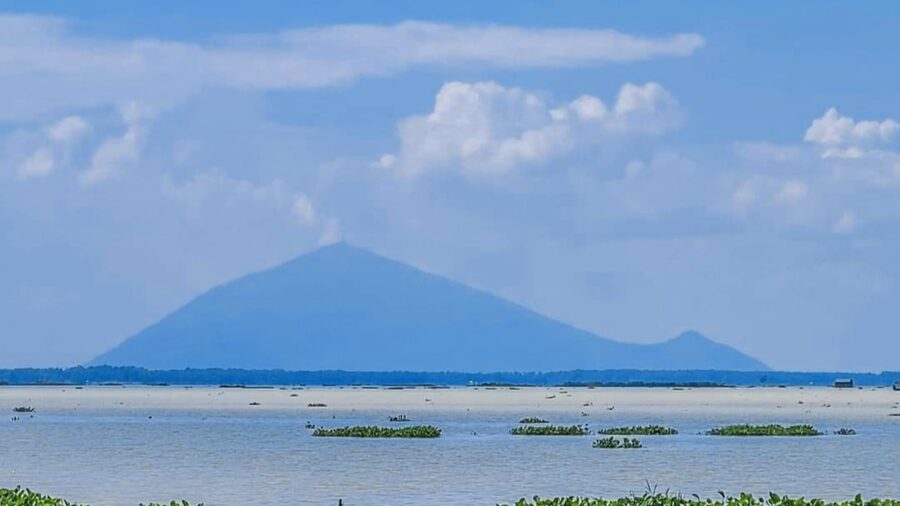
From outside, the sanctuary is the yellow octagonal tower at the back, about 36 m high. It points east, toward Bà Đen Mountain on the horizon, while the facade looks west over the open plain.
Watching a ceremony
The Holy See keeps four services a day, at midnight, 6am, noon and 6pm, the hours of Tý, Mẹo, Ngọ and Dậu. Each lasts roughly 30 to 45 minutes. Visitors watch from the upper gallery that runs along the sides of the nave, and stewards in white will point you to the stairs and tell you where you may stand.
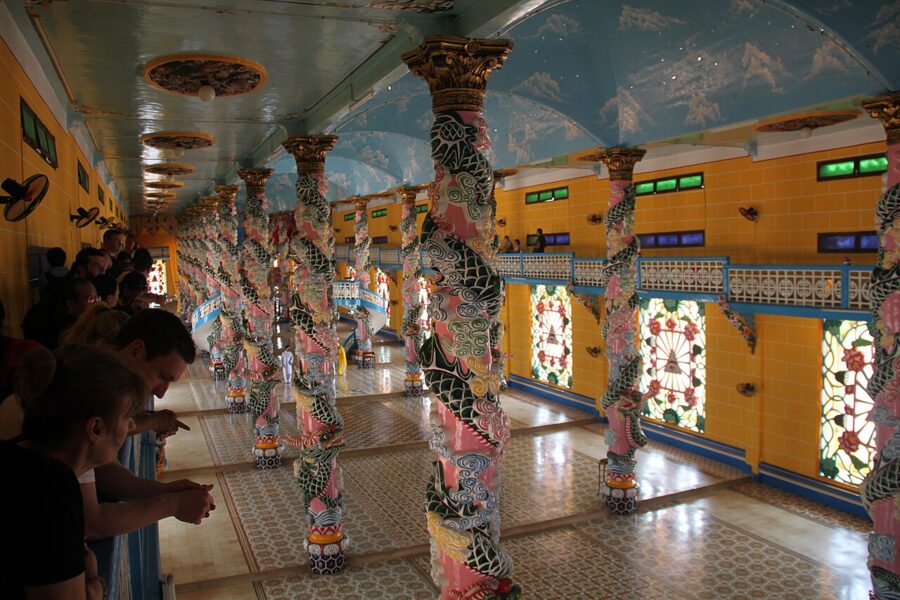
The noon service is the one tour buses aim for, and between about 11am and 12:45pm the gallery gets crowded. Arrive by 11:20 to find a place at the rail. The 6am and 6pm services draw far fewer outsiders, and the midnight service is attended almost only by the faithful.
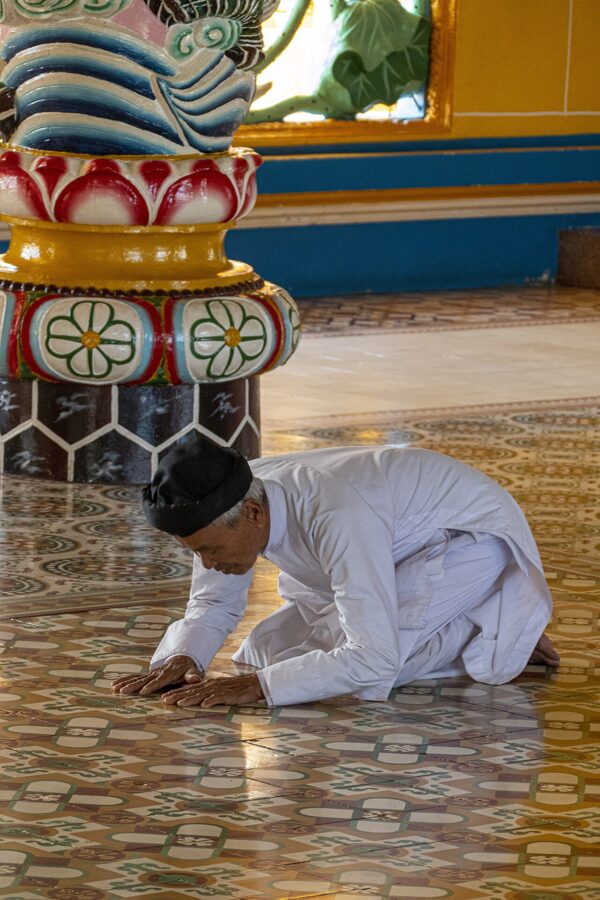
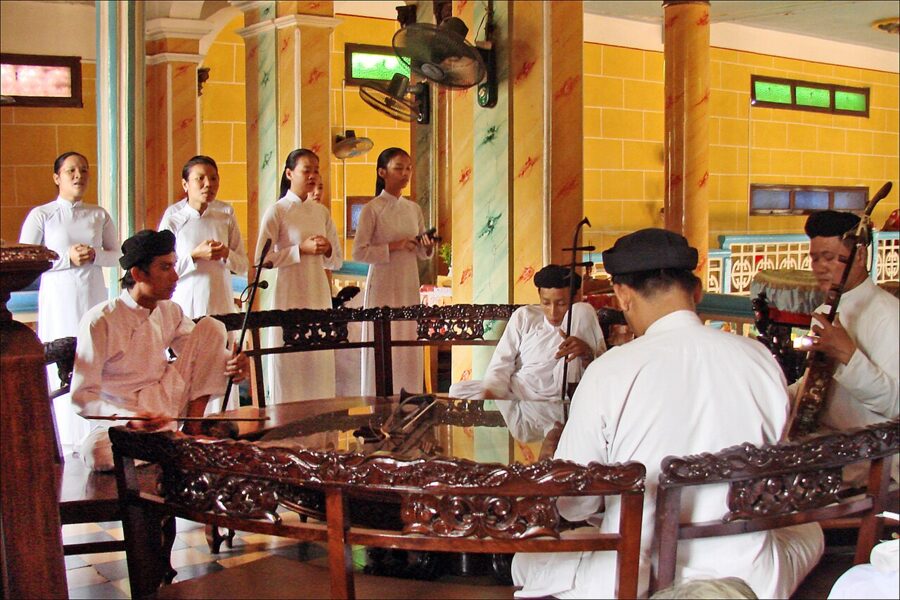
What you see follows a fixed order. The music starts on the floor above the entrance, where the orchestra plays traditional instruments and a choir of young singers, the đồng nhi, chants the prayers in a high, carrying unison. The adepts enter in lines, men on the right and women on the left, and kneel in rows by rank; offerings of flowers, wine and tea, standing for the essence, energy and spirit of the body, are made at the altar; prayers to God and to the founders of the three teachings are chanted and the congregation bows to the floor together. A gong closes it.
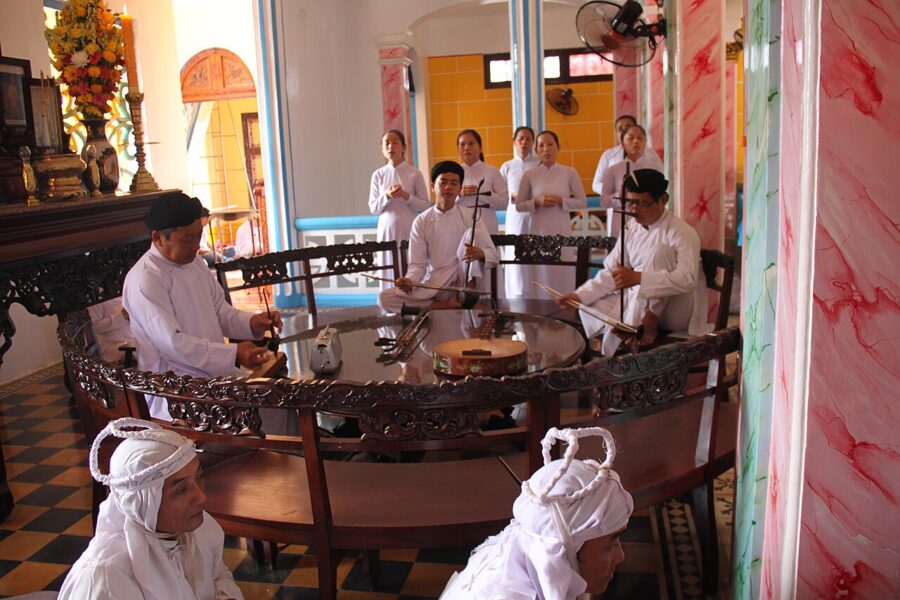
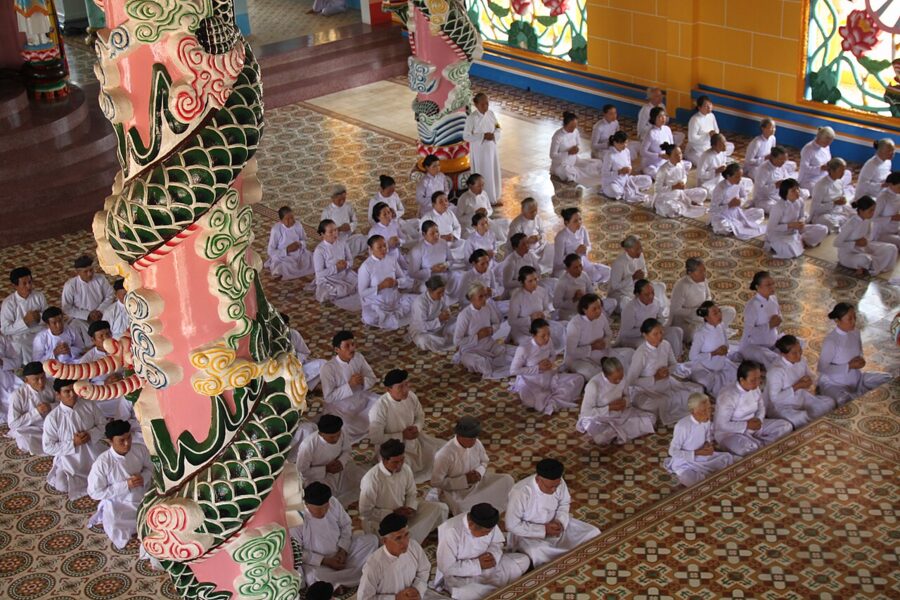
The rules are those of any working place of worship. Take off your shoes at the steps (a bag for them helps), cover shoulders and knees, take off your hat, and keep quiet. Stay off the central aisle, which belongs to the dignitaries’ procession, and photograph the building freely but without flash, and never in the faces of people at prayer. The general dos and don’ts for Vietnamese temples cover the rest.


After the service, when the floor clears, you can usually walk slowly along the side aisles at ground level to see the columns and the globe more closely. Ask a steward first; the rules change for festivals and special services. Allow about two hours for the visit as a whole: time on the square, the service, the aisles and a walk around the outside.
Priests, popes and an army
No Vietnamese religion was more tangled up in politics. By the late 1930s the Holy See ran a network of temples across the south and in Cambodia, and the French, then under the Vichy government, suspected Phạm Công Tắc of sympathy for Japan. In June 1941 they arrested him and five other dignitaries and shipped them to Madagascar.
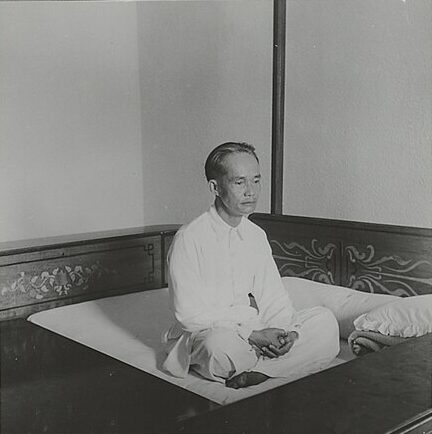
In his absence Trần Quang Vinh, working in Phnom Penh, accepted Japanese support and training and formed an armed Cao Đài militia. It took part in the Japanese coup against the French in March 1945. After the Japanese surrender it fought alongside the Việt Minh for a time, then turned against them after a series of killings of Cao Đài clergy and villagers that the church still commemorates. In 1946 Vinh, captured by the French, signed a truce that brought the exiles home, and for the rest of the war against France the Cao Đài army held large parts of the south as a French ally.
The army was never a single force. In 1951 its chief of staff, Trình Minh Thế, broke away with his troops, set up a base on Bà Đen Mountain and fought the French and the Việt Minh alike; he was killed in Saigon in May 1955. American officials courted him, and many readers think he was the model for General Thé in The Quiet American.
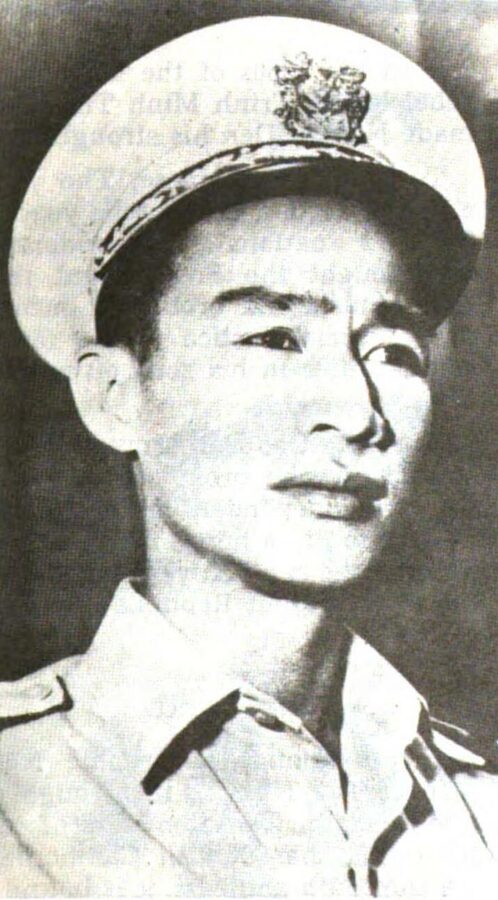
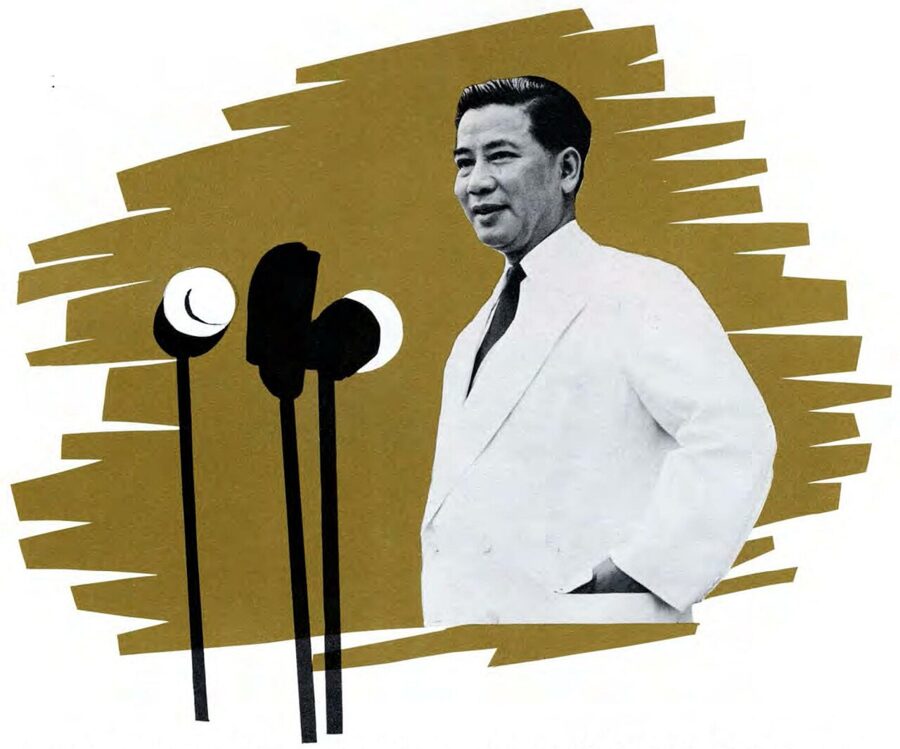
The end of the Holy See’s political power came from Saigon. Ngô Đình Diệm, prime minister and then president, set out to absorb the sect armies into the national army. In March 1955 the Cao Đài, the Hòa Hảo and the Bình Xuyên formed a united front against him with Tắc as its chairman, and lost. In October 1955 Diệm sent the Cao Đài general Nguyễn Thành Phương into the Holy See itself, where some 300 of the pope’s guards were disarmed.
On 16 February 1956, at three in the morning, Tắc left the Holy See and crossed into Cambodia along Route 22. From Phnom Penh he published a call for peaceful coexistence between North and South. He died there on 17 May 1959 and was buried under the protection of King Sihanouk, on the understanding that he would go home when Vietnam was united and at peace.

After 1975 the church had to account for its record. Followers had fought on both sides: the Holy See’s own forces had been anti-communist, while a separate Cao Đài National Salvation movement had backed the Việt Minh and later the National Liberation Front. According to figures compiled by the historian Sergei Blagov, the new government took over 40 of the 46 buildings at Tây Ninh and arrested 1,291 religious leaders; 39 were killed in clashes and nine sentenced to death. Séances were banned and the church’s activities placed under close state supervision.
Legal recognition came back in 1997, and the Holy See now works under a management council approved by the state. Spirit messages are still not used to promote clergy, so the higher ranks have thinned out over the decades. The faith’s centenary in November 2026 was marked with official visits and anniversary rites, and the church today describes its course with the motto “Nước vinh, Đạo sáng”, roughly, the nation glorious and the faith shining.
Festivals, and the days to choose
Twice a year the precinct fills. The Đại Lễ Đức Chí Tôn, the feast of the Supreme Being, falls on the ninth day of the first lunar month, a week after Tết; in 2026 the festival ran from 24 February to 4 March, with exhibition stalls on the square, unicorn and dragon-horse dances and a dragon made of incense sticks. The Hội Yến Diêu Trì Cung, the banquet for the Mother Goddess and her nine fairies, falls on the full moon of the eighth lunar month, the same night as the mid-autumn festival.
The September festival is the bigger spectacle. On 25 September 2026 nearly 200,000 people came for it. The highlight is the evening procession of the flower carriage of the Mother Goddess from her temple, the Báo Ân Từ, to the Holy See, with dragon, unicorn, tortoise and phoenix dances; congregations display offerings sculpted from fruit and vegetables, which go to children for the mid-autumn holiday afterward.
If you want spectacle, go on one of these days and expect heavy traffic, full buses and no space at the rail. If you want to see the building and the daily rite clearly, avoid them, and avoid Tết as well; the festival schedule for the first lunar month is crowded with special rites, and some visitor guides report daily ceremonies suspended for part of the holiday, which the Holy See’s own schedule does not confirm. Weekday services outside festival weeks are the calmest.
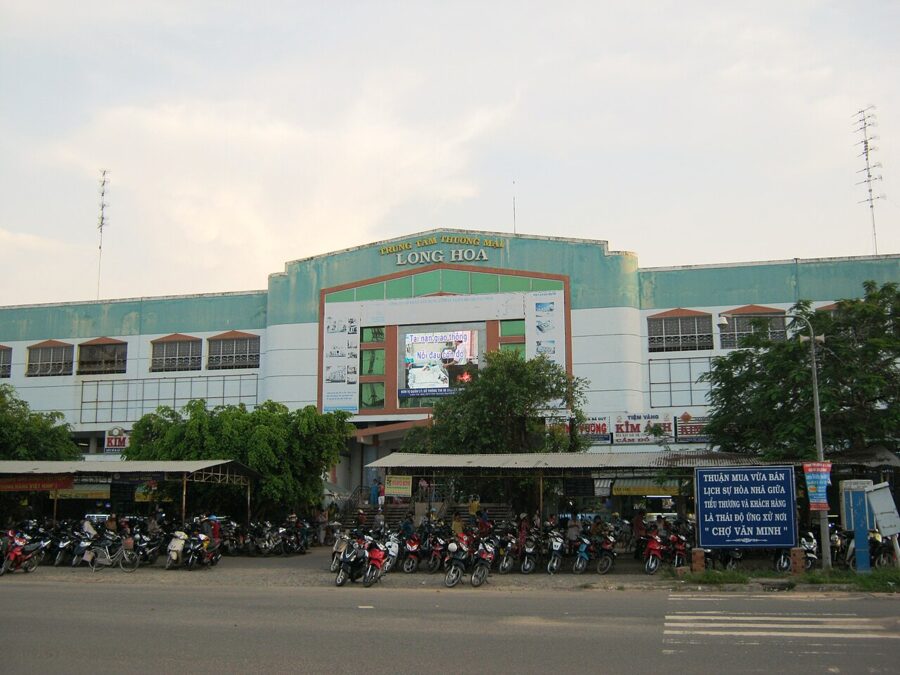

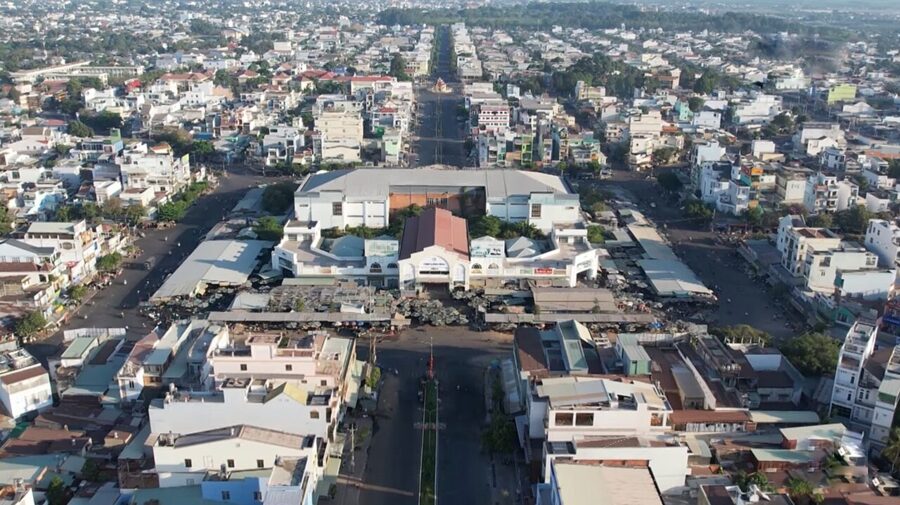
The area around the precinct has one of the highest shares of vegetarians in Vietnam, so a meatless lunch near Long Hoa market is easy to find. Bà Đen Mountain, the cable cars and the rest of Tây Ninh province are a separate trip; the mountain is about 10 km from the temple.

Getting there from Saigon
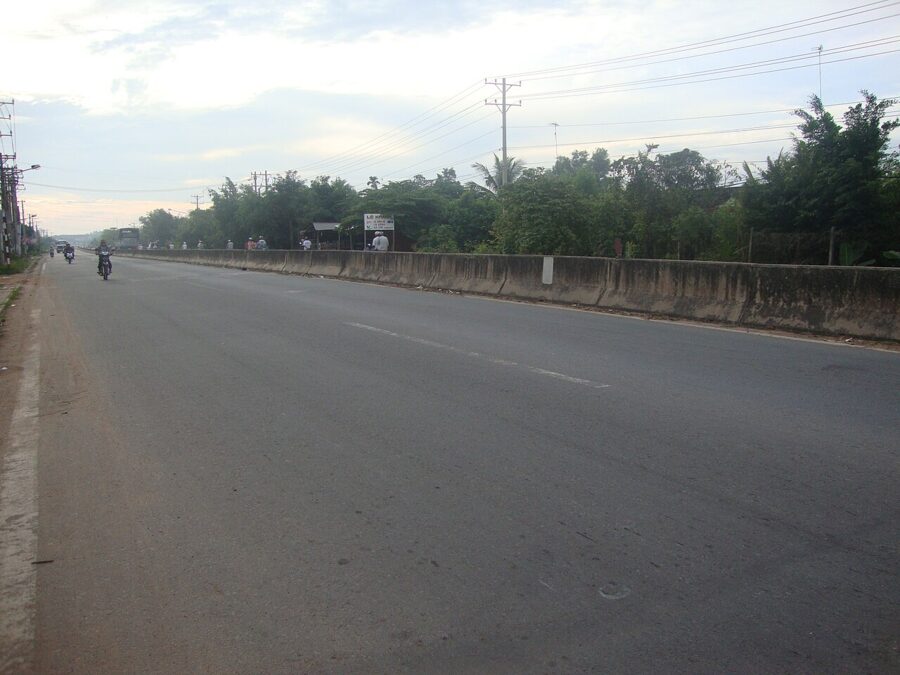
The Holy See is on Phạm Hộ Pháp avenue, Long Hoa ward, Tây Ninh province (formerly Hòa Thành town). Maps and drivers may still use the old names after the 2025 reorganization, so the safest instruction is simply “Tòa Thánh Tây Ninh”. From central Ho Chi Minh City the road runs northwest on National Route 22 through Củ Chi and Trảng Bàng, then north on Route 22B to Tây Ninh, about 90 to 100 km in all.
| Option | Time each way | Cost (late 2026) | Notes |
|---|---|---|---|
| Bus or limousine van | 2.5 to 3 hours | 120,000-200,000₫ (about US$5-8) | Most terminate at Tây Ninh bus station; confirm the drop-off. A Grab from there is 50,000-80,000₫ (US$2-3), 10 to 15 minutes. |
| Grab car, one way | 2.5 to 3 hours | 900,000-1,400,000₫ (about US$35-55) | Drops you at the gate; finding a car back is harder. |
| Private car with driver | Full day | 1,800,000-2,800,000₫ (about US$70-105) | The easiest way to add Củ Chi or Bà Đen. |
| Group tour | Full day | Varies | Usually the noon ceremony plus Củ Chi. |
| Motorbike | 3 to 4 hours | Fuel | Route 22 carries heavy trucks; experienced riders only. |
Fares and times come from prices published in late 2026 and shift with operators and traffic; rush hour at the city’s edge adds time. Entry to the precinct is free, with donations optional; parking costs about 5,000₫ for a motorbike and 20,000-30,000₫ for a car. No official opening hours are published: the grounds are open from early morning into the evening, and entry to the temple itself follows the ceremony schedule and the stewards.

One day, with Củ Chi
Leave Saigon by 8am and you reach Tây Ninh around 10:45, with time for the square, the Siddhartha statue and a walk around the outside before taking your place in the gallery at 11:20. After the noon service and a vegetarian lunch near Long Hoa, drive back toward the city and stop at the Củ Chi Tunnels, about an hour and a half away, for the afternoon. You are back in Saigon in the early evening, tired.
Two days, with the quiet services
Arrive for the noon service, spend the afternoon on the grounds and at the market, and watch the 6pm service, which tour groups rarely attend. Sleep in the old center of Tây Ninh, now Tân Ninh ward, about 5 km away, where there is a choice of mid-range hotels.

Go back for the 6am service, then spend the rest of the morning on Bà Đen Mountain before the heat builds, and stop at Củ Chi on the way back to Saigon.
When to go
The dry season, roughly December to April, gives the clearest skies and the best light for the facade. From May to November the pattern follows Saigon’s weather: hot mornings and heavy afternoon storms, which can make the 6pm service a wet one. The noon service is the hottest time to be outside at any season; bring water and a hat for the square, and remember the hat comes off at the door.
| Before you go | |
|---|---|
| Address | Tòa Thánh Tây Ninh, Phạm Hộ Pháp avenue, Long Hoa ward, Tây Ninh province (formerly Hòa Thành town) |
| Ceremonies | Daily at 12am, 6am, 12pm and 6pm; about 30 to 45 minutes each |
| Entry | Free; donations optional |
| Grounds | Early morning to evening; no official hours published |
| Dress | Shoulders and knees covered; shoes and hats off inside |
| Busiest | Noon service (11am to 12:45pm); the ninth day of the first lunar month; the full moon of the eighth lunar month |
When the noon service ends, the gong sounds again, the rows rise and turn, and the white lines file back out the way they came in, men to the right and women to the left. The gallery empties fast as the buses call. Stay at the rail for five more minutes, until the floor is bare again and the only thing still facing you is the eye on the globe.