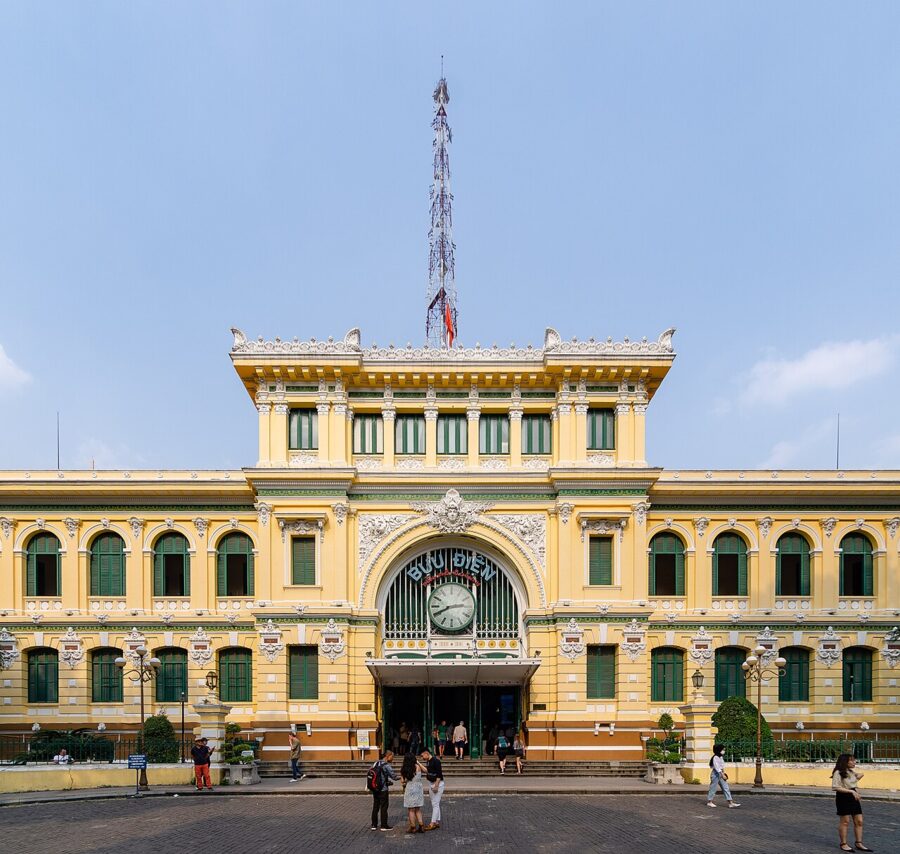
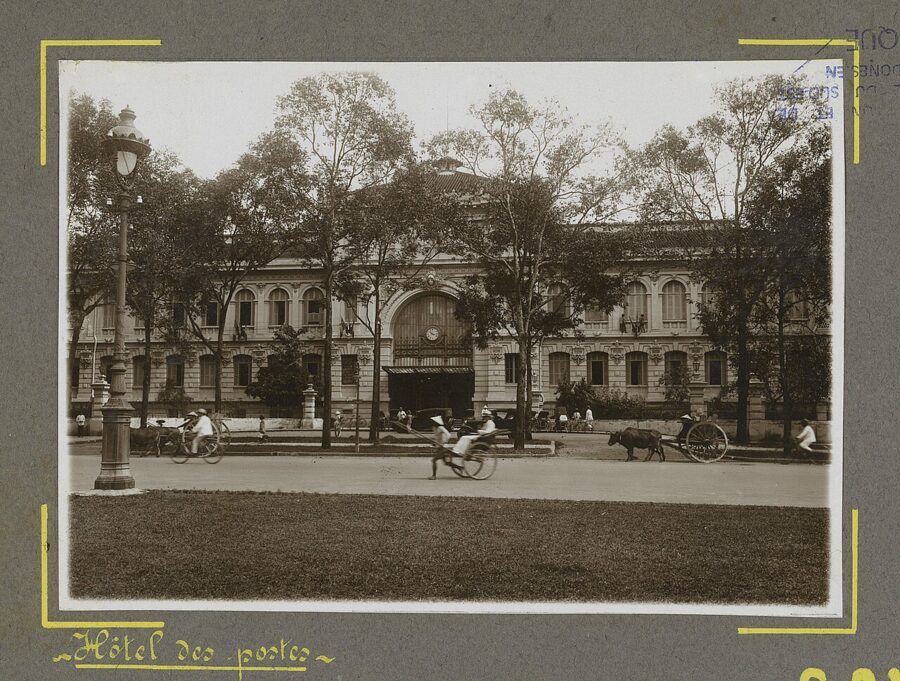
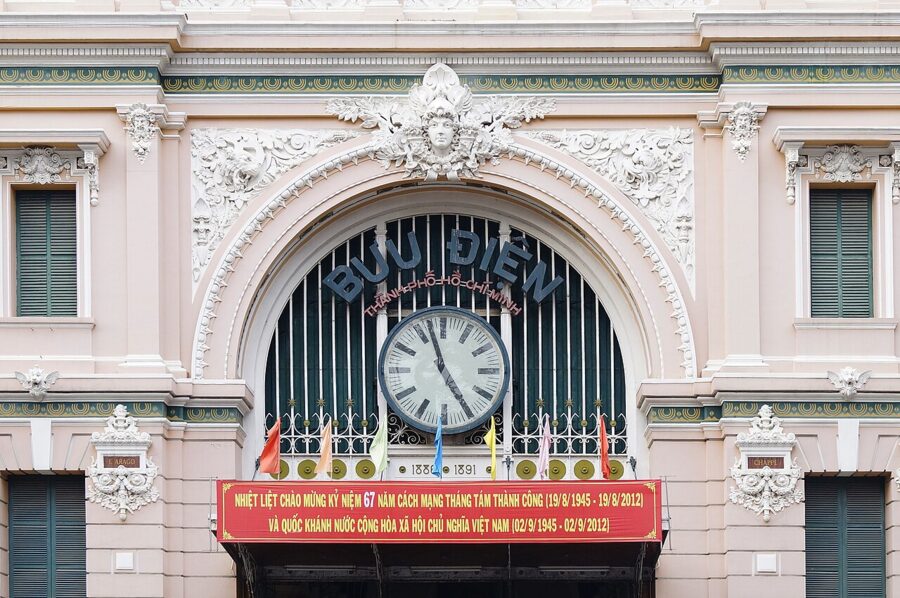
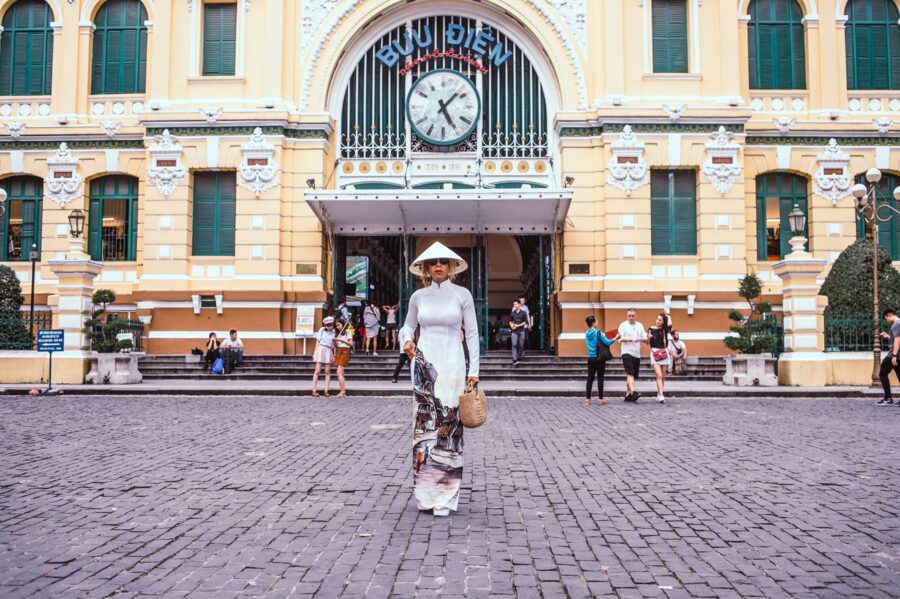
Just below the clock over the main door of the Saigon Central Post Office (Bưu điện Trung tâm Sài Gòn), two dates are set into the arch: 1886 and 1891. Most people photograph the clock and miss them. They mark the five years it took the French colony of Cochinchina to raise a post and telegraph office big enough to stand up to the Notre-Dame Cathedral (Nhà thờ Đức Bà) across the square. More than 130 years later it is still doing the job it was built for.
Behind the wooden counters, staff of the city post office sell stamps, weigh parcels and handle money transfers. In October 2025 the supervisor of the counters told a reporter that the hall serves 700 to 800 customers a day, most of them foreign visitors writing postcards home. Entry is free. A working office inside a building that looks like a monument is the whole appeal, and it deserves more than the twenty minutes a tour bus usually allows.
The word over the door is simply Bưu điện, “post office”. The official address is 2 Công xã Paris, in Sài Gòn ward since the July 2025 reorganisation of the city (District 1 on older maps and on most signs). In Vietnamese it is usually Bưu điện Thành phố, the City Post Office, and that is the name to type into Grab.
On this page
A post office built like a railway station
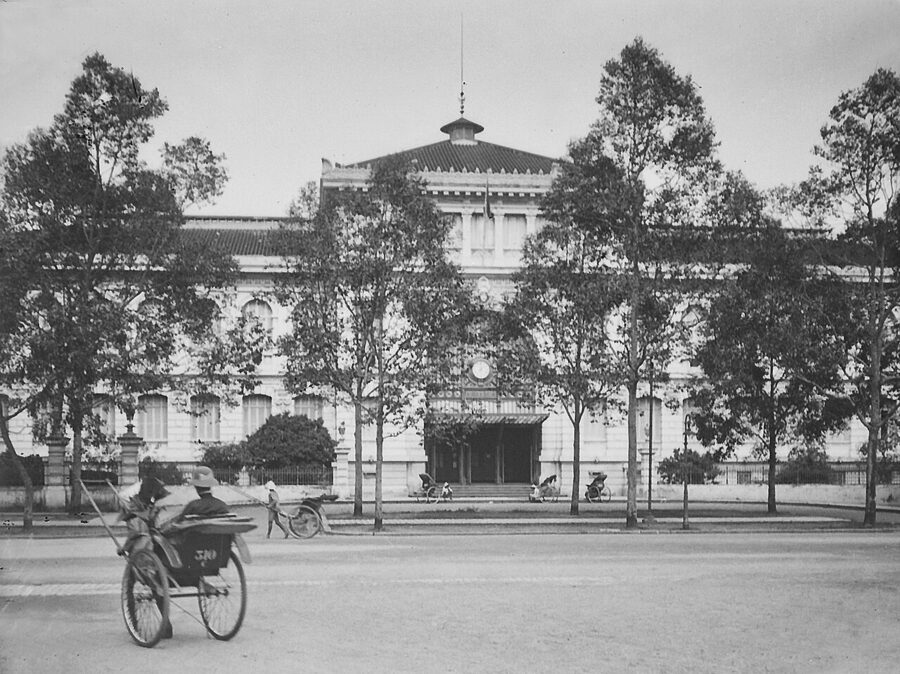
Saigon in the 1880s was a young colonial capital. French forces took the citadel in 1859, the three eastern provinces of the south were ceded in 1862, and by 1867 all of Cochinchina was a French colony governed from here. A grid of boulevards was laid over the old town of Gia Định, and what held the colony together was the mail and the telegraph wire.
The colony’s first post office was inaugurated by Admiral Bonard on 13 January 1863, at first only for the administration. It took letters from the public from 1 January 1864, and the first stamps went on sale that year; Saigoners called a stamp con cò, “the stork”. The network spread quickly: a telegraph line of about 2,000 kilometers from Saigon to Hanoi, through Quy Nhơn, Đà Nẵng, Huế and Vinh, was finished on 22 March 1888. A line to Bangkok followed in 1889, and Saigon’s first telephones came into use on 1 July 1894.
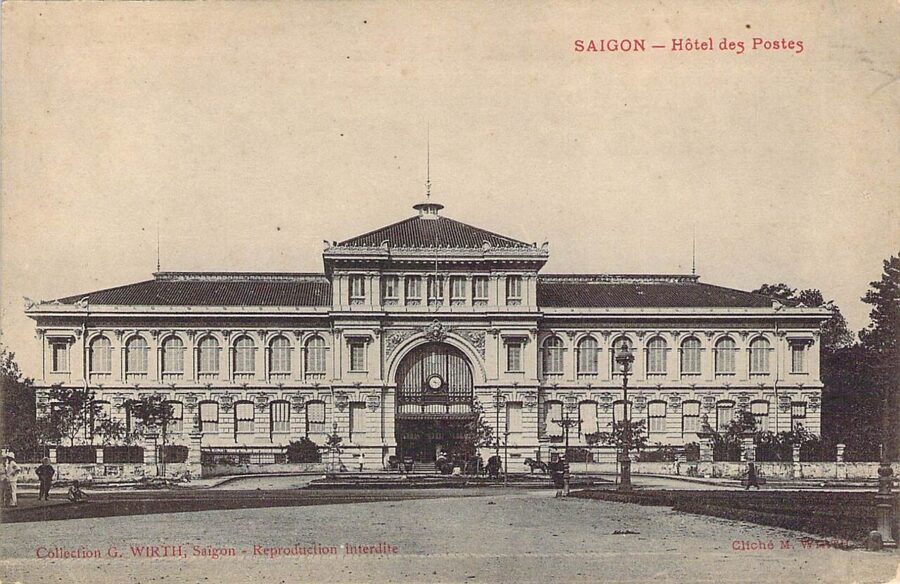
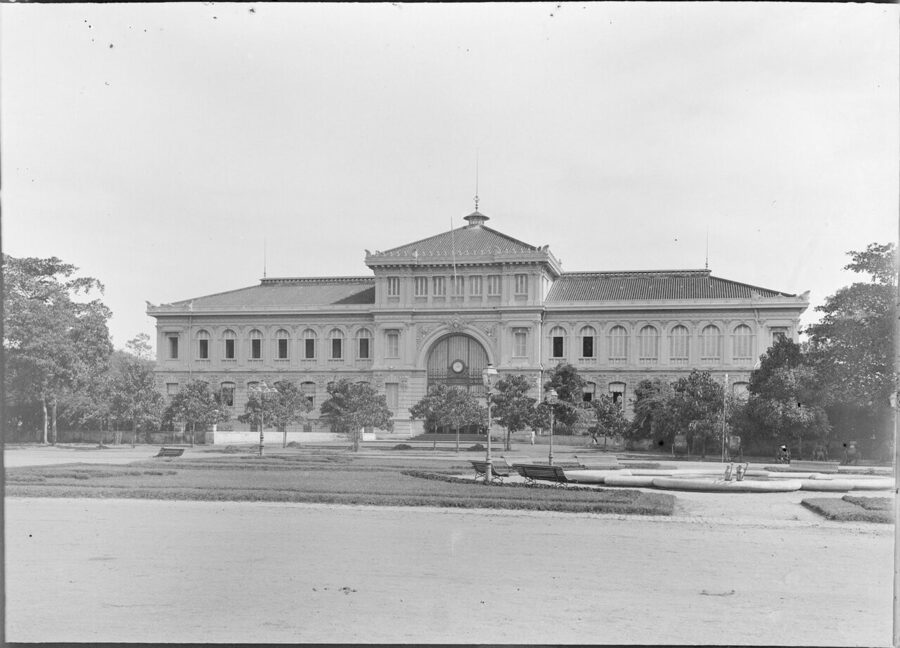
A service on that scale needed a headquarters. Work started in 1886 on the site of the former headquarters of the colony’s troop commander, beside the top of rue Catinat (today Đồng Khởi). A colonial council budget of 1887 set aside 40,000 piastres to finish the Hôtel des Postes et des Télégraphes, and noted that its great iron roof frame was still being made in France, to be shipped out and assembled on site.
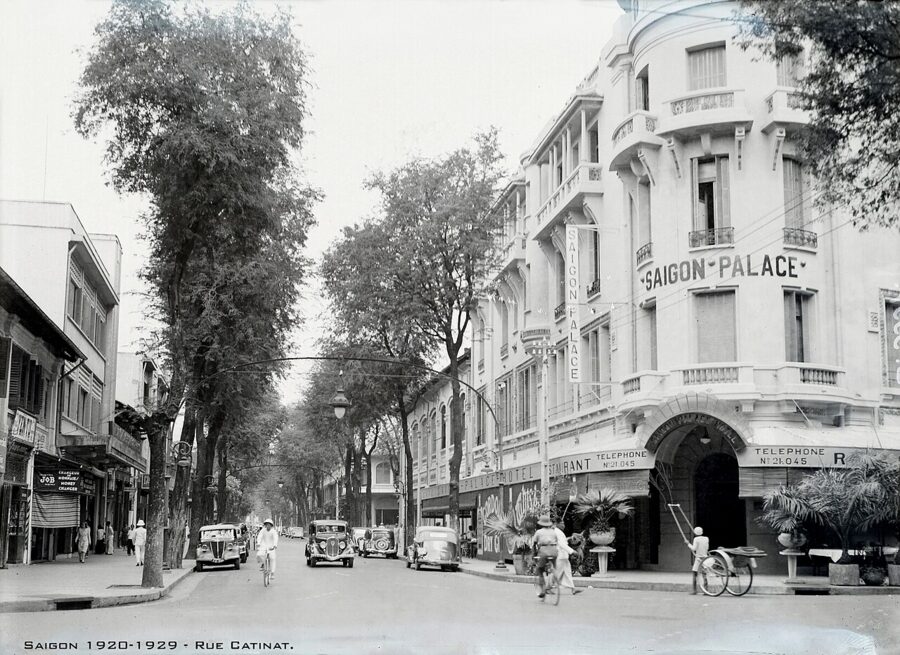
The model was the European railway station: a long, top-lit hall under a barrel vault, with iron columns carrying the load so the floor could stay open for crowds. That is why the interior feels less like a government office than a terminus waiting for a train. A Paris architecture journal reported the inauguration in September 1891, noting that it had been held back until the Governor General returned to Saigon.
Foulhoux, not Eiffel
Ask in the square who designed the building and the answer will often be Gustave Eiffel. He didn’t. Eiffel’s company did work in Cochinchina between 1872 and 1889, but the historian Tim Doling, who has been through the colonial council records and the French press of the period, found no mention of it in connection with the post office. The iron frame isn’t on Eiffel’s own list of metal structures either.
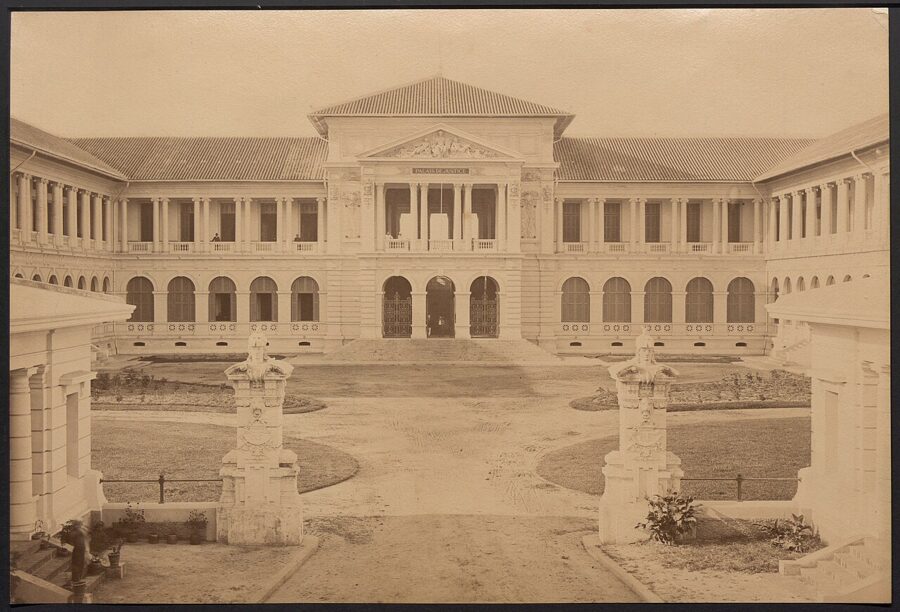
The sources written at the time name one man. In February 1888 the Paris daily Le Temps reported that the colony’s chief architect was building a superb post office in Saigon, and the 1891 journal notice gave him the credit by name. Marie-Alfred Foulhoux, born in Mauzun in the Auvergne in 1840 and trained at the École des Beaux-Arts, came to Saigon in 1874 and became chief architect of the colony in 1879. His Palais de Justice still stands on Nam Kỳ Khởi Nghĩa street.
The post office was his last building. Foulhoux died in Saigon after a short illness on 20 January 1892, aged 52, and was buried in the old cemetery on rue Massiges, which the city cleared in 1983 to make Lê Văn Tám Park. No grave marks him now. He lost the race for mayor of Saigon in 1890, the year he was made an officer of the Légion d’honneur, and he was a keen hunter.

So where did Eiffel come from? Doling traces the story to a 1990 guidance note from the city’s foreign affairs department to tourism agencies, which credited Eiffel with designing and directing the construction. A second version, giving the plans to Auguste-Henri Vildieu with Foulhoux as his assistant, appeared in a French anniversary book in 1998; Vildieu was a junior architect at the time, and the book’s editors later accepted the credit was probably wrong. Both versions still turn up in Vietnamese newspapers, so don’t be surprised to read three architects’ names in one afternoon.
Reading the façade
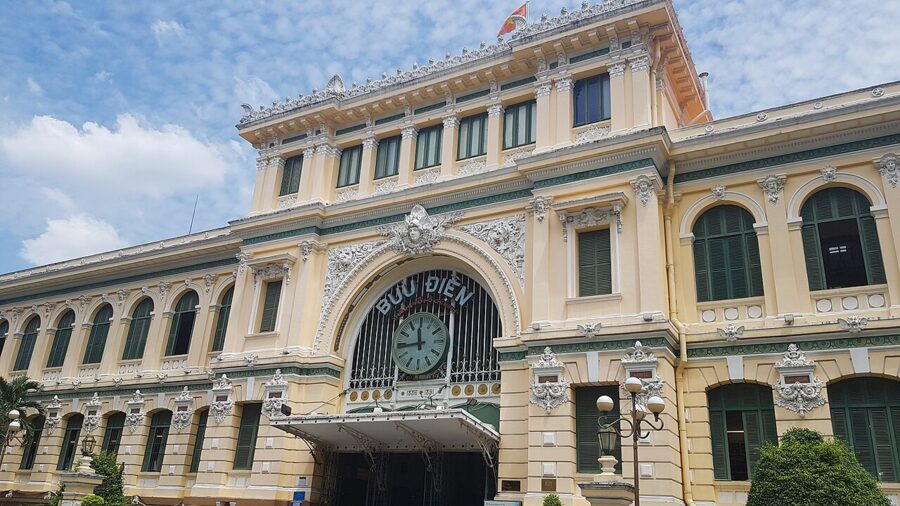
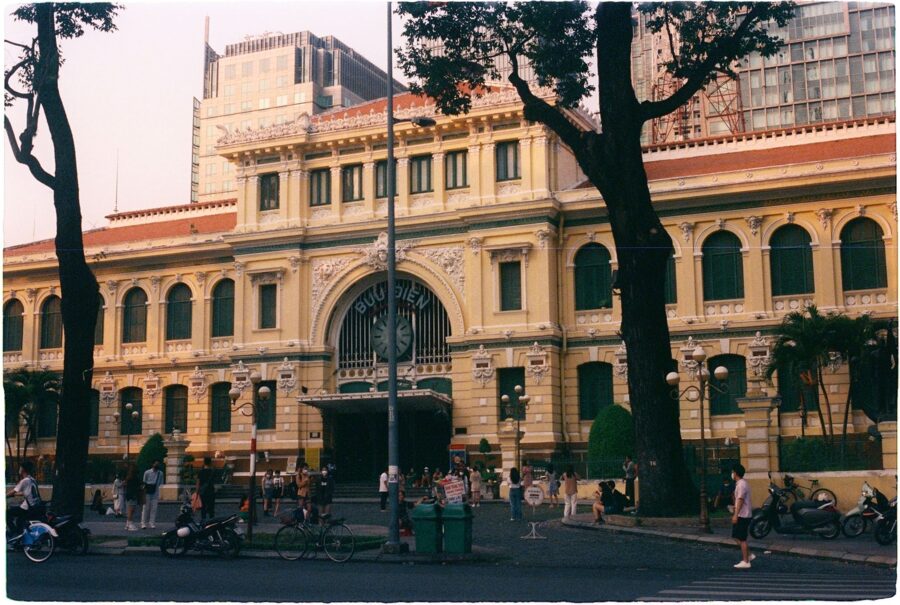
Stand at the cathedral end of the square, where the whole front fits in a phone frame. The building is symmetrical: two long wings of two stories with arched, green-shuttered windows, and a taller central block that rises a floor higher under a crest of stucco ornament. A radio mast pokes up behind the roofline, a reminder that this is still a working telecom site.
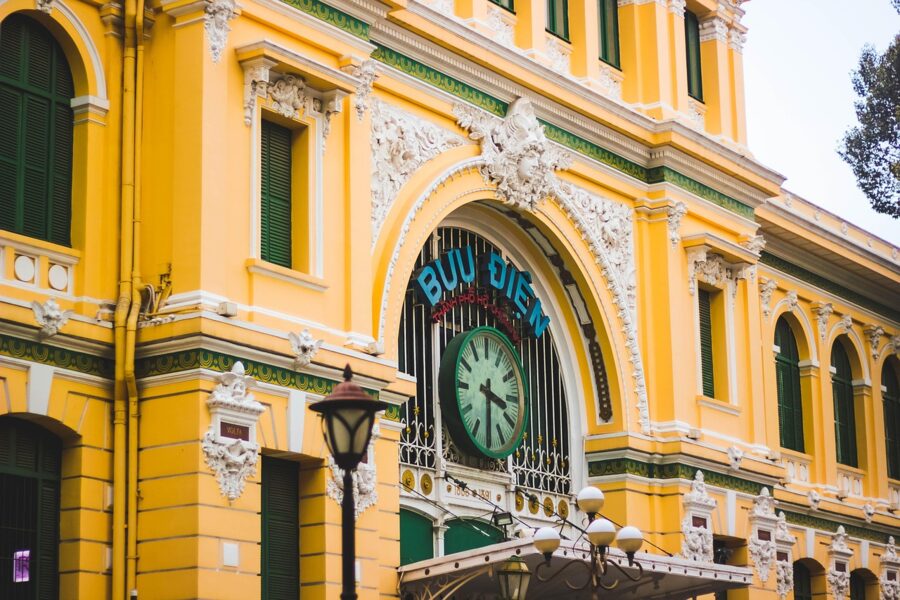
The main arch frames the clock, with the two dates below it and the word BƯU ĐIỆN in large letters across the top. Behind the clock, the arch is filled with steel louvres rather than glass; they were made to pivot, worked by a hand crank, so the entrance hall could be shaded from the sun and still let air through.

The detail almost everyone walks past is at eye level. Between the ground-floor windows, carved cartouches hold small dark plaques with surnames: Ampère, Descartes, Volta, Ohm, Faraday, Morse. These are the scientists and thinkers behind electricity and the telegraph, a roll of honor for the technology the building was put up to serve. One Vietnamese newspaper count puts the total at 35 names, so it’s worth walking the full length of both wings.
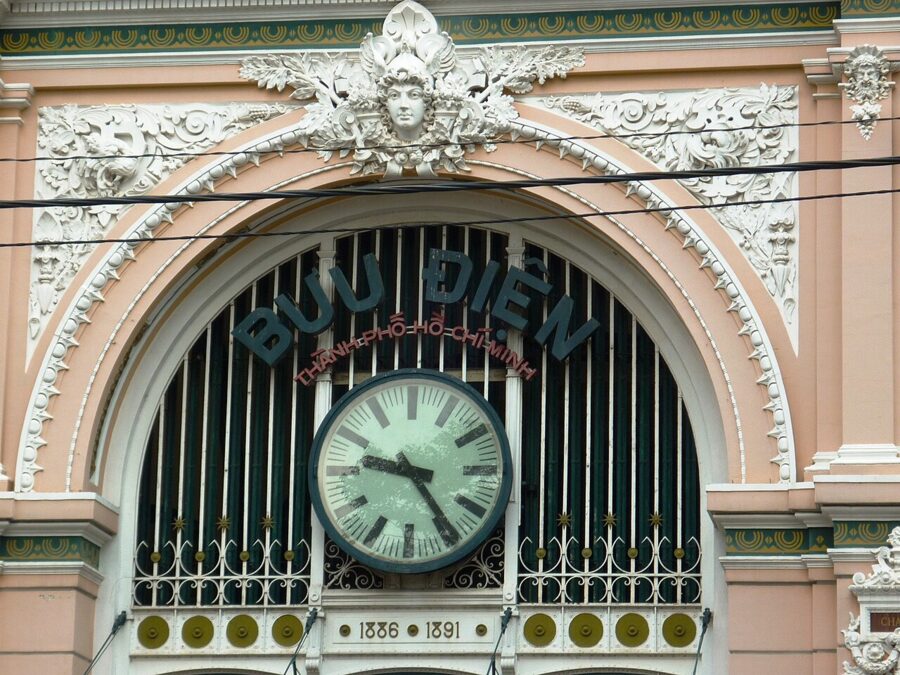

Look up from the plaques and you’ll see heads crowned with laurel wreaths over the windows. Vietnamese descriptions of the building also point out a Hermes, messenger of the gods, and naga serpent motifs of Khmer origin on the roofline. A deputy director of the city’s Department of Culture and Sports has called the building a textbook case of East and West borrowing from each other. That’s generous for a building this French, but the motifs are real; bring a zoom lens, because they’re small and high up.
Pink, golden, then soft yellow
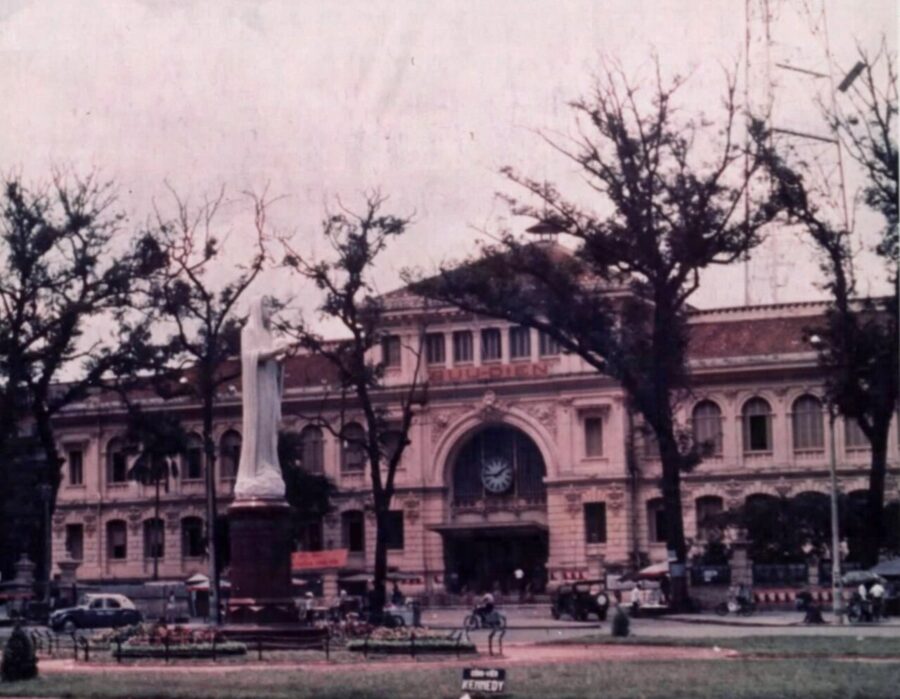
Photographs from 1970, and as late as mid-2014, show the post office in a pale pink with cream trim. At the end of 2014 the operator repainted the whole building a strong golden yellow, after testing seven shades and without consulting the city’s Fine Arts Association. The job, the biggest since 1975, also fixed leaks in the roof.
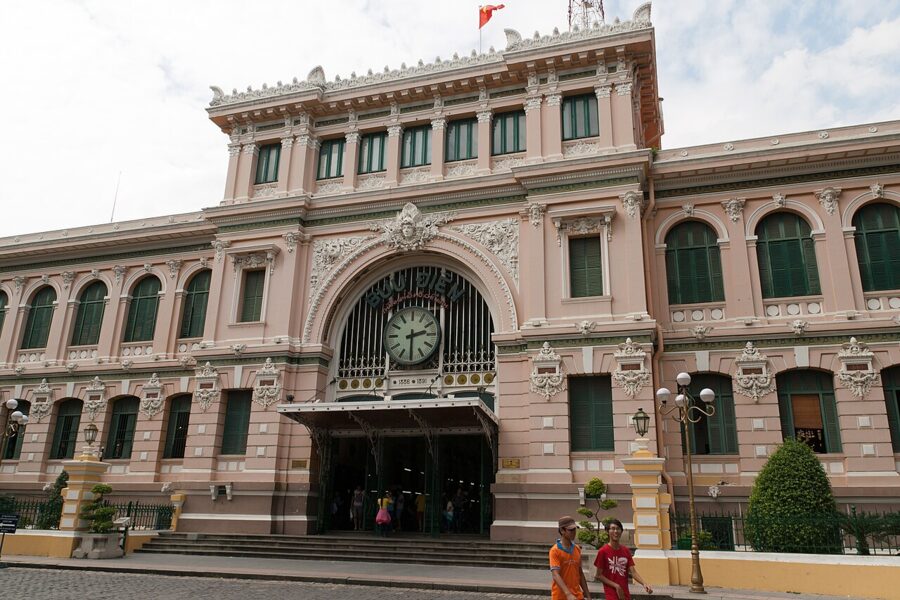

The color went down badly. Architects called it unacceptable, a souvenir seller told a newspaper it made the building look like a pagoda, and a tour guide said nearly all his foreign clients complained it hurt their eyes. In January 2015 the director of the city post office admitted it had been negligent to choose the color without experts.
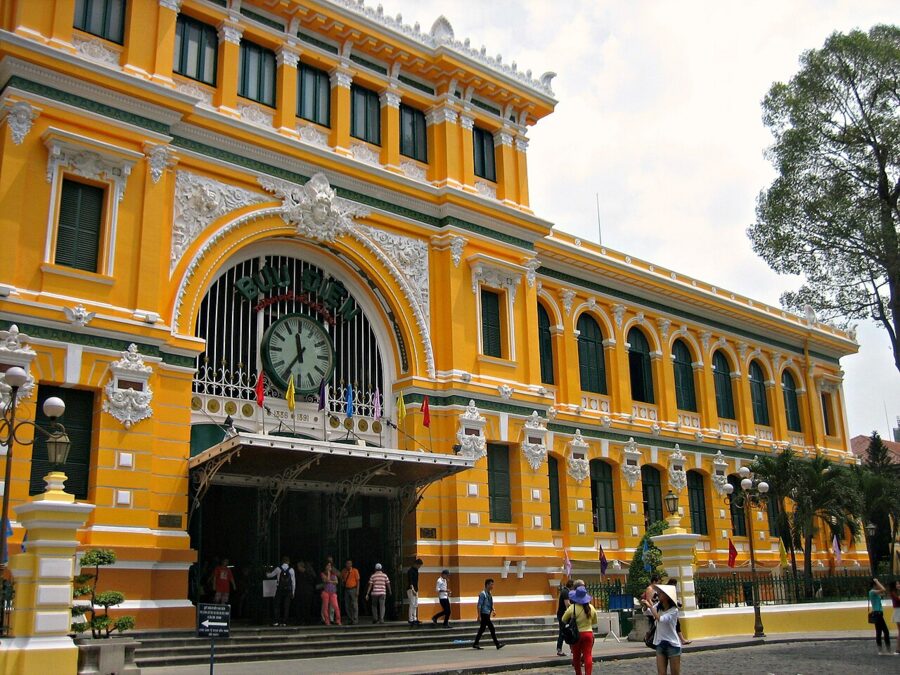

A softer yellow, approved by the city’s planning and architecture council and paid for by a paint company, was on by April 2015, in a repaint reported at 5 billion₫ (about US$233,000 at the time). That is the color you see today. The green shutters and white trim stayed through all three coats.
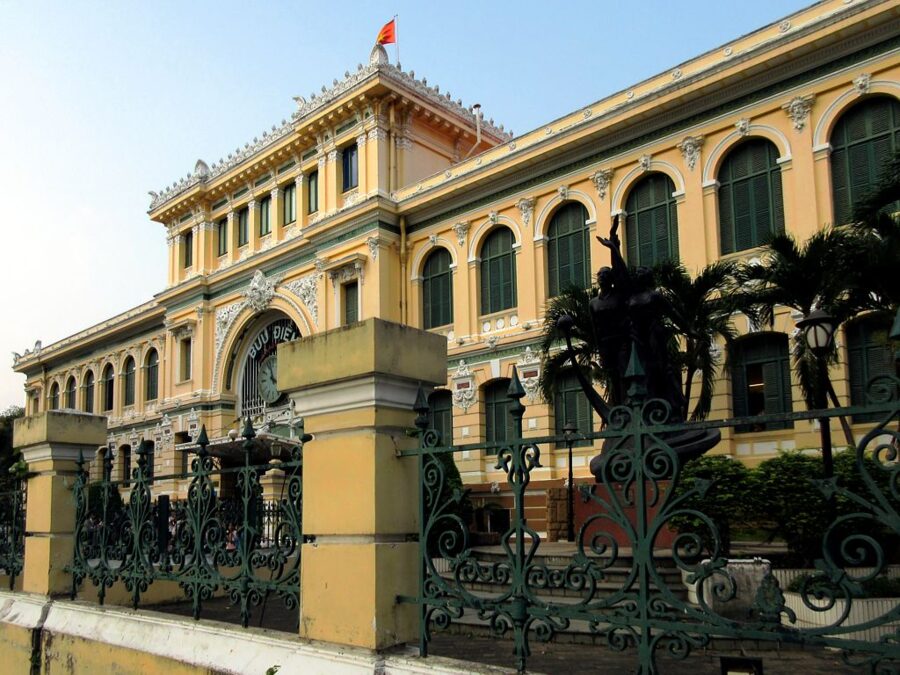

The row turned on one fact: the building has never been formally listed as a heritage monument, so the operator argued it had not needed to consult anyone. It has been on the city’s inventory of heritage buildings since 2010. In October 2025 the city post office wrote to the Department of Culture and Sports supporting a listing, and in November 2025 it formally asked for one at city level, committing to keep the original architecture untouched. At the same time it said the leaking tile roof would be replaced by the first quarter of 2026.
Under the iron vault
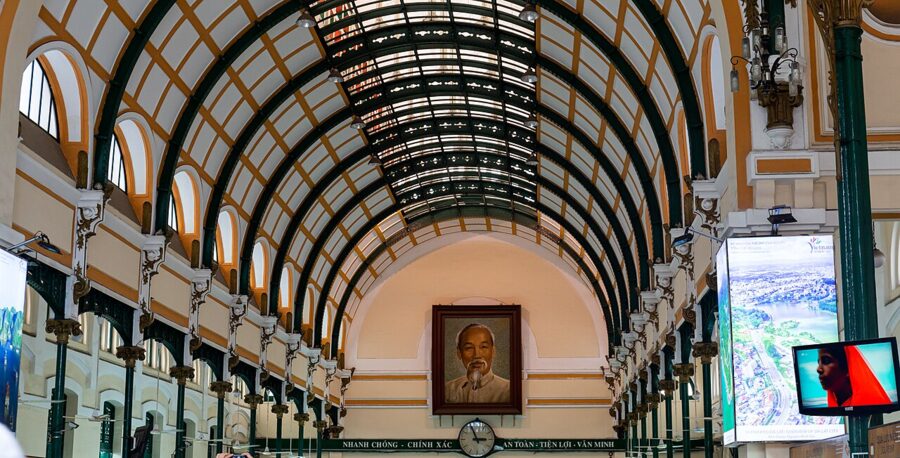
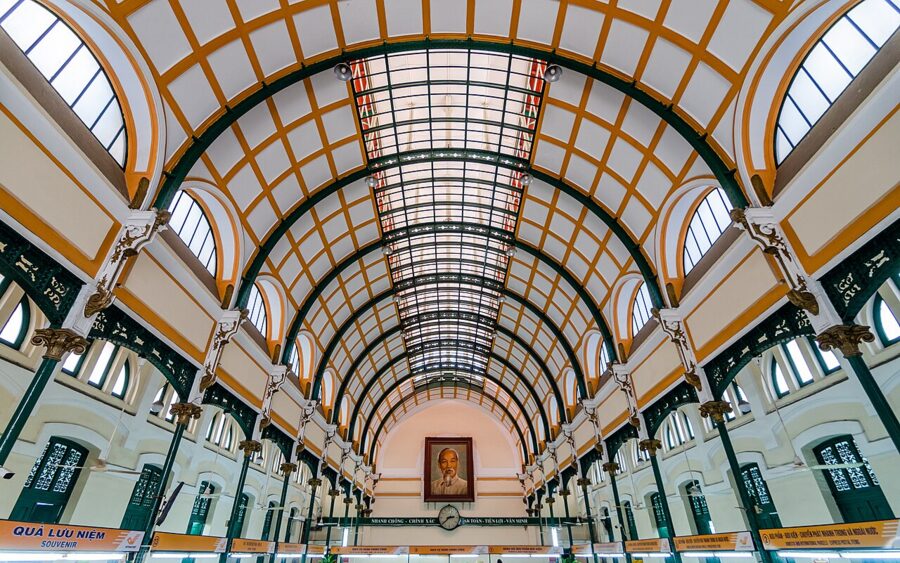
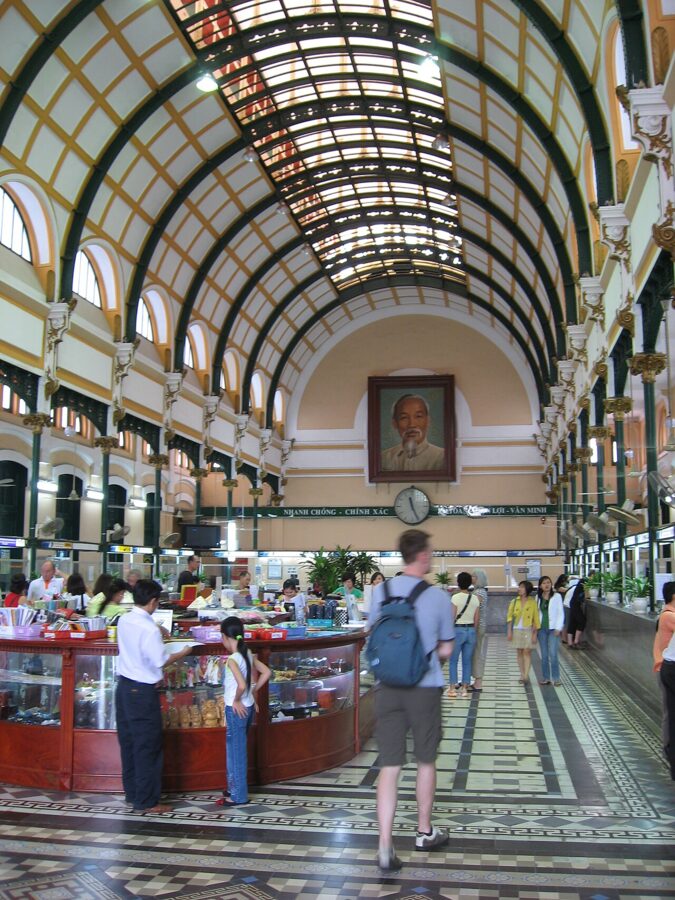
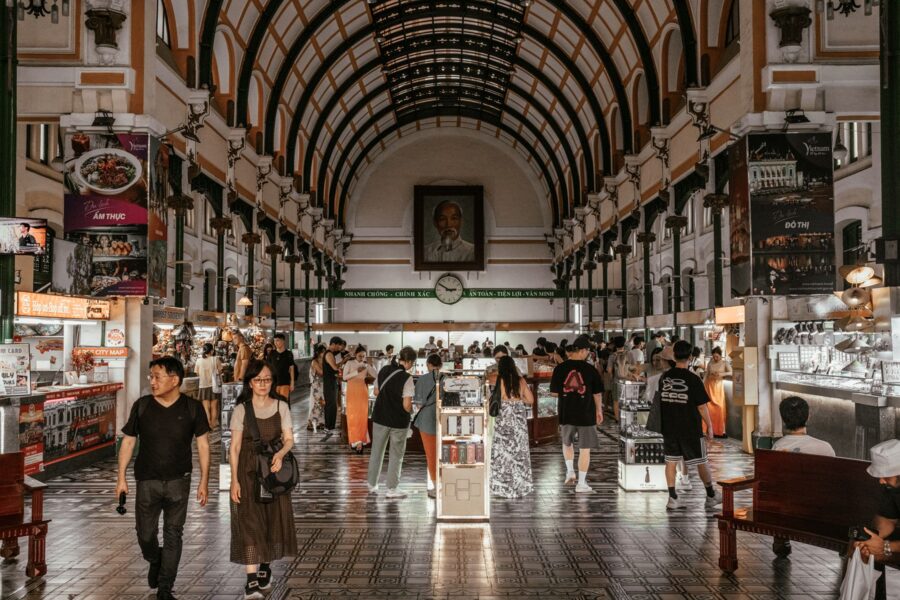
Walk through the doors and the first space is a square entrance hall under its own vault, held up by four iron columns at the corners, each spreading four ribs. Beyond it runs the main hall, a long barrel vault on two rows of slim iron columns, glazed along its length so the light falls straight onto the counters. Where the columns meet the ribs, the joints are worked into leaves and scrolls, painted green against cream walls.

The floor is laid in patterned tiles, set out like long carpets, and photographs from the 1920s show the same design running the length of the room. In those pictures clerks in white suits stand at sorting tables, and the counters along the sides carry the names of Cochinchina’s provinces, among them Bà Rịa and Bạc Liêu. At the far end, where the portrait hangs today, the wall carried a large painted panel.
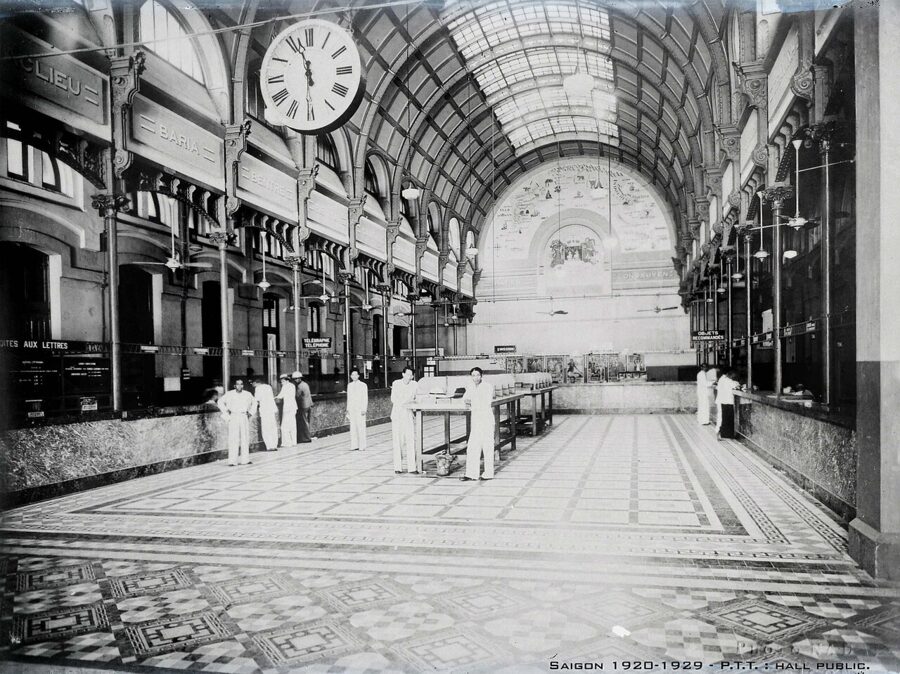
Some things have gone. Doling notes that a statue of Iris, another messenger of the gods, stood in the main lobby until it was removed in the 1950s. Much of the woodwork you lean on now is restored: the counters and the phone booths were rebuilt to the old designs around 2011.
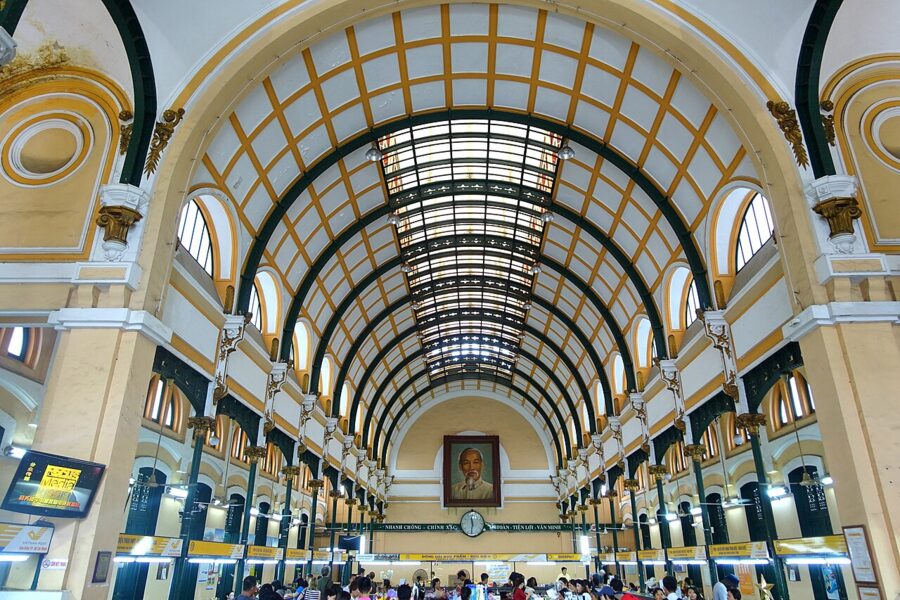
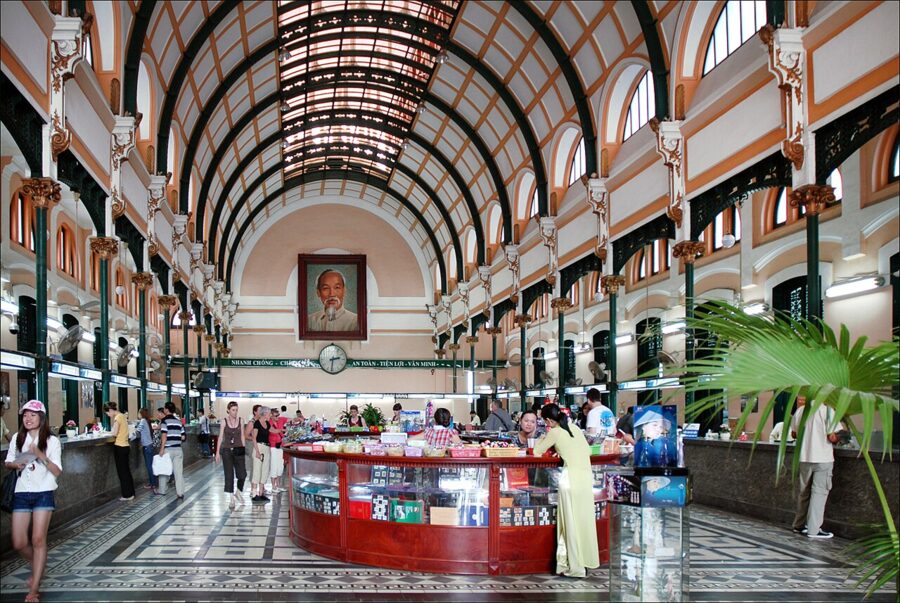

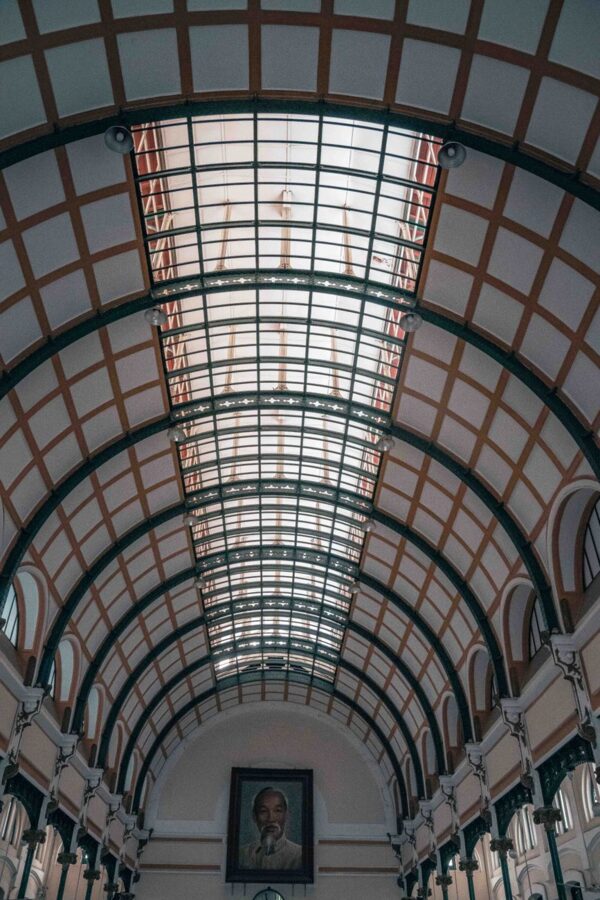
The best way to see the vault is to stop in the middle of the main hall and look straight up. The glazing runs in a continuous strip along the crown, with the iron ribs crossing it at regular intervals, and on a bright morning the shadows of the ribs move slowly across the floor tiles.
The two maps
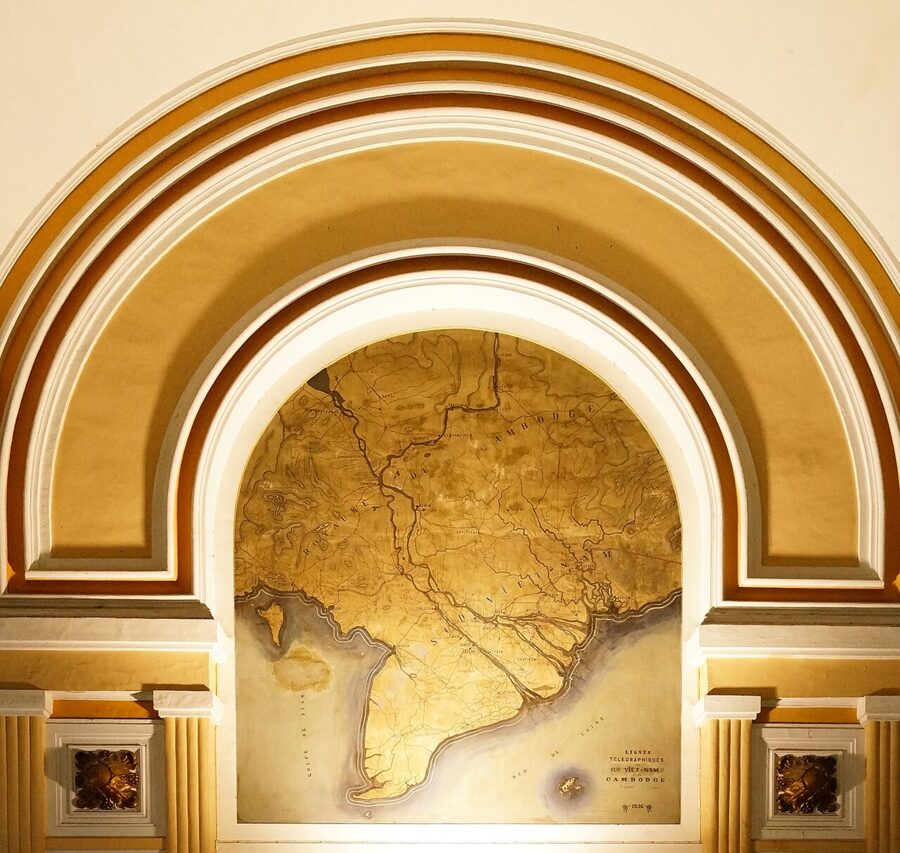
High on the walls of the entrance hall, two painted maps fill arched panels, one on each side. One is Saigon et ses environs, dated 1892: Saigon and its outskirts toward Chợ Lớn, the river looping round to the east, the web of arroyos, and the Canal de Ceinture, the ring canal the French dug around the back of the city. The other, Lignes télégraphiques du Sud Vietnam et du Cambodge, traces the telegraph wires across the Mekong Delta and into Cambodia.
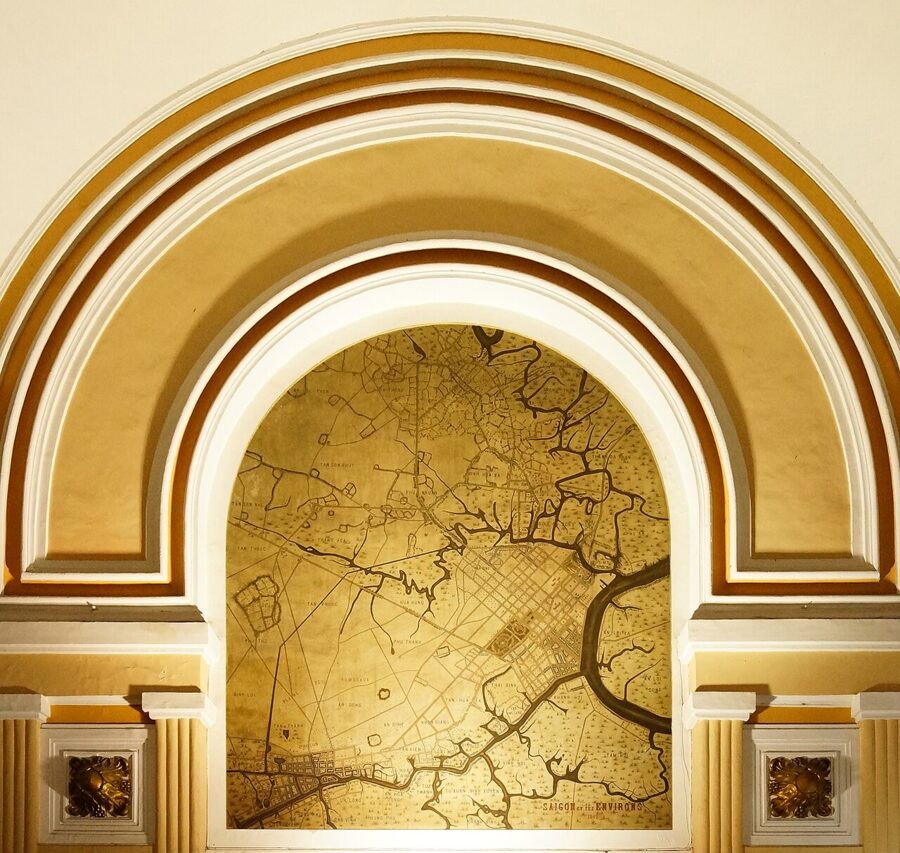

If you only give the maps two minutes, give them to the Saigon one. Find the cathedral square, follow the canal around, and see how quickly the street grid gives way to waterways.
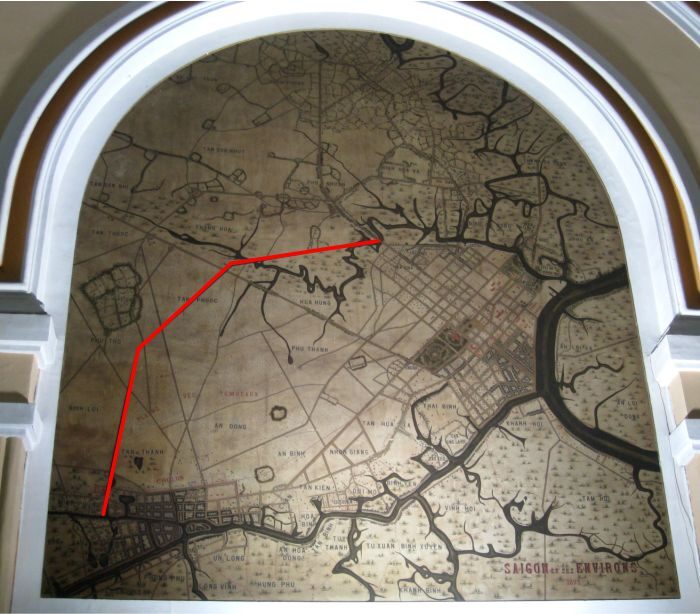

Their dates are a small puzzle. The cartouche on the telegraph map reads 1936, and most Vietnamese sources give that year, while many English-language guides give 1892 for both. A 1920s photograph of the hall already shows a large map of the south and Cambodia in one of the arches, so a map hung there before 1936.
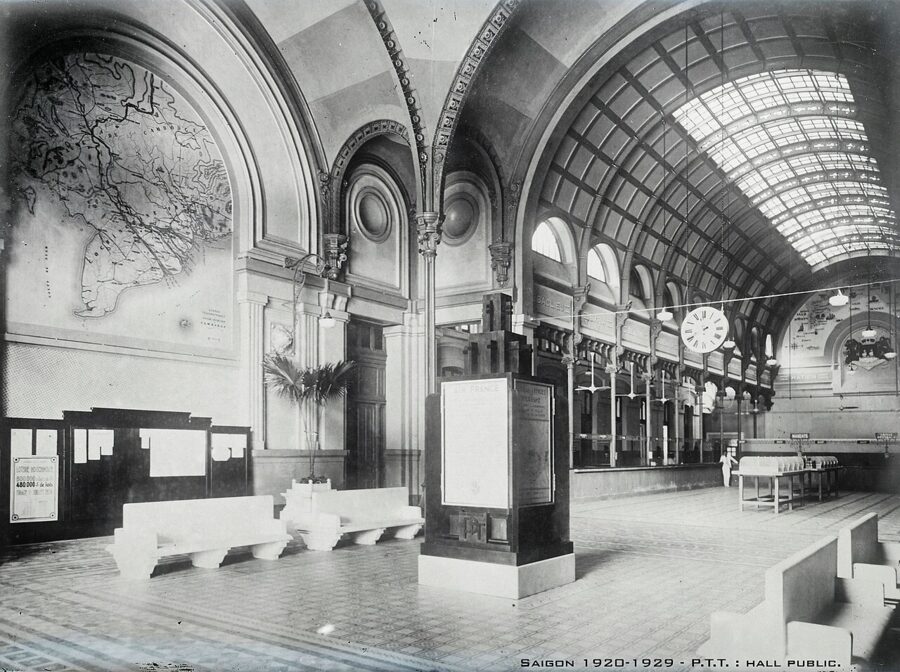
The title as it reads today uses “Sud Vietnam”, a name the French did not use for their colony in 1936, when it was still Cochinchine. The likeliest explanation is that the panel has been repainted and relabeled at least once. Vietnamese researchers say the material the maps are painted in has still not been identified.

The portrait at the end of the hall
The vault leads the eye to a single point: a large portrait of Hồ Chí Minh on the end wall, hung after 1975 where the colonial building had its painted panel. It is the most photographed spot inside, partly because the ribs converge on it so neatly. Stand on the center line of the floor near the entrance for the symmetrical shot, and expect to share the spot.

Booths, clocks and counters
Along the walls of the entrance hall stand rows of numbered wooden telephone booths with glazed doors. These were the call booths for long-distance and international calls; in 2008 a visitor noted they were still being used to phone abroad. Since the restoration several have held ATMs and money-transfer desks instead.
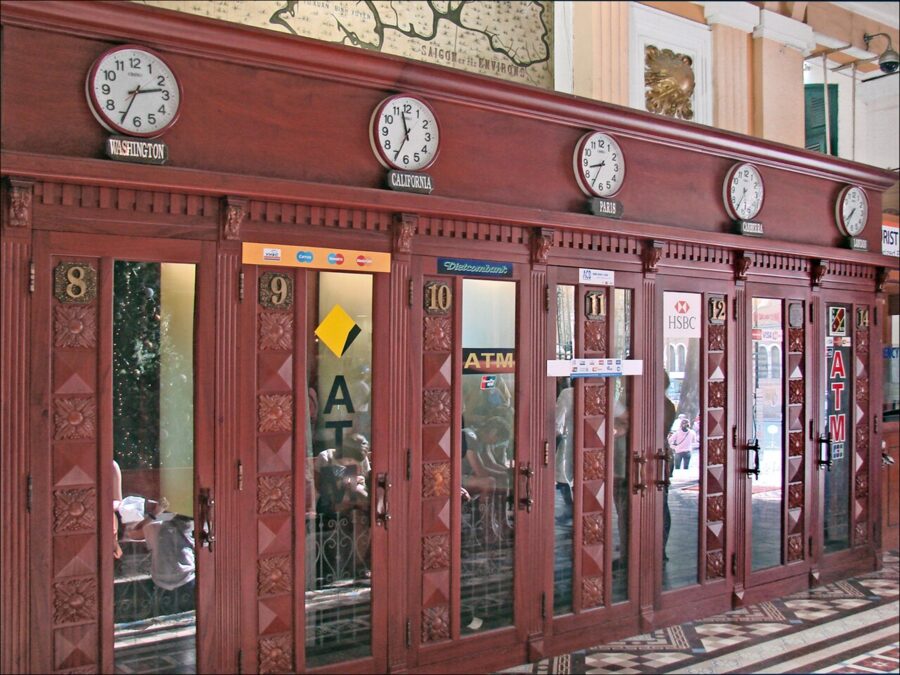

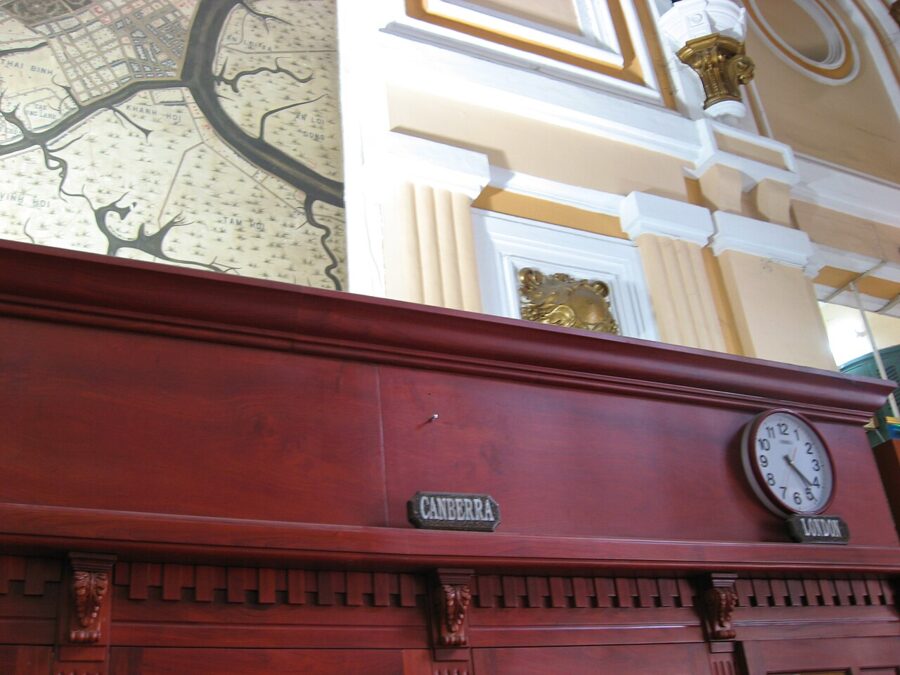
Above the booths, a line of clocks gives the time in Washington, California, Paris, London and other cities. In 2008 the nameplate for Canberra had lost its clock, an empty slot a passing photographer could not resist. Count how many are running when you visit; the clocks are a small gauge of how the building is being looked after.

The service counters run down both sides of the main hall, more than 30 of them. Most of the windows deal with ordinary business: parcels, express mail, money transfers. Visitors need only the ones selling stamps and postcards, and the staff there handle a queue of tourists every day.
Stamps, postcards and the last letter writer
The reason to come, rather than just look, is to post something. Buy a postcard at the counters or the stalls, write it at one of the long wooden tables worn smooth by decades of elbows, then buy stamps at the counter and hand it over. One stamp clerk with eight years at the counter told a reporter in 2025 that most of the cards go to the senders’ own countries.
Postage is priced by weight and destination, so ask the clerk for the current rate rather than trusting a figure from a guidebook. Small notes speed things up. If you’re sending more than a card, the counters also take parcels and express mail.
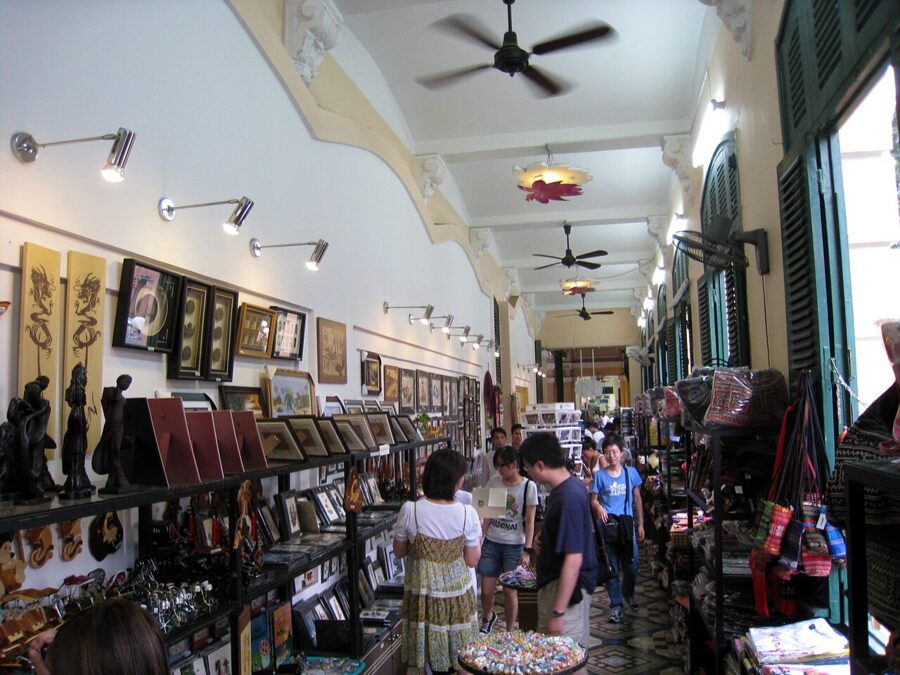
Stalls between the counters and in the side galleries sell lacquerware, prints, notebooks, tote bags printed with city landmarks, and more postcards, at prices a little above street-market level. Since 2025 a modern coffee brand and a few Vietnamese fashion labels have taken space inside, and a photo booth called Hộp tem (“stamp box”) has become a meeting point for young locals.

The post office also runs a cultural calendar: book fairs, events for the city’s tourism week, and regular Saturday performances of traditional music in the hall. Times aren’t published in English, so treat anything you catch as a bonus. In the weeks before Tết the hall fills with young people in áo dài writing New Year cards to grandparents and posing in photo corners hung with red envelopes.
Dương Văn Ngộ, the letter writer
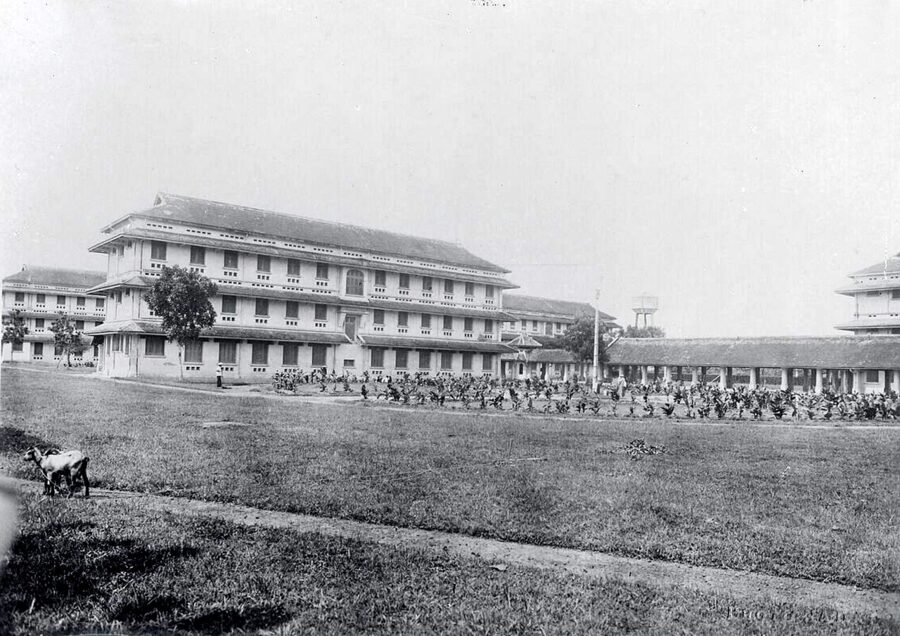
For three decades a wooden desk near the counters belonged to Dương Văn Ngộ. Born in 1930 into a poor ethnic Chinese family, he studied at the Petrus Ký school (today Lê Hồng Phong High School for the Gifted), learned French and English, and worked as an interpreter. At 16 he joined the postal service at the Thị Nghè post office, and he moved to the Central Post Office in 1952.
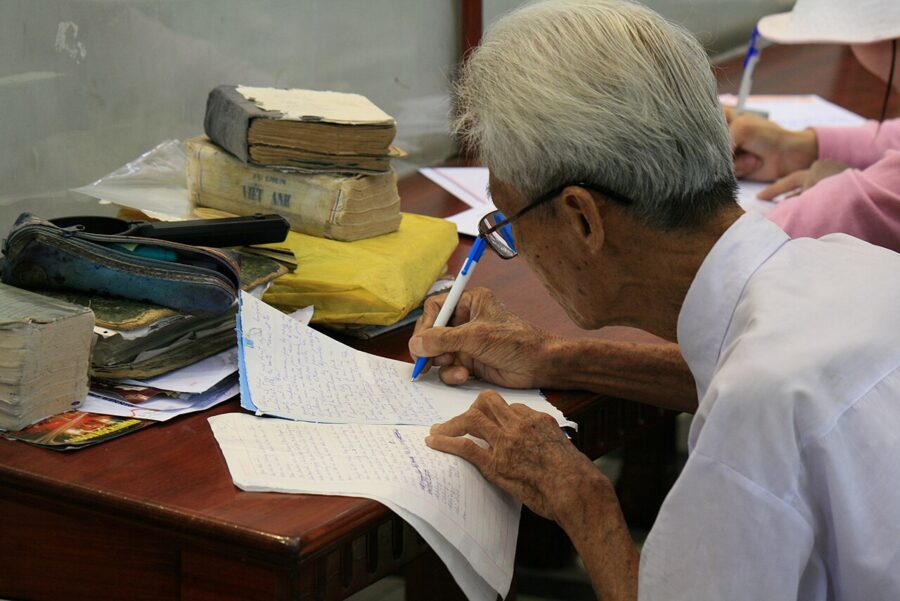

When he retired in 1990, he asked to keep coming in. From his desk he wrote letters for people who could not write, translated Vietnamese letters into French or English for families with relatives abroad, and addressed envelopes for travelers. He told interviewers he had written and translated letters and postcards to countries all over the world, and Vietnam’s national record keepers named him the country’s longest-serving letter writer.
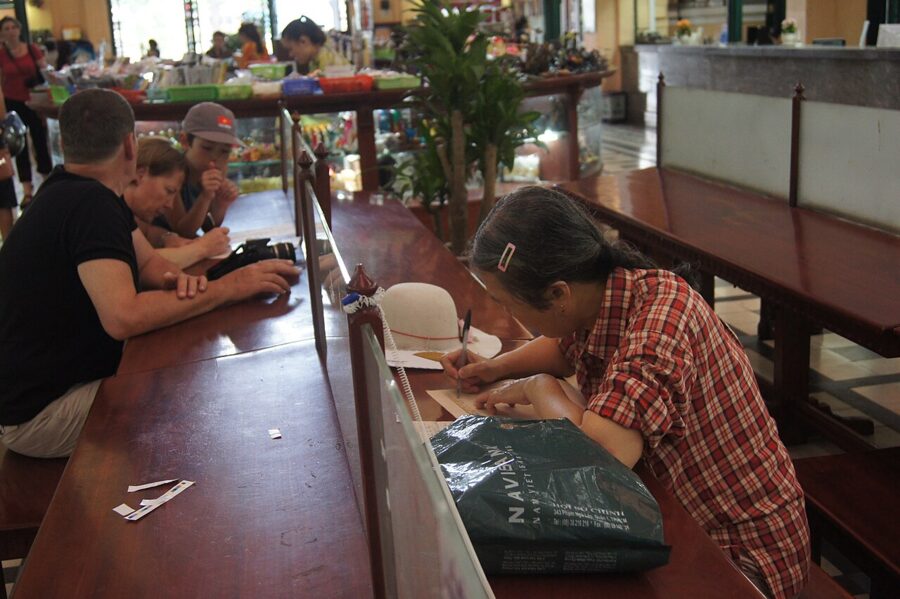

Age and poor health stopped him in 2020, though he kept visiting to look at the table he had worked at for thirty years. Ngộ died at home on 1 August 2023, aged 94 by the traditional count, and was buried in a cemetery park in Bình Dương, which has itself been part of Hồ Chí Minh City since 2025. The obituaries called him the last of the post office’s public letter writers.
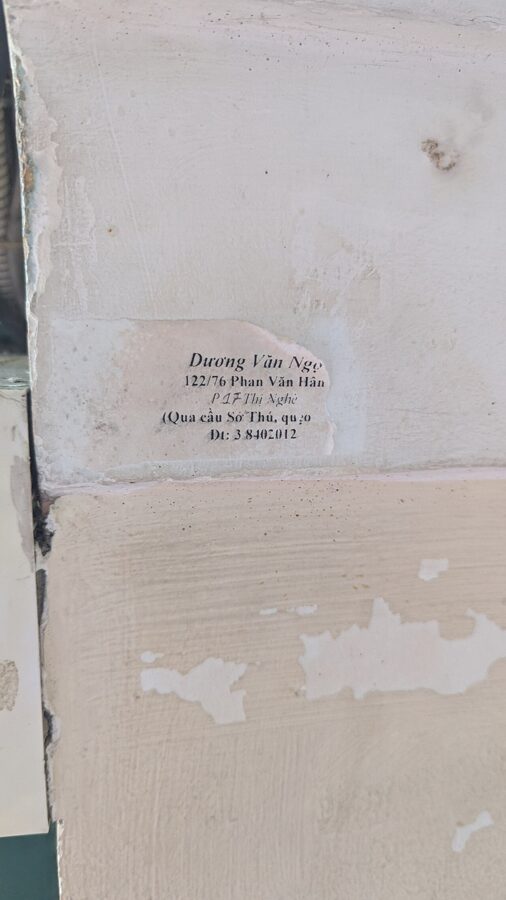
In February 2025, a faded poster with his name and details was still on a wall in the hall. Ask at the counters and the staff may point out where he sat. Writing your own card at the old tables is the nearest thing to his trade left in the building.
The square and the streets around it
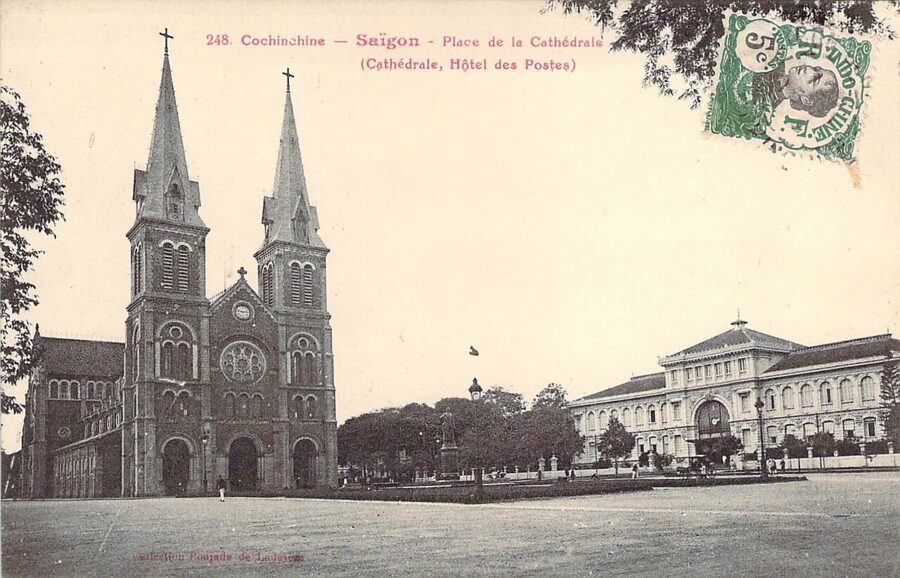
The post office stands on Công xã Paris, the Paris Commune square, which the French called Place de la Cathédrale. Its partner across the lawn is the cathedral, finished in 1880, eleven years before the post office. The two were built to be seen together, and the old postcards show them as a pair at the top of rue Catinat.
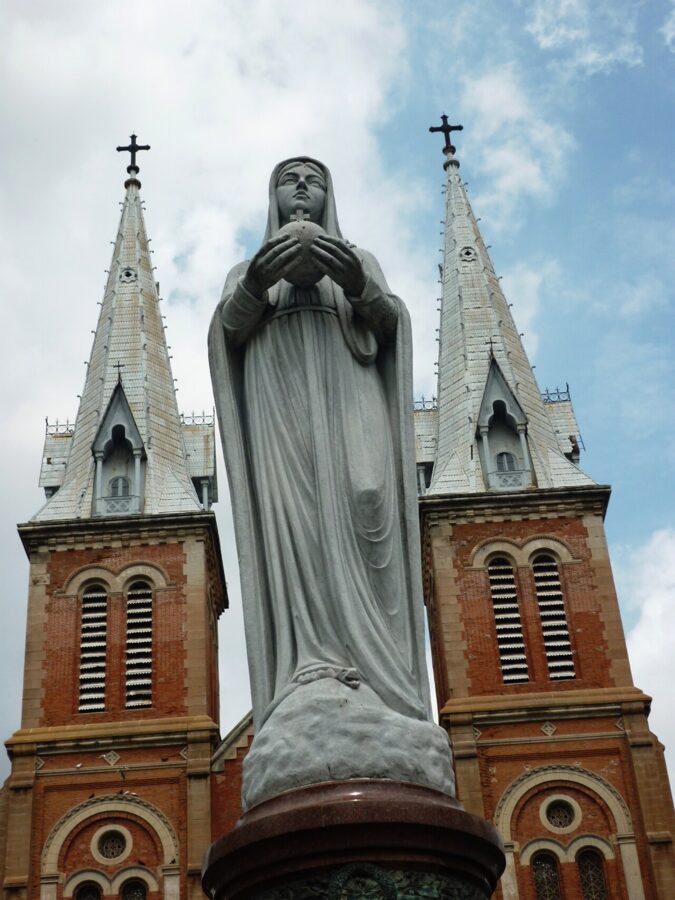
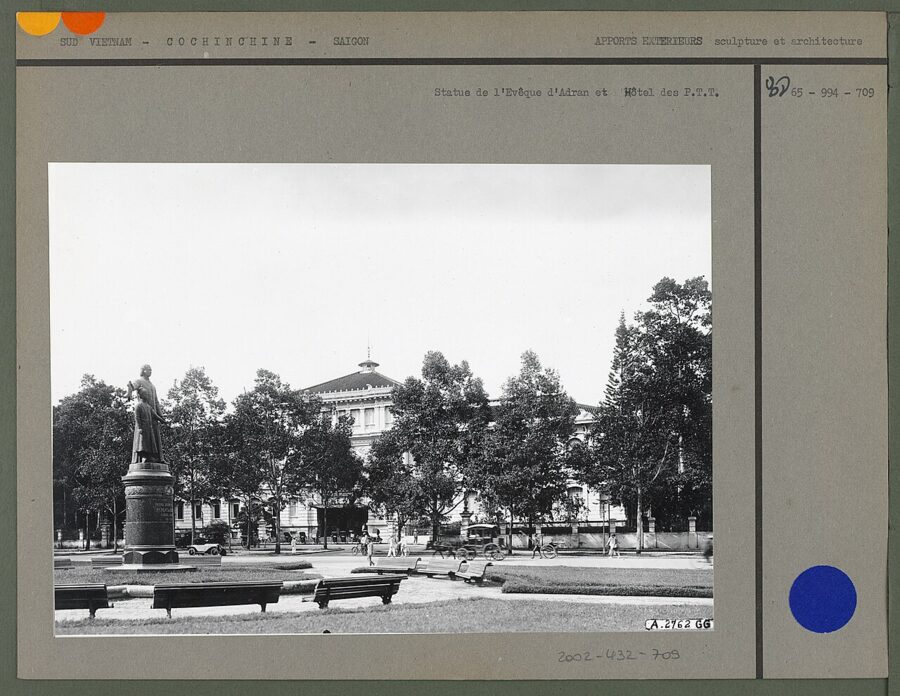
In the 1920s the square held a statue of Pigneau de Behaine, the French Bishop of Adran who backed Nguyễn Ánh, the future Emperor Gia Long, in his wars of the late eighteenth century. It has long gone. The center of the square now belongs to a white statue of the Virgin Mary in front of the cathedral, and to the traffic that circles it.

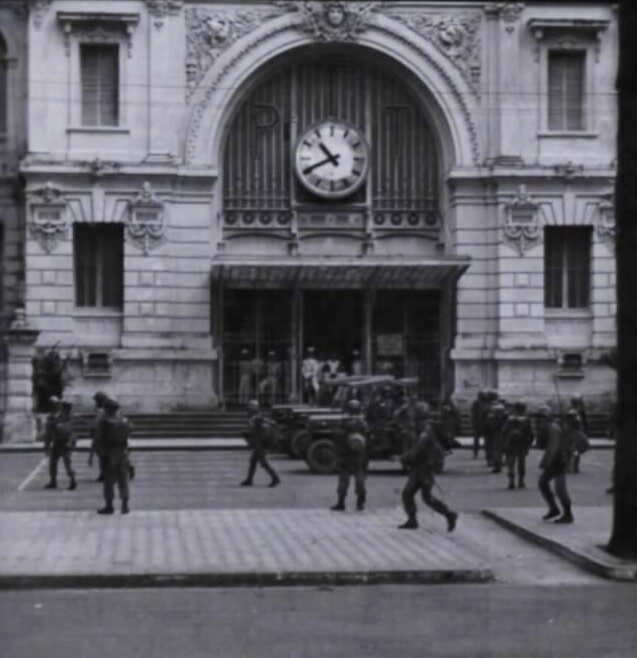
The square was never just scenery. On 13 September 1964, during an attempted coup against the military government of Nguyễn Khánh, troops of the Saigon garrison marched past the post and telegraph building, and an American army photographer caught them at the door. Six years later another army photographer recorded the building in its pink coat.
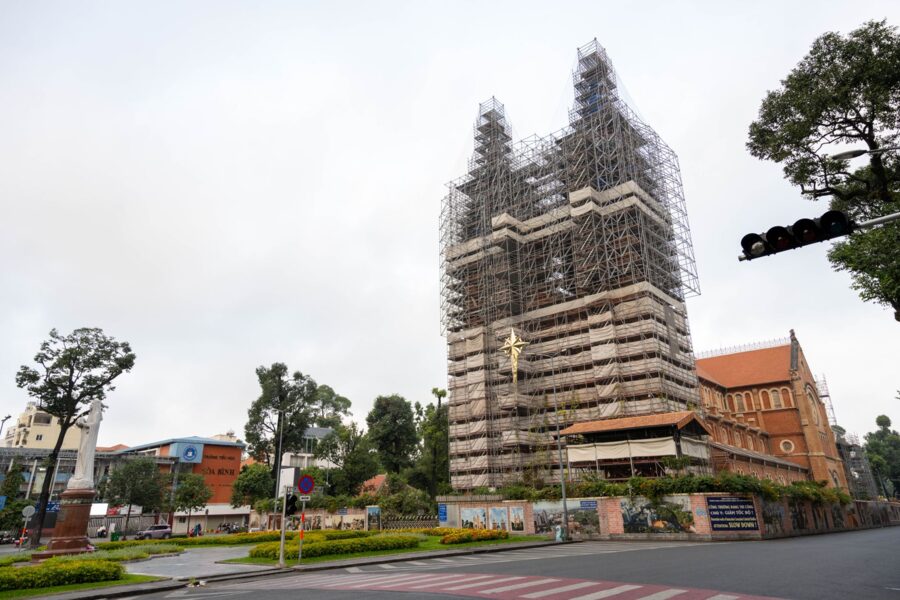
The cathedral’s restoration began in 2017 and is still going, so expect scaffolding on its towers and check Mass times before you plan to go inside. From the post office steps you can at least see how the two façades answer each other: red brick against yellow stucco, twin spires against a single clock.

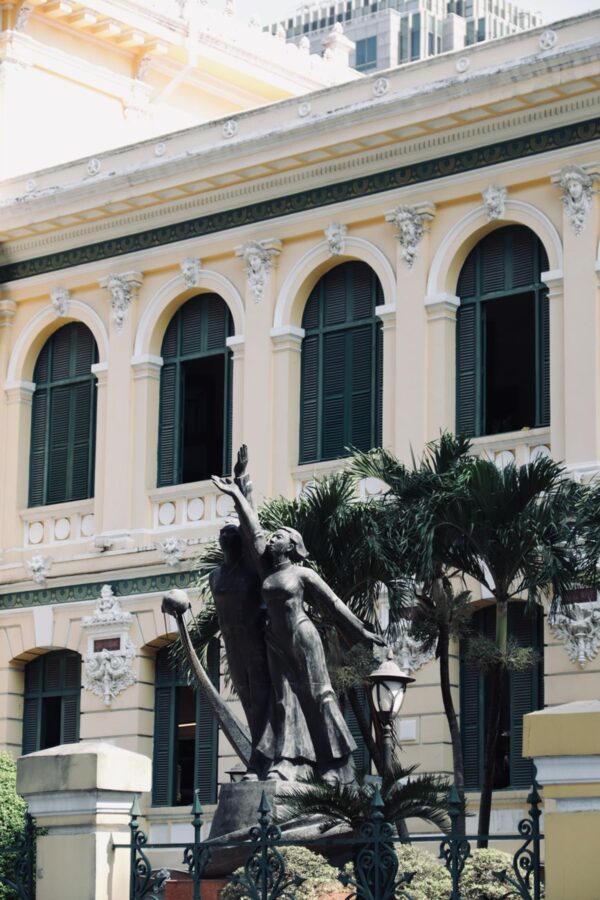
Two small gardens flank the post office. One has a monument to the wartime telecom soldiers and liaison runners, the other a sculpture for the postal and telecom industry of the modern era, and the winged bronze is the one people stop to photograph.
One thing to avoid confusing: the large block behind the post office at 125 Hai Bà Trưng is a separate building, run by the city’s telecom company rather than the post office. Its ground floor made the news in late 2025 when part of it was leased as a so-called “Russian market”, and the city’s Department of Industry and Trade stepped in to say the historic post office had nothing to do with it.
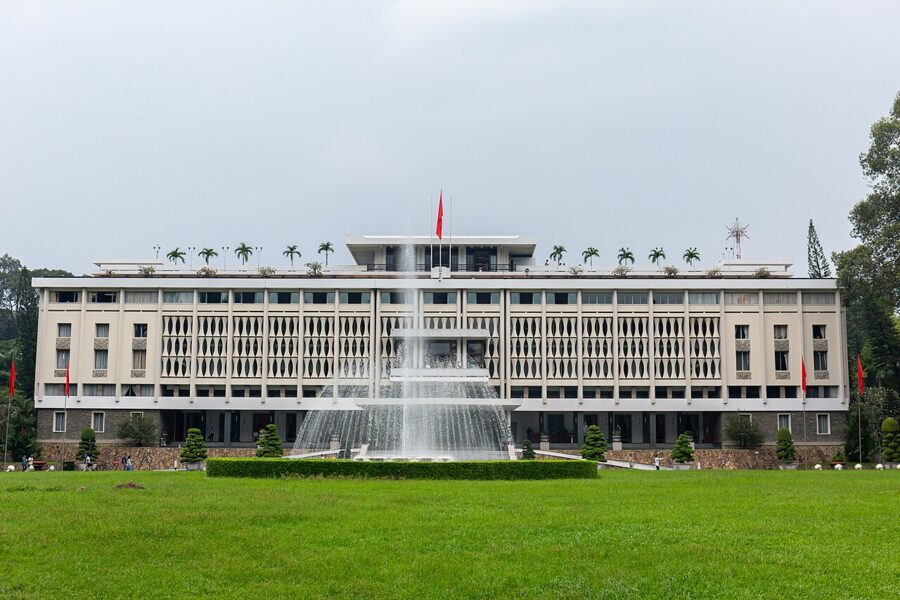
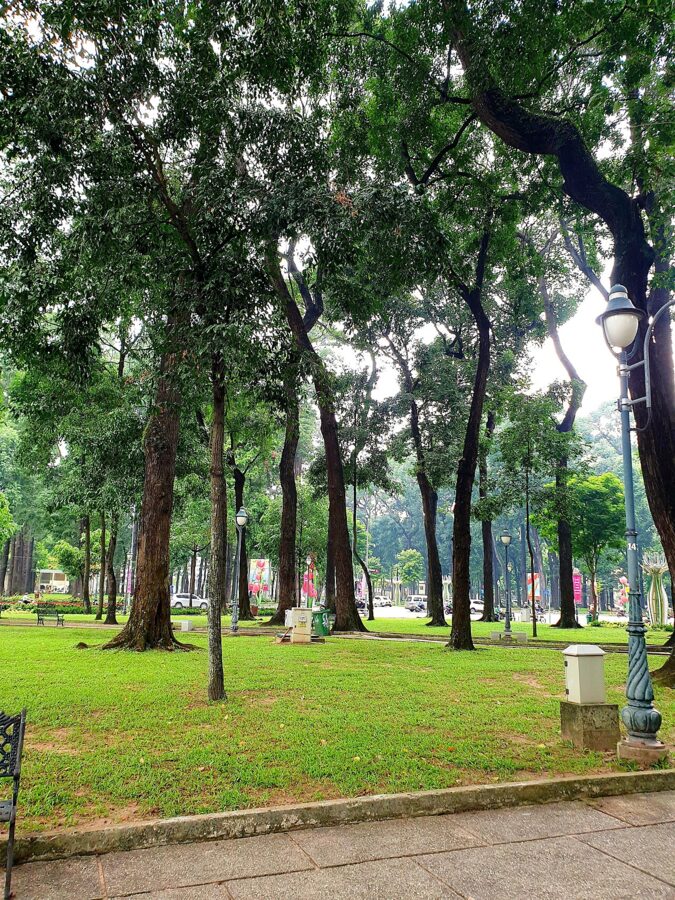
The Reunification Hall (Dinh Độc Lập) is about ten minutes’ walk southwest through 30/4 Park. Đồng Khởi street runs from the cathedral down to the Municipal Theatre (Nhà hát Thành phố) and on to the river, past most of what is left of rue Catinat.

Đường sách Nguyễn Văn Bình, the book street
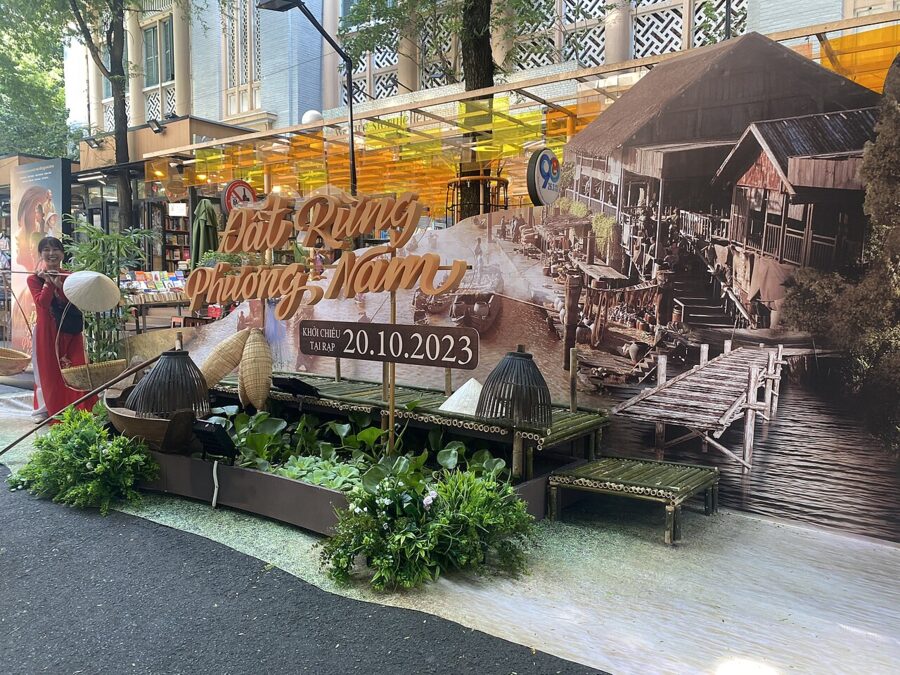
The short street running along the side of the post office is Nguyễn Văn Bình, closed to traffic and turned into the Ho Chi Minh City Book Street (Đường sách TP. Hồ Chí Minh). It opened on 9 January 2016 as the country’s first dedicated book street, about 140 meters of shaded paving lined with stalls run by publishers and distributors. It is managed by the city’s Book Street Company.
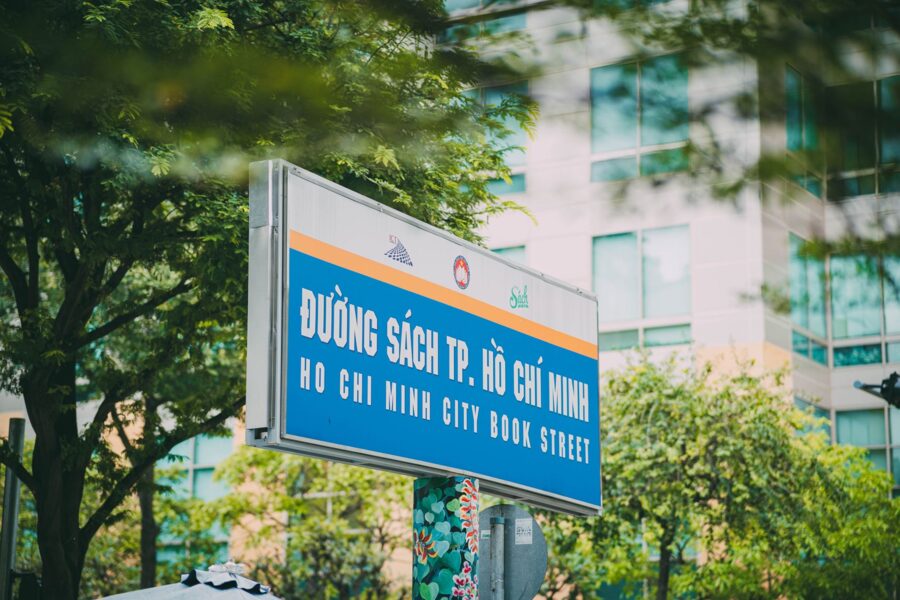
It began with 19 booths and now has about 30, from more than 20 publishers and distributors. By its tenth anniversary in 2026 it had sold nearly 7 million books and hosted more than 3,000 events, from author talks to film launches.
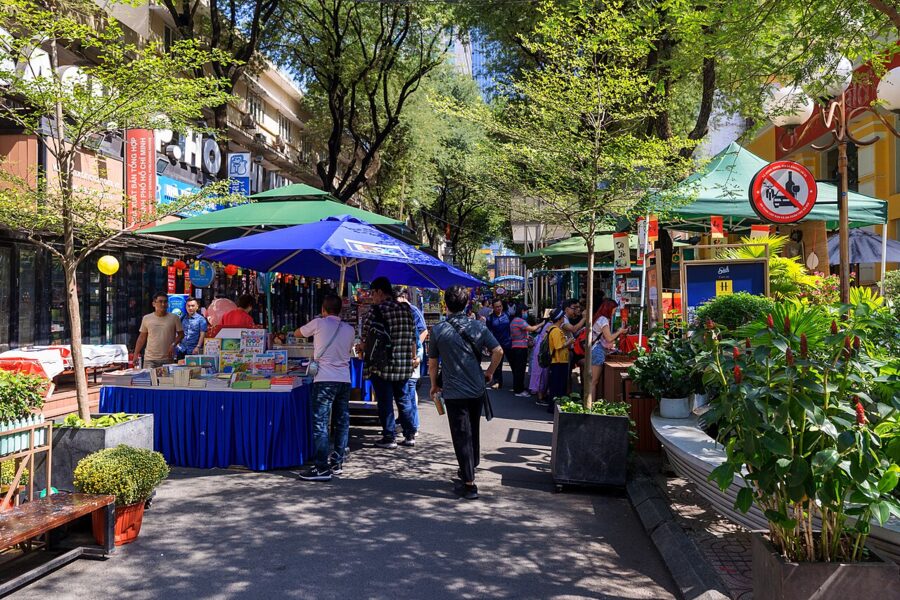

Most of the stock is in Vietnamese, which is part of the appeal: this is where the city’s readers browse, not a souvenir arcade. Stall hours vary, so come in daylight rather than late evening if you want everything open.

Planning your visit
| Address | 2 Công xã Paris, Sài Gòn ward, Hồ Chí Minh City (old District 1) |
|---|---|
| Hours | Monday to Friday 7am to 7pm; Saturday 7am to 6pm; Sunday 8am to 6pm (hours shift on public holidays, especially around Tết) |
| Entry | Free |
| Time to allow | 30 to 45 minutes; an hour with a postcard and the book street |
| Nearest metro | Opera House station (Ga Nhà hát Thành phố), Metro Line 1, about ten minutes on foot |
Grab and Be cars and motorbike taxis drop at the forecourt; type “Bưu điện Thành phố” or “Saigon Central Post Office”. The hours above come from a listing dated May 2026; if you’re cutting it close, check the times posted at the door.
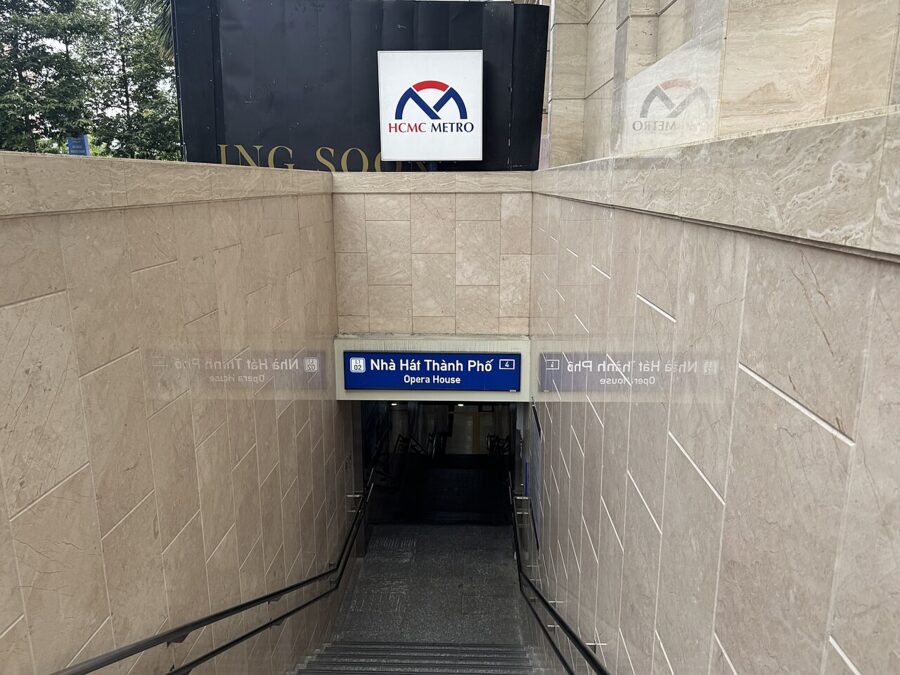

Metro Line 1, which opened in December 2024, stops at Opera House station under Lê Lợi street. Come up by the Municipal Theatre and walk up Đồng Khởi to the cathedral, about 700 meters. From Bến Thành Market (Chợ Bến Thành) it is a 15-minute walk, and the same from Bến Thành metro station.
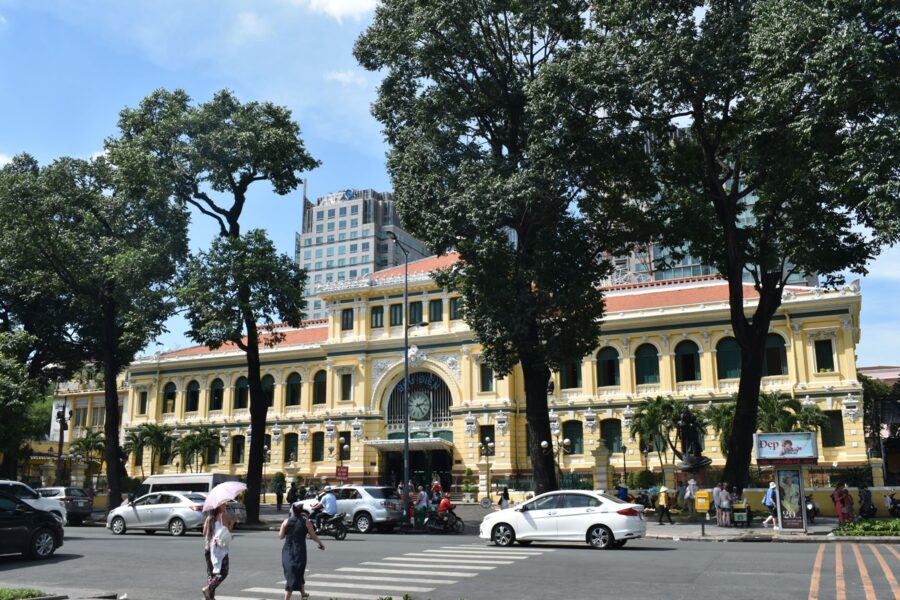
Weekday mornings soon after opening are the quietest time inside. Tour groups build from mid-morning, and weekends bring local families and áo dài photo shoots, fun to watch but hard on the light in the hall. The façade faces the square to the southwest, so it takes the sun in the afternoon; late in the day is the time for exterior photographs.
There’s no dress code in the post office itself. Dress for the cathedral if you plan to go inside it: shoulders and knees covered. Personal photography is fine throughout the public hall, but keep your lens off customers’ paperwork at the counters, and keep your phone in a front pocket in the square, where bag snatching is a known problem.
For a longer morning, add the Reunification Hall, then walk down Đồng Khởi to the Municipal Theatre. The War Remnants Museum (Bảo tàng Chứng tích Chiến tranh) is about 1.5 kilometers west, a short Grab ride. Post your card before you leave the hall rather than carrying it around the city; the stamp and the postmark from this counter are the souvenir.