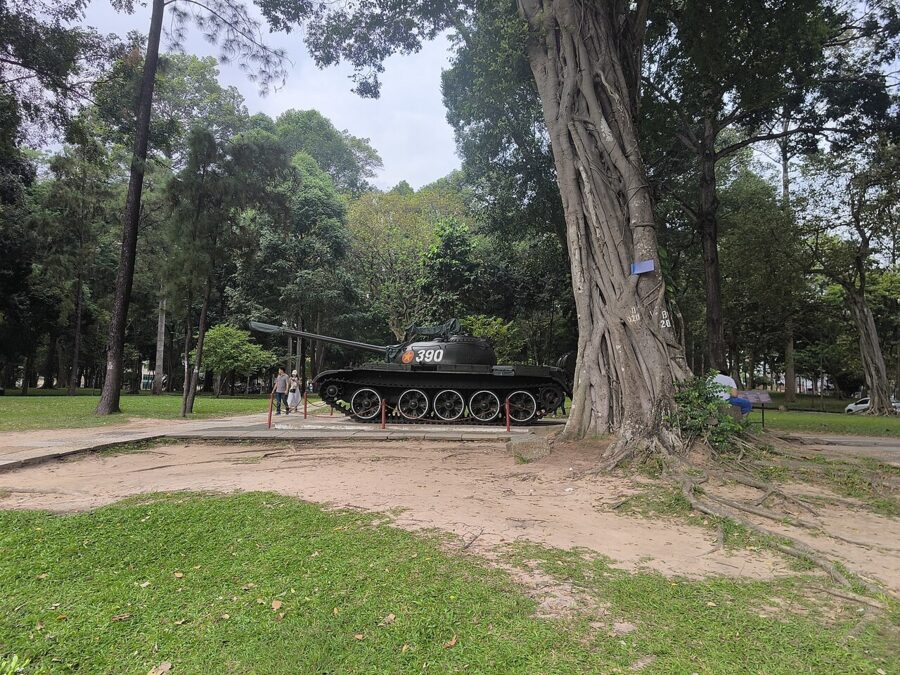
Two tanks stand under the trees on the lawn of the Independence Palace, painted with the numbers 843 and 390. Neither is the machine its number belongs to. The real 843 and 390, the tanks that broke the gates on the morning of 30 April 1975, were declared national treasures in 2012 and sit in museums in Hanoi; the pair in Saigon are tanks of the same types, parked where the story needs them.

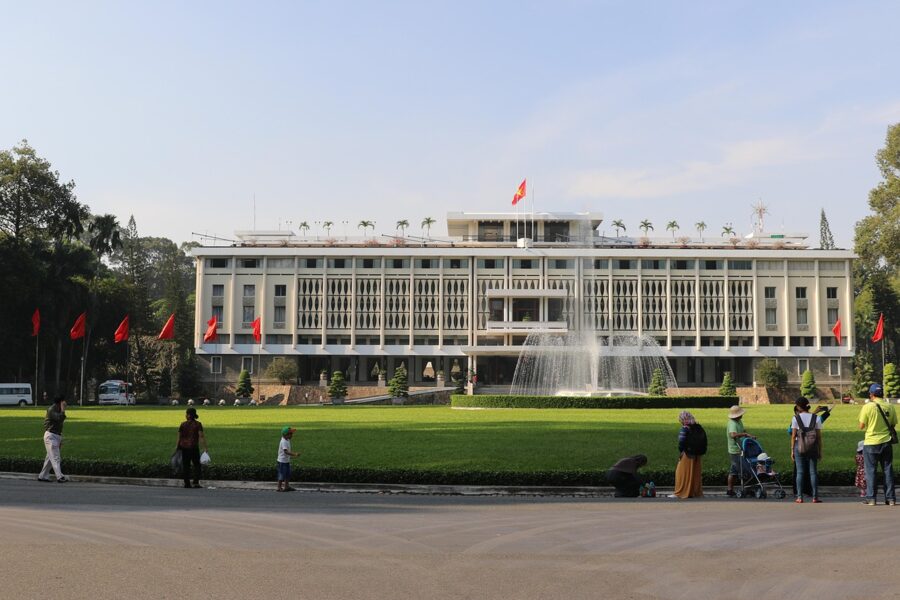
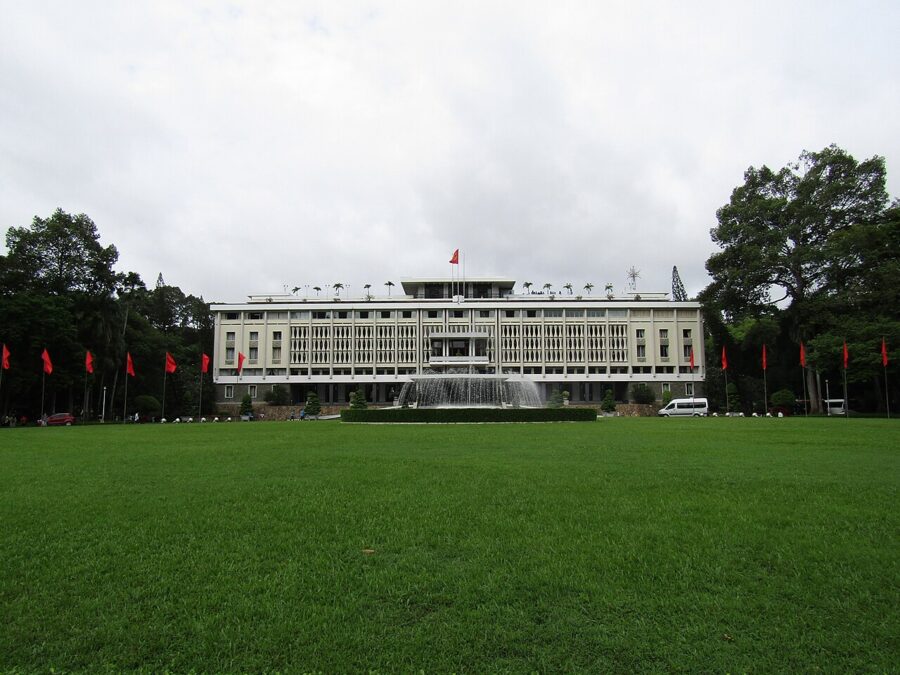
That gap between the object and the event runs through the whole building. The Reunification Hall (Dinh Độc Lập, the Independence Palace on most signs and tickets) is a 1960s presidential palace kept close to the way its last occupants left it, on a site the French used for their governors for almost a century.
Some of what you see is original down to the rotary phones. Some of it is a stand-in, and the labels do not always say which is which.
Dinh Độc Lập is still the building’s official name; Hội trường Thống Nhất, the Reunification Hall, is the government office that manages it, named after the conference on reunifying the country held here in November 1975. “Reunification Palace”, the name most English guidebooks use, mixes the two. Vietnamese writers point out that “Dinh Thống Nhất” has never been an official name at all. Ask for any of them and you will end up at 135 Nam Kỳ Khởi Nghĩa.
On this page
Norodom Palace: the French governor’s house, 1868 to 1954
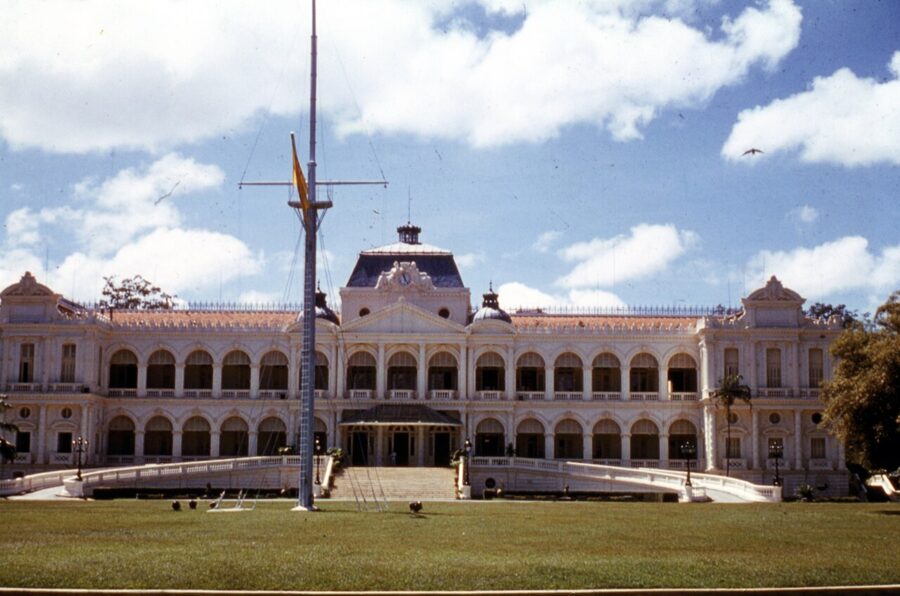
The French took the three eastern provinces of the Mekong region in 1862 and the rest of Cochinchina by 1867. The first governors made do with a wooden residence put up in 1863. In 1868 Admiral Pierre-Paul de La Grandière laid the first stone of something grander, a palace designed by the architect Achille-Antoine Hermitte on a site of about 12 hectares at the head of what became Boulevard Norodom. The street, and then the palace, took the name of the Cambodian king Norodom, whom the French had recently taken under their protection.
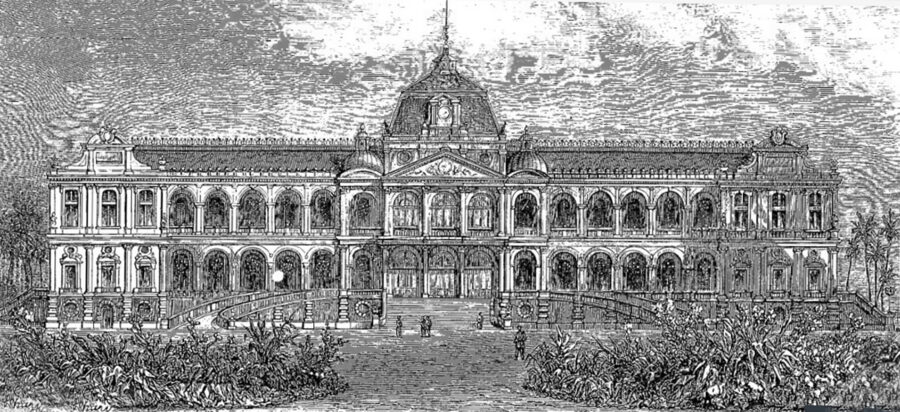
The building was huge and slow. Sources give 1871 or 1873 for its completion, and the Franco-Prussian War of 1870 is usually blamed for the delay; the formal opening came in 1873 under Governor Marie Jules Dupré, with decoration running on until 1875. The front was 80 meters long. The reception hall at the back, according to an 1885 description, could take 800 guests, and the waterlogged ground under it needed repairs to its foundations for the rest of its life.
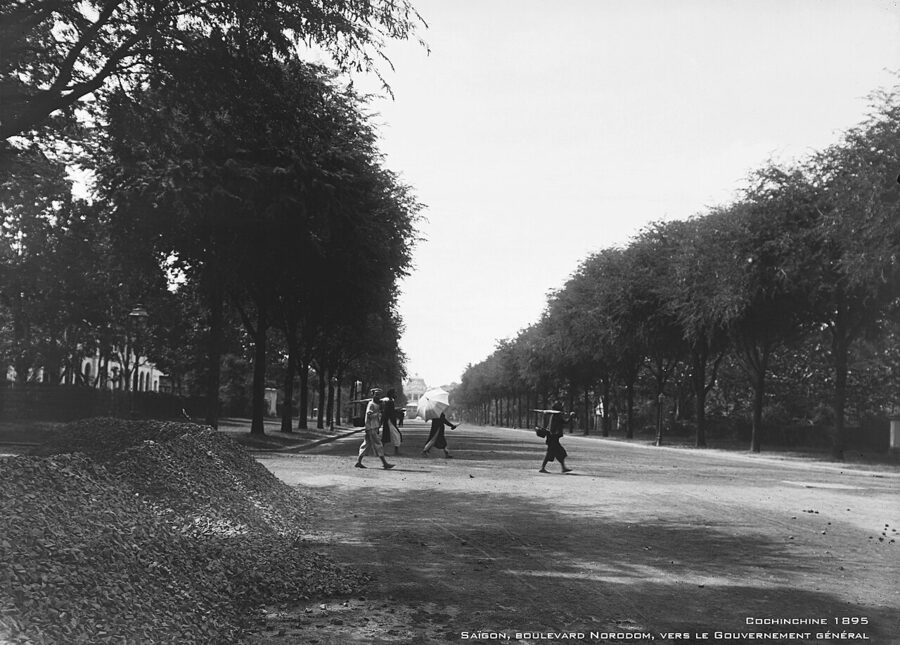
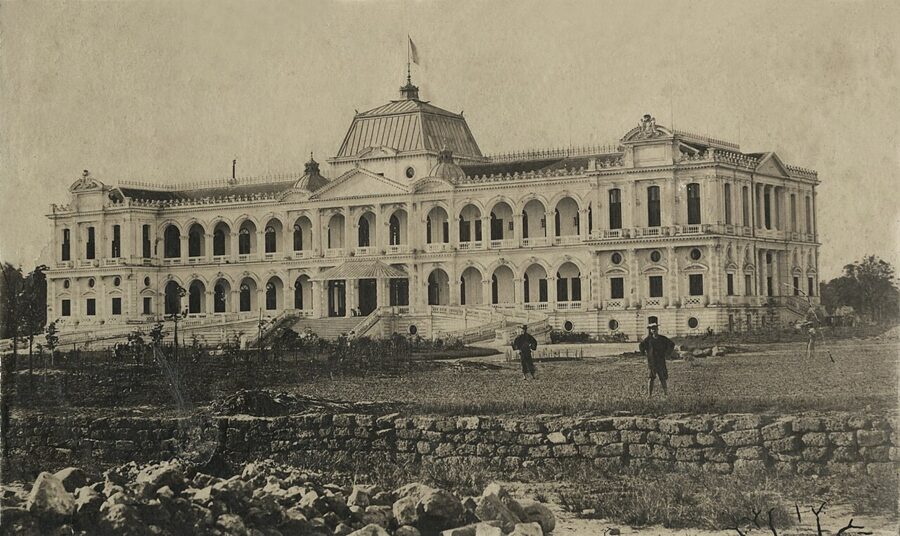
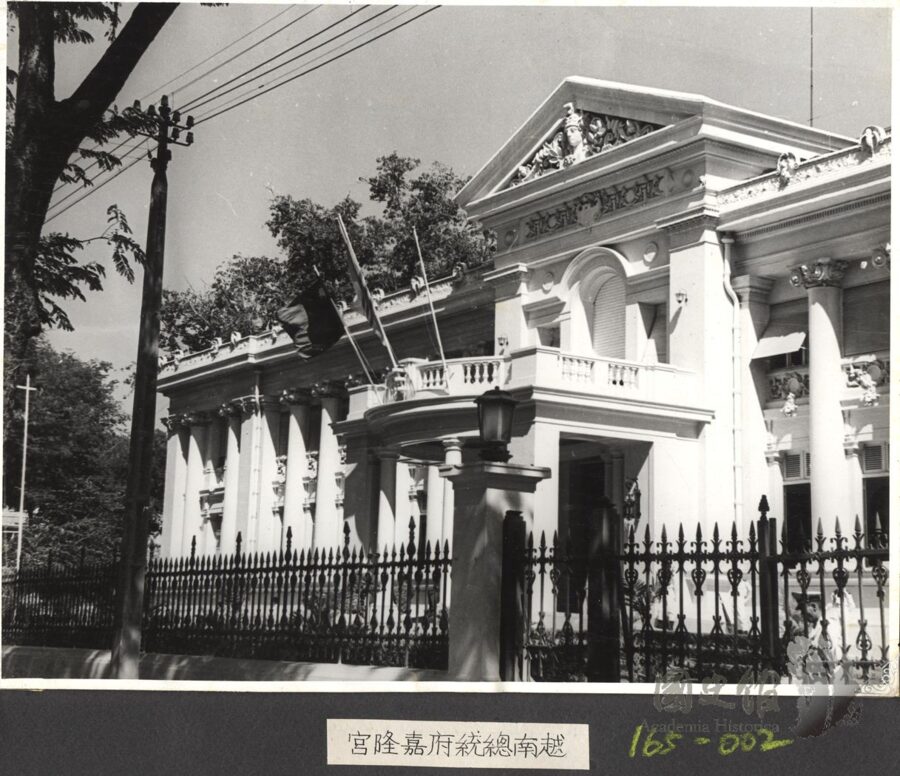
Its working life as the governor’s house was short. In 1887 Cochinchina was folded into the new Indochinese Union, the governor of Cochinchina was demoted to lieutenant governor and moved into a smaller house nearby, the building later known as Gia Long Palace, and the palace became the seat, and later the Saigon house, of the governor-general of all French Indochina. When the capital of Indochina moved to Hanoi in 1902, Norodom Palace kept the parades, the receptions and the visiting dignitaries.
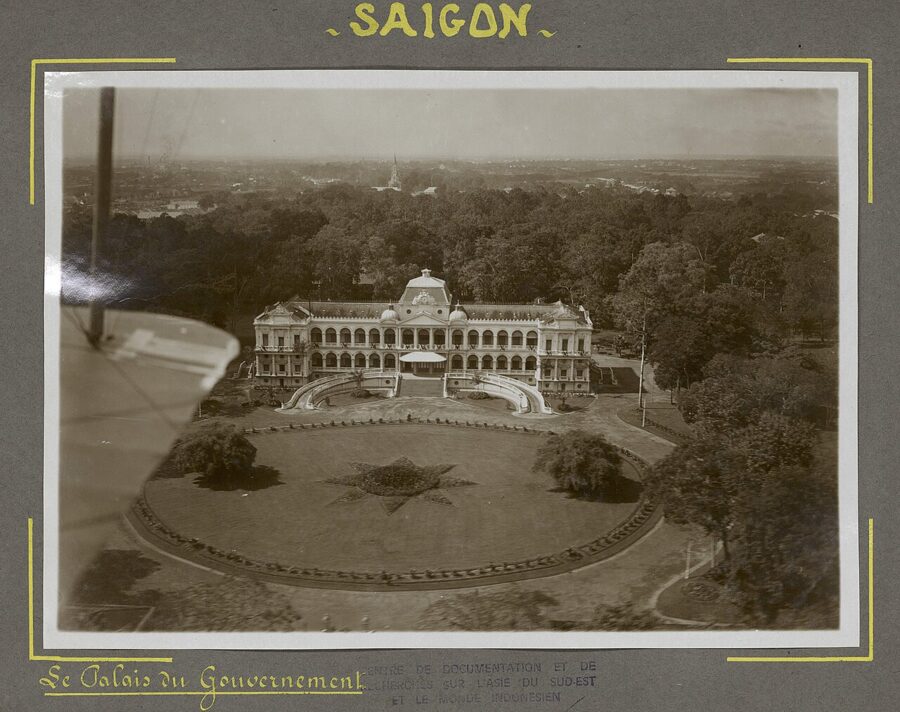
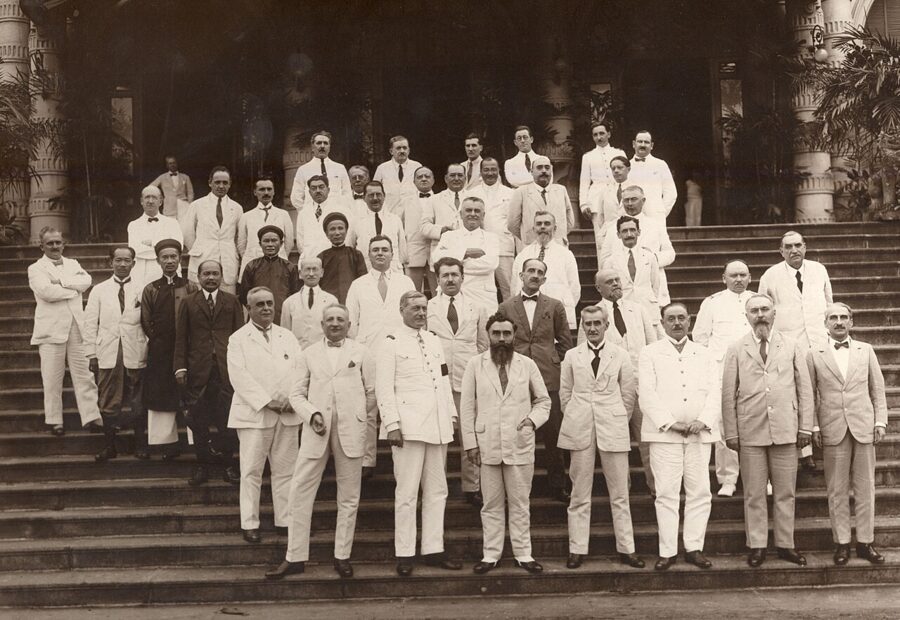
The Second World War broke the routine. On 9 March 1945 the Japanese overthrew the French administration across Indochina and took the palace. After Japan’s surrender, the French came back and stayed until the defeat at Điện Biên Phủ and the Geneva Accords of 1954.
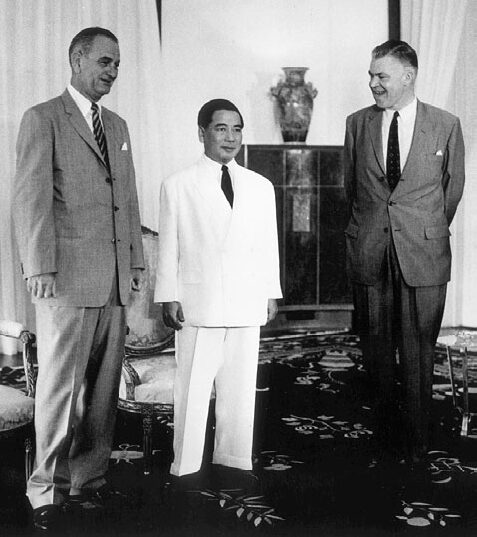
On 7 September 1954 General Paul Ely handed the palace to Ngô Đình Diệm, prime minister of the State of Vietnam, and it was renamed the Independence Palace; the palace’s own history gives the renaming as the next day, while other Vietnamese sources date it to 1955, when Diệm made himself president of the new Republic of Vietnam.
27 February 1962
At about 7am that day, two Republic of Vietnam Air Force pilots, Second Lieutenant Nguyễn Văn Cử and First Lieutenant Phạm Phú Quốc, peeled away from a mission over the Mekong Delta in their A-1 Skyraiders and attacked the palace with bombs, napalm, rockets and machine guns. Cử’s father, a leader of the nationalist VNQDD party, had been jailed by Diệm. Quốc had been decorated by Diệm as one of the best pilots in the air force.
One 500-pound bomb went through a room in the west wing where Diệm was reading and failed to explode. He and the Nhu family reached a cellar; Madame Nhu broke her arm on the way. Three palace staff were killed and about 30 injured.
Quốc was shot down over the Saigon River and arrested; Cử made it to Cambodia. Diệm told the country on the radio that he had been saved by divine protection.
The west wing was wrecked and the rest was judged beyond repair. Diệm ordered the old palace pulled down and a new one built on the same footprint, and moved his household a few blocks away to Gia Long Palace while it went up. That building, once the French lieutenant governor’s house, is now the Museum of Ho Chi Minh City, and it is worth the detour: it was from Gia Long Palace, not from here, that Diệm fled on the night of the 1963 coup.
A palace written in characters: Ngô Viết Thụ’s building
Ngô Viết Thụ was in his mid-thirties when he got the commission. Born in 1927 near Huế, he had studied at the École des Beaux-Arts in Paris and in 1955 won the Grand Prix de Rome, the first Vietnamese to take the prize, which bought him three years at the Villa Medici in Rome. Diệm invited him home in 1960. By the time of the palace he was also designing the university campus in Huế, the nuclear research center at Đà Lạt and Phủ Cam Cathedral in Huế.
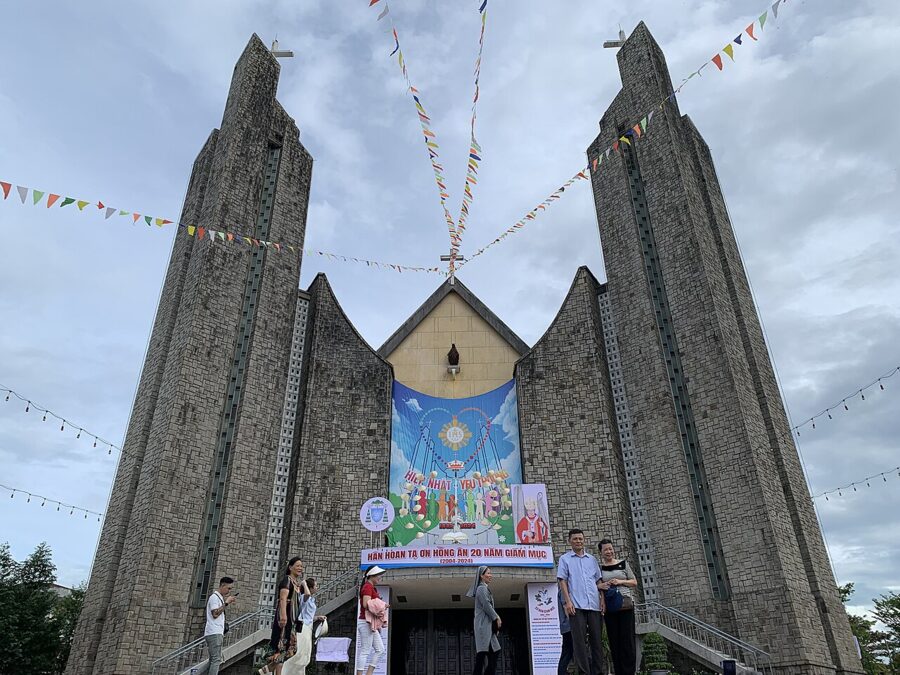

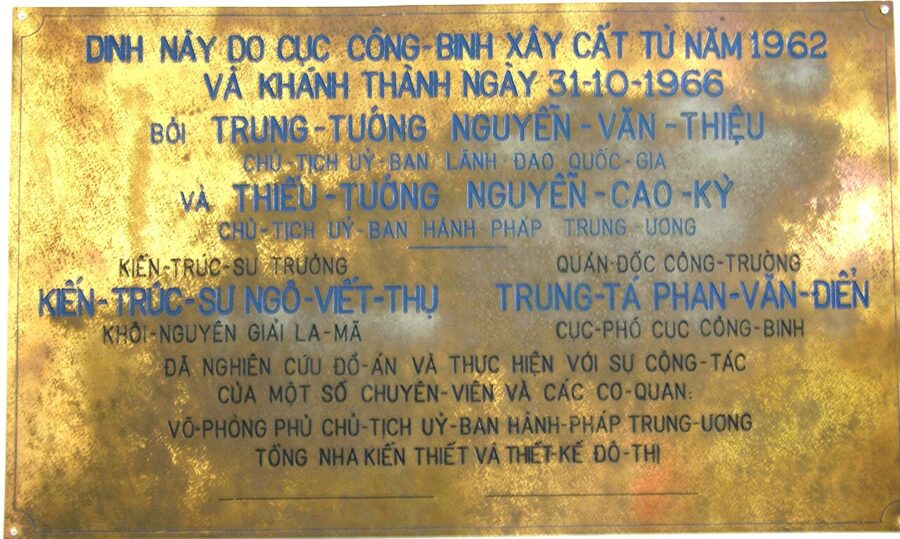
Construction began on 1 July 1962. It outlived the man who ordered it: on 1 November 1963 the army overthrew Diệm, and he and Nhu were killed the next morning, with General Dương Văn Minh at the head of the coup. Work stopped and restarted through a run of short-lived governments. The finished palace was inaugurated on 31 October 1966 by General Nguyễn Văn Thiệu, chairman of the ruling military committee, and Air Vice Marshal Nguyễn Cao Kỳ.

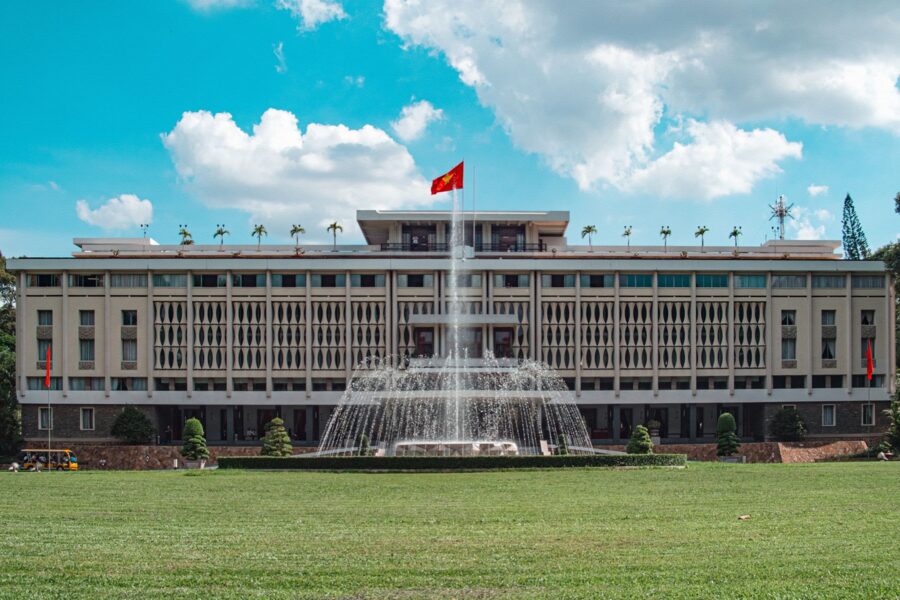
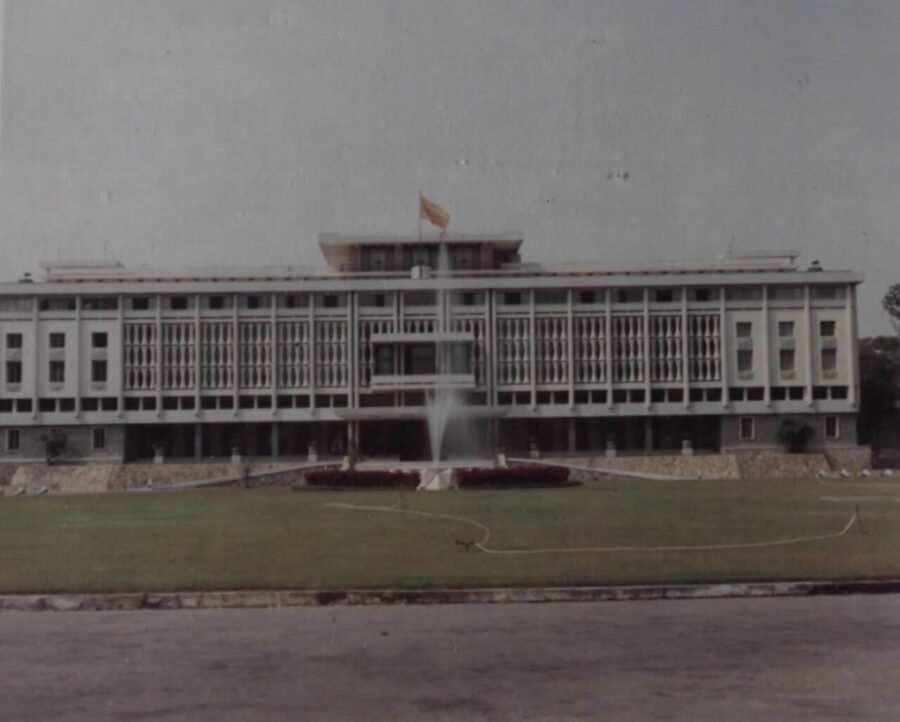
Vietnamese sources put the cost at 150,000 taels of gold, the most expensive building in the South in the 1960s. What the money bought is a long, low, very modern block, 26 meters high, with 4,500 square meters on the ground and about 20,000 square meters of floor in all, laid out over a basement, a ground floor, three main floors, two mezzanines and a roof terrace. The palace counts roughly a hundred rooms, each furnished for its use.
Reading the façade
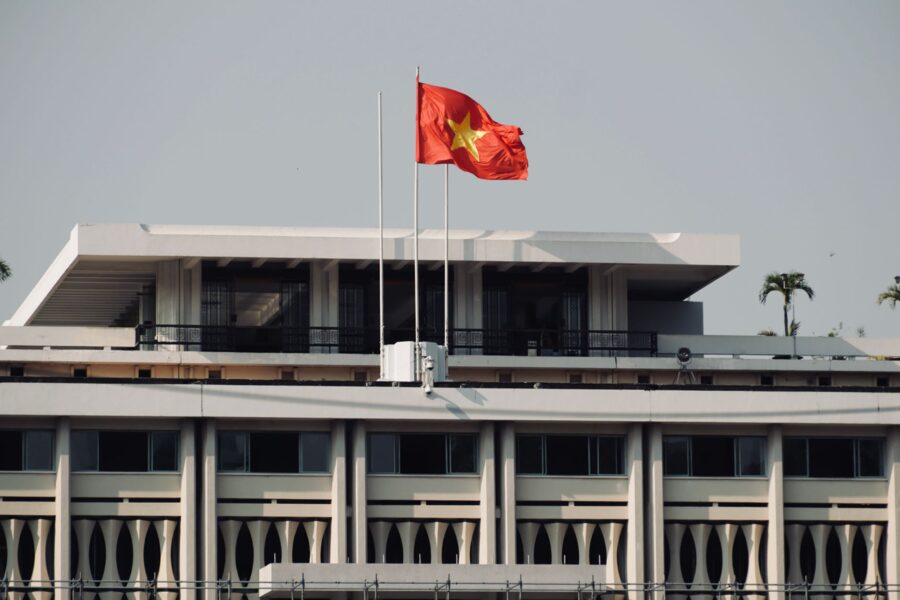
Ngô Viết Thụ wrote meanings into the building that you can read once someone shows you where to look. The palace’s own description sets them out. Seen from above, the plan forms the Chinese character cát (吉), good fortune. The roof pavilion is the character khẩu (口), a mouth, standing for education and free speech; with the flagpole through it, it becomes trung (中), loyalty.
On the front, the three horizontal lines of the roof eaves and balconies make tam (三), read as the three virtues of nhân, minh and võ (humanity, wisdom, courage). Join them with a vertical stroke and you get vương (王), the king; add the flagpole on top and it becomes chủ (主), sovereignty. The whole façade, balconies, eaves and the two wooden columns together, is meant to read as hưng (興), prosperity. The architect’s son, the architect Ngô Viết Nam Sơn, has described the façade as his father’s message about Vietnamese sovereignty.
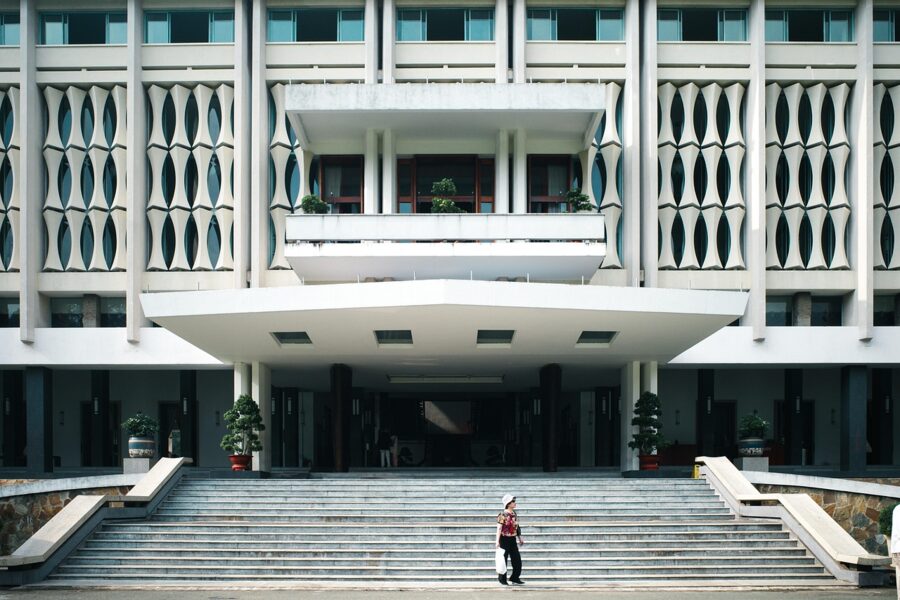
The detail most people walk past is that stone screen. It wraps the second floor in rows of tall concrete panels shaped like sections of bamboo, borrowed, the palace says, from the carved bàn khoa doors of the imperial palaces in Huế. It is also the building’s air conditioning before the air conditioning: the screen shades the glass walls behind it and filters the light that reaches the corridors.
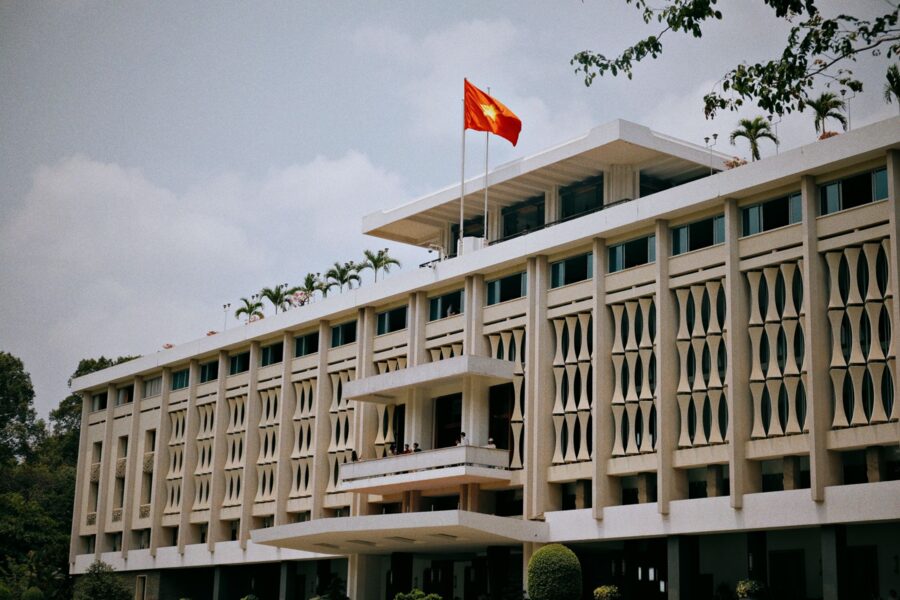
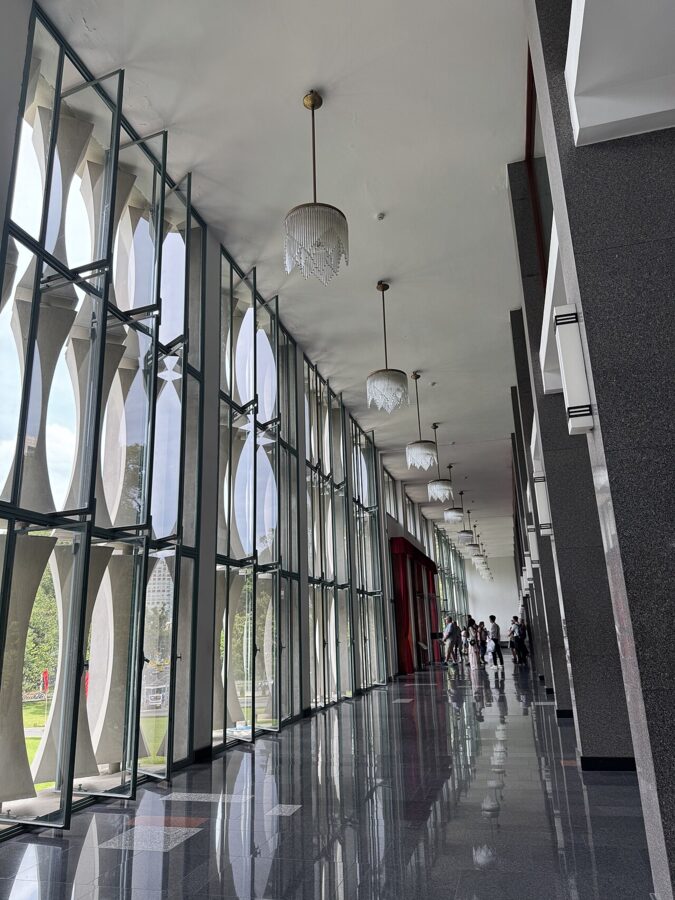

The other pieces of the old repertoire are water and roofs. Across the front of the main hall runs a semicircular pond planted with lotus and water lilies, a nod to temple and pagoda courtyards. And instead of curving tiled eaves, Ngô Viết Thụ gave the building flat concrete roofs with a slight upward hollow, a modern line that still remembers the old one.
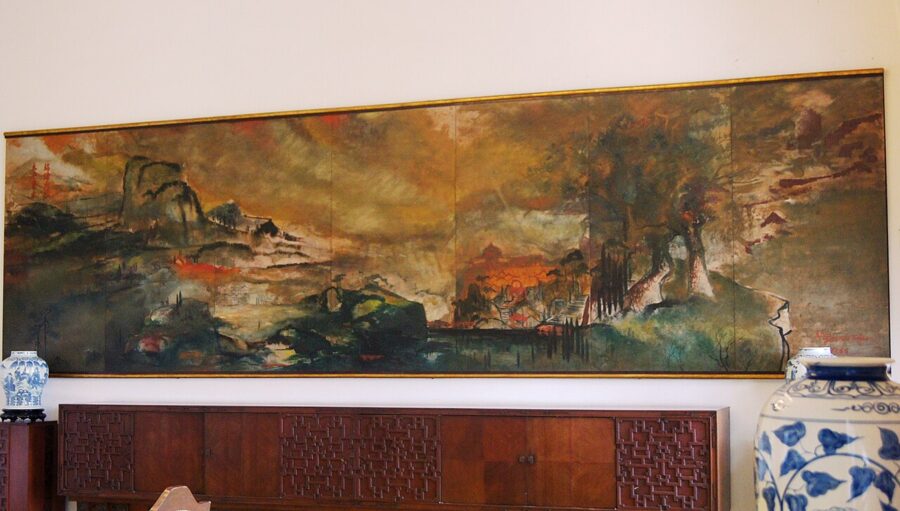

Inside the palace, floor by floor
The palace runs a free route marked with signs and about 35 information panels in Vietnamese, English and French, designed in a revamp with French and Vietnamese consultants. Ropes keep you to the edges of most rooms. The order below goes from the ground floor up to the roof and then down to the basement.
The ground floor: the state rooms
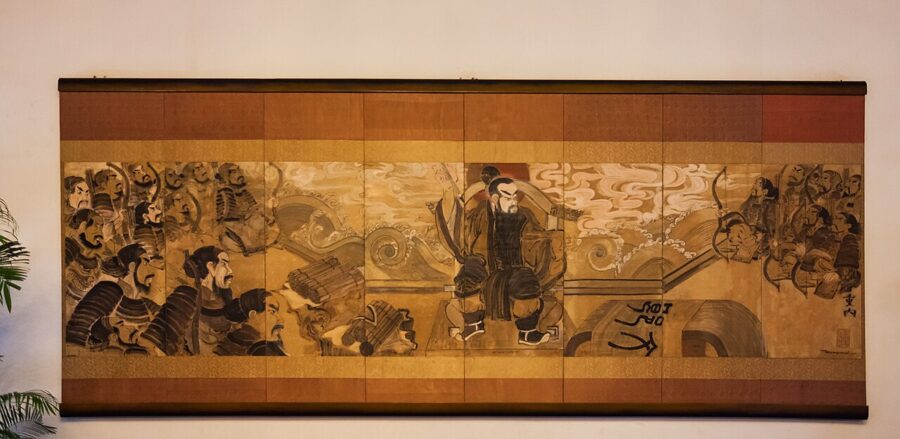
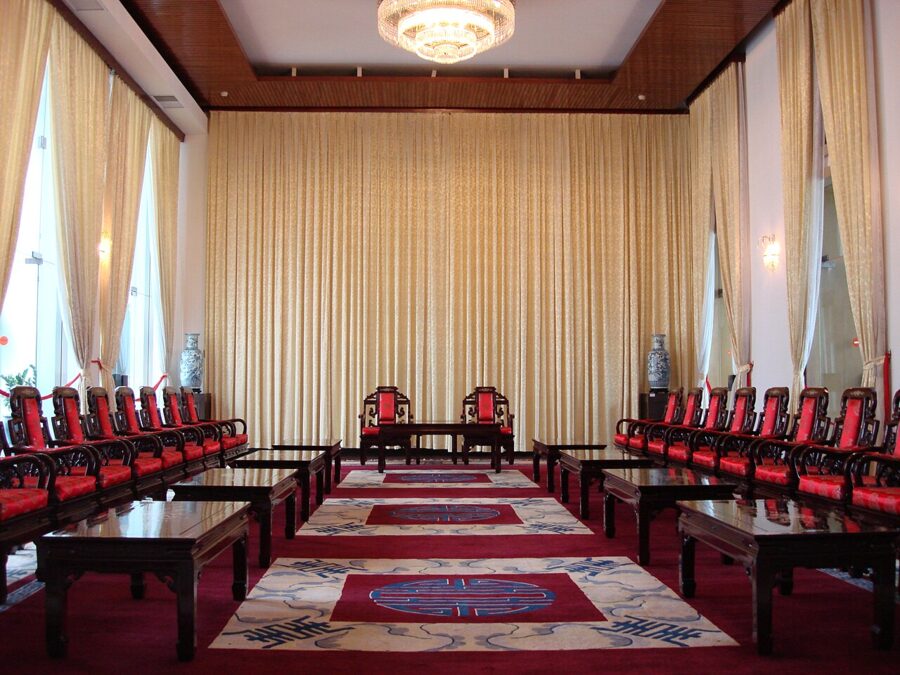
The biggest room is the conference hall, the reception hall known in Vietnamese as phòng Khánh tiết, with rows of chairs on a red carpet and space for several hundred people. On its wall hangs a painting by Trần Trọng Nội from 1966 of the Hùng King, the legendary founder of the first Vietnamese state, a choice of subject that both the republic and its successor could live with.
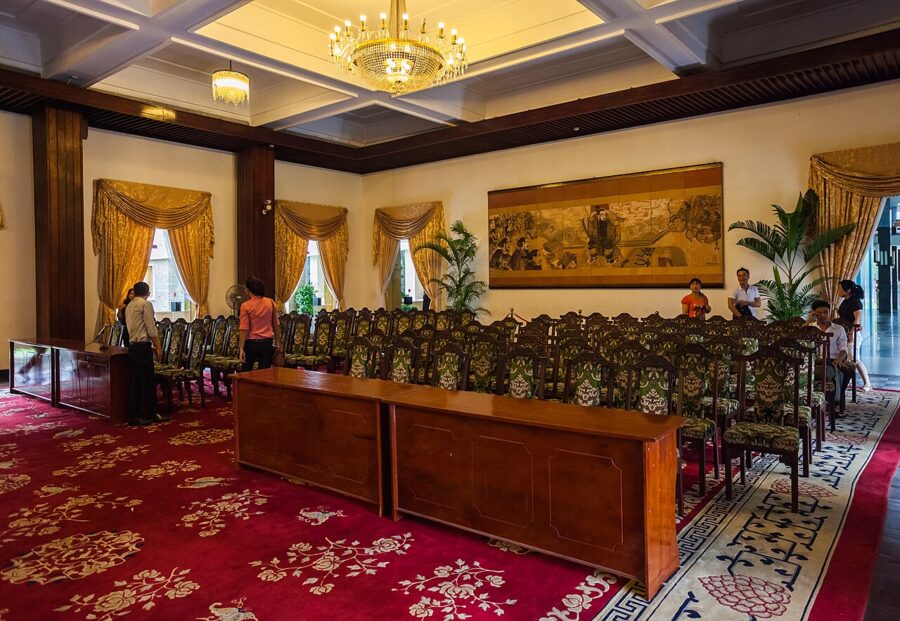


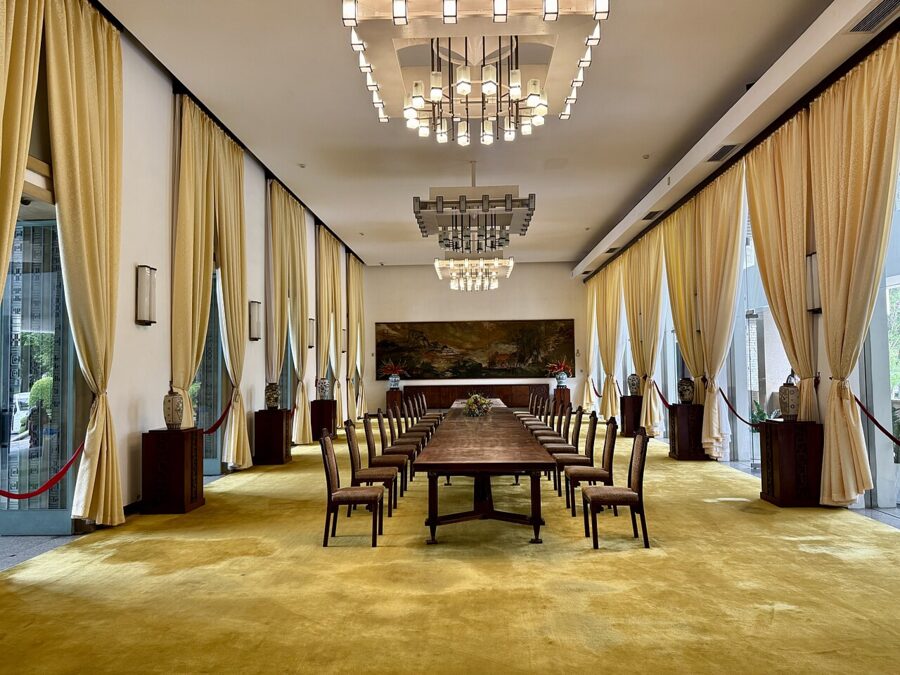
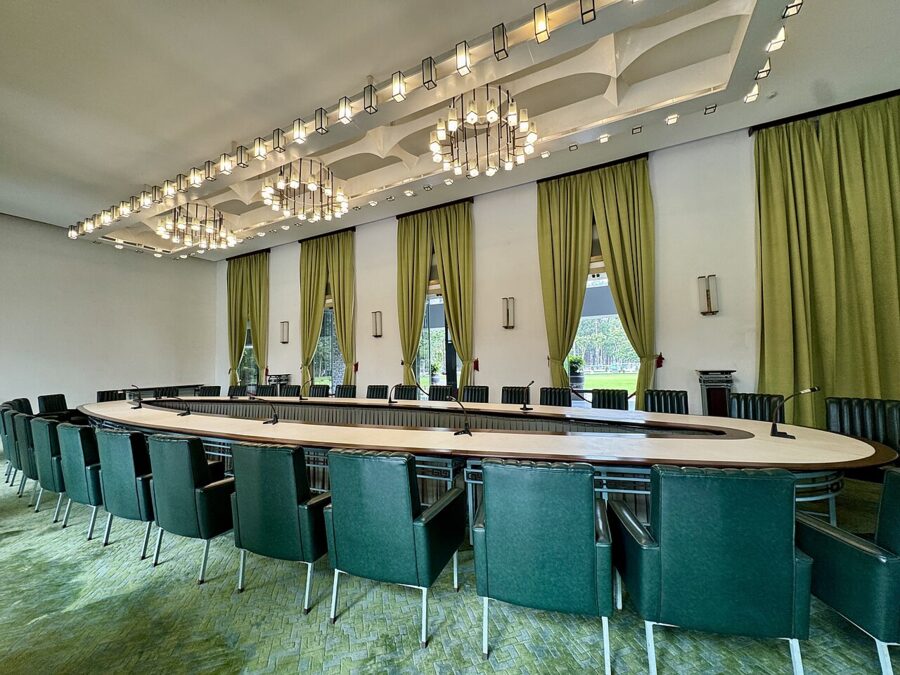
Next door is the State Banquet Room, phòng Đại Yến, with Ngô Viết Thụ’s own Sơn Hà Cẩm Tú at the far end of a long table. Then the Cabinet Meeting Room, a long oval table ringed with green chairs, where the ministers of the Republic of Vietnam met under the president.


One floor up: the president’s rooms
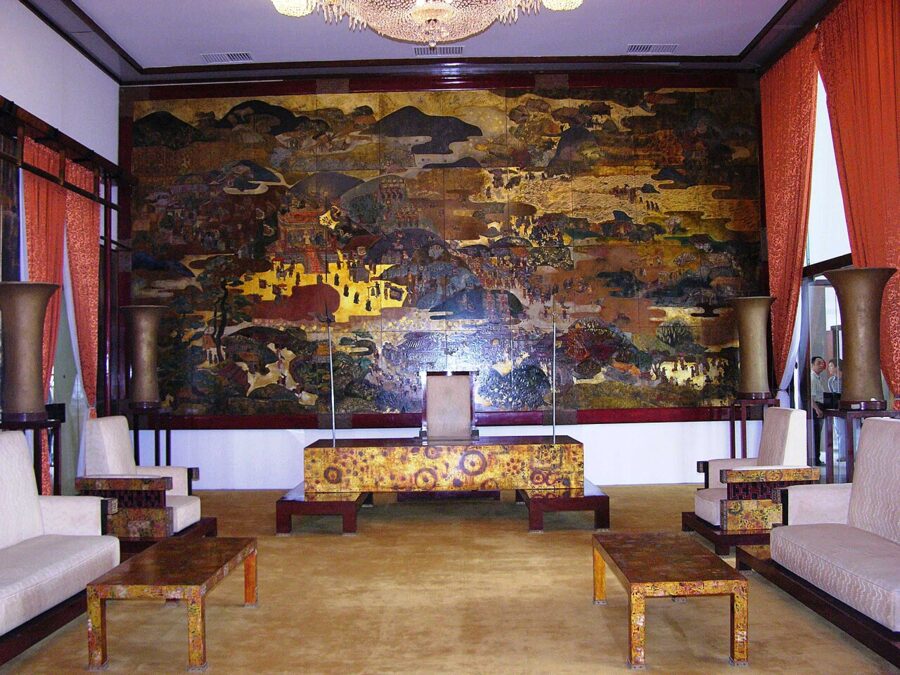
At the center of the building, the palace says, is the Credentials Presenting Room, where new ambassadors handed over their letters. A lacquer panel fills the end wall in gold, red and black, and white sofas line the sides of the room.

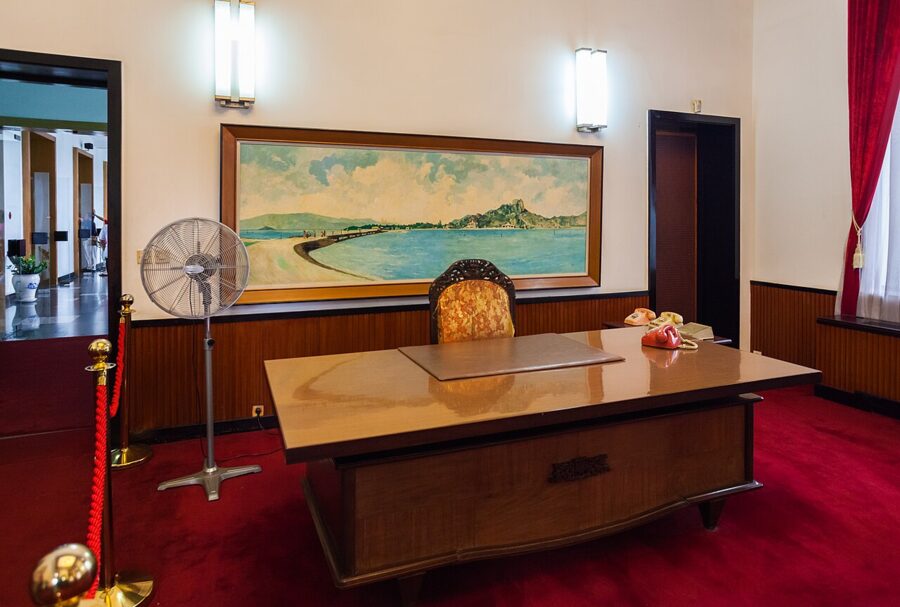
Around it are the working rooms of the presidency. The President’s Office has a wide wooden desk and a painting of the coast behind the chair. In the President’s Reception Room, according to the palace, his own chair stands higher than the rest, with a wooden panel behind it in the yellow and red stripes of the old national flag; his chair and the one for the chief guest are carved with dragon heads, while the chairs for secretaries carry phoenixes or the character thọ, longevity.


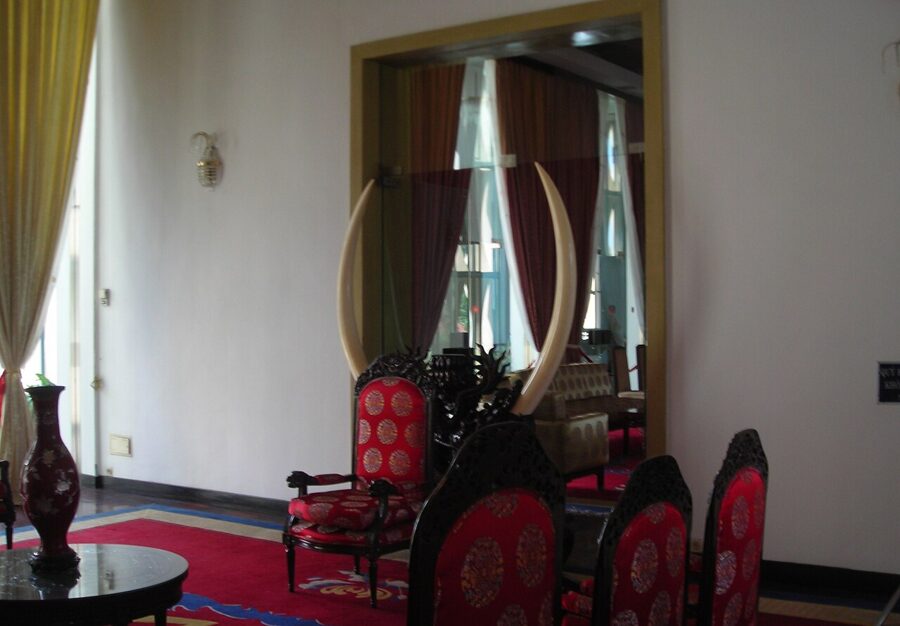
Look out for the hunting trophies. A pair of elephant tusks stands at the doorway between the president’s two reception rooms, and elephant feet, a stuffed Indochinese leopard and mounted heads appear in rooms on several floors. They say a good deal about how a head of state furnished his house in 1960s Saigon.
Elsewhere on the route, the Ambassador Chamber seats more than a hundred and was used for formal receptions; on 31 October 1967 it hosted the banquet for the inauguration of Thiệu and Kỳ as president and vice-president.
The family floors
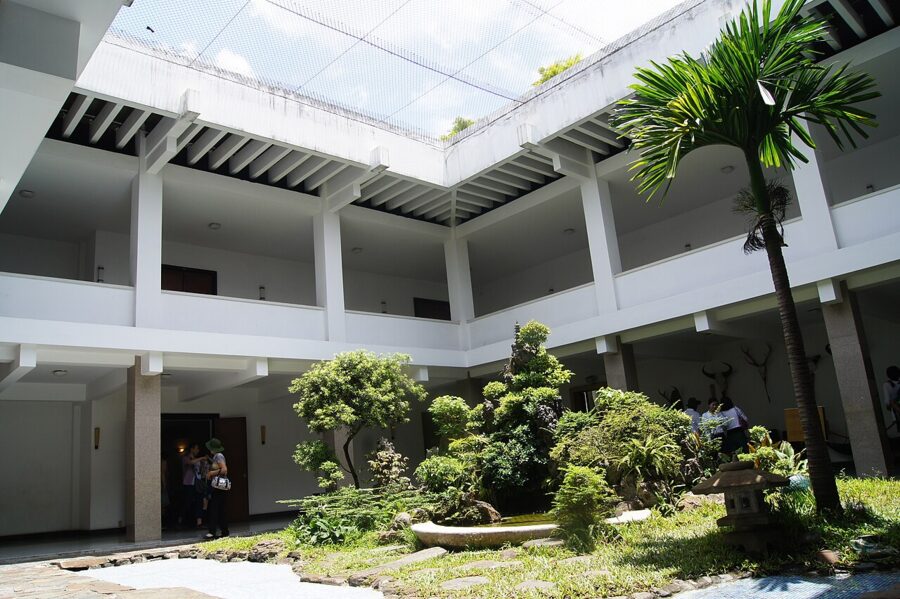
The higher you go, the more domestic it gets. The First Lady’s reception room, used by Nguyễn Thị Mai Anh, Thiệu’s wife, has a round sofa and a mahjong table. The family’s private rooms are on the upper floors, and on the second floor an open courtyard planted with palms and a rock garden sits in the middle of the building.
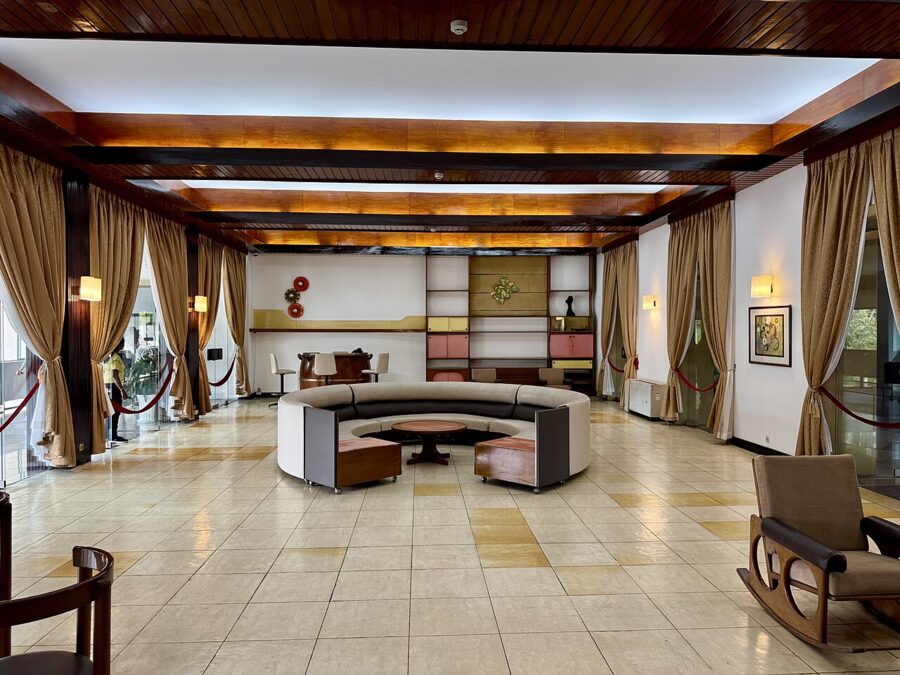


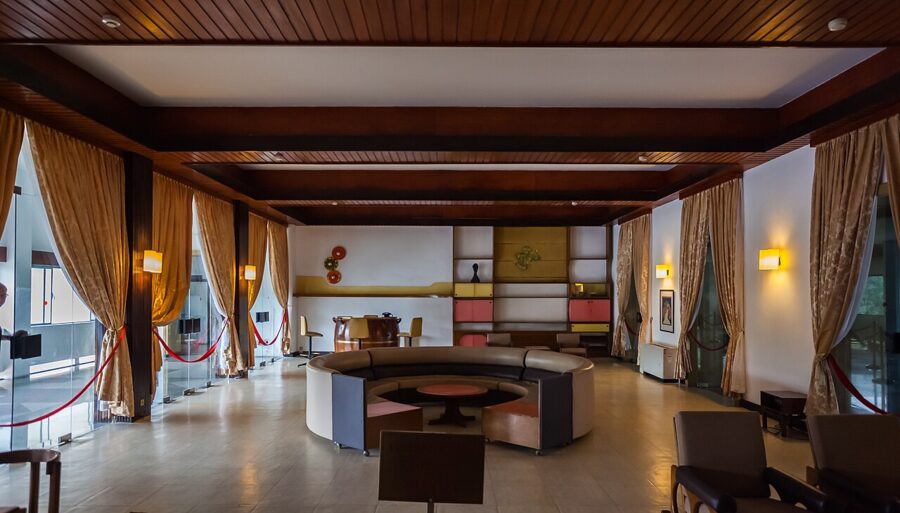
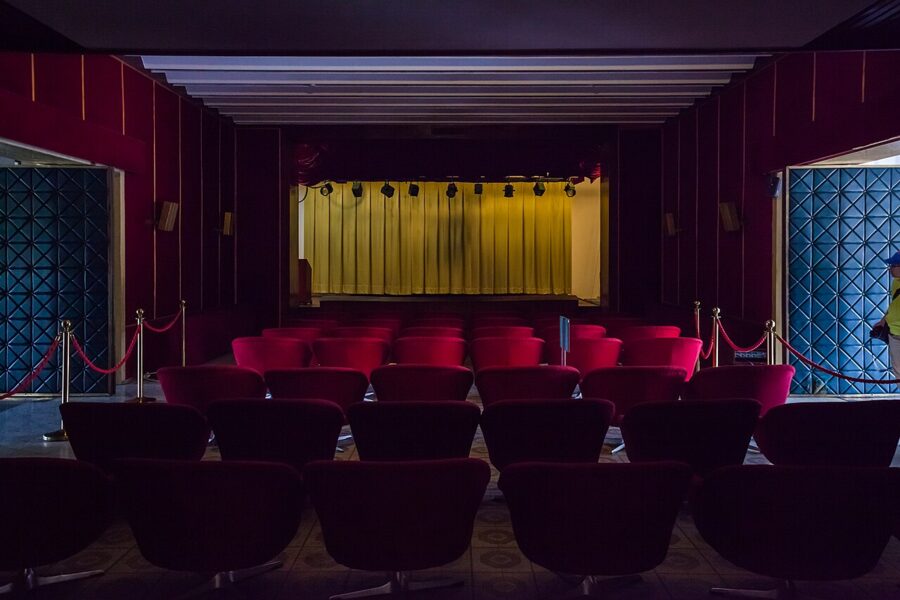
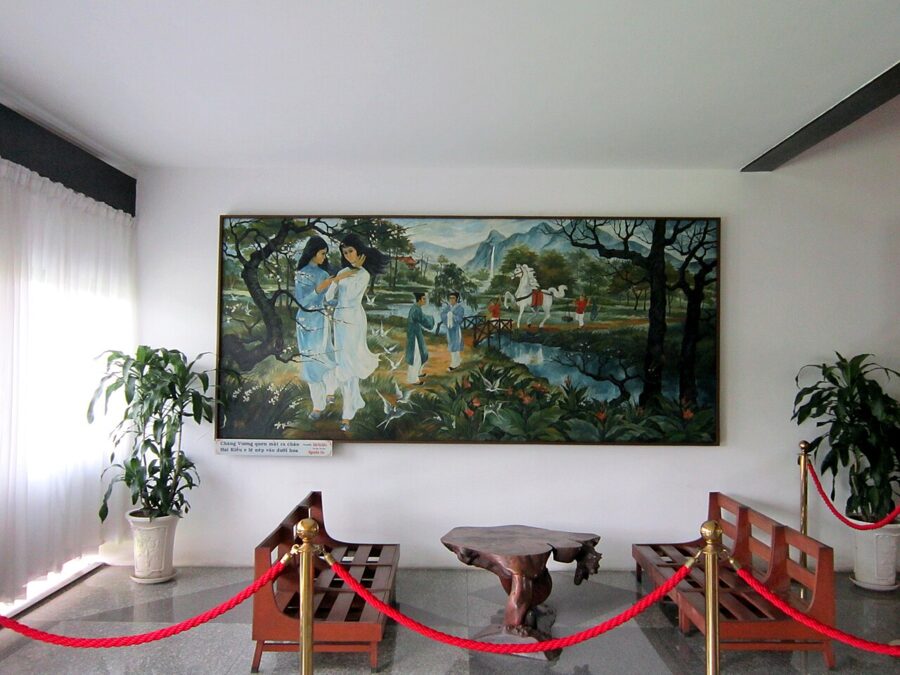
The third floor was where the palace relaxed. The recreation room has a curved sofa and card and mahjong tables. Next to it is a small private cinema with rows of red seats and its projector still in place. Also on the third floor hangs a large painting by Lê Chánh of the scene from the Tale of Kiều in which Kim Trọng first meets Thúy Kiều and her sister.



The top pavilion and the roof
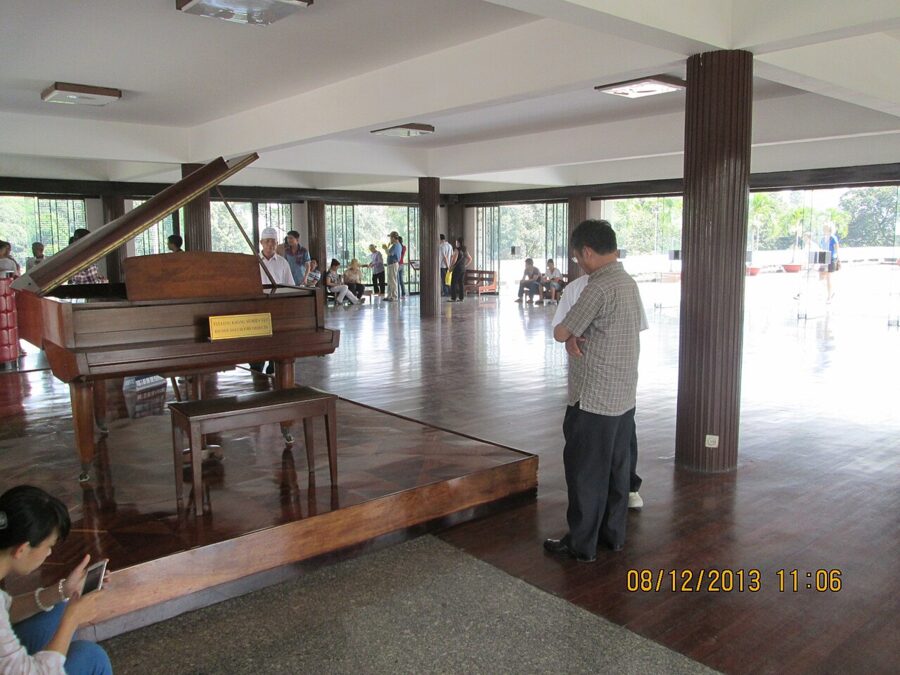
The square pavilion on top, the khẩu of the façade, is called Tứ Phương Vô Sự, “peace in all four directions”. The top floor also holds an open-sided hall with a grand piano on a low stage, and from here you step out onto the roof terrace.
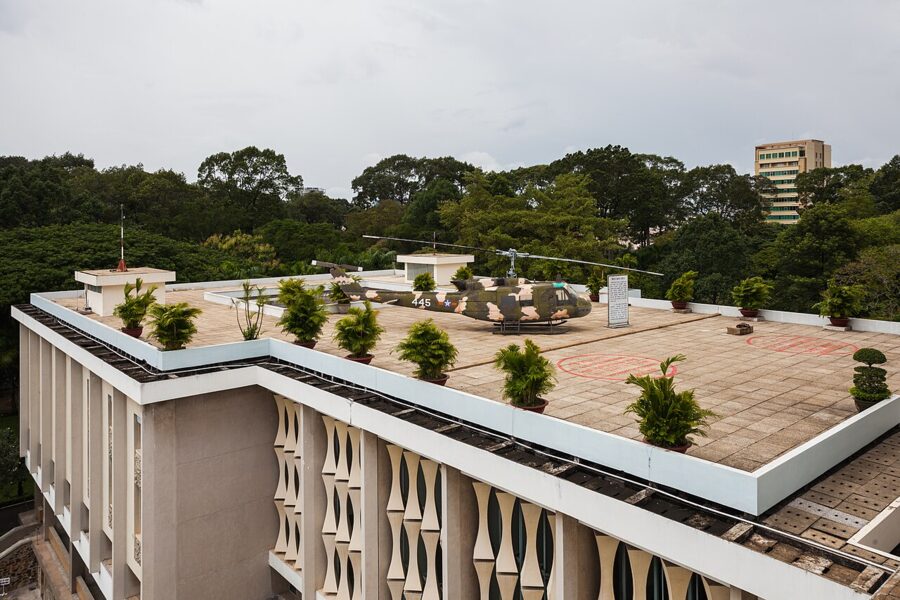
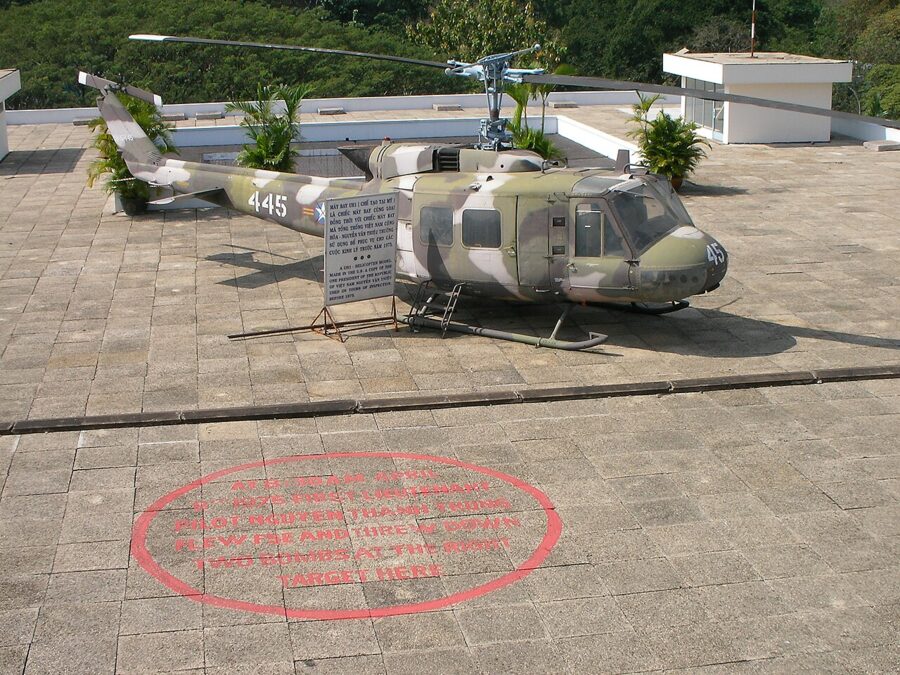
On the helipad sits a Bell UH-1 helicopter of the kind kept here to fly the president out in an emergency. Two red circles painted on the concrete mark where bombs hit on 8 April 1975, when Nguyễn Thành Trung, a South Vietnamese air force pilot who was secretly working for the communists, broke away from his squadron in an F-5E and attacked the palace. His own account, published by the palace, says his first two bombs landed in the garden and he came round again; one of the next hit the roof. The palace describes the damage as minor: the bomb only partly detonated and caused a local collapse.


The basement: bunker and war room
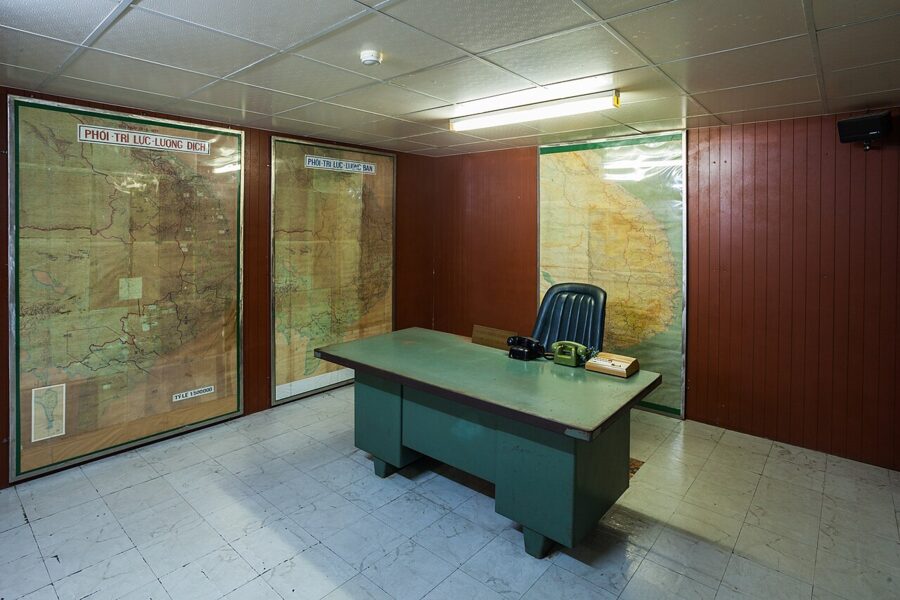
The basement is the part people remember. It was designed by the engineer Phan Văn Diễn, the same man named on the foundation plaque, and built to take heavy bombs: a reinforced structure about 72.5 meters long, its rooms joined by narrow concrete corridors with their own ventilation. There is a war room with large military maps still on the walls, a working room for the president and a bedroom.

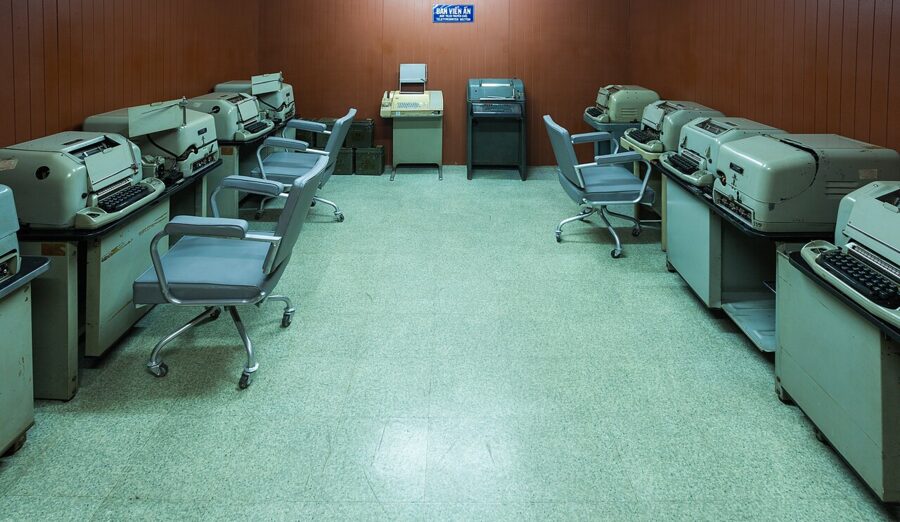
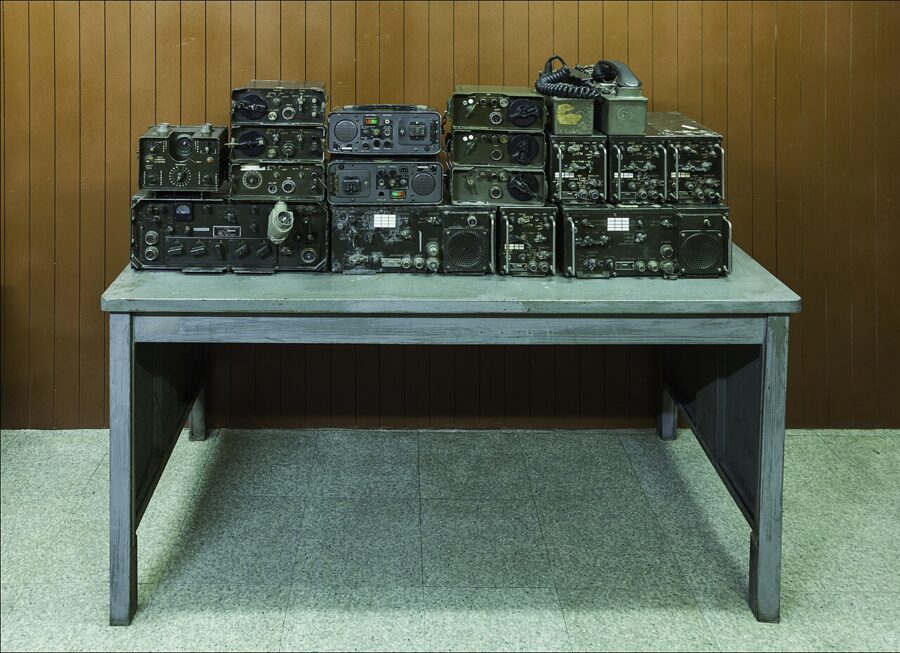
The rest of the basement is communications. A report in VietTimes from May 2025 describes a center that received, relayed and encrypted telegrams and served as a backup to the ground radio network, run by 41 people, among them 21 telegraph operators and six teleprinter operators, with a 45-meter antenna tower in the grounds. The rooms are lined with teleprinters, radio sets and telephone switchboards, many of them American military equipment, all of it switched off since 1975.


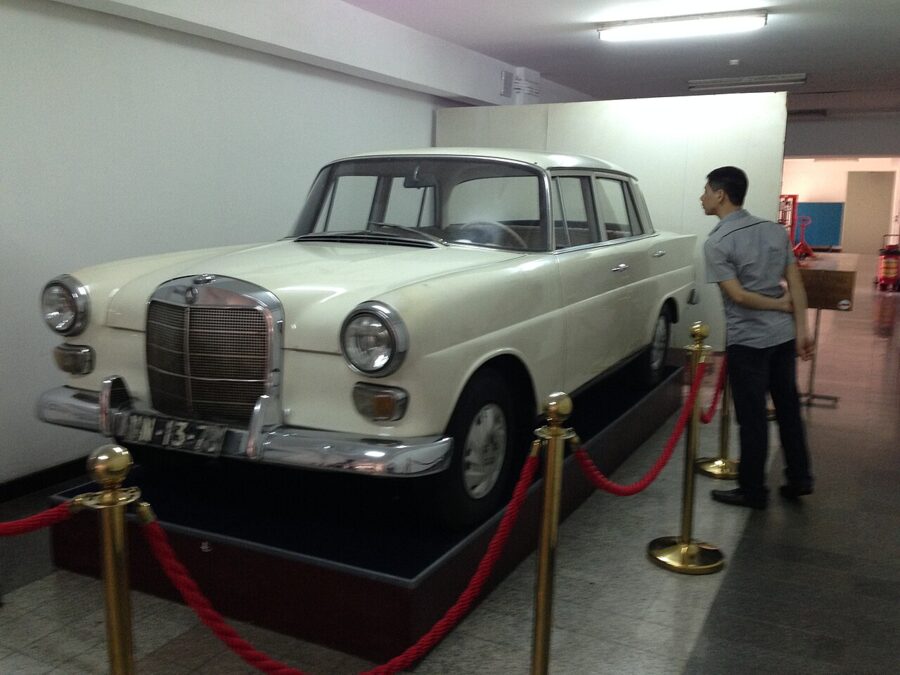
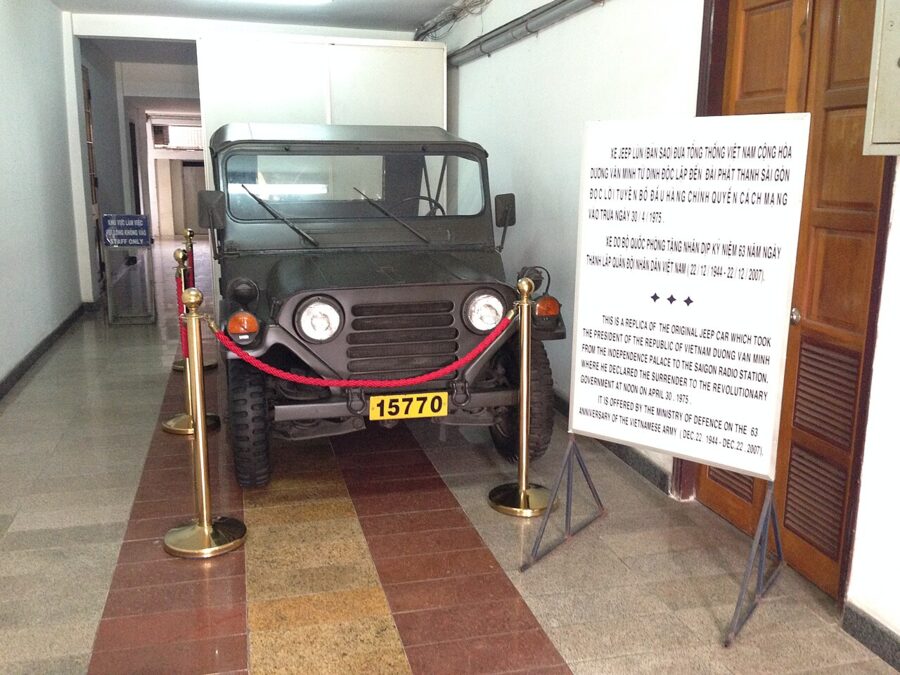
When you come up from the basement at the back of the building you pass two vehicles. One is a Mercedes-Benz 200 from the W110 series, built in West Germany in the 1960s and used by Thiệu; it was captured at the army’s General Staff headquarters on the morning of 30 April and first shown at the palace in 1995. The other is an M151A2 jeep, which the palace presents as the vehicle that took Dương Văn Minh to the radio station on 30 April to read the surrender.


30 April 1975
No president lived in the new palace longer than Nguyễn Văn Thiệu, who moved in in October 1967. By the spring of 1975 his armies were collapsing. Buôn Ma Thuột was attacked on 10 March and lost within days, Huế fell on 26 March and Đà Nẵng on 29 March; on 21 April the last line of defense at Xuân Lộc gave way. That evening, at 7:30pm, in the state room of the palace and in front of senators, deputies, judges of the supreme court, the cabinet and the generals, Thiệu read his resignation.
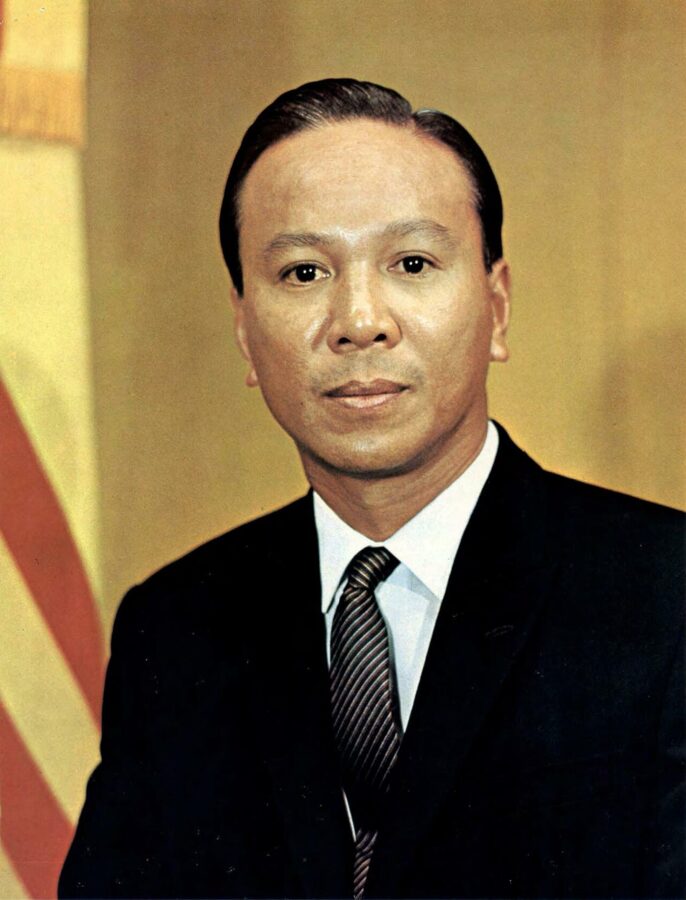
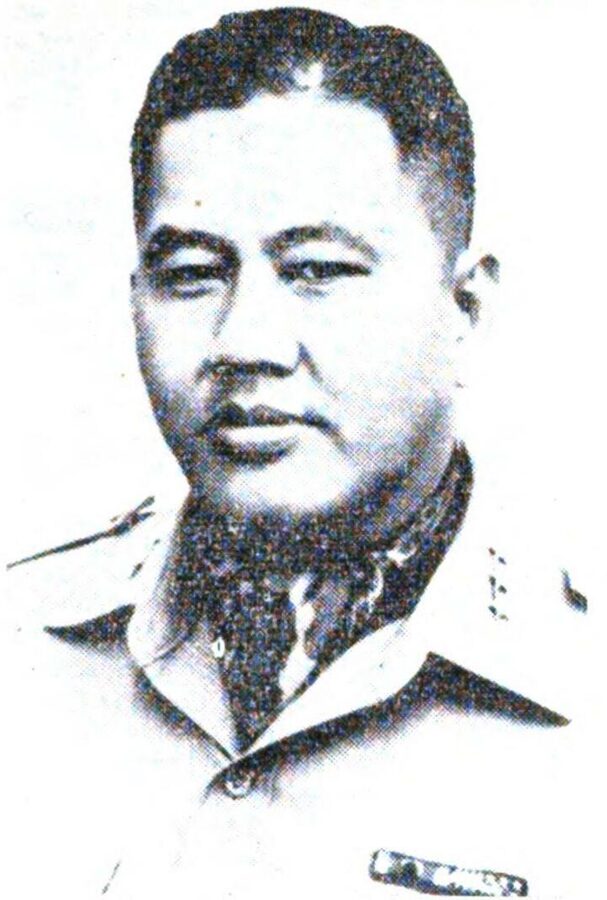
He handed power to his vice-president, Trần Văn Hương, and left the country within days. On 28 April at 4:45pm, in the palace, Hương passed the presidency to General Dương Văn Minh, the officer who had led the coup against Diệm twelve years earlier, in the hope that Minh could negotiate. Hanoi had no interest in negotiating.
The gates
On the morning of 30 April Minh spoke on Saigon radio, ordering South Vietnamese troops to stop fighting and stay where they were while the government waited to hand over power. Sources time the broadcast between about 9:30am and 10:24am. Then he and his cabinet sat down in the palace to wait.
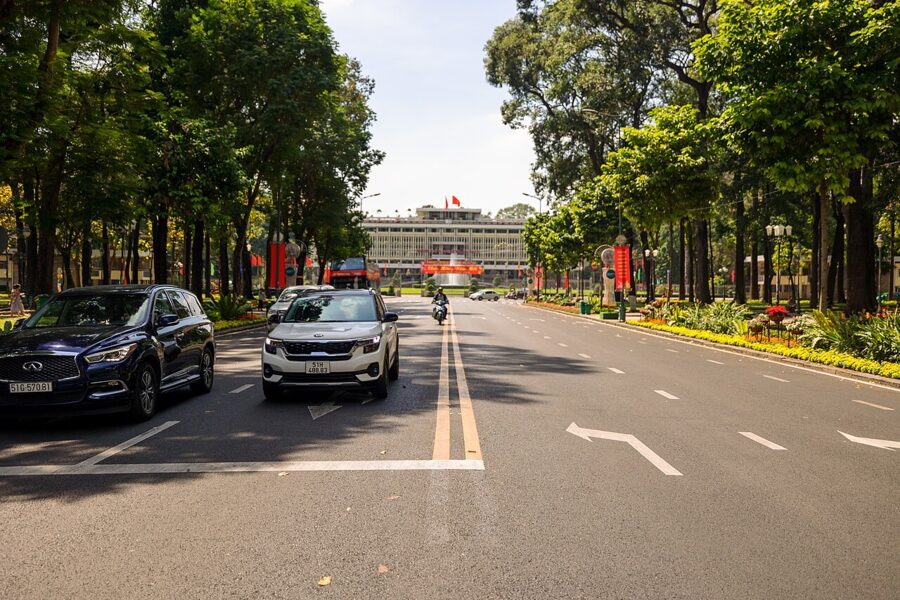

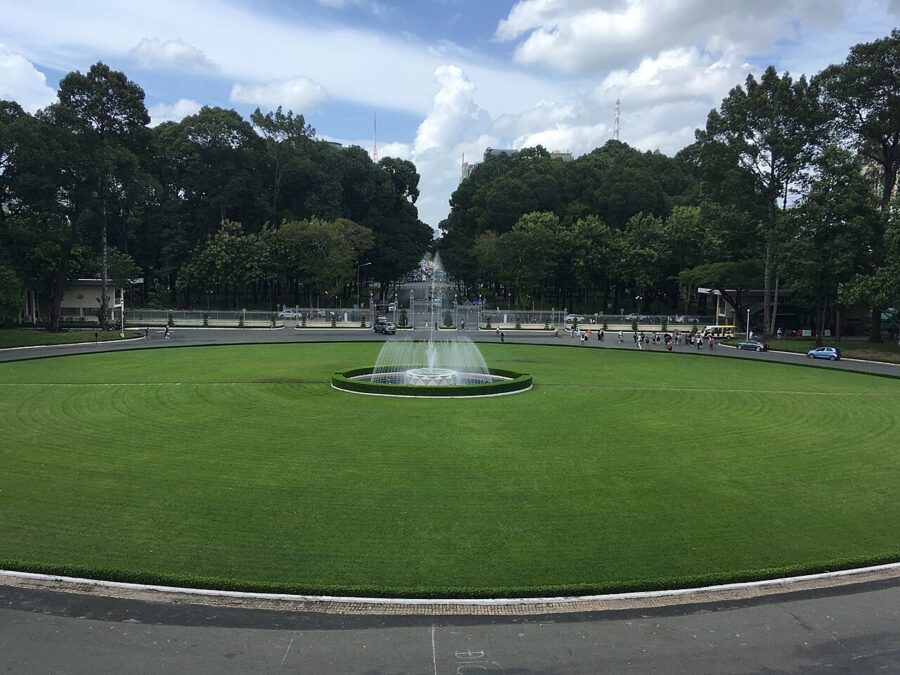
The tanks of the 203rd Brigade came down Thống Nhất Boulevard, the street now called Lê Duẩn. At 10:45am, by the palace’s account, tank 843, a Soviet-built T-54 commanded by Lieutenant Bùi Quang Thận, rammed the side gate and stuck. Behind it, tank 390, a Chinese-built Type 59 commanded by Vũ Đăng Toàn, drove straight through the main gate onto the lawn. Thận ran into the building with a flag and at 11:30am raised the red and blue banner of the National Liberation Front over the roof.
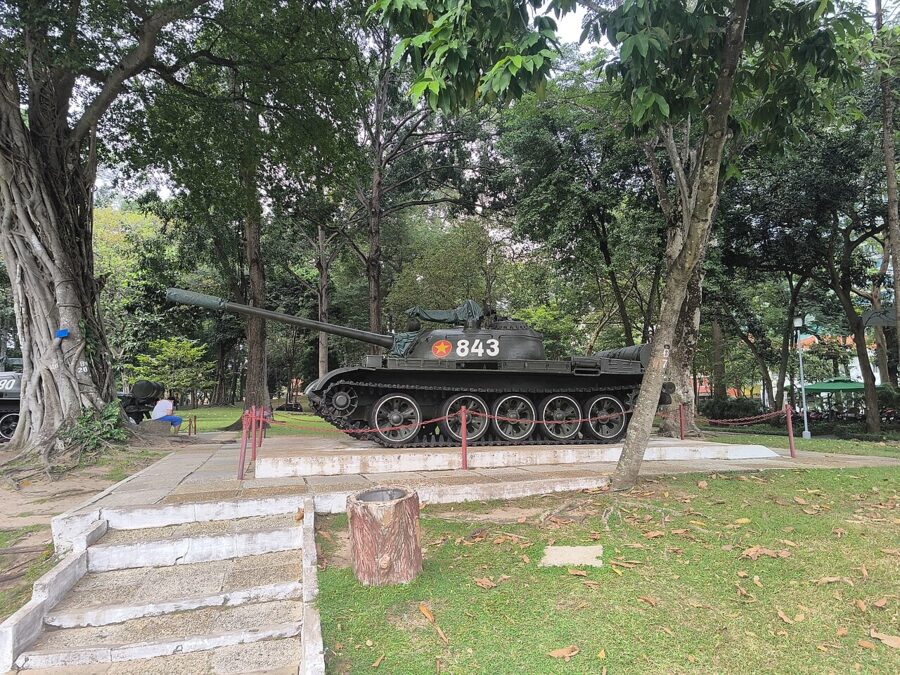

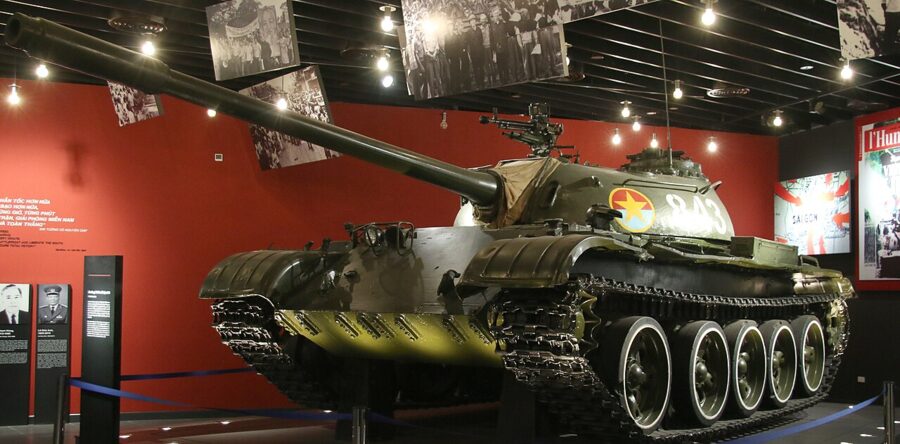

For twenty years the official story said 843 was the first tank through the main gate, because its commander raised the flag. In 1995 photographs taken that noon by the French photographer Françoise Demulder showed tank 390 inside the main gate while 843 was still caught at the side entrance. Vũ Đăng Toàn, asked years later how he felt about the correction, said that history happens once and his crew had been lucky to be chosen. The palace now tells it Demulder’s way.
His own memory of the order was short. His driver, Nguyễn Văn Tập, asked him what to do in front of the closed main gate, and Toàn told him to crash through it.
The surrender
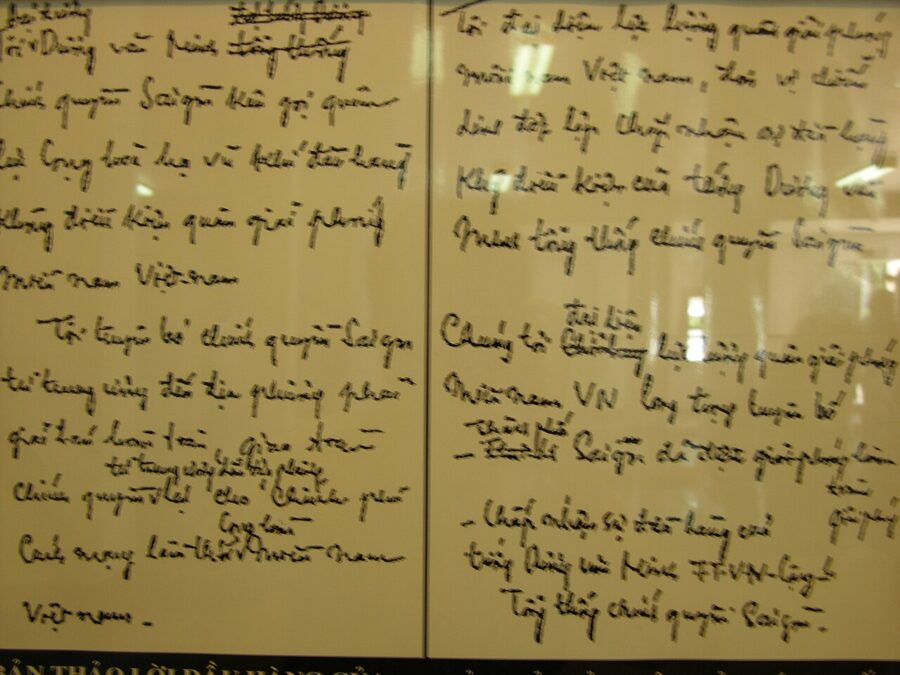
Inside, Minh and his ministers were waiting in a meeting room. The political commissar of the brigade, Lieutenant Colonel Bùi Văn Tùng, arrived soon after the first tanks. Minh is usually quoted as telling him that they had been waiting to hand over the government; Tùng’s reply, as it is usually recorded, was that Minh had nothing left to hand over and could only surrender unconditionally. Tùng wrote out a statement, and Minh and his prime minister, Vũ Văn Mẫu, were driven to Radio Saigon to record it.
The surrender went out in the early afternoon; the palace dates the broadcast to about 1:30pm, other accounts to 2:30pm. Minh called on the army of the republic to lay down its arms and declared the Saigon government dissolved at every level. The German journalist Börries Gallasch recorded it on his own tape recorder. The handwritten texts of the surrender and its acceptance have been shown in the palace.
What each side records
Even the small facts of that morning are contested. Times differ by an hour depending on whose account you read. For years the colonel and journalist Bùi Tín was named in Western books as the officer who took Minh’s surrender, a version he himself gave in a 1981 interview before he defected to France; in his later memoir he credited Bùi Văn Tùng. The palace tells the day through the soldiers on the tanks.
In Vietnam, 30 April is the Day of the Liberation of the South and National Reunification, a public holiday, and the palace is its main stage: for the 50th anniversary in 2025, a grandstand went up on Lê Duẩn in front of the gates for the parade. Many Vietnamese families who left after 1975, and their descendants abroad, call the same day Black April or the day the country was lost.
Western books mostly call it the fall of Saigon. The rooms upstairs belong to the government that lost, presented by the government that won, and it is worth reading the panels with that in mind.
After 1975: the Reunification Hall
The palace kept working. In November 1975 the political consultative conference between North and South on reunification met here, which is where the name Hội trường Thống Nhất comes from; formal reunification followed on 2 July 1976, when Saigon was also renamed Ho Chi Minh City. On 25 June 1976 the palace was listed as a national historic and cultural site. It opened to tourists in 1990 and on 12 August 2009 became one of the first ten sites in Vietnam classed as a Special National Monument.
It still hosts state receptions, conferences and official ceremonies for the city and the national government, and it is the setting for large anniversary programs: in April 2025 alone the hall staged several televised concerts and received the prime minister of Spain. It is also one of the busiest sights in the city. The managing office reported nearly 1.5 million visitors in 2024.
The grounds
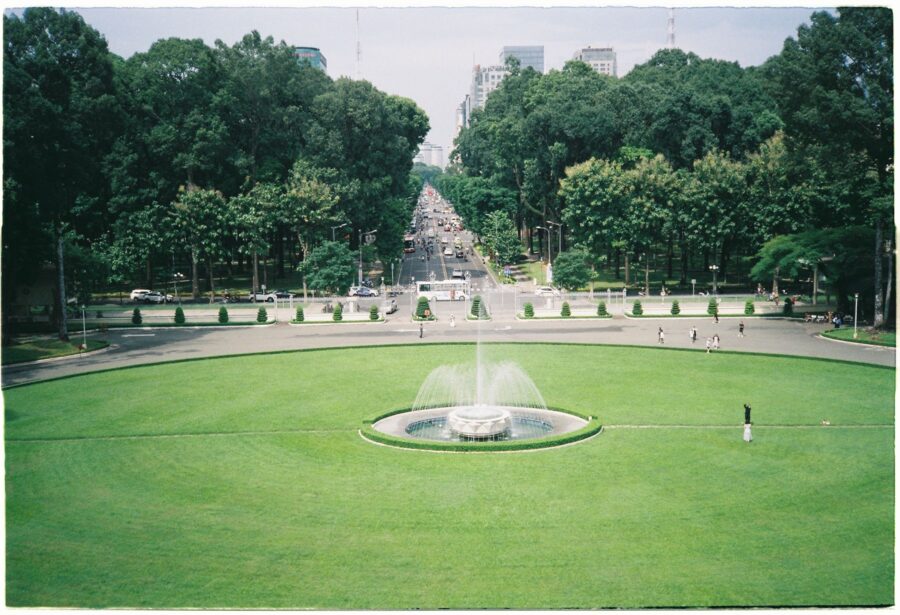
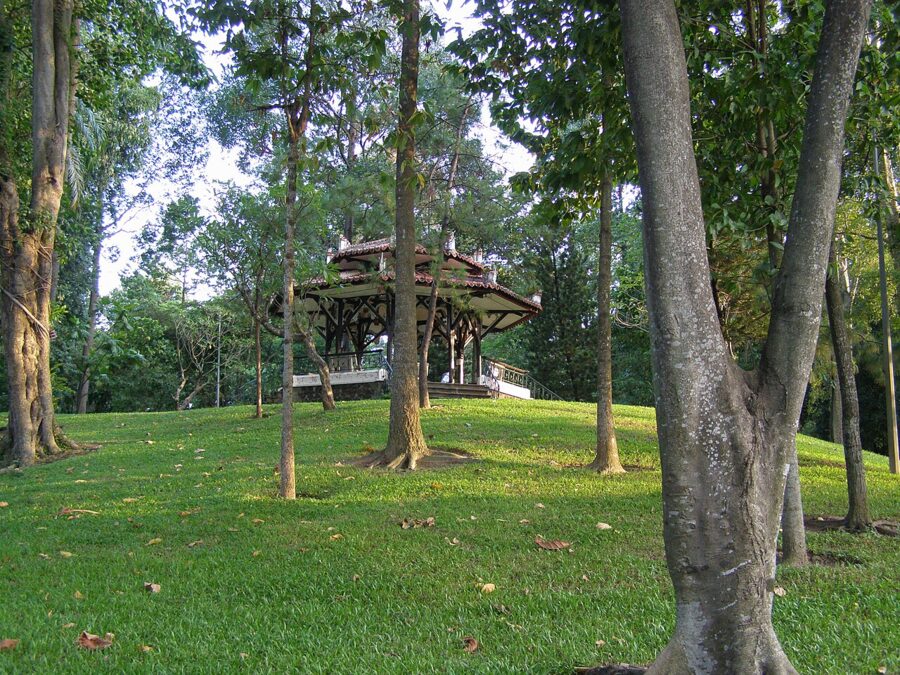
The grounds cover 12 hectares, bounded by Nam Kỳ Khởi Nghĩa, Nguyễn Du, Nguyễn Thị Minh Khai and Huyền Trân Công Chúa streets. Old trees shade most of the edges, and your ticket covers the gardens as well as the building.
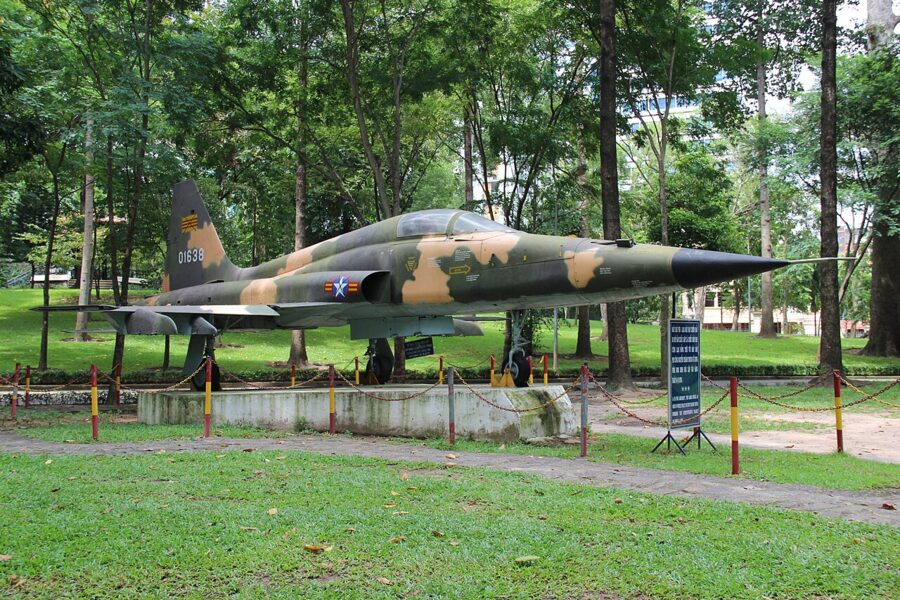
Besides the two tanks there is an F-5E Tiger II fighter in the camouflage of the South Vietnamese air force, the same type Nguyễn Thành Trung flew on 8 April 1975. Aircraft registers give its serial as 73-01638; Vietnamese captions link it to Trung’s raid, but an independent record that this is the very aircraft is hard to find.


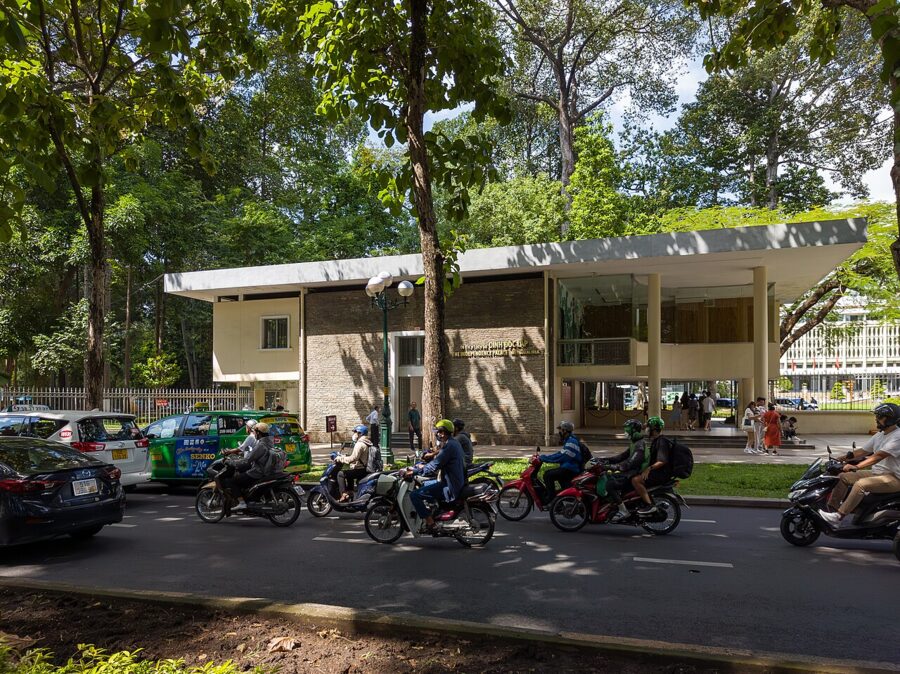
The French era survives in one building. At the corner of Nam Kỳ Khởi Nghĩa and Nguyễn Du stands a two-story colonial house from the time of Norodom Palace, now home to the exhibition “From Norodom Palace to Independence Palace 1868-1966”. Opened in March 2018, it draws on archives and photographs to cover the French palace, the 1962 bombing and the Ngô family’s rule, including a room on Diệm’s life and death. It is included in the general ticket and is the best place to fill in what the main building leaves out.
From 28 October 2026 the palace is also showing “Từ bản vẽ đến biểu tượng” (From drawings to symbol), a themed exhibition of design drawings, photographs and documents on how the building was conceived, placed so you can compare them with the rooms themselves. No closing date has been announced, so check before you plan around it.

Visiting the Independence Palace
The palace is open every day, including weekends and public holidays, except on days it closes for state events, which it announces on its website. The main gate at 135 Nam Kỳ Khởi Nghĩa sells tickets from 7am to 6pm; the second gate at 106 Nguyễn Du sells them from 8am to 4pm. Visiting hours for the palace and the exhibition run from 7am to 6pm. The address is 135 Nam Kỳ Khởi Nghĩa, Bến Thành Ward (formerly District 1).
| Ticket (from the official price list, in force since 1 August 2025) | Adult |
|---|---|
| Palace only | 40,000₫ (about US$1.50) |
| General ticket: palace and the Norodom-to-Independence exhibition | 80,000₫ (about US$3) |
| Palace and electric car | 65,000₫ (about US$2.50) |
| Palace, exhibition and electric car | 105,000₫ (about US$4) |
| Electric car around the grounds, about 10 minutes with recorded narration | 25,000₫ (about US$1) a ride |
| Audio guide, 10 languages including English | 90,000₫ (about US$3.40) a device |
| Guide from the palace’s own service | from 350,000₫ (about US$13) |
Children, seniors over 60 and Vietnamese university students pay less; the English price list says the children’s rate covers ages 6 to under 16 and the Vietnamese list says 6 to 17, so expect to be asked. You can pay by QR code as well as cash, and the palace sells tickets online through its own e-ticket site. Prices and hours here are from the official site as checked in November 2026.
Photography and rules
Souvenir photos on your phone are fine. Since 1 August 2026 the palace has charged for commercial photography: a camera ticket of 500,000₫ (about US$19) and packages from 1.5 million₫ (about US$57) for wedding and fashion crews, with no flash indoors, no light stands, no staged sets and no drones anywhere. The rules say to tell the ticket desk if you are bringing a camera. After complaints in August, the management explained in the press that ordinary visitors taking souvenir photos are not charged; if you carry a large camera, expect a question at the gate.
There is no published dress code for visitors, but this is a state building that still hosts official events, and modest clothes avoid any trouble. The roof has no shade, there are a lot of stairs, and the basement corridors are narrow, not ideal for anyone who dislikes tight spaces.
Getting there
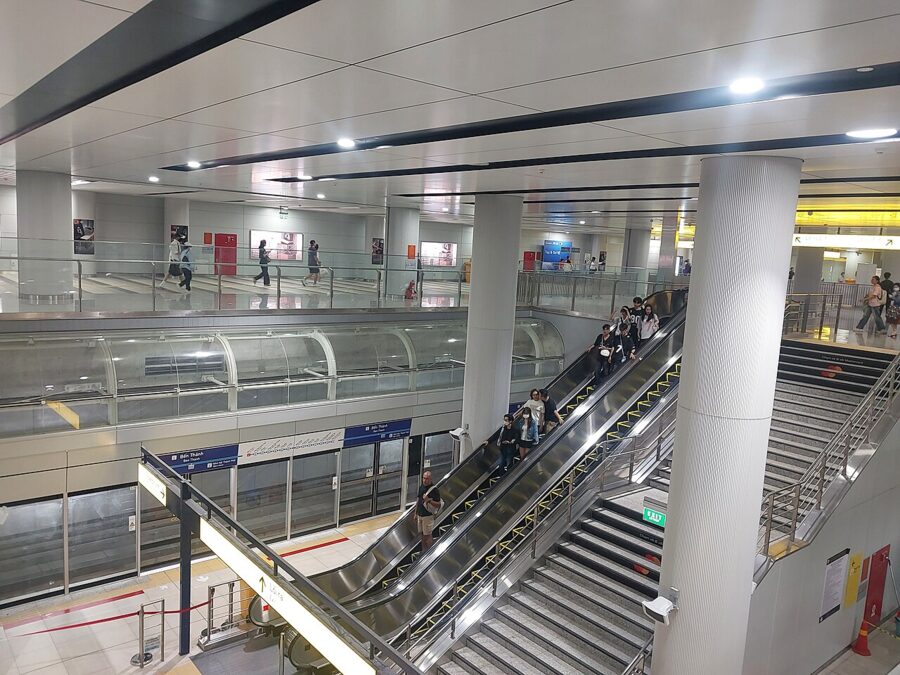
Grab and Be cars and motorbike taxis know the palace as Dinh Độc Lập; ask for the Nam Kỳ Khởi Nghĩa gate, since the visitor entrances are on Nam Kỳ Khởi Nghĩa and Nguyễn Du, not at the main gate on Lê Duẩn. Metro Line 1 ends at Bến Thành station by Bến Thành Market, about a kilometer away: walk northeast along Lê Thánh Tôn and turn left up Nam Kỳ Khởi Nghĩa, about 15 minutes.

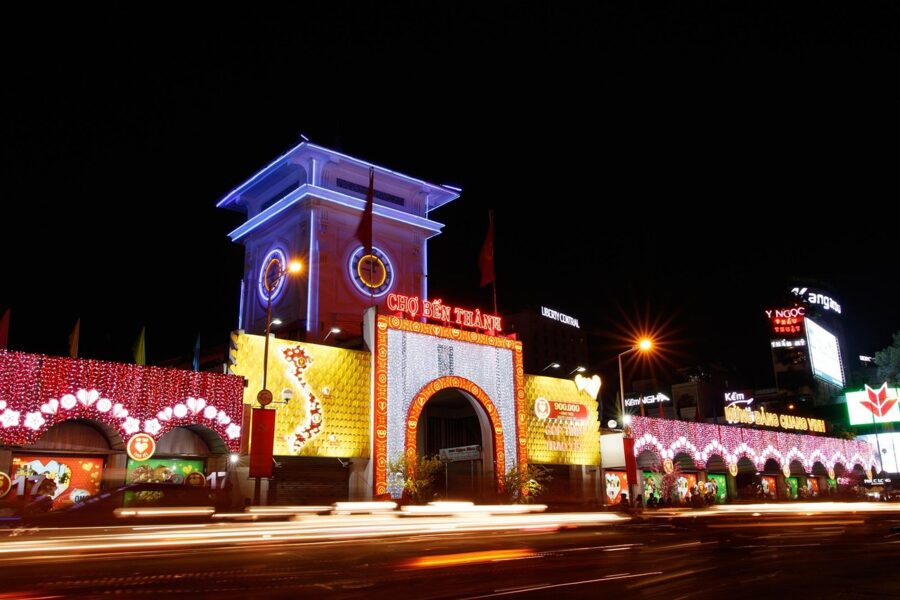
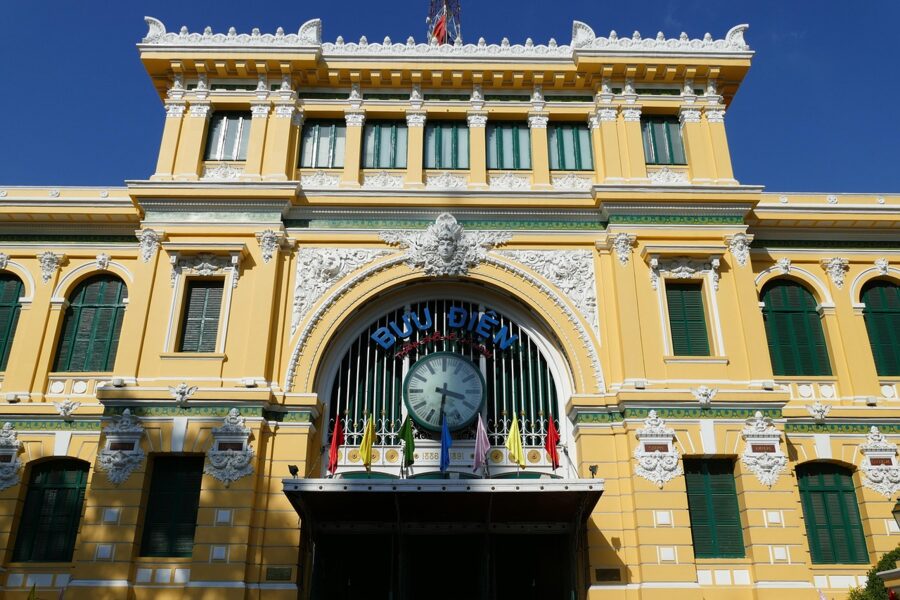
On foot, the palace sits at the center of old Saigon. Bến Thành Market (Chợ Bến Thành) is about 15 minutes south. Notre-Dame Cathedral (Nhà thờ Đức Bà) is about 10 minutes away across the park in front of the gates, with the Central Post Office beside it. The Museum of Ho Chi Minh City, Diệm’s old Gia Long Palace, is five minutes away on Lý Tự Trọng.
How long, and when
Allow 90 minutes for the palace, the roof and the basement, and another 45 minutes for the exhibition house. Go at 7am when the gates open, or after 3pm: tour groups arrive from mid-morning and the roof is at its hottest around noon. Avoid the days around 30 April and 2 September, the national day, when the palace fills with visitors and can close for ceremonies. The audio guide is worth its price if you go without a guide; the panels are short, and the device tells you what the rooms were for.
What to pair it with
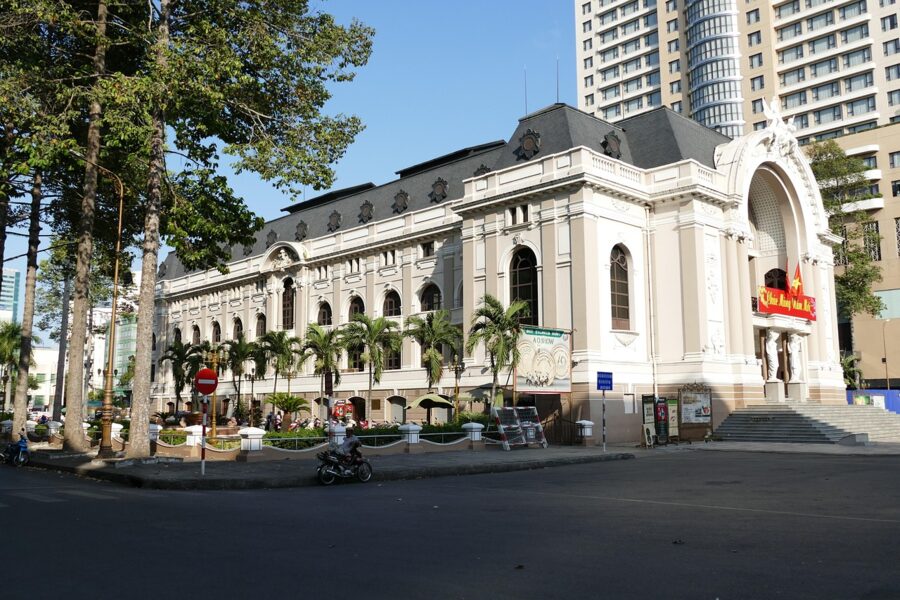
The War Remnants Museum on Võ Văn Tần is about 10 minutes’ walk away, and the two make a morning: the palace shows the government that lost the war, the museum shows the war as the winners present it, with the American bombing campaigns and their victims at the center. Do the palace first, while it is cool. For the longer history of the country, the Museum of Vietnamese History sits inside the zoo at the far end of Lê Duẩn, the same boulevard the tanks came down. In the evening, the Municipal Theatre, the old opera house on Đồng Khởi, is a 20-minute walk.

Before you leave, walk back to the two tanks under the trees. Read the numbers again, 843 and 390, and look past them to the main gate, shut now, with Saigon’s traffic going by on the far side.