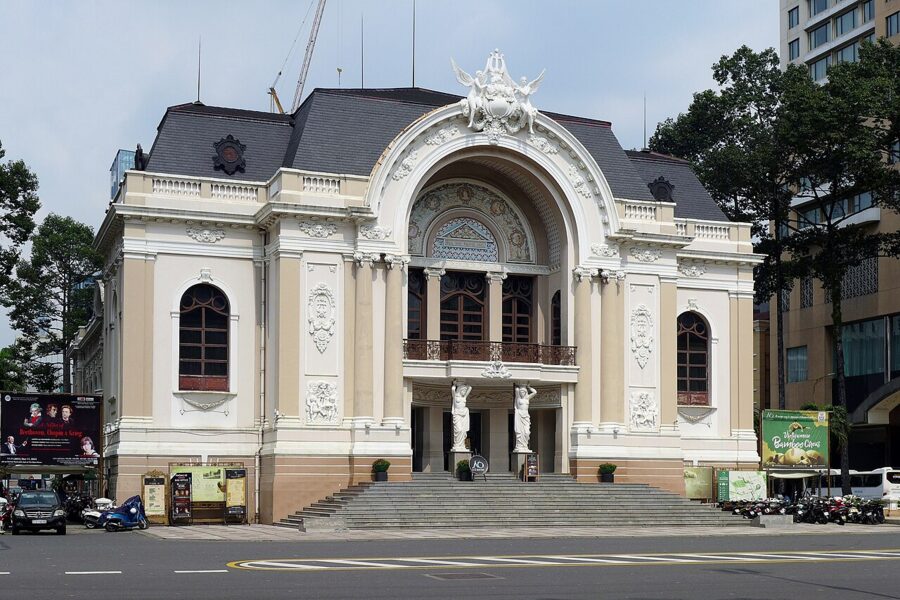
In 1998 a crew restoring the front of Saigon’s Municipal Theatre knocked out a plain rendered wall and found, about 20 centimeters behind it, the carvings everyone assumed were gone. The men who had turned the opera house into a parliament in 1955 had not chiseled the old ornament away. They had built a new, sober face a hand’s width in front of it and left the original waiting, as if they expected someone to come back for it.
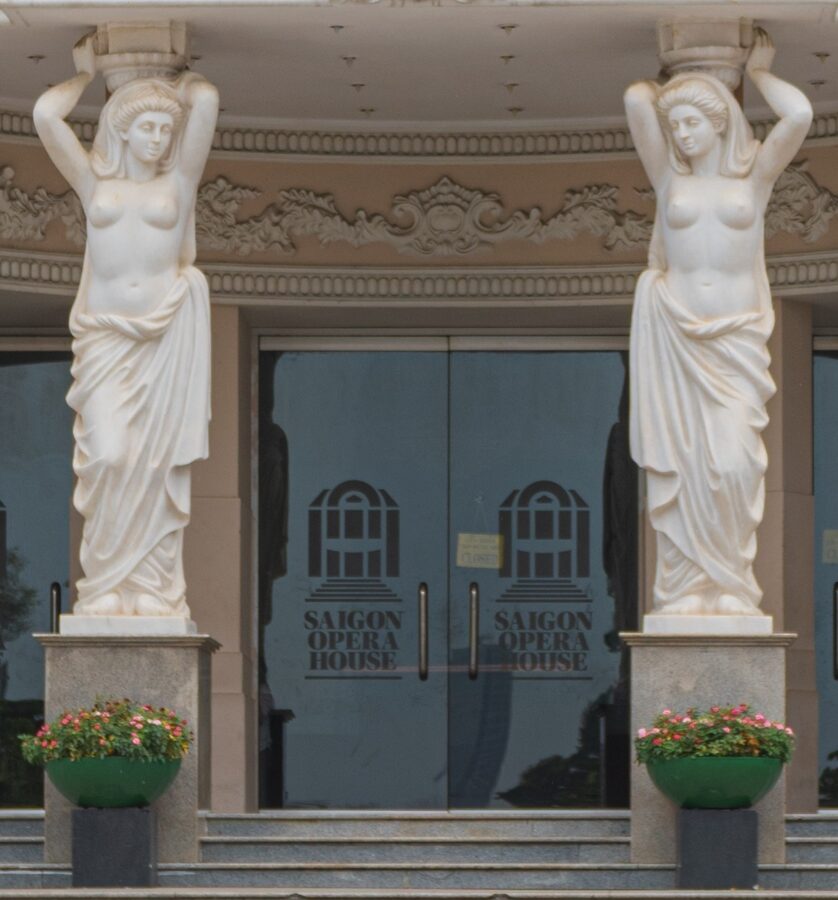
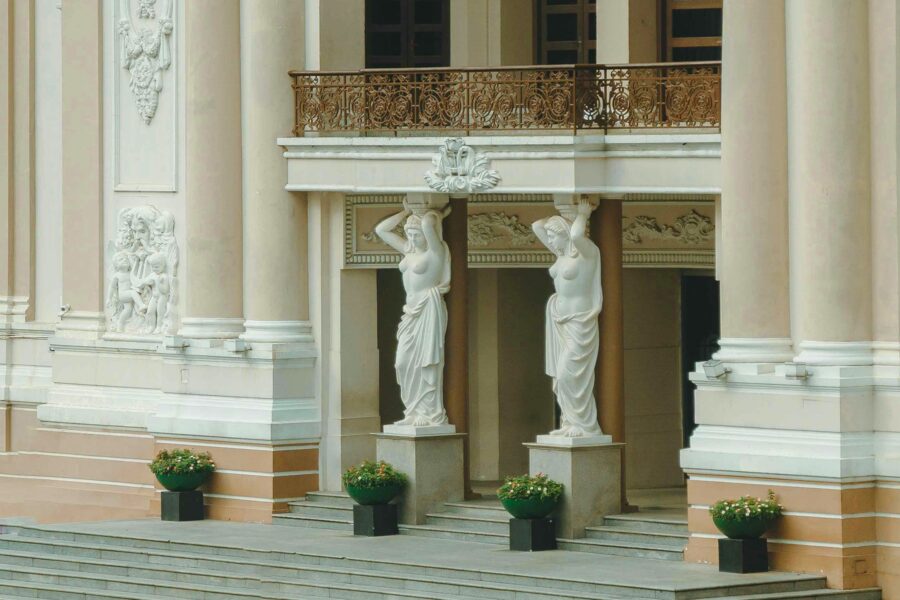
That someone came back is why the building on Lam Sơn Square looks the way it does today: two stone women holding up the porch, winged figures and a lyre riding the top of the great arch, garlands, masks and lamps returned to their places. The Municipal Theatre (Nhà hát Thành phố), which most visitors know as the Saigon Opera House, has been a colonial playhouse, a bomb site, a refugee shelter, the Lower House of the Republic of Vietnam and a stage again. It still sells tickets.
Saigoners have called it many things. In the colonial years it was the Nhà hát Tây, the Western theater, because few Vietnamese ever got through its doors; older people still say Nhà hát Lớn, the Grand Theatre. Today it is the main stage of the city’s symphony and ballet company and the home of the A O Show, Saigon’s bamboo circus, and its front steps are among the most photographed spots in District 1.

On this page
- A theater built for four months a year
- Reading the façade
- Empty seats, a stripped front and a bomb
- The Lower House on Lam Sơn Square, 1955 to 1975
- Back to the stage, and the long restoration
- Lam Sơn Square and Đồng Khởi Street
- What's on: the bamboo circus, ballet and the symphony
- Seeing inside without a show
- How to visit
A theater built for four months a year
French theater arrived in Saigon almost as soon as the French army did. From 1863, touring companies shipped out from France played for officers and officials in temporary rooms, first in the wooden residence of the admiral-governor near what was then Place de l’Horloge, at today’s corner of Nguyễn Du and Đồng Khởi streets. The first purpose-built theater went up in 1872 on the site the Caravelle Hotel occupies now, a wooden house that specialized, according to a Saigon paper of 1880, in Offenbach and comic opera rather than Mozart.
It burned down in 1881 and was rebuilt the next year in sturdier materials. Le Figaro dismissed the second theater in 1887 as primitive but impossible to burn, while a Paris weekly in 1893 adored its boxes hung with plants and its verandas full of flowers. By then the colony wanted something grander, a building that would stand at the top of the rue Catinat and announce the French city to anyone walking up from the river.
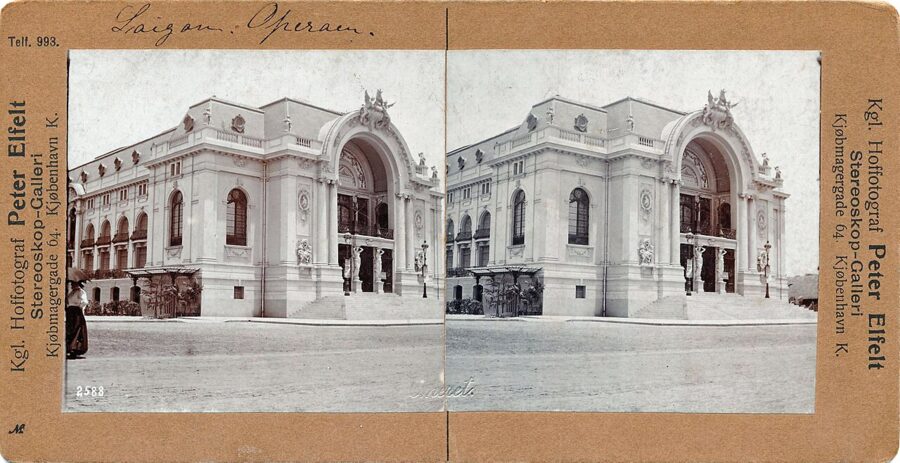
A design competition in 1895 shortlisted three architects: Ferret, Genet and Berger. The judges chose Eugène Ferret, and his plans for an 800-seat “Grand-Théâtre de Saigon” were shown in Paris at the 1896 Exposition du théâtre et de la musique. Construction began late in 1896 according to the historian Tim Doling, though most Vietnamese sources give 1898. Félix Olivier and Ernest Guichard are usually credited alongside Ferret, and the architectural historian Gwendolyn Wright names a Joseph-Victor Guichard instead, so the credits are less settled than most accounts admit.
The opening date is just as slippery. Sources give 1 January, 15 January and 17 January 1900. Doling, working from colonial newspapers, puts the inauguration on 15 January in the presence of Saigon’s mayor Paul Blanchy and Prince Waldemar of Denmark, with the Asian premiere of Massenet’s one-act opera La Navarraise. The bill came to more than 2.5 million francs, and plenty of colonists said the money should have gone on a new central market and better drains.
The Petit Palais question
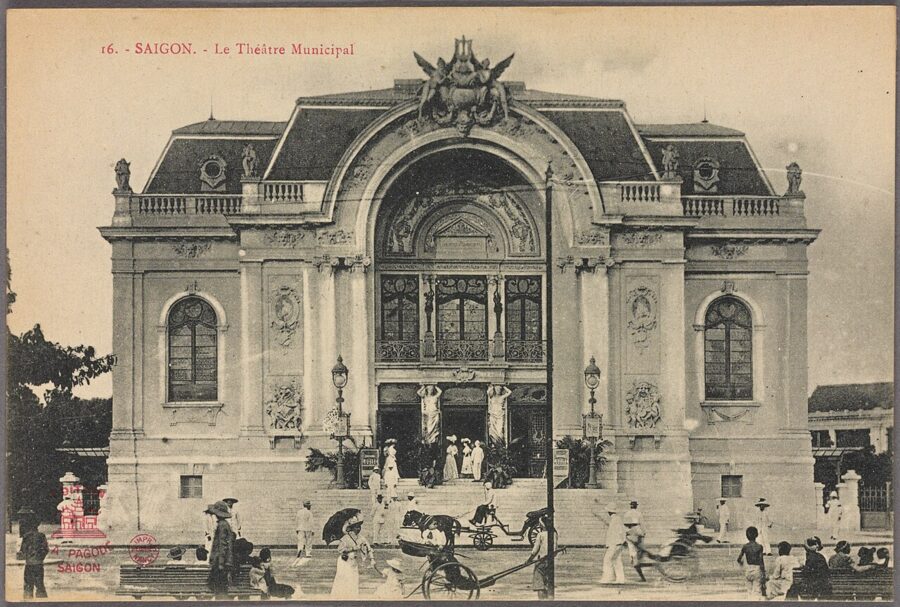
The comparison everyone makes is with the Petit Palais in Paris, which Charles Girault built for the 1900 World’s Fair at exactly the same time. The resemblance is real but loose. Both use a single great entrance arch, framed by paired columns and topped by sculpture, set into a long, low classical front. What Saigon borrowed was a vocabulary, not a drawing.
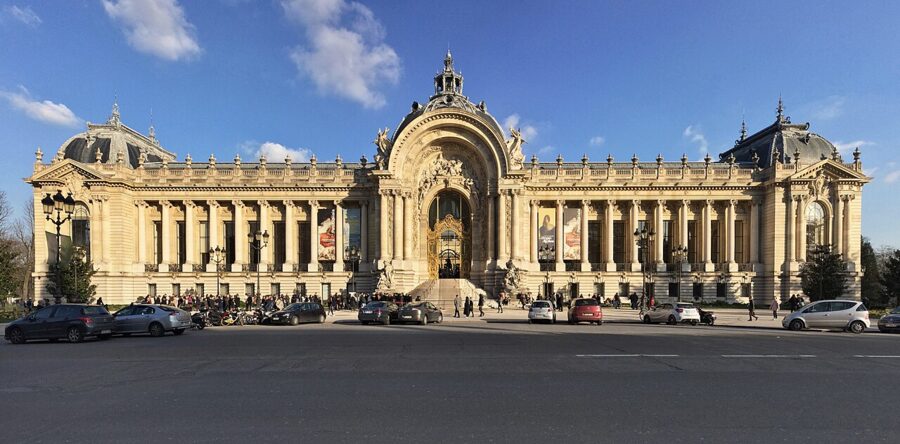

The other comparison people make is with the Palais Garnier, the Paris Opera, and some Vietnamese writers call the Saigon theater a Garnier in miniature. That holds for the spirit, a showy Third Republic confidence, more than for the shape. Hanoi’s opera house, finished in 1911 and much closer to Garnier in outline, makes the better match if you have seen both.
Reading the façade
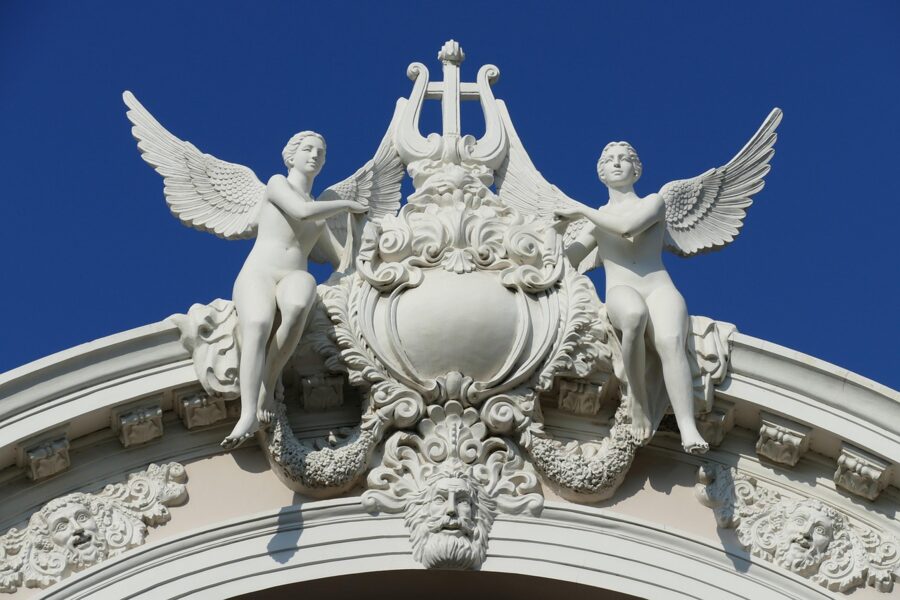
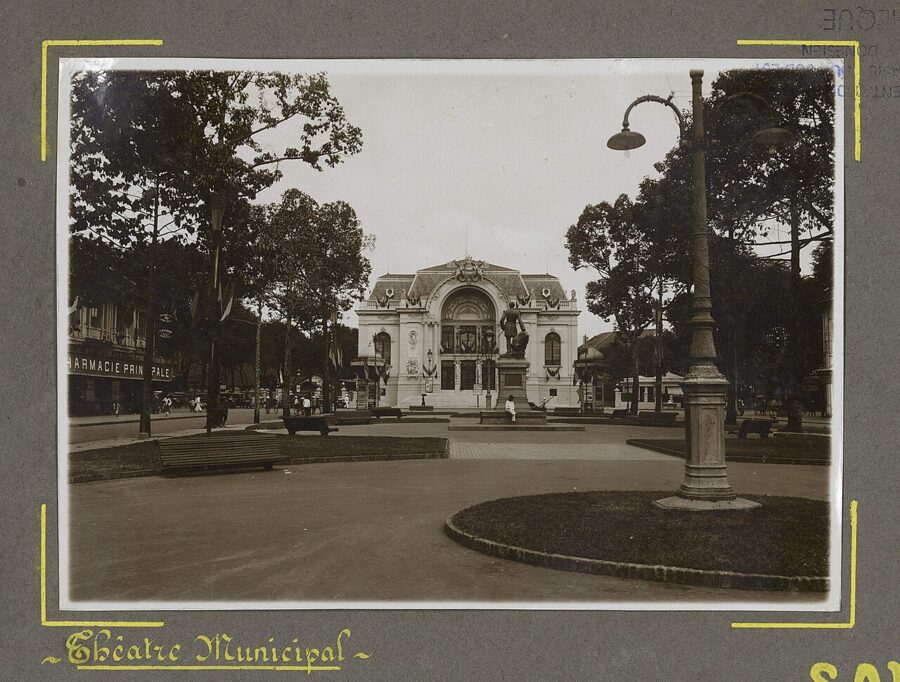
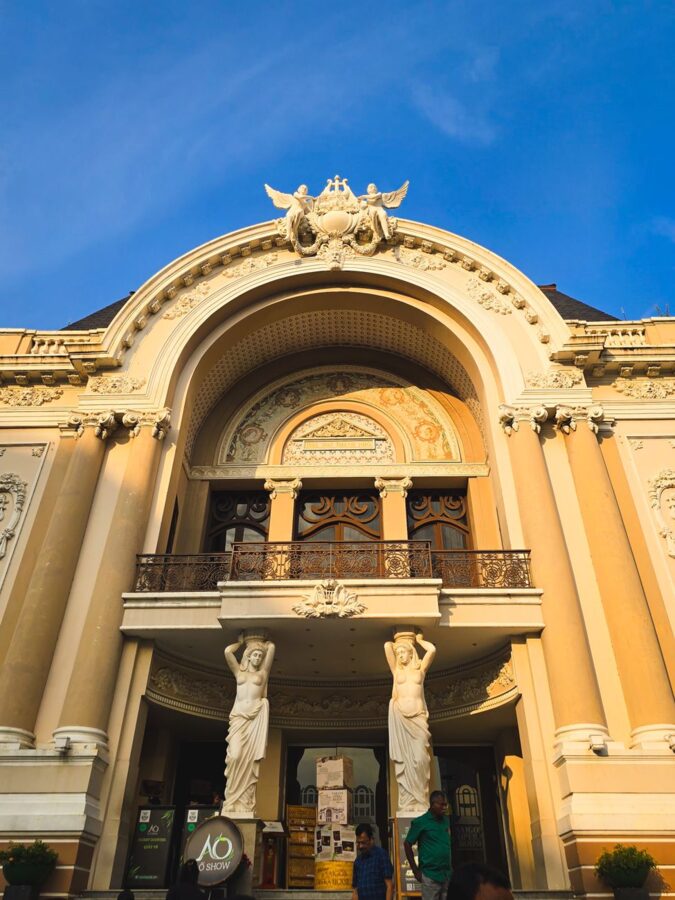
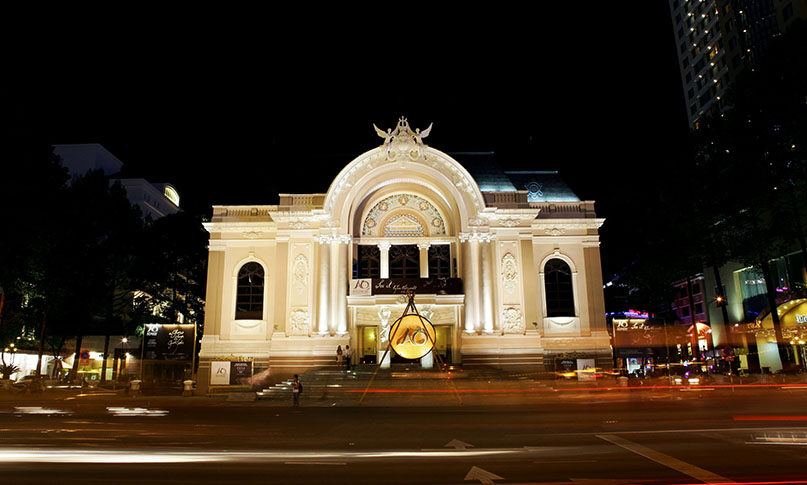
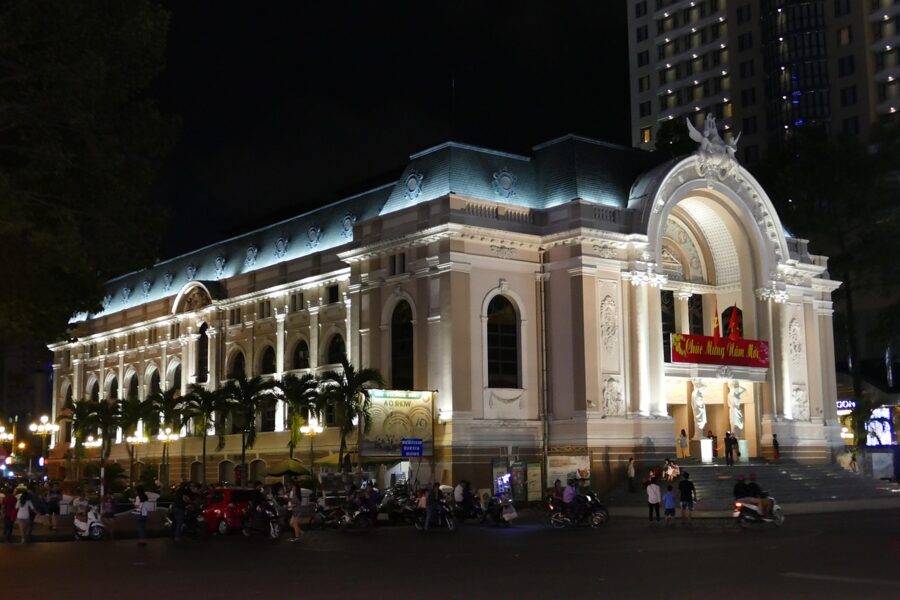
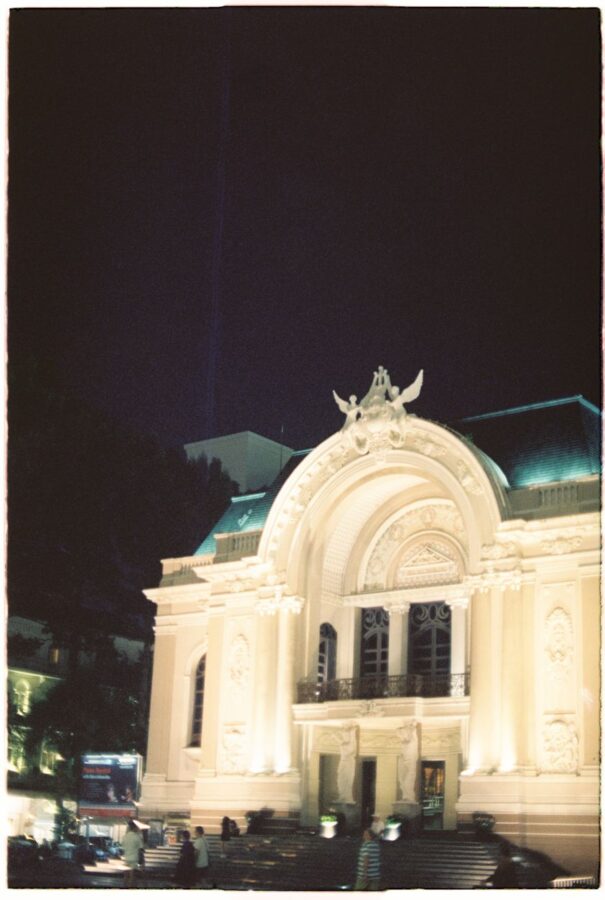
Stand in Lam Sơn Park, in front of the building, and work from the top down. The crowning group above the main arch has two winged figures seated either side of a lyre, the classic shorthand for music. Below them, a row of heads of Pan, the Greek god of rustic music, runs along the curve of the arch. Inside the big arch sits a smaller one with five figures arranged around what looks like a little temple, and across it the words “Nhà Hát Thành Phố”, which replaced the original “Théâtre Municipal”.
The building stands about two meters above the pavement on a raised platform, and the entrance has two layers of doors. Both were deliberate: the height and the double doors kept out street noise in an age before air conditioning, when the doors and windows had to open to the evening air. Inside, the original plan gave a ground floor and two balcony levels, which is where the often-quoted figure of 1,800 seats comes from, although Ferret’s own plans were drawn for 800.
Most of the decorative material, from the balustrades and cartouches to the roof elements, was made in France and shipped out, as were the designs for the inscriptions and interior fittings. That was normal for prestige colonial buildings of the 1890s, and it is one reason the 1998 restorers went to Paris archives for drawings rather than relying on photographs alone.
The style is usually labeled “Flamboyant”, sometimes “Flamboyant Gothic”, after the Third Republic taste for exuberant ornament. Neither label quite fits a building with no pointed arches at all. Belle Époque Beaux-Arts is closer: classical bones, piled-on ornament, a love of allegory. Ignore the labels and look at how much sculpture a building this small carries.
Empty seats, a stripped front and a bomb
Running the place was harder than building it. The city hired director-impresarios to ship whole companies out from France and paid them a subsidy of 200,000 francs a year. At first the season ran only four months, October to January, because the heat made the rest of the year unbearable in a full auditorium, and by 1910 it stretched to April. The first trio of impresarios ran up debts and resigned within five months of the opening.
On 18 November 1918 a Vietnamese company staged a performance there for the first time, a play mixed with cải lương, the southern reform opera that was then taking off in Saigon. The writer and collector Vương Hồng Sển remembered the theater as a place the French themselves did not much love: too small, too ornate, and expensive to fill. Through the 1920s, nightclubs and dance halls with live music drew away the audiences, and by the end of the decade the city stopped paying the subsidy.
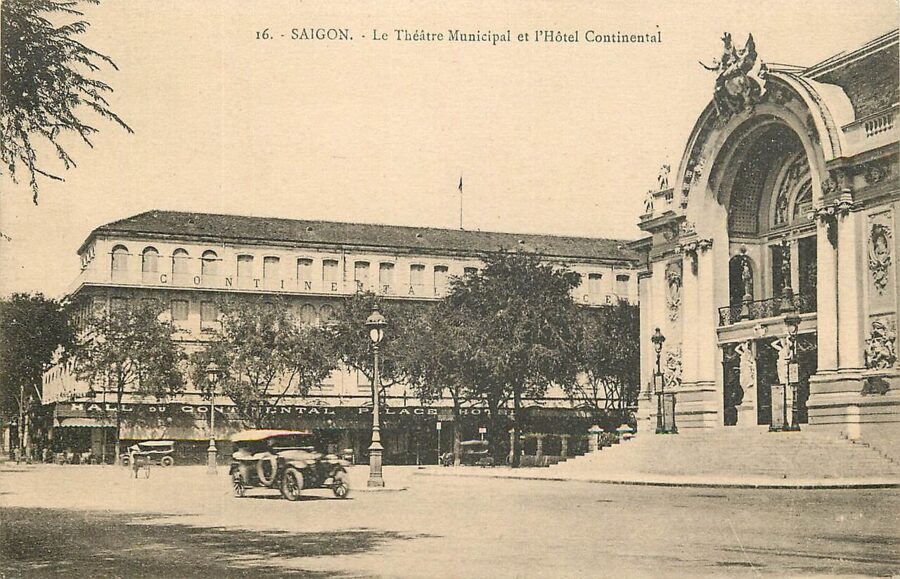
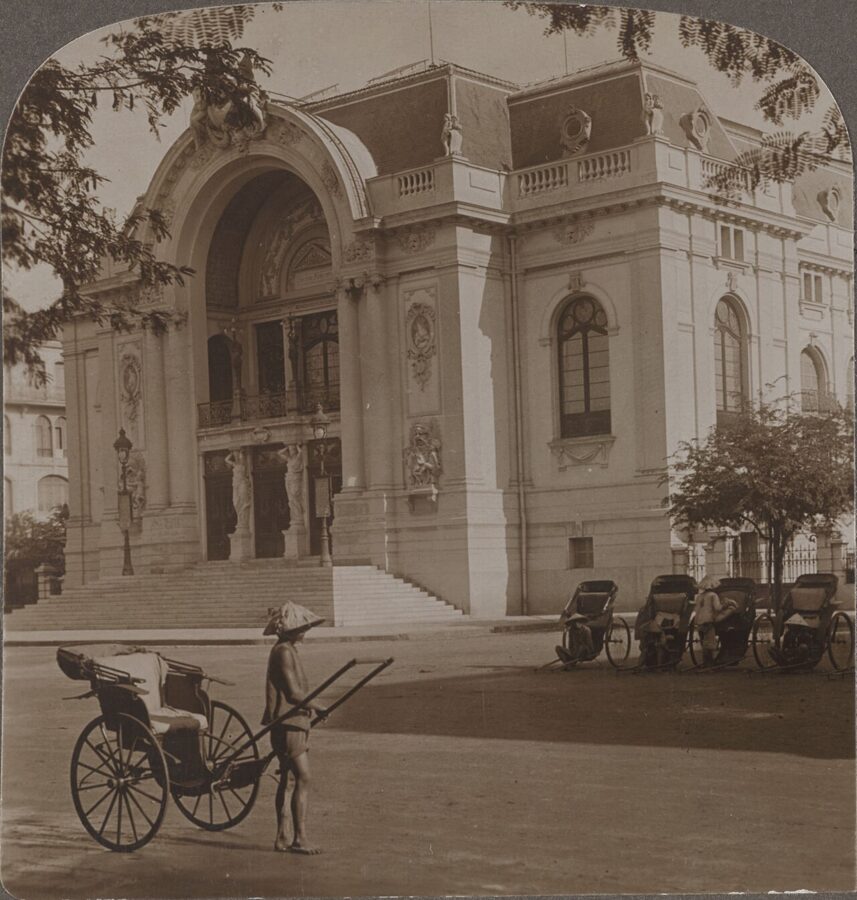
After that the theater was mostly rented out for amateur shows and the occasional gala. In 1943, under the Vichy administration during the Japanese occupation, the authorities stripped the ornate front to make it look modern, taking down garlands, lamps and sculpture. Some Vietnamese sources say the porch muses went then; others say they went in 1955. The next year Allied aircraft bombing Japanese positions in Saigon damaged the building badly enough that it closed.
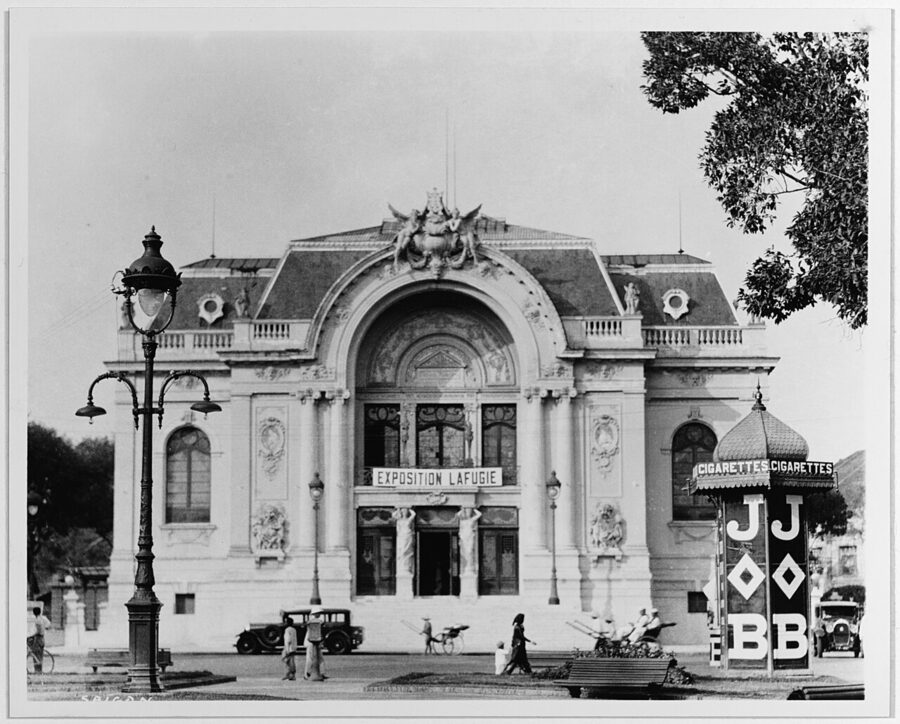
The war years that followed left little money for repairs. After the Geneva Accords of 1954 divided the country, the half-ruined theater served as temporary housing for French civilians and other migrants arriving from the north. It looked, for a while, like a building with no future.
The Lower House on Lam Sơn Square, 1955 to 1975
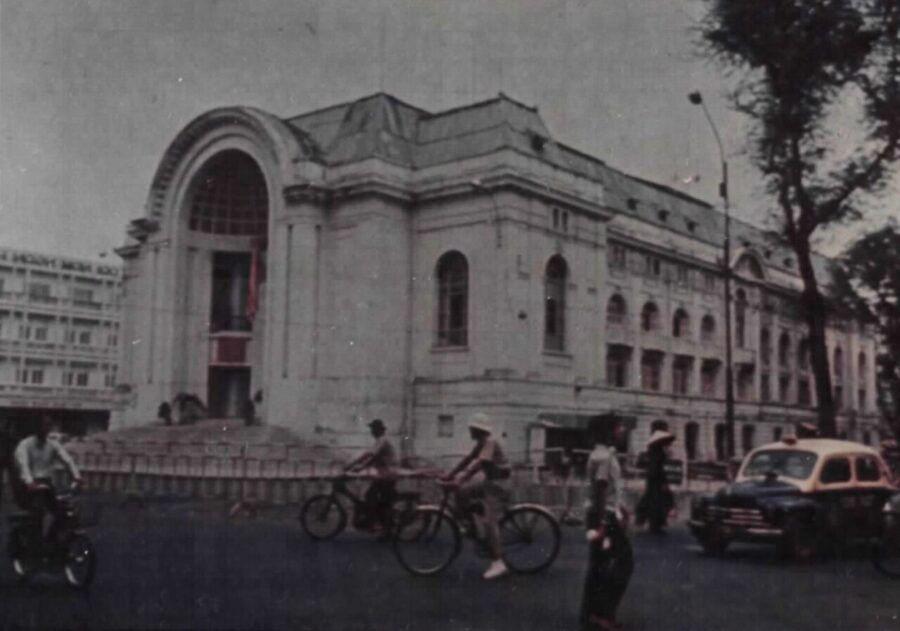
The new southern state under Ngô Đình Diệm gave it one. In 1955 the theater was repaired and converted into the seat of the National Assembly, and the square outside was renamed Lam Sơn, after the 15th-century uprising led by Lê Lợi against Ming rule. This is the refit in which the plain new wall went up in front of the old reliefs, and whatever ornament was left went out of sight. A parliament, the reasoning went, should not look like a music hall.
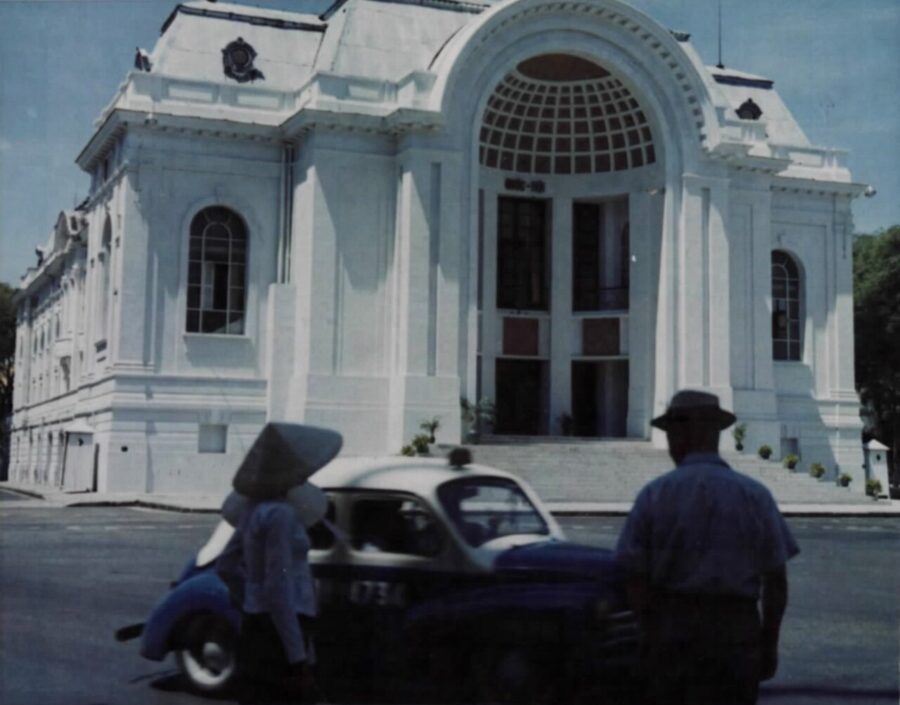
When the generals overthrew Diệm in November 1963, the assembly was dissolved and the building briefly became a cultural hall. The 1967 constitution created a two-chamber legislature: the Senate met in the Diên Hồng hall, the former chamber of commerce, and the old theater became the Lower House (Hạ Nghị viện). For eight years the building on Lam Sơn Square was where the Republic of Vietnam’s deputies argued over budgets, the draft and the war.
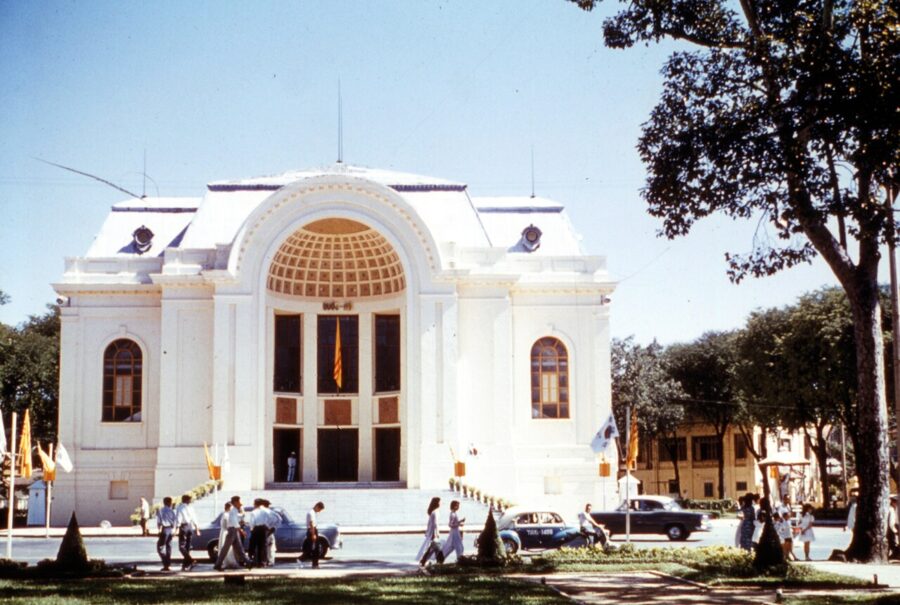
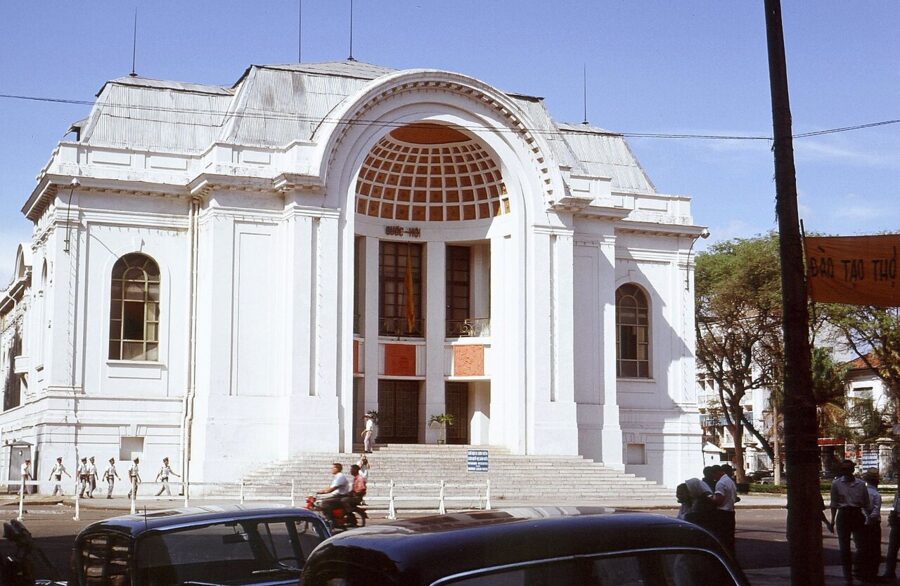

In 1967 the government also put a nine-meter monument to the South Vietnamese Marines in the garden in front, two soldiers charging with their weapons pointed straight at the parliament door. Saigon read it as a bad omen, and the joke about the army aiming its guns at the assembly outlived the regime. On 25 July 1970 two French anti-war activists, André Menras and Jean-Pierre Debris, climbed the statue, unfurled the flag of the National Liberation Front and scattered leaflets.
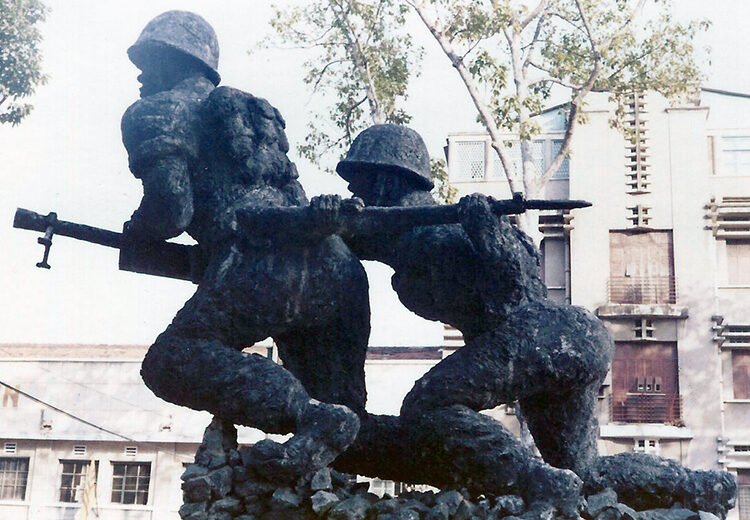
Both men were arrested and sentenced, Debris to four years and Menras to three, and served time in Chí Hòa prison and on Côn Đảo before being expelled to France at the end of 1972. Back in France they published a book denouncing the southern prison system. On 30 April 1975 a crowd pulled the statue down.
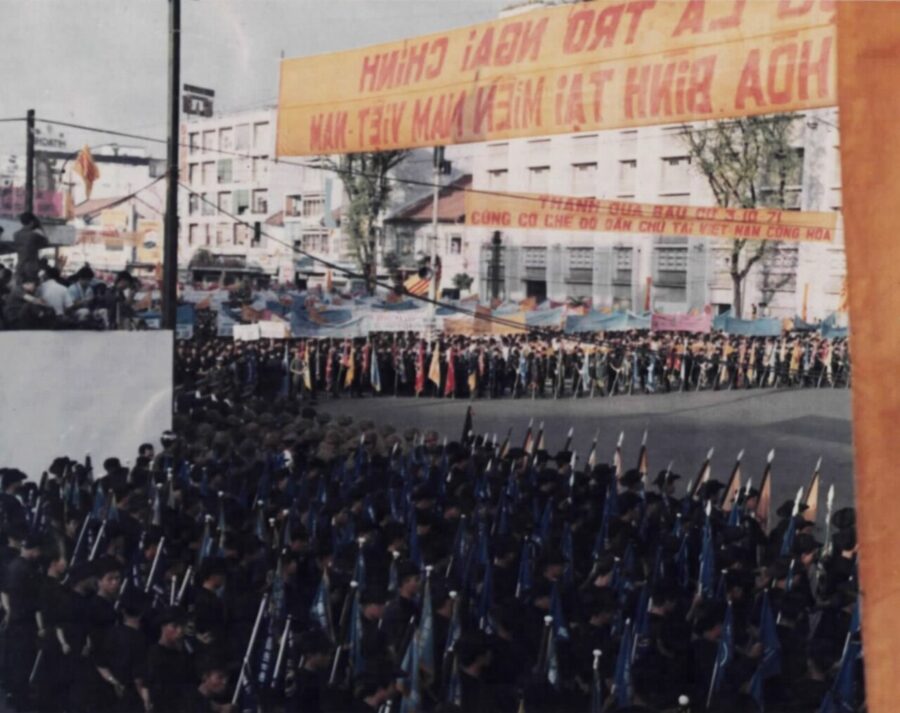
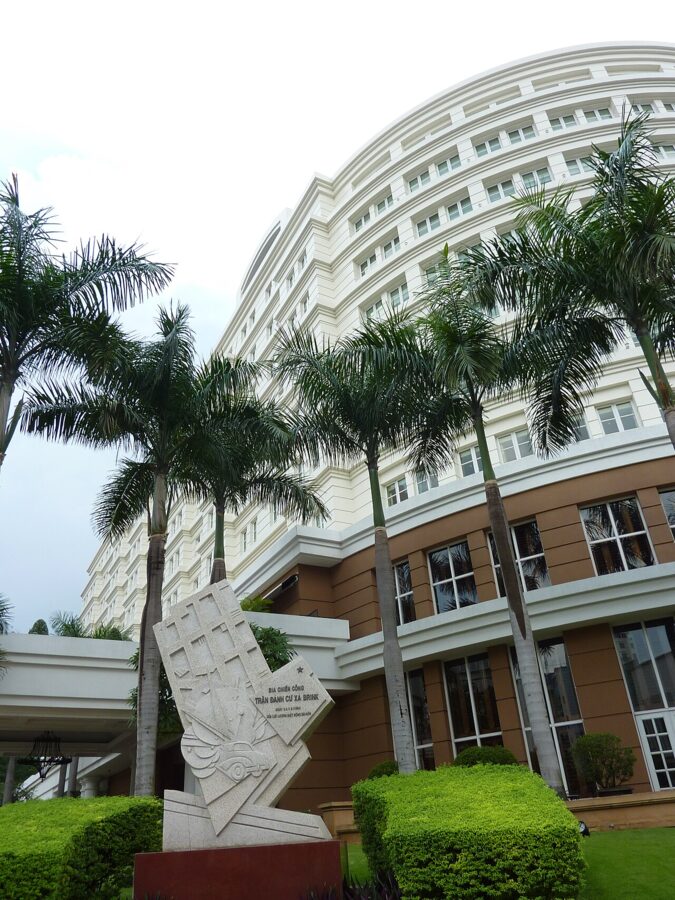
Lam Sơn Square saw everything else the war years brought. A Viet Cong bomb went off in the Caravelle Hotel on 25 August 1964, in a room on a floor taken mostly by foreign journalists, and on Christmas Eve that year a car bomb under the Brinks Hotel, an American officers’ billet on the square, killed two Americans and injured about 60 people. The Park Hyatt now stands on the Brinks site.
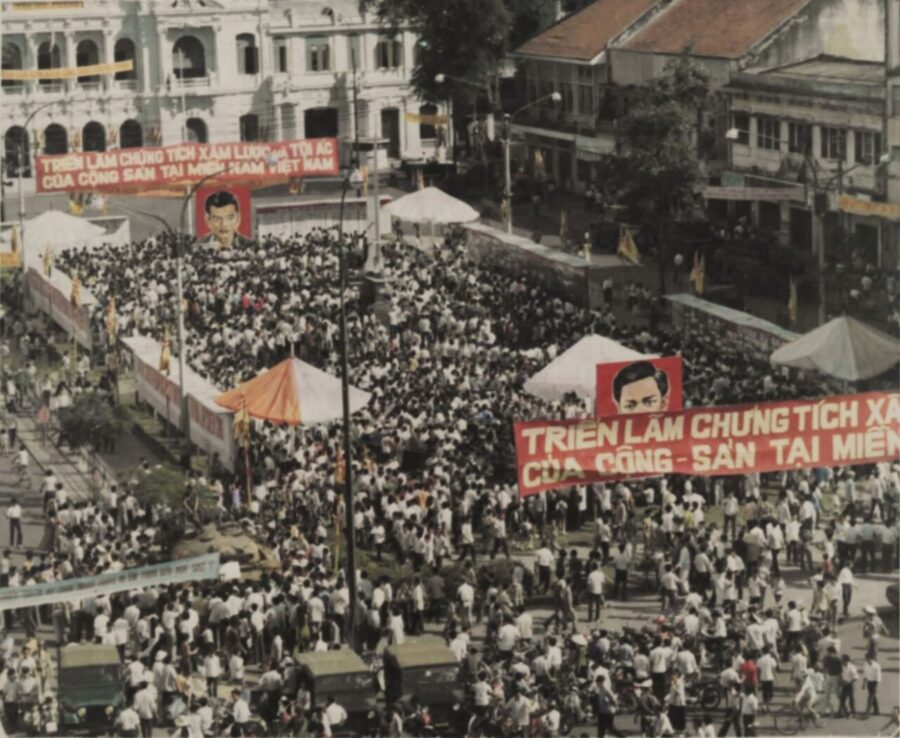
Accounts differ on how quickly the building returned to the stage after April 1975. Some say it was named the city theater in May 1975; the English and Vietnamese reference works both note that the Provisional Revolutionary Government held a congress of deputies there that year and that performances resumed only in 1976. Doling gives 1982 for a full reopening as a theater. What nobody disputes is that it never housed a legislature again.
Back to the stage, and the long restoration
The building limped through the late 1970s and 1980s as a venue for state functions and touring troupes. The turning point came with the 300th anniversary of Saigon in 1998, counted from the arrival of the Nguyễn lords’ envoy Nguyễn Hữu Cảnh in 1698. The city closed the theater in 1996 and spent two years and about 25 billion dong on a restoration, with French technical help and young Vietnamese architects who went to Paris to look for drawings.
The architect Phạm Trường Giang later described the call he got from those young colleagues during the work. When the masons began breaking off the 1955 front, he wrote in the magazine Người Đô Thị, the plaster fell away to reveal a second layer of reliefs, intact, behind a wall built about 20 centimeters out from the original. The 1955 builders had chosen to bury the ornament rather than destroy it.
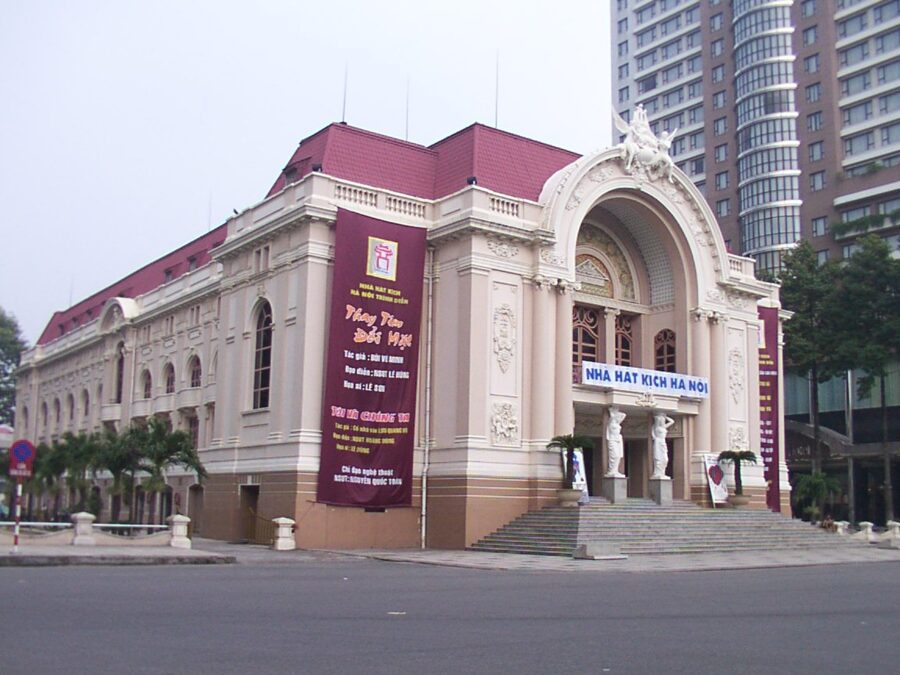

Much of what you see now dates from that project: the stone veranda and white stone statues at the entrance, the granite floors, the chandeliers, the bronze figures by the lobby stairs and the reliefs on the auditorium arch and walls. The two muses returned to the porch, along with the garlands and the two lamps that the 1943 remodeling had removed. The theater reopened on 18 December 1998 with new sound, lighting and air conditioning.
A second, smaller round of work followed after the city council approved it in November 2007. The roof was retiled to match the materials of 1900, the floors replaced, the interior statues and wall reliefs restored, and the seats replaced with upholstered ones, reducing the count from 559 to 500. Lyon paid 160,000 euros for the architectural lighting, and the work wrapped up at the end of 2009.
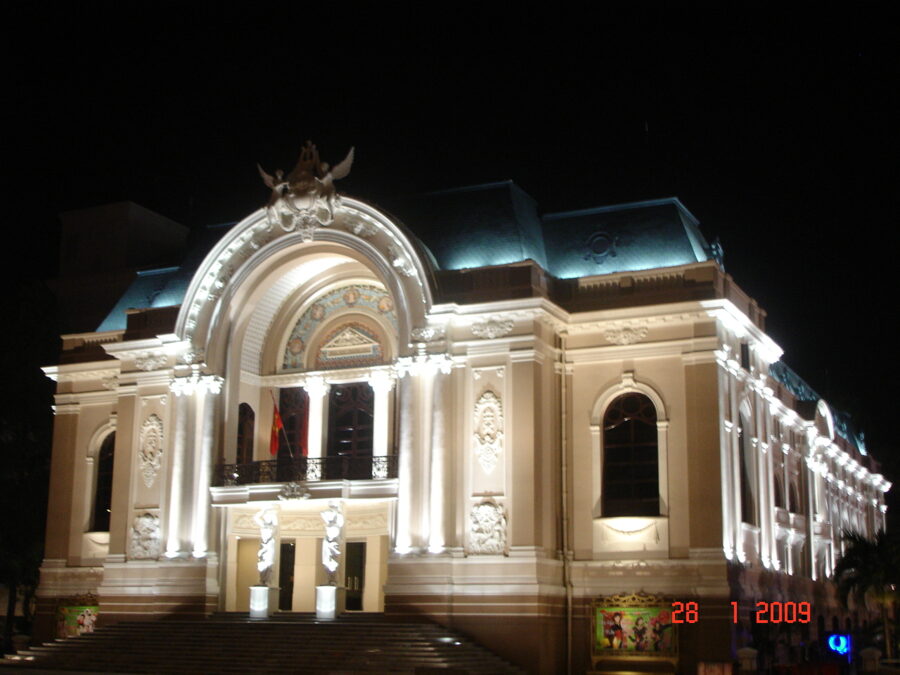

In 2012 the building was classified as a national architectural and artistic monument. Seven years later, in September 2019, a team of about 30 engineers laser-scanned it from more than 350 positions, recording over 1,000 individual ornaments, from column capitals to lamps, so that any piece can be copied by 3D printing and recast if it fails. The data was handed to the theater’s management and the city’s culture department.
That scan is the basis for the next restoration. In September 2023 the city council approved a 337 billion dong plan (about US$13 million) to restore the main building, replace its worn-out air conditioning, wiring, drainage, fire safety and sound systems, and take down and repair decorative elements, some with materials imported from abroad. The published timetable had construction in 2025 and 2026, carried out in phases so that the theater stays open. No report from the last twelve months confirmed that work had actually started, and shows were running normally in November 2026.
Lam Sơn Square and Đồng Khởi Street
The theater closes the end of Lê Lợi Boulevard, between Đồng Khởi and Hai Bà Trưng streets, and the square around it has changed names with every regime. Under the French, the garden in front was Place Francis Garnier and the space behind became Place Augustin Foray, after a former mayor, in 1935. The Republic renamed the whole of it Công trường Lam Sơn in 1955, and the name has outlasted the Republic.
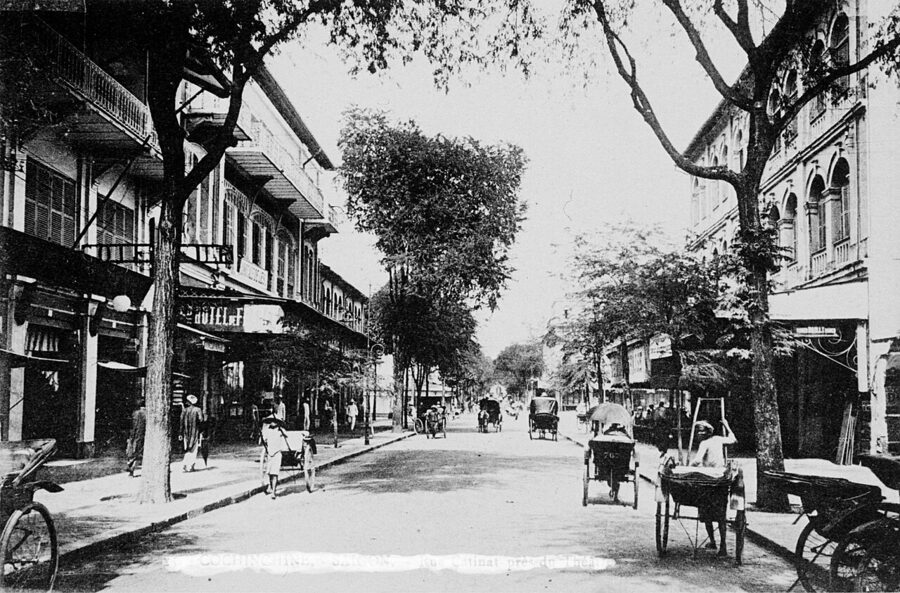
Đồng Khởi has had three names too. The French called it rue Catinat, the Republic renamed it Tự Do (Freedom) Street in 1955, and after 1975 it became Đồng Khởi, “simultaneous uprising”, after the 1960 revolt in the Mekong Delta. It runs about 900 meters from the river up to the cathedral, and the theater stands on it close to the midpoint.
The Hotel Continental
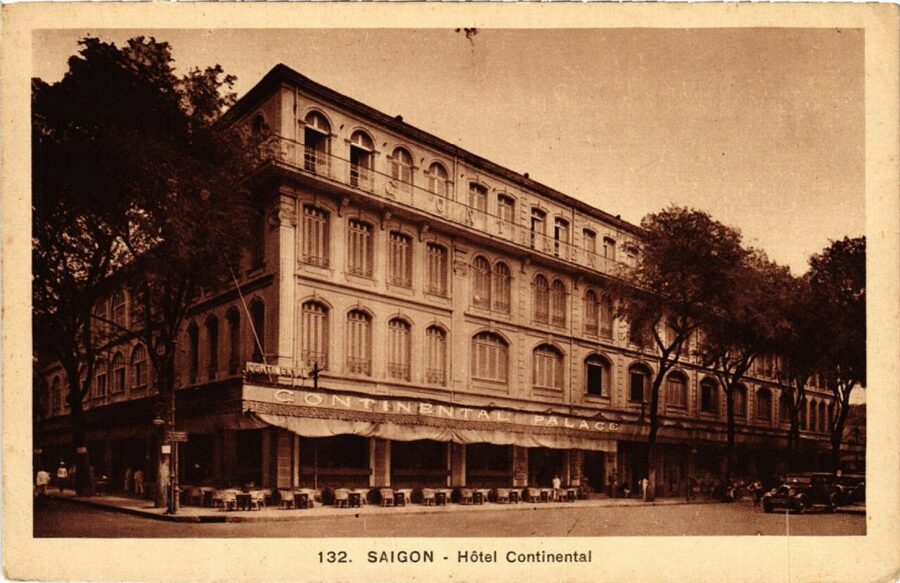
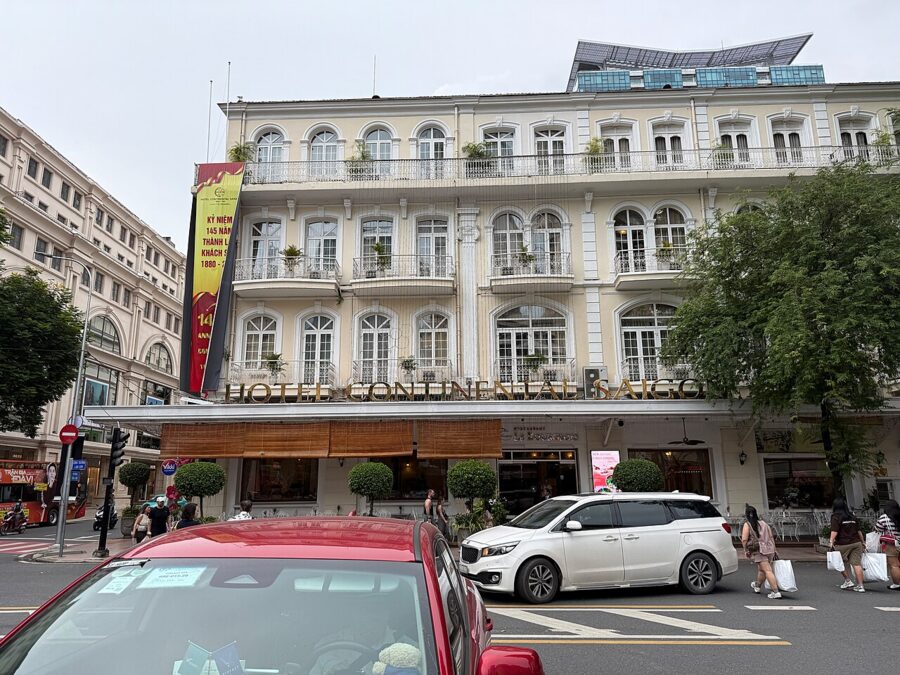
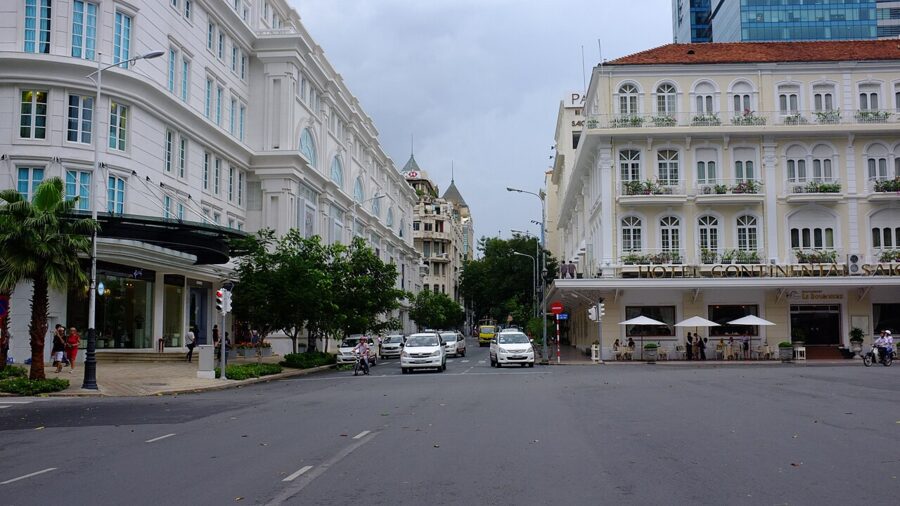
On the theater’s left as you face it stands the Hotel Continental (Khách sạn Continental Sài Gòn), opened in 1880 and named after the Continental in Paris. During the French war, journalists, officials and businessmen met so often on its terrace that the place was nicknamed “Radio Catinat”. Graham Greene was a long-staying guest in the early 1950s, and the hotel turns up in The Quiet American.
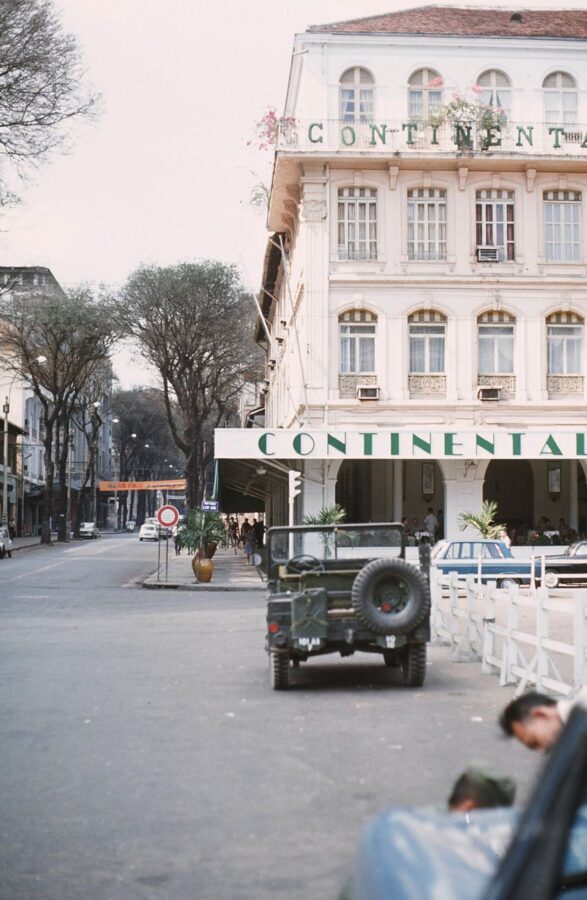

After 1975 the city took over the hotel, closed it in 1976 and reopened it after a full restoration in the late 1980s. Today it belongs to the state-owned Saigon Tourist group, and its Đồng Khởi frontage holds luxury boutiques rather than the souvenir and tailor shops of twenty years ago. The hotel’s courtyard is a calmer place for a meal before an evening show than anywhere on the street outside.

The Caravelle
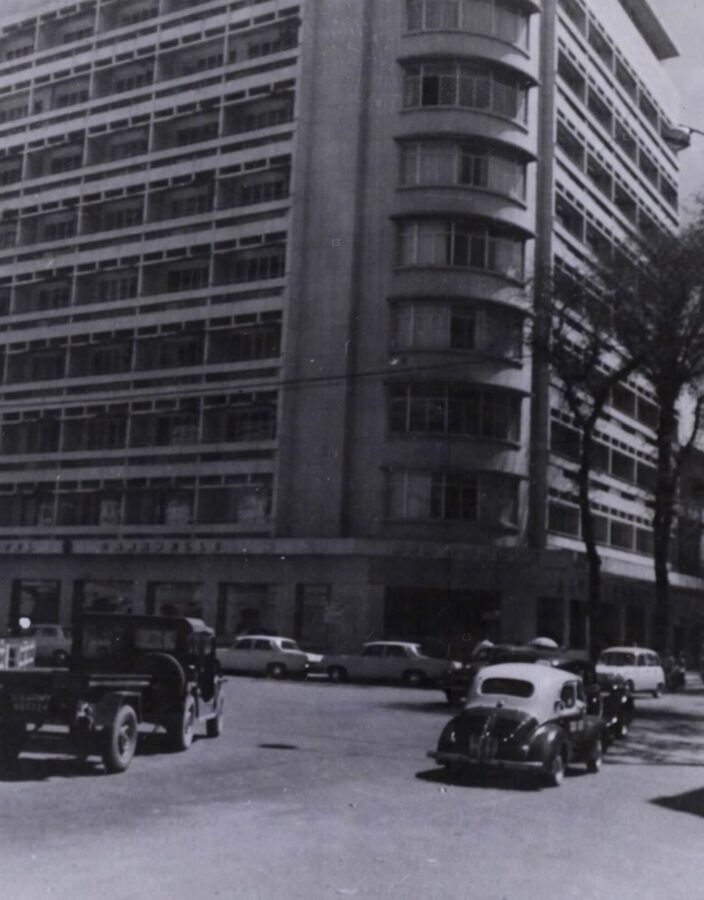
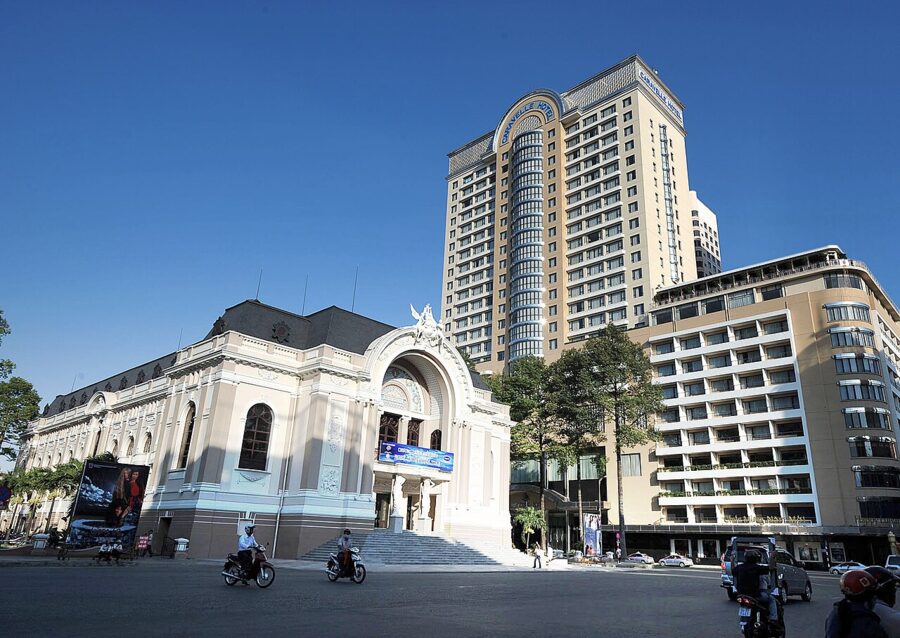
Across the square, on the theater’s right, the Caravelle opened on Christmas Eve 1959 on the site of the first city theater and, later, a famous colonial café. Ten stories high, it was the tallest and most modern building in Saigon, and it was named after the French Caravelle jetliner. In the 1960s it housed the Australian and New Zealand embassies and the bureaus of NBC, ABC and CBS, and its rooftop bar became a correspondents’ haunt.


Lam Sơn Park and the metro
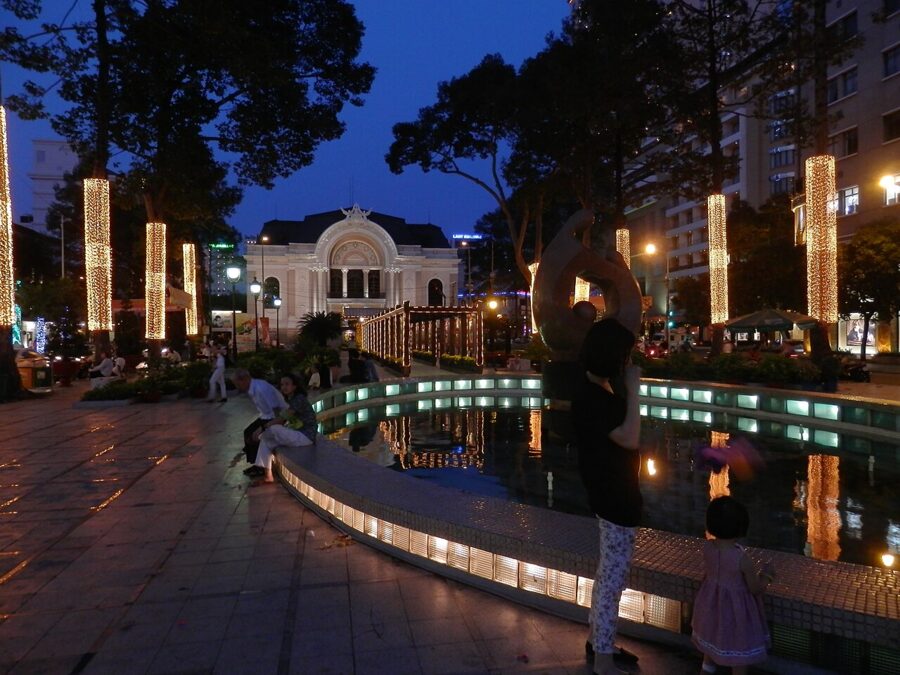
The garden in front of the theater went through its own changes. After the Marines statue came down in 1975, the plinth stood empty for years. A red granite sculpture called “Tình mẫu tử” (mother’s love) stood in a fountain there from about 1998, until the fountain and most of the trees were cleared in 2014 to dig the metro station underneath.
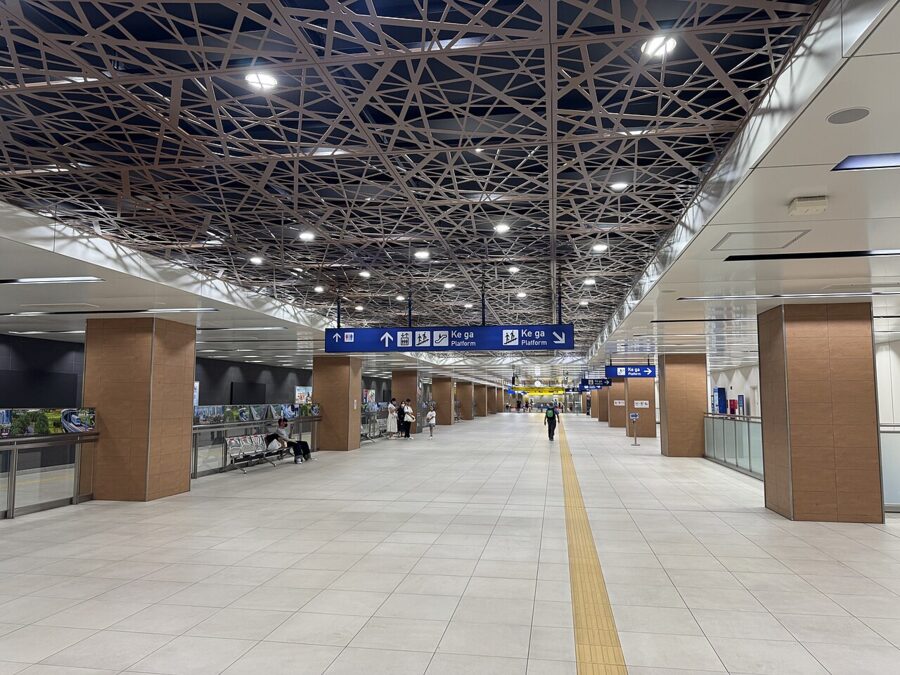
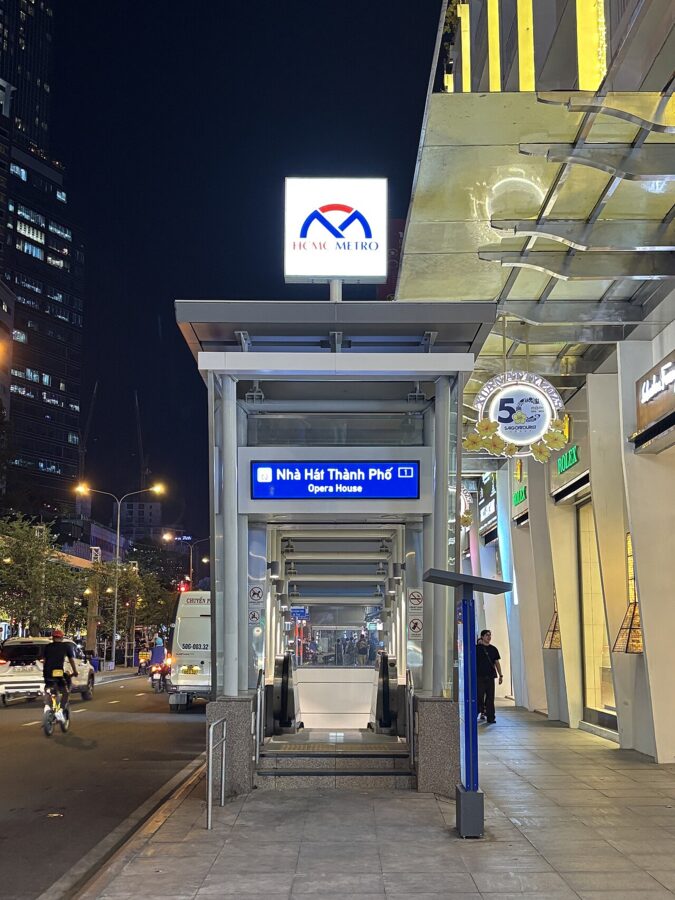
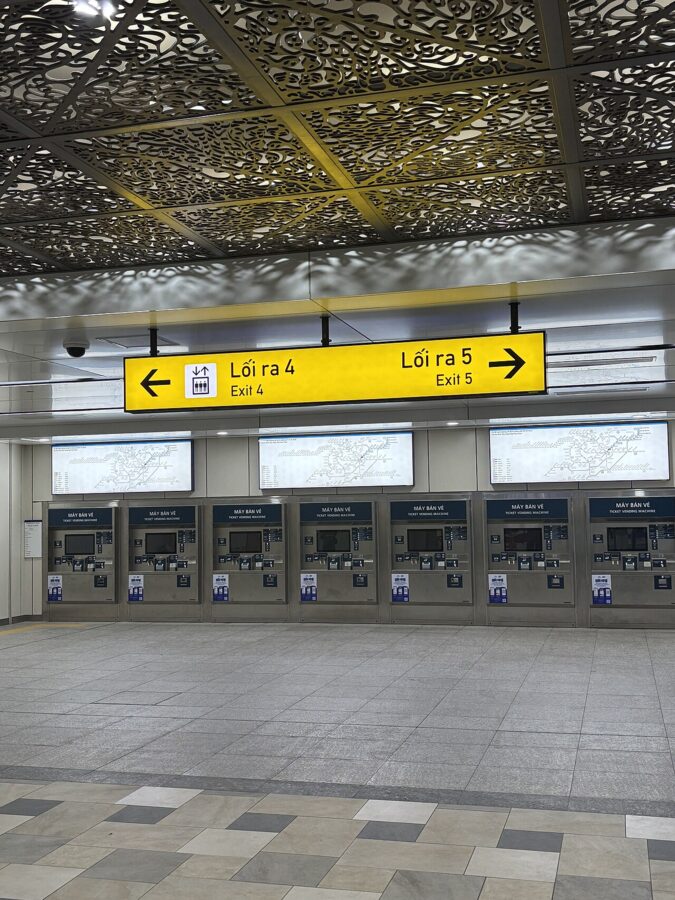
Opera House station (Ga Nhà hát Thành phố) opened with the rest of Metro Line 1 on 22 December 2024. It lies under Lê Lợi Boulevard, between Bến Thành and Ba Son, and its long underground concourse runs from Pasteur Street almost to the theater steps. The ground behind the theater, a scruffy parking lot for years, was turned into a garden in 2018.

What’s on: the bamboo circus, ballet and the symphony
The theater is managed by the city’s performance and cinema center (Saigon Concert), which hosts touring companies, resident productions and state events, so the program mixes long-running shows, concerts and one-off galas. For a visitor on a short stay, two names cover most nights: Lune Production’s bamboo circus and the city’s symphony, ballet and opera company.

The A O Show
The À Ố Show is the one most visitors see. Its name comes from “làng phố”, village and town, and the hour-long piece follows southern Vietnam from rice fields and fishing villages to the motorbike roar of the modern city, told almost entirely with bamboo poles, woven baskets, round coracle boats and acrobatics. The music is played live on traditional instruments and draws on southern work songs, so the stage is never quiet.
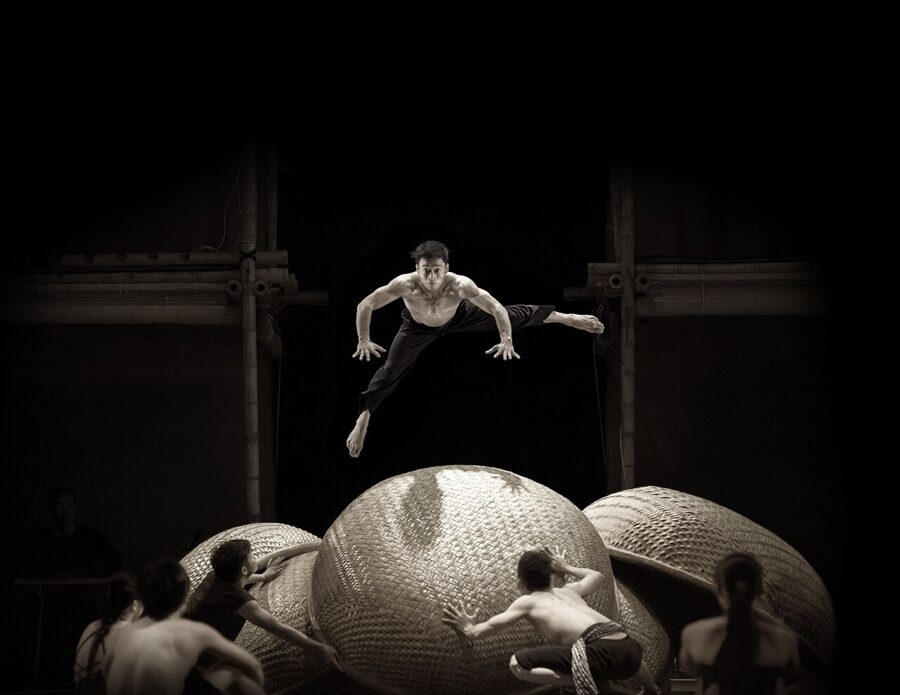

Lune Production’s published prices for the A O Show, effective 20 November 2026, are 800,000₫ (about US$31), 1,250,000₫ (about US$48) and 1,750,000₫ (about US$67), for three seating tiers. The producer lists performances at the theater from 24 November 2026 onward. The producer’s pages don’t state the curtain time; ticket listings over the past year have shown a 6pm start on most dates, with occasional later shows, so check the date you want before you plan dinner.
Is the top tier worth it? For acrobatics, being close matters, but this is a small room of under 500 seats, so even the cheapest tier is close by big-theater standards. The middle tier is the sensible buy if you want faces as well as shapes. Photography is not allowed during the performance, since a flash at the wrong moment can put a performer at risk.
Teh Dar has moved
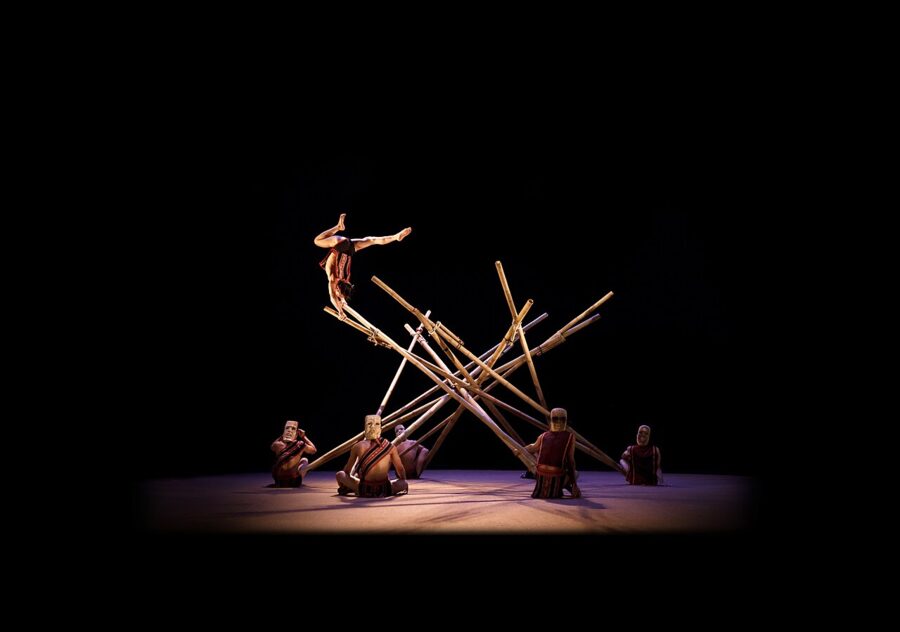
Teh Dar used to share the Opera House stage with the A O Show. It is Lune’s darker piece, built around the music and myths of the Central Highlands peoples. Its name means going in a circle in the K’Ho language, and it uses gongs, buffalo horns and bamboo instruments.
As of November 2026 the producer lists Teh Dar only at its Hội An venue, the bamboo-domed Lune Center in the old town, while its Hanoi piece, Làng Tôi (My Village), plays in Hanoi. In Saigon, the bamboo circus means the A O Show.

Symphony, ballet and opera
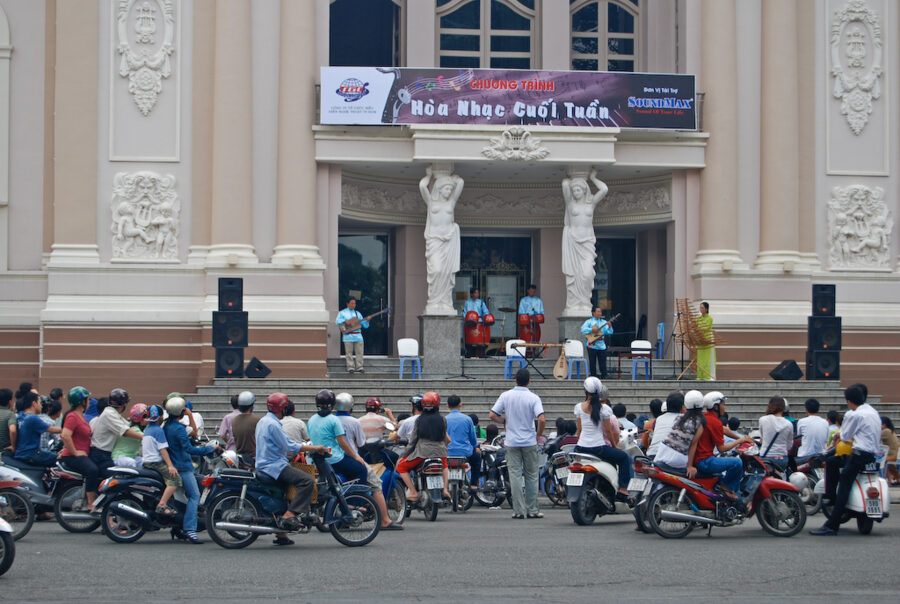
Since 2012 the theater has been the main stage of the Ho Chi Minh City Ballet Symphony Orchestra and Opera (HBSO), whose offices are in the building’s basement. Its seasons mix symphonic programs, full-length ballets, opera and Vietnamese works, and international soloists and conductors come through each year. Former HBSO director Trần Vương Thạch has described a backstage so cramped that visiting conductors gave up their dressing rooms to the singers, which is part of why the city wants the restoration.
HBSO publishes its program and sells tickets on its own site, hbso.org.vn. Prices vary by program and seat, so look before you go. As a rule, an HBSO concert costs less than the bamboo circus and is the cheapest way to sit inside the auditorium.

Booking
Buy A O Show seats through Lune Production’s website, luneproduction.com, and HBSO seats through hbso.org.vn. Resellers and hotel tour desks sell the same seats, sometimes with a markup. For galas and one-off concerts, the city’s performance center (Saigon Concert), which runs the building, announces events on its own channels.
Seeing inside without a show
The short answer is that you can’t, reliably. The theater runs no regular public tours, and no daytime visiting program was confirmed for 2026. The doors open for ticket holders and for official events, and that’s it. Turning up at midday hoping to look around usually ends at a locked door.
What you miss is a small oval auditorium of red seats under a decorated dome, with the arch over the stage carved to match the façade. The lobby has the granite floor, the chandeliers and the bronze figures by the stairs. The 1998 restoration put most of this back; Lune Production now counts 468 seats in the house.
If you want the interior and don’t care for acrobatics, an HBSO concert keeps you in the room longer for less. Arrive when the doors open, take a lap of the lobby and the upper landing before you sit down, and look up as the house lights go down. The ventilation openings in the dome, decorated like everything else, are a reminder that this room was designed to breathe without machines.
The other route is the outside, which is free and open at all hours. The best close view of the ornament is from the top of the steps, under the caryatids. The best overall view is from the middle of Lam Sơn Park, or from the terrace of the Continental’s café on the left, where you can sit with the building in front of you.
How to visit
| Address | 7 Công Trường Lam Sơn, Sài Gòn Ward, Ho Chi Minh City (the former Bến Nghé ward, District 1) |
|---|---|
| Outside | Free, open at all hours; lit after dark |
| Inside | Ticket holders and event guests only; no regular tours |
| A O Show | 800,000₫, 1,250,000₫ or 1,750,000₫ (Lune Production prices from 20 November 2026); about one hour; book at luneproduction.com |
| HBSO | Program and prices at hbso.org.vn |
| Metro | Line 1, Opera House station (Ga Nhà hát Thành phố), one stop from Bến Thành |
| Time needed | 20 to 30 minutes outside; about 2 hours for a show, including arrival |
Getting there
Metro Line 1 is the easy option from anywhere along the line out to Thủ Đức. Get off at Opera House station, the first stop after Bến Thành, and take one of the exits at the theater end of the concourse to come up beside Lam Sơn Park. Single-journey fares on the line run from 7,000₫ to 20,000₫ in cash, depending on distance, so the hop from Bến Thành costs the minimum.
With Grab or Be, enter “Nhà hát Thành phố” or “Saigon Opera House”. On show nights, ask to be dropped on Đồng Khởi or Lê Lợi rather than in front of the steps, which jam with cars as an audience arrives or leaves. From Bến Thành Market (Chợ Bến Thành) it’s a flat 15-minute walk straight down Lê Lợi, about a kilometer, with the theater in view at the end of the boulevard the whole way.
From Notre-Dame Cathedral (Nhà thờ Đức Bà), walk down Đồng Khởi, past the Vincom Center, for about ten minutes. The Central Post Office (Bưu điện Thành phố) is next door to the cathedral, so the three buildings make one easy French-era loop.

When to go
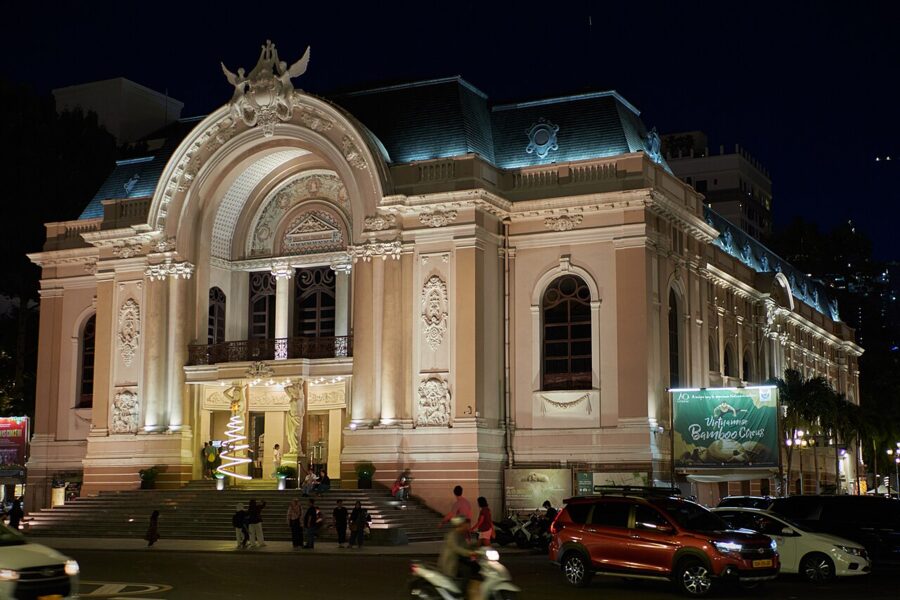
Late afternoon is the best time to photograph the front, when the sun comes straight up Lê Lợi onto the stone. Early morning has fewer people, though the façade is in shade, and on weekend mornings the steps fill with wedding and graduation shoots. After dark the lighting comes on, and on show nights the audience on the steps adds some life to the picture.
Saigon’s rainy season runs roughly May through November, and afternoon downpours tend to be short. The porch is a good place to wait one out. The dry months from December to April give the clearest skies for photographs.
What to pair it with
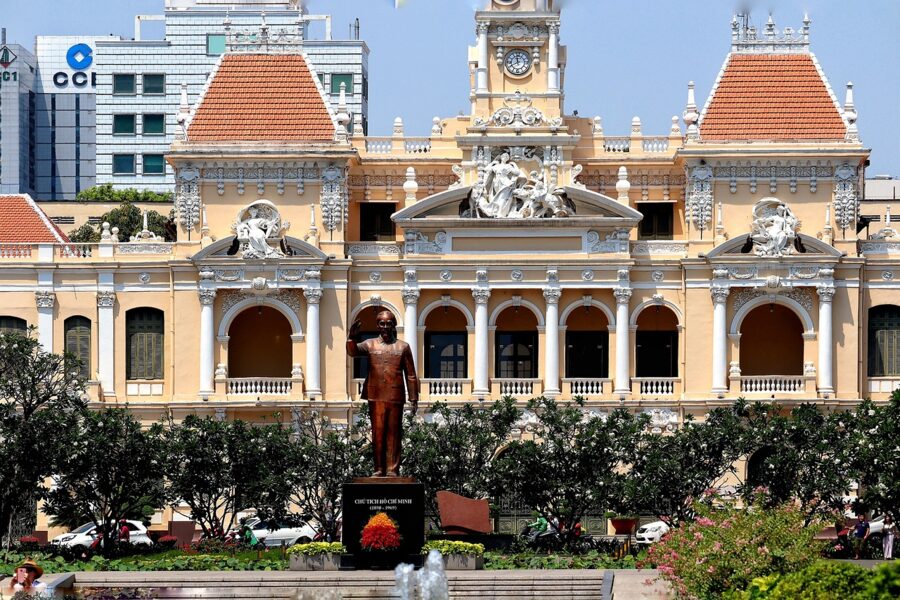
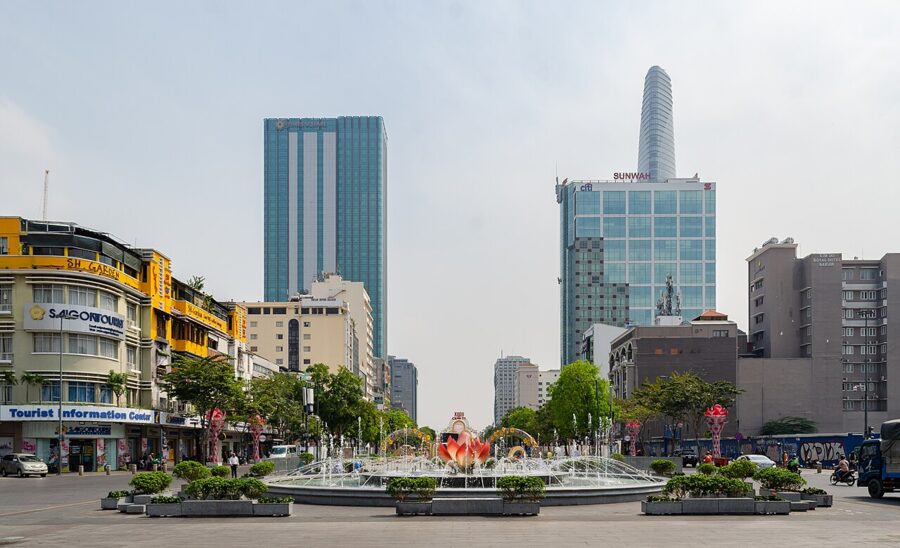
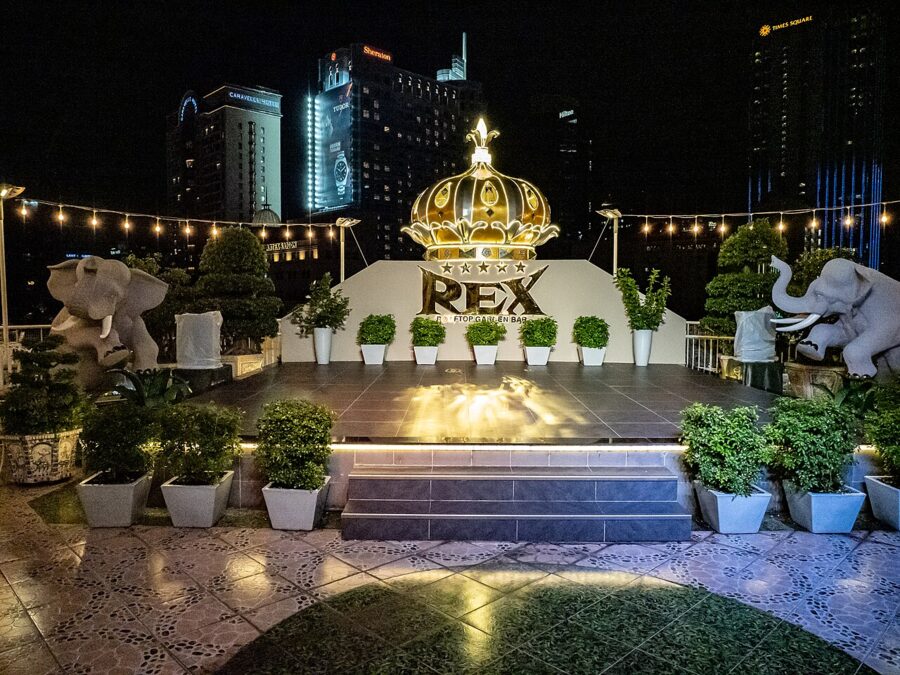
Nguyễn Huệ, the pedestrian boulevard that runs from City Hall (the former Hôtel de Ville) down to the river, starts about 300 meters from the theater along Lê Lợi. City Hall itself is closed to visitors but worth a look from the square with the Hồ Chí Minh statue, especially lit at night. On the corner between them, the Rex Hotel hosted the US military’s daily press briefings during the war, which reporters nicknamed the Five O’Clock Follies.


For a full morning, start at the Reunification Hall (Dinh Độc Lập) when it opens, walk to the cathedral and post office, then down Đồng Khởi to the theater and the Continental for lunch. Give the War Remnants Museum its own half day; it is a 15-minute ride away and heavy going. The Lower House years make more sense if you see the palace and the museum first.
On a show night, eat early. The streets around Lam Sơn Square have everything from hotel restaurants to cơm tấm stalls on the side streets toward Hai Bà Trưng, and the A O Show audience is back on the pavement about an hour after curtain. Then cross into Lam Sơn Park and turn around: the lights are on, the caryatids are lit from below, and the front that waited 43 years behind a false wall is looking straight down Lê Lợi at you.