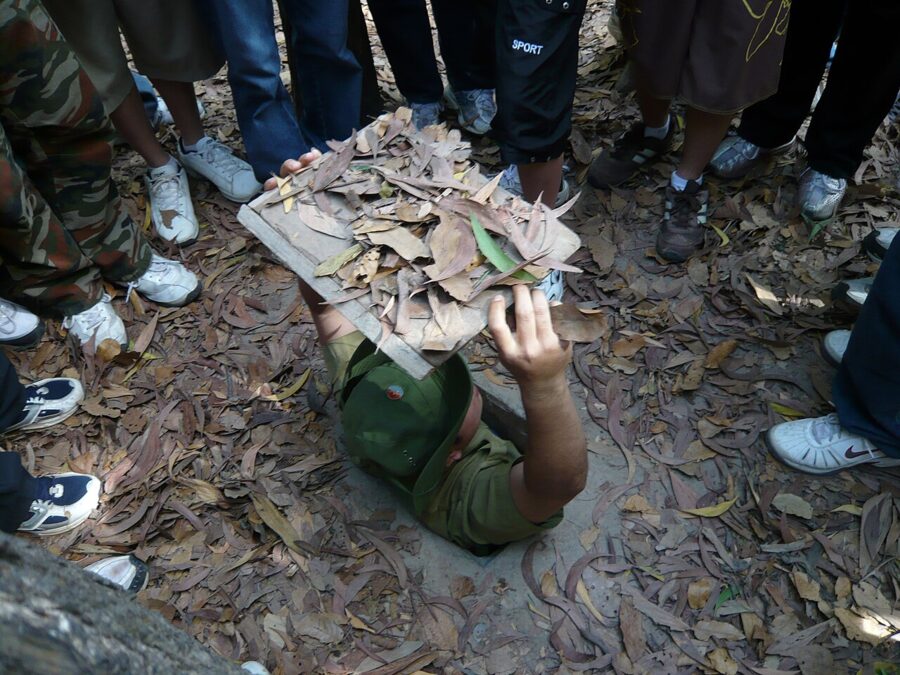
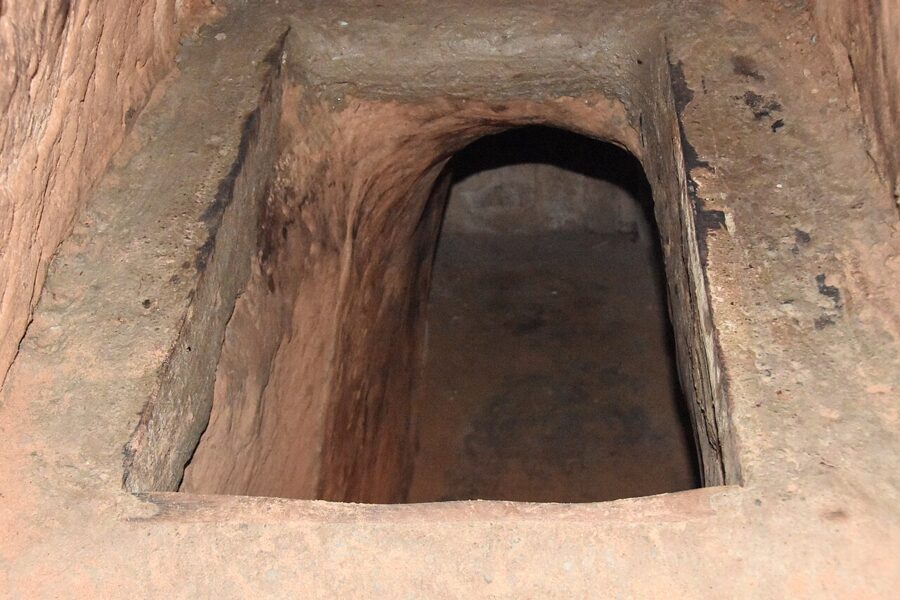
At seven in the morning, when the gates at Củ Chi open, the forest floor looks like any patch of woodland west of the Saigon River: dry leaves, red earth, thin trunks. Then a guide crouches, brushes the leaves aside and lifts a lid of wood and packed soil no wider than his shoulders. Underneath is a square hole. He drops into it, raises his arms, pulls the lid back over his head, and the ground is empty again.
That trick is the reason the Củ Chi Tunnels (Địa đạo Củ Chi) are among the most popular day trips out of Ho Chi Minh City. Between the late 1940s and 1975, the farmers and guerrillas of Củ Chi dug a network of passages, chambers, wells and firing posts under their villages, and used it to survive two wars fought over their heads.
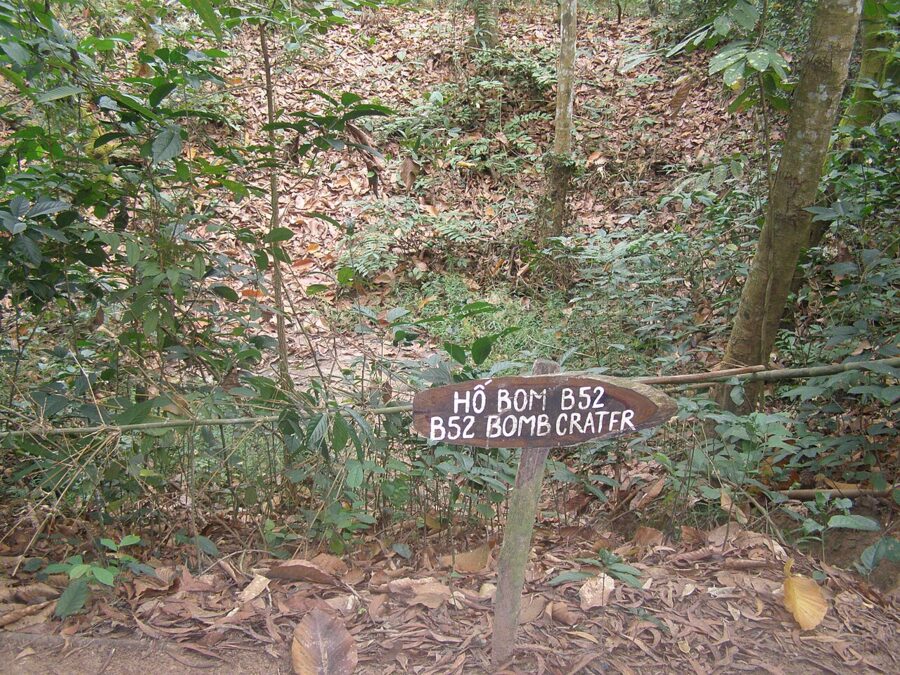
The American army built a division headquarters on top of part of it. B-52s cratered the ground above it. Much of the rest lies under fields and gardens, collapsed or buried.
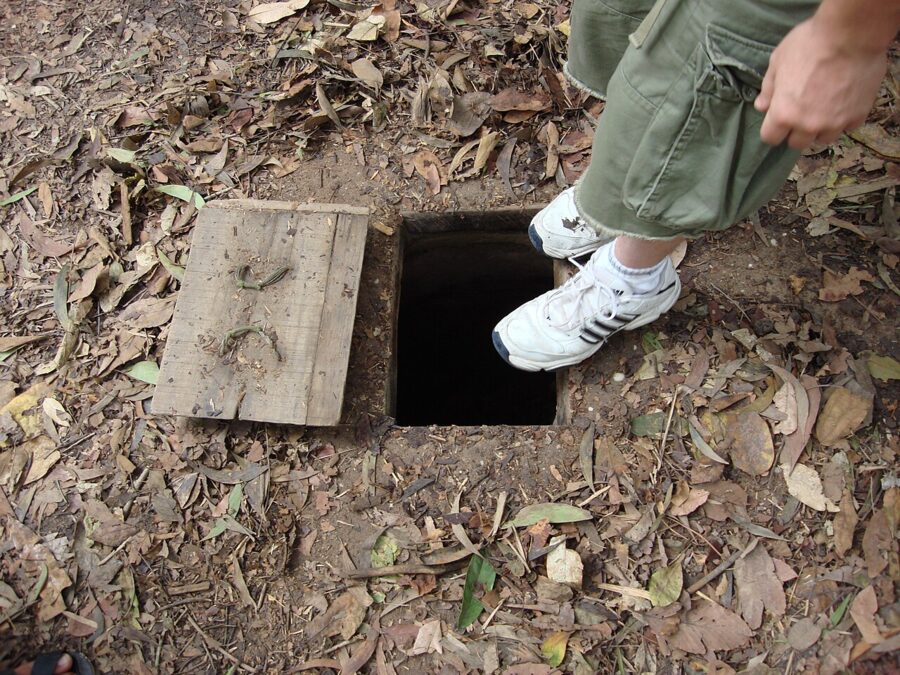

Two short stretches are open to the public, at Bến Đình and Bến Dược, about 13 km apart along the river. Together they keep roughly 4 km of tunnel in something like its original shape, plus exhibits, a memorial temple, a firing range and a re-created wartime village.


On this page
Dug with hoes, carried out in baskets
The tunnels began small. In 1946, by the account in Vietnam’s 2026 submission to UNESCO, families in the communes of Tân Phú Trung and Phước Vĩnh An started cutting hiding holes to escape French sweeps: pits two or three meters across and about two deep, roofed with bamboo and a layer of earth. Other Vietnamese sources date the first digging to 1948, and the difference is less a dispute than a sign of how informal the beginning was.
Nobody planned a network. Each household dug its own refuge, then connected it to the neighbors’. By 1947 two of these systems, in Cây Da hamlet and Ba Gia hamlet, had been joined into a line about 17 km long, still a shelter and a place to hide documents and rice.
The great expansion came after 1960. Between 1961 and 1965 the six northern communes of Củ Chi, among them Phú Mỹ Hưng, An Nhơn Tây and Nhuận Đức, dug a main spine, and party organizations, units and villages cut branches into it until the hamlets were linked underground.
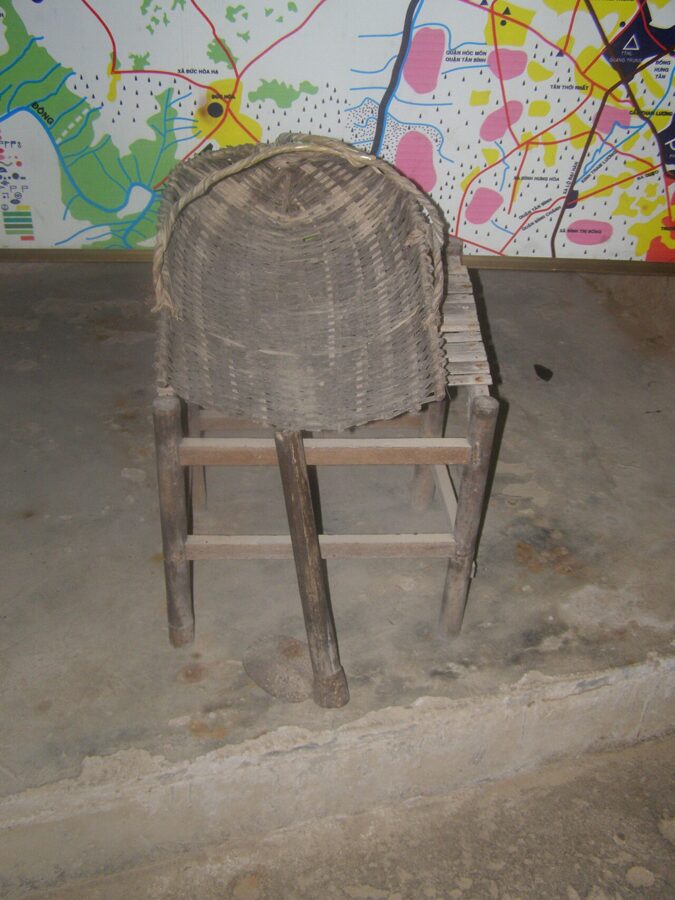

The method was simple and slow. A crew sank a test shaft three or four meters down, then dug sideways in two directions at once, team by team, until the next section met them. When the stretch was finished the shaft was filled in, and real entrances were opened elsewhere, usually among tree roots or in thickets. The UNESCO dossier records the division of labor in a single line: the old whittled spikes, children boiled water, men dug and women carried the earth away.
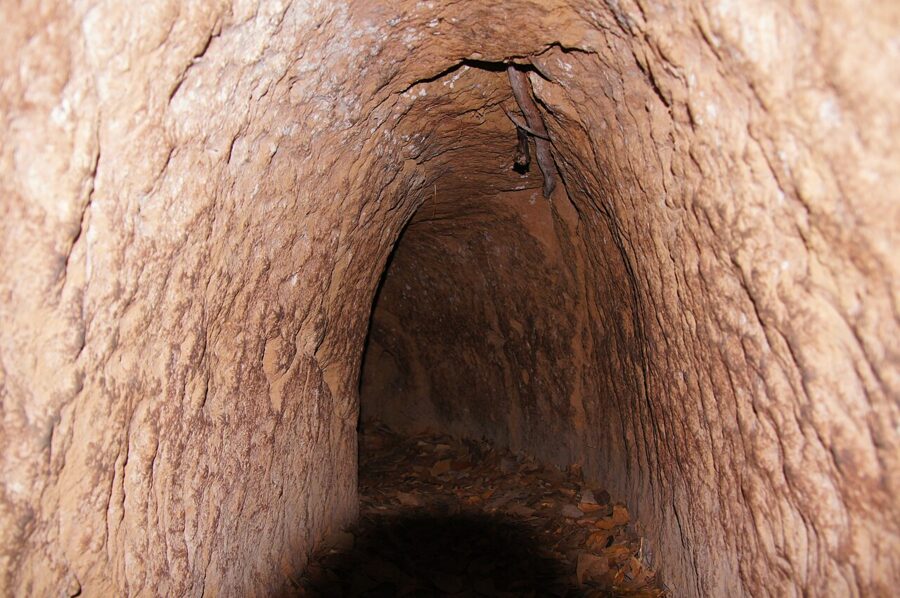
The ground made it possible. Củ Chi sits on a low rise between the Saigon River and the Vàm Cỏ Đông, and its soil is laterite clay: dry, compact and, deeper down, oxidized into a rust-red layer as hard as concrete. A tunnel cut through it needed no props. The upper level could carry the weight of a tank, and the deeper ones stood up to most bombs short of a direct hit.
Three levels, and three sets of numbers
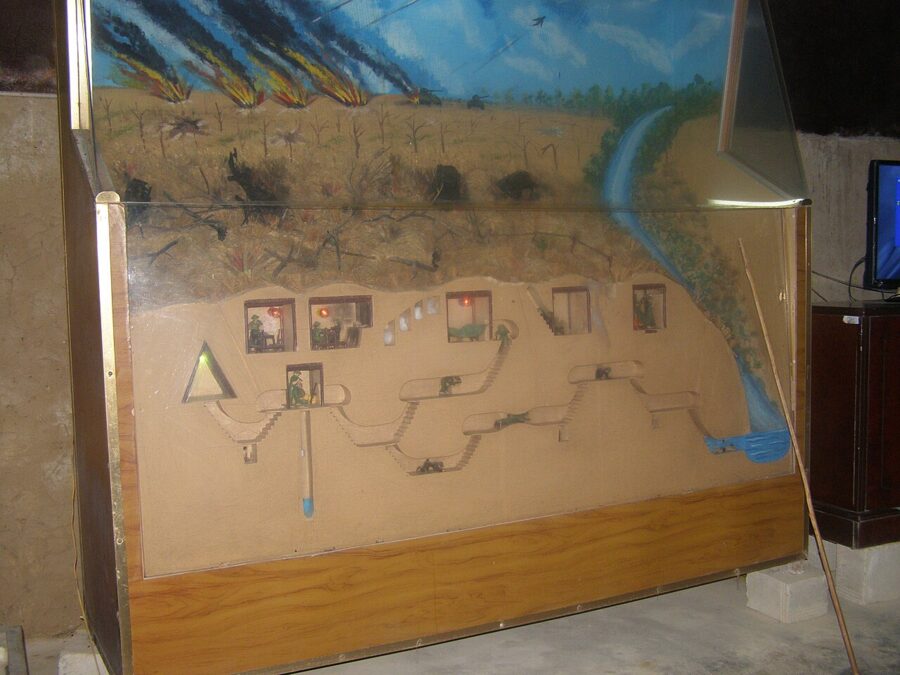
Most descriptions give the system three levels, though the figures vary with the source and the place. Vietnamese reference works put the first level about 3 m down, strong enough to carry a tank; the second at 5 to 8 m, proof against small bombs; and the deepest at 8 to 12 m.
The 2026 survey of Bến Dược measured its levels at about 4 m, 6 m and 7 to 10 m, with the deepest passage 75 cm wide and 95 cm high. Bến Đình, the district committee’s base, is shallower: its first level lies 3.4 m down, and the narrowest squeeze measured there is 40 cm wide and 73 cm high.

Total length is the most quoted number and the least certain. Signs and guides usually say 250 km; older Vietnamese accounts give 200 km by 1965; the UNESCO dossier says only that the network across Củ Chi ran to several hundred kilometers and admits that a secret system dug by hand cannot be measured exactly. What survives in good order is far smaller: the two public sites hold about 4 km between them, restored and opened in 1991.
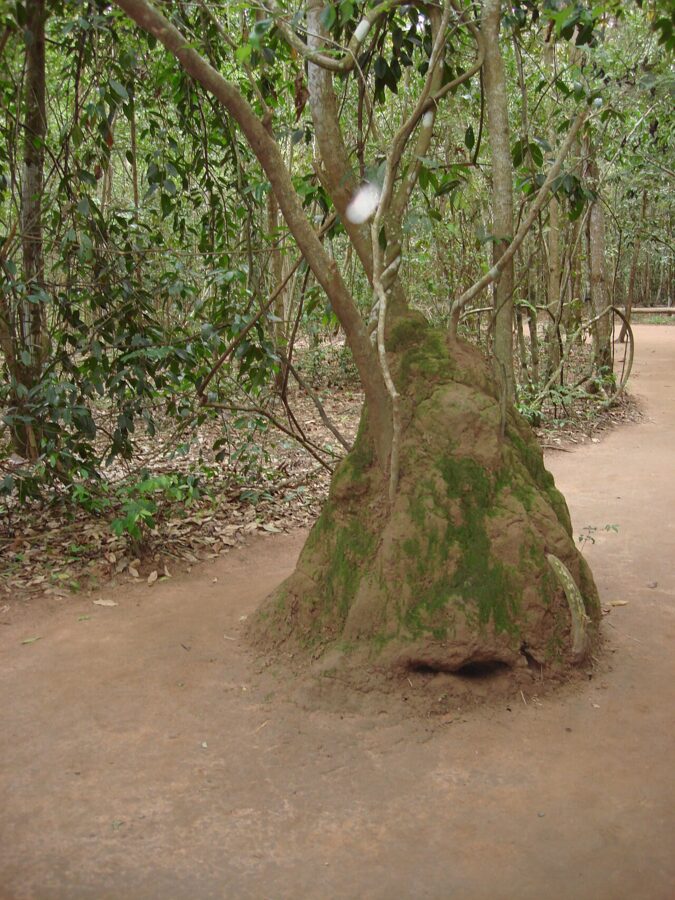
The passages zigzag. Straight runs rarely exceed 30 m, and the drops between levels were built as S-bends, so a grenade rolled in from one side would not reach the next chamber and gas or water pumped down would pool before it spread. Trap doors between levels could be closed and hidden from below. Air came through bamboo pipes 10 to 15 cm across, their mouths tucked into bamboo clumps or built up to look like termite mounds.

A kitchen that hid its smoke
Cooking was the hardest thing to hide. Smoke over a forest at noon meant a target. The answer came from the north: the Hoàng Cầm stove (bếp Hoàng Cầm), designed by an army cook of that name during the Hòa Bình campaign of 1951 and 1952, and used by the Việt Minh and, later, by the guerrillas in the south.
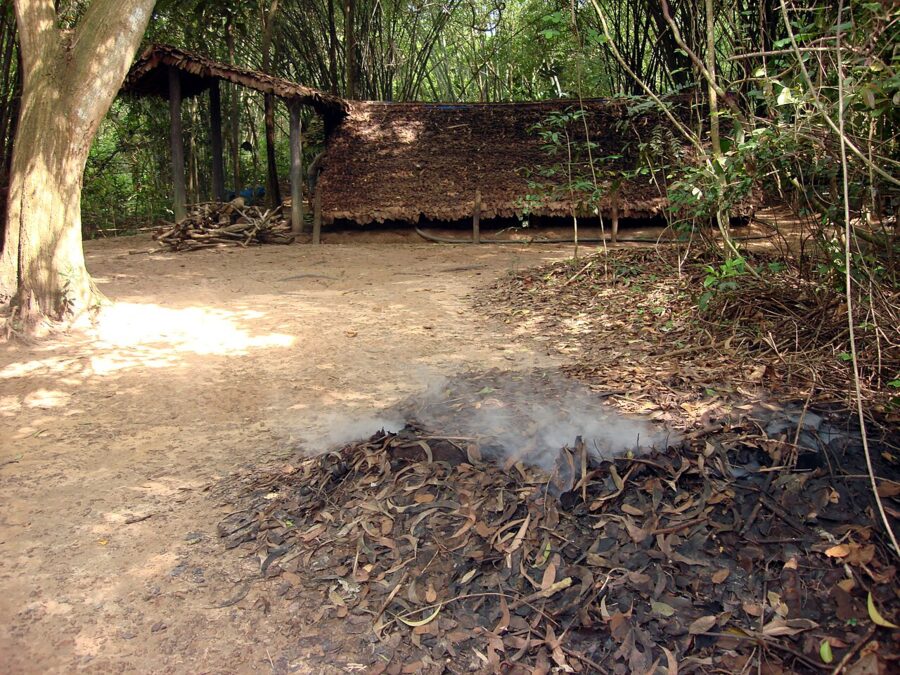

The stove sits in a pit, and its smoke is led away through earth channels to one or two buried chambers, then out through several gently rising vents, each 4 to 7 m long, that open under bushes. The channels are roofed with green branches, leaves and loose soil, so the smoke seeps out thin and low rather than rising in a column. In the army’s phrase, the aim was to “march without a trace, cook without smoke”.

The Iron Triangle years
Củ Chi mattered because of where it sat. Saigon lay to the southeast, less than a day’s march away. Across the river to the northeast was the Iron Triangle (Tam Giác Sắt), a wedge of forest and paddy between the Saigon and Thị Tính rivers that had been a guerrilla base since the war against the French. Whoever held this ground could threaten the capital, and the guerrillas held it.
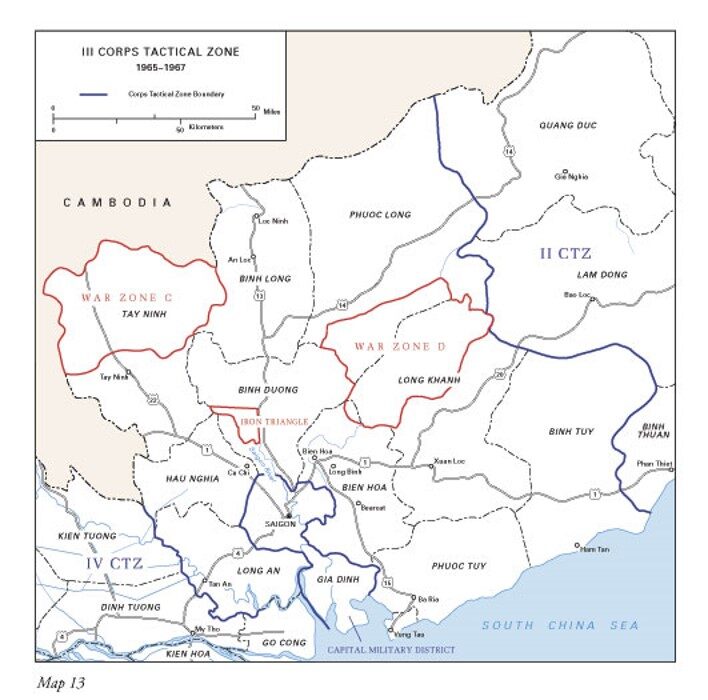
By 1965 the guerrillas were entrenched enough to choose where and when to fight. For the American command, newly committed to a ground war, clearing the northwest approach to Saigon became a priority.
A division camped on the roof
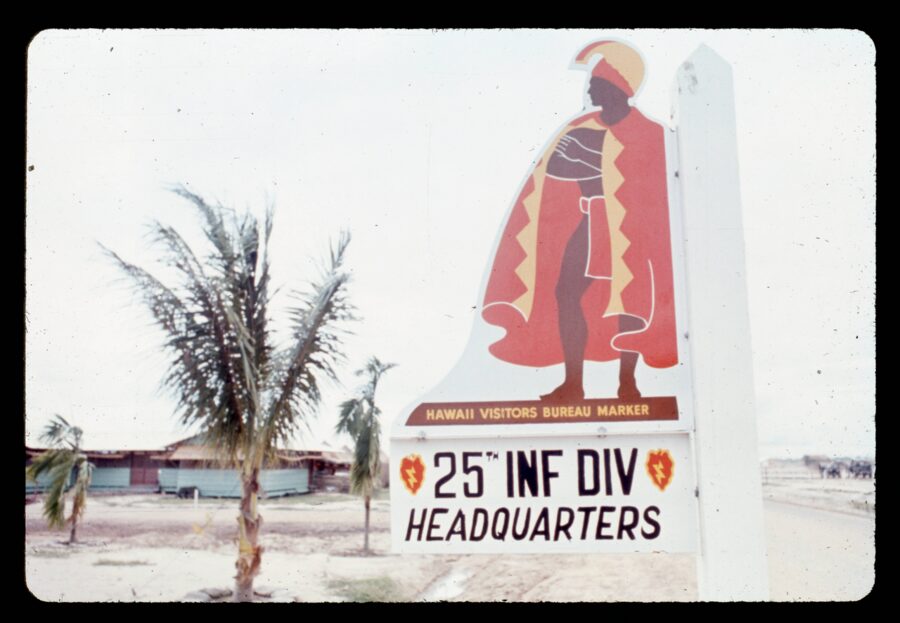
In January 1966 the American 25th Infantry Division began building its base at Đồng Dù, just outside Củ Chi town, on ground the Vietnamese had already riddled with tunnels. The base would be the division’s headquarters until February 1970. In the first months the division took fire inside its own perimeter at night, from guerrillas who came up out of the tunnels beneath it. At Bến Đình, a tunnel still points toward the old base.
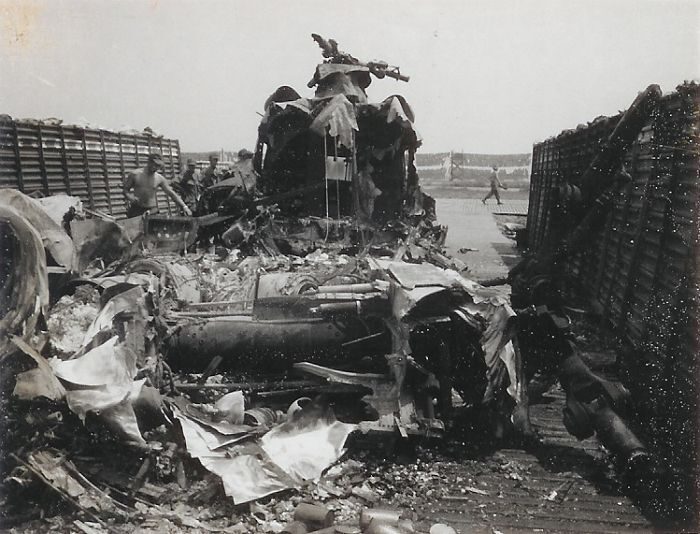
The base never stopped being a target. On 26 February 1969, sappers attacked it and destroyed nine Chinook transport helicopters on the ground. The logic was the same one the tunnels had made possible from the start: a force that could not be found in daylight, choosing its moment.
Operation Crimp, January 1966
The first large attempt to clear the area came in the second week of January 1966. Operation Crimp sent about 8,000 American and Australian troops, after a heavy bombardment, into the Hồ Bò woods north of Củ Chi to find a headquarters believed to be underground. Most of the guerrillas simply stayed below. Troops who found an entrance tended to throw in grenades or smoke, pump in water or gas, and seal the hole, which barely touched a system built with trap doors, water traps and air shafts.
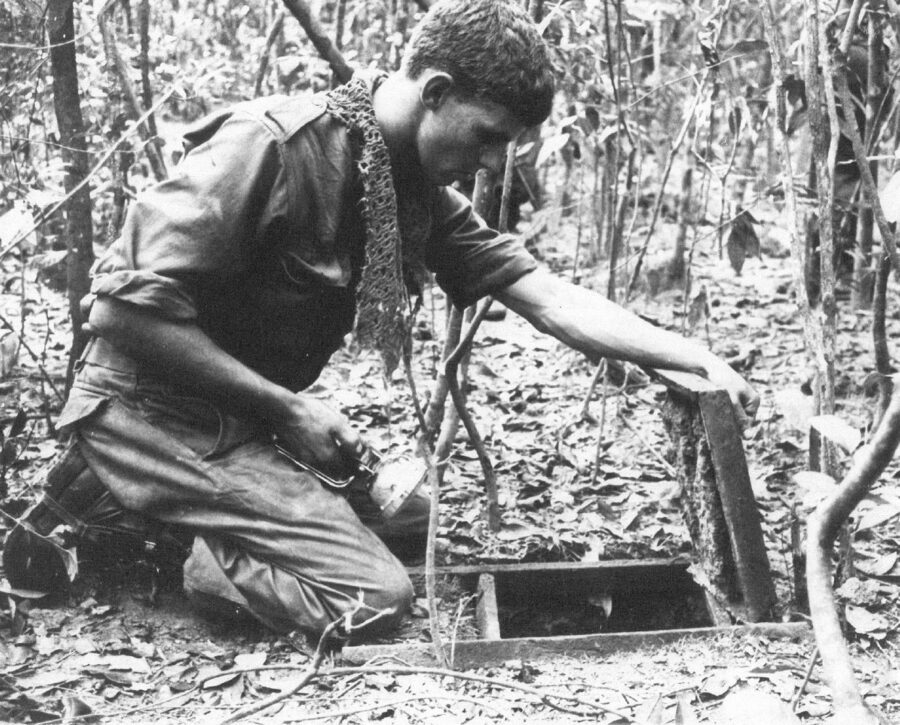
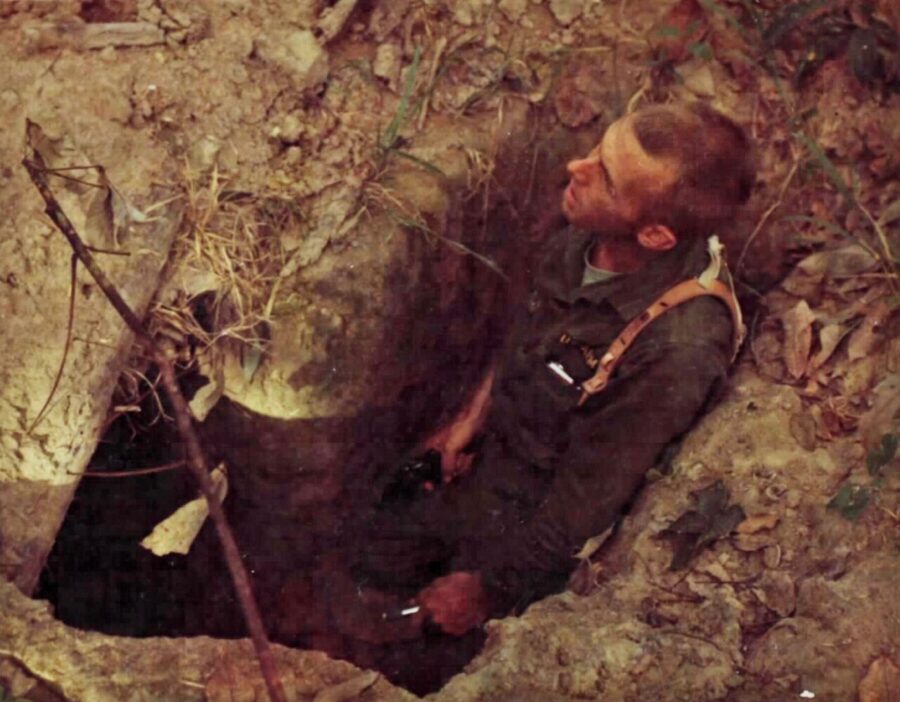
The exception was an Australian engineer unit, 3 Field Troop, under Captain Alexander “Sandy” MacGregor. His men went down and kept going for days, mapping chambers and hauling out what they found. One of them, Corporal Bob Bowtell, became trapped in a passage that turned out to be a dead end, and died there. By the Australians’ account, MacGregor called his men “tunnel ferrets” at a press conference in Saigon; the name the press made famous was “tunnel rats”.
Cedar Falls: peeling the earth
A year later the Americans tried again, much bigger. Operation Cedar Falls ran from 8 to 26 January 1967 and put about 30,000 American and South Vietnamese troops into the Iron Triangle, with Củ Chi on its western flank. It was the largest ground operation the allies had yet mounted in the war. The plan went beyond hunting fighters: the area’s civilians were to be moved out, their villages destroyed, the forest flattened and the ground declared a free-fire zone.
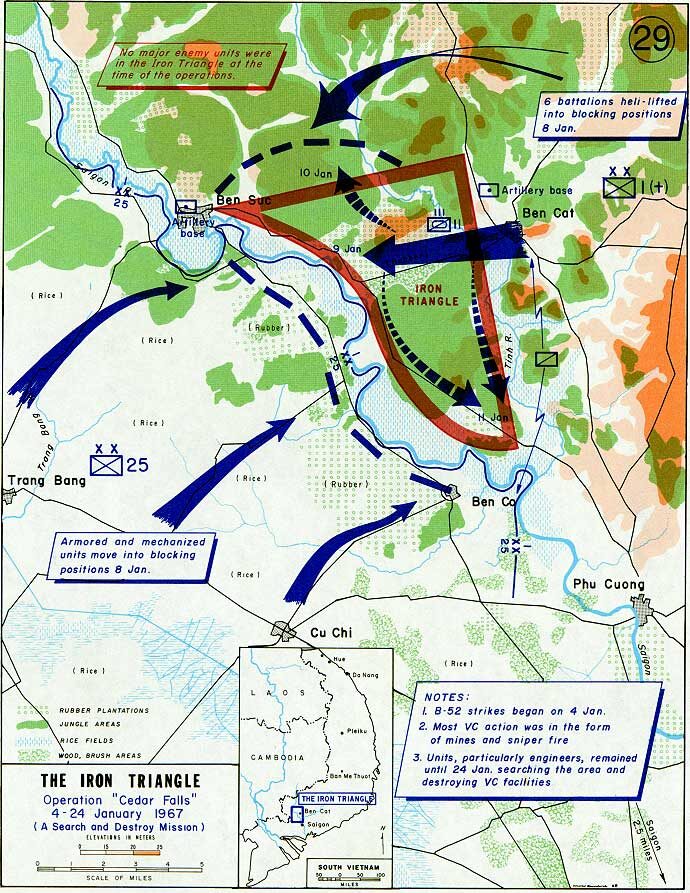
The whole population of Bến Súc, a market town of about 3,500 people on the Saigon River, was moved out and the town razed; the American journalist Jonathan Schell followed the removal and wrote it up as The Village of Ben Suc. Rome plows, heavy bulldozers fitted with cutting blades, scraped away whole tracts of forest. Engineers blew up the tunnels they found, and on 18 January a team from the 25th Division’s 1st Battalion, 5th Infantry, came across a district headquarters complex holding a huge cache of documents.
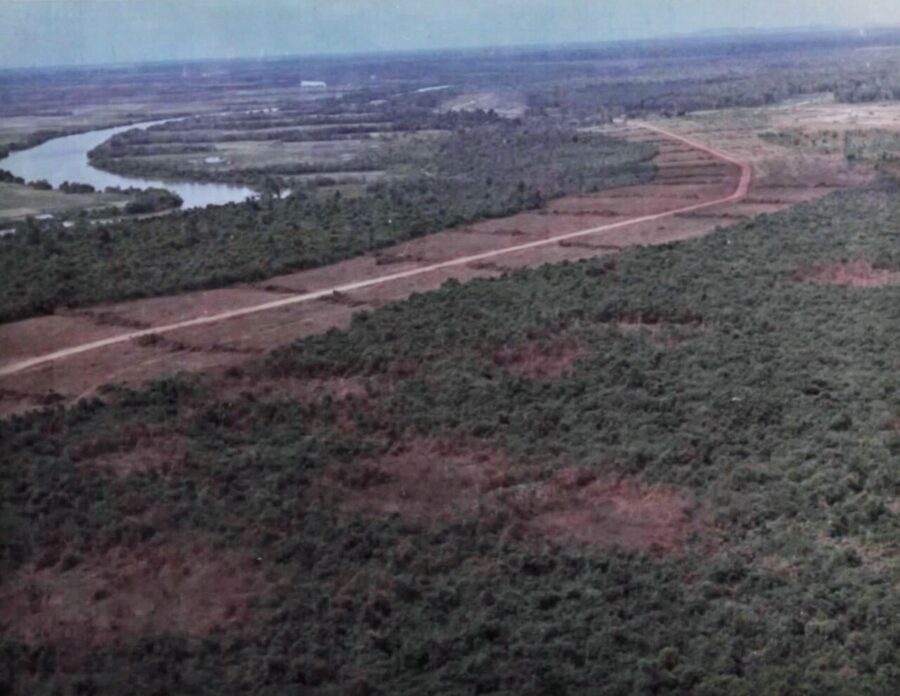
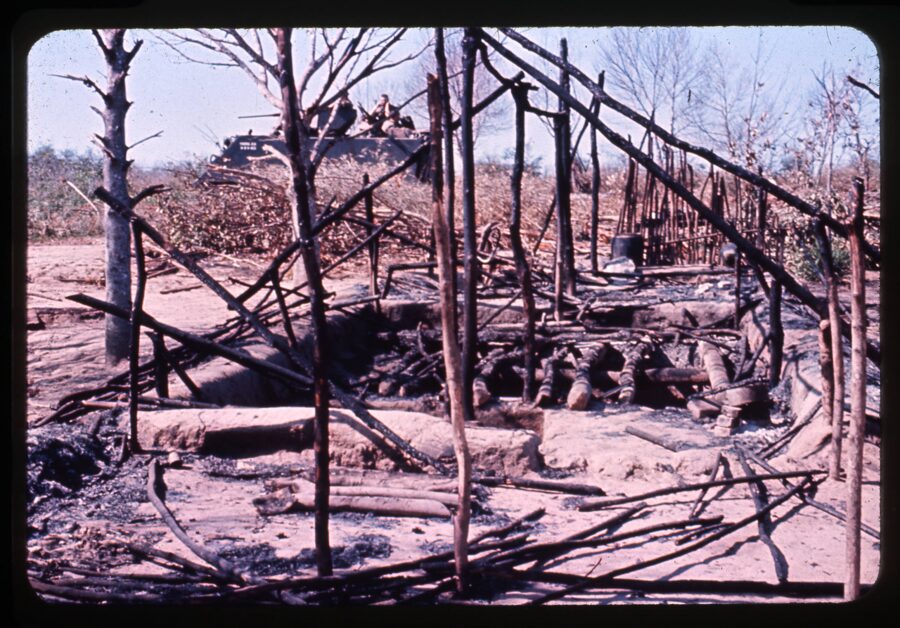
The Vietnamese side calls the operation the attempt to “peel the crust off the earth” (bóc vỏ trái đất), and the relic site’s own account says it was beaten off after 19 days and nights with the regional command intact. Both accounts are partly right. The Americans destroyed tunnels, supplies and a great many homes; the guerrillas’ leadership survived, the area was not cleared, and fighters were back within months. Many historians argue that the forced removals did more to recruit for the guerrillas than to defeat them.
Tết, the B-52s and 1975
The tunnels earned their place in the war’s history in early 1968. During the Tết Offensive, units that struck Saigon set out from the Củ Chi base areas, and the network served as a staging ground and a route for men and weapons moving toward the city. The offensive cost the guerrillas dearly.
From 1969, with B-52 bombers freed from targets in the north, the Americans began carpet bombing Củ Chi and the Iron Triangle. Shallow passages caved in and some sections were laid bare. The deep levels mostly held. In April 1975 the area served once more as a staging ground, this time for the last advance on Saigon, which ended when tanks broke through the gates of the presidential palace now known as the Reunification Hall.
The human cost was enormous on every side. Much of the area was declared a free-fire zone, which by many accounts meant artillery could fire into it at night without clearance and pilots could drop leftover bombs there on the way home. The memorial temple at Bến Dược lists 45,666 names of the dead of Saigon, Chợ Lớn and Gia Định from both wars against the French and the Americans. How many civilians died in Củ Chi alone has never been settled.
Life in the dark
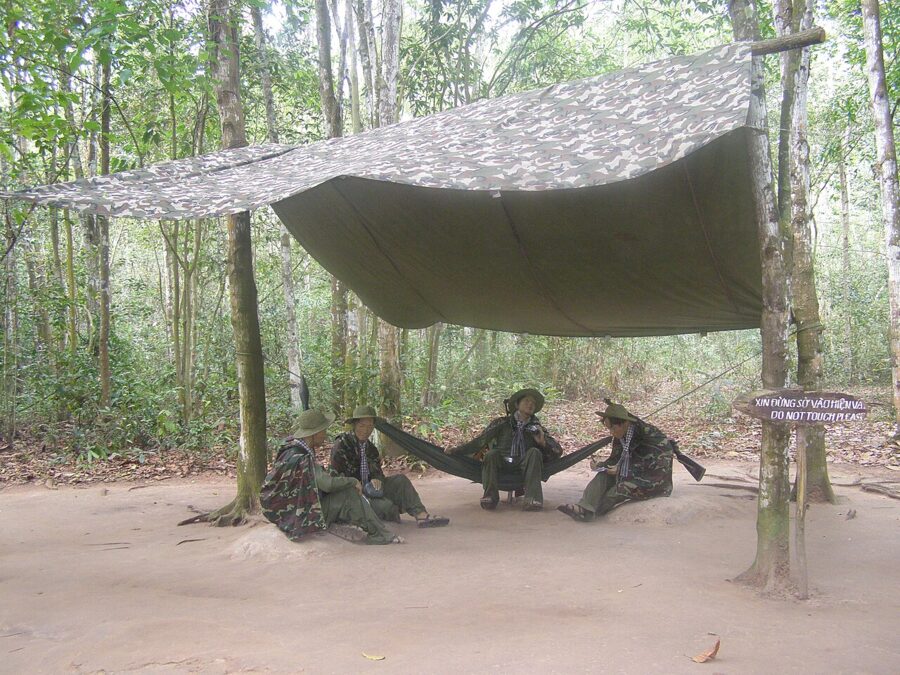
The tunnels were never comfortable, and nobody lived in them by choice. The usual pattern was to work, rest and hide below by day and to come up at night to farm, fetch water, carry supplies and fight. During big operations or heavy bombing, people stayed down for days, sometimes much longer. Air was short, the heat was close, and the passages were shared with ants, centipedes, scorpions, snakes and rats.
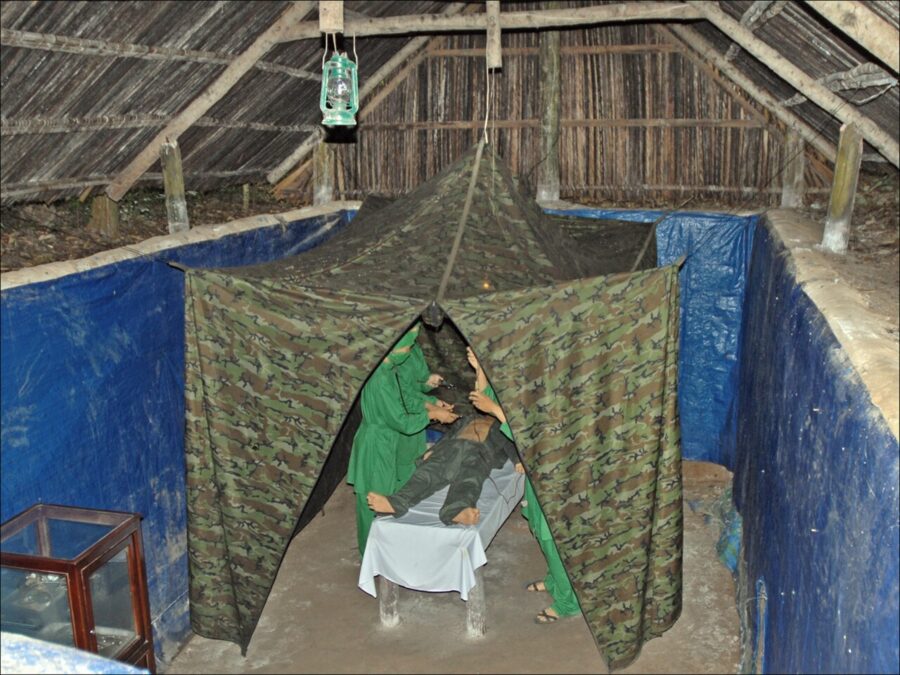

Disease did as much damage as bombs. Malaria was the second biggest killer after battle wounds, and a captured guerrilla report of the period estimated that, at any given time, half a unit had malaria and every man carried intestinal parasites. Vietnamese accounts add skin disease and bone problems from damp and darkness. Food was rice balls, cassava and whatever could be grown in the fields above at night.
Yet the tunnels were also a community. Alongside the sleeping chambers, wells and stores were meeting rooms and spaces large enough for a theater troupe to perform. The survivors’ accounts gathered for the UNESCO dossier dwell on village loyalties carried underground and on couples who met while digging. When the Americans brought in tracker dogs, the guerrillas answered by leaving American soap at the entrances and vents, so the scent at the hole smelled like the soldiers’ own.

The women’s platoon
Many of the tunnels’ defenders were women. The Củ Chi Women’s Guerrilla Platoon (Trung đội Nữ du kích Củ Chi) was founded on 10 November 1965, at the height of the fighting. By the official tally read out at its 60th anniversary at the relic site in November 2025, it fought in more than 100 engagements, built close to 100 bases, put 659 enemy soldiers out of action and destroyed 61 tanks. The platoon was named a Hero of the People’s Armed Forces in 2018, and 25 of its members and liaison workers are honored as martyrs.

Võ Thị Trong, born in Củ Chi in 1950 and one of the platoon’s leaders, now heads its liaison committee and spoke at the anniversary. Accounts of her service include a homemade mine that killed more than ten soldiers and an interrogation in which she gave nothing away. Stories like hers are the backbone of what the guides at both sites tell, and they are worth hearing in full.

The tunnel rats
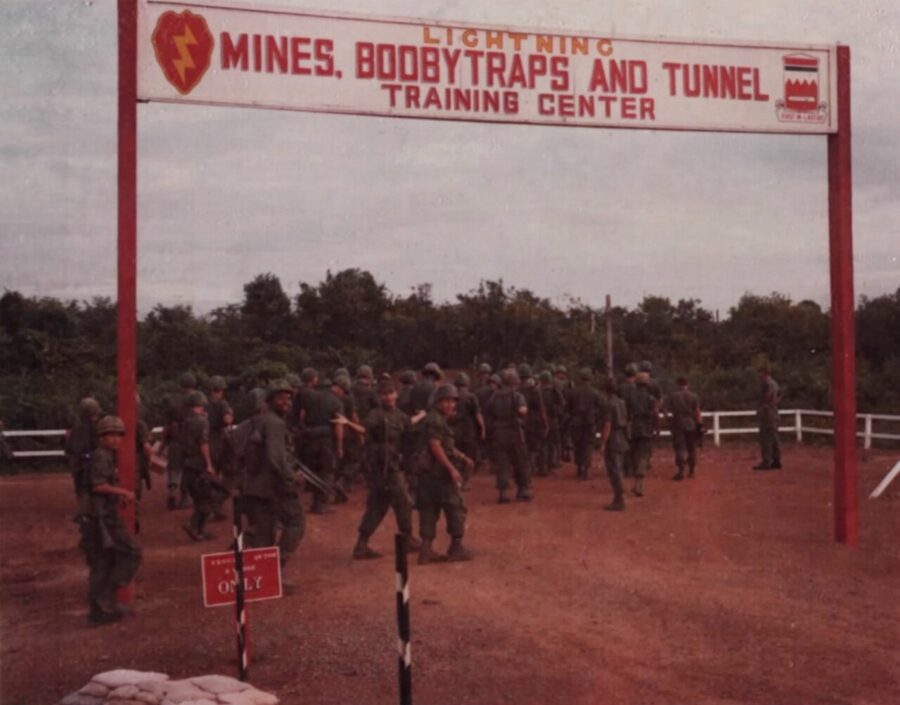
After Crimp, the American 1st and 25th Infantry Divisions formed volunteer teams to enter and clear tunnels. Captain Herbert Thornton, a chemical officer with the 1st Division, organized the first of them in 1966. The U.S. Army’s own museum puts their number at roughly a hundred, nearly all of them short, wiry men.
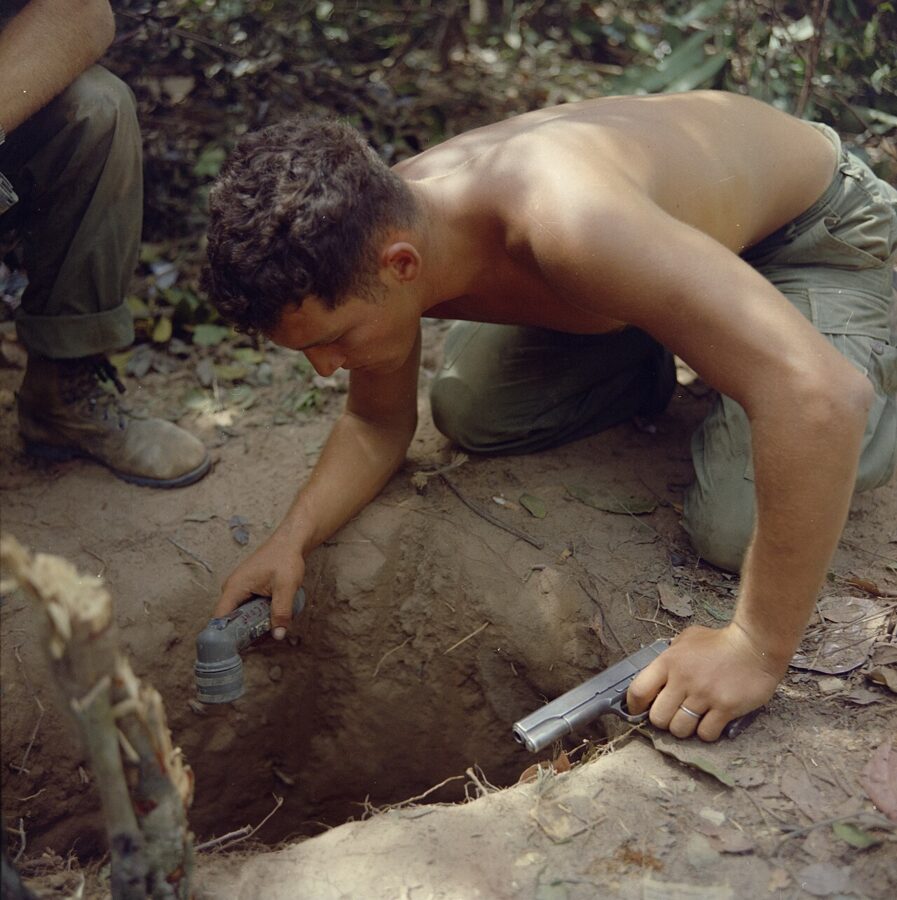
A tunnel rat went in alone or with one partner behind him, carrying a pistol, a flashlight and a knife or bayonet for probing the floor. Helmets, packs and often gas masks stayed outside; there was no room for them. Booby traps, cave-ins, flooded U-bends and the guerrillas waiting in the dark were the dangers.
The unit’s unofficial motto, in mock Latin, was Non Gratum Anus Rodentum: not worth a rat’s ass. American soldiers called the experience below “the black echo”.
The best record of both sides is The Tunnels of Cu Chi by Tom Mangold and John Penycate, two BBC journalists, published in 1985. They interviewed former tunnel rats in America and Australia and, unusually for the time, veterans of the guerrilla units in Vietnam, and set their memories side by side. If you read one book before the trip, make it this one.

Bến Đình or Bến Dược
Both sites belong to the Củ Chi Tunnels Historical Site (Khu di tích lịch sử Địa đạo Củ Chi), run by a management board that answers to the Hồ Chí Minh City military command. It was set up in 1994 and employs close to 300 people, nearly all of them from Củ Chi. The two areas were classified together as a special national relic in December 2015, and in July 2026 Vietnam put the tunnels on its tentative list for World Heritage status. The board says the site had received more than 27 million visits by 2025.
They are not interchangeable. Bến Đình was the base of the Củ Chi district party committee; Bến Dược was the base of the regional party committee and the military command for Saigon, Chợ Lớn and Gia Định. One is compact and set up for foreign groups on a half-day schedule. The other sprawls, carries the memorial temple and is where Vietnamese families, school groups and veterans go.
Bến Đình: the one most tours mean
Bến Đình lies along Provincial Road 15 in what is now Nhuận Đức commune, on a rise above the Saigon River. The district committee chose it as its base for 1968 to 1975 because the ground was high and firm and the river offered a way out. The protected area covers 6.71 hectares of forest, and most half-day tours sold in central Saigon come here.
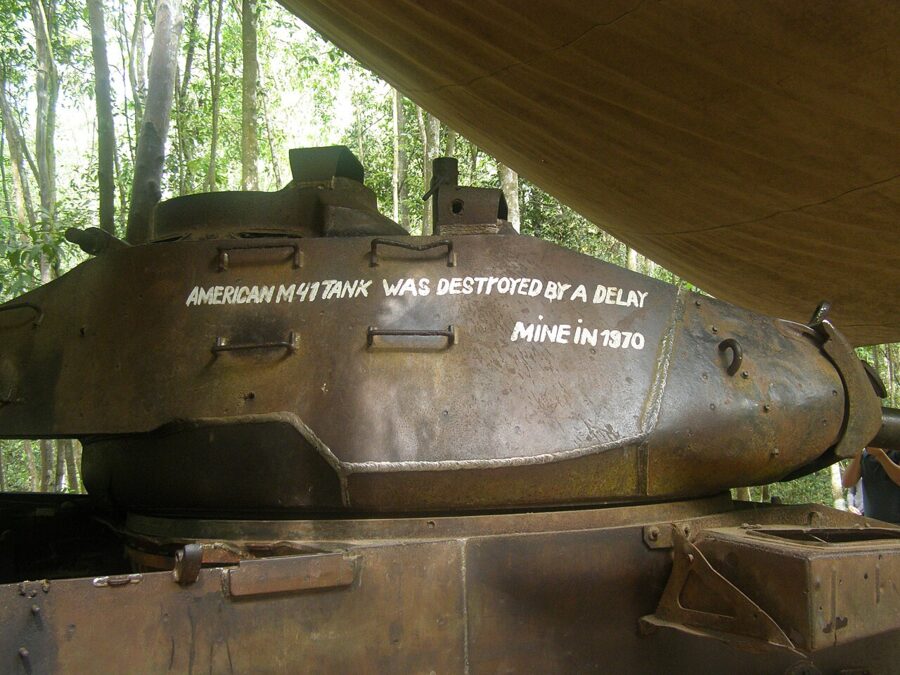

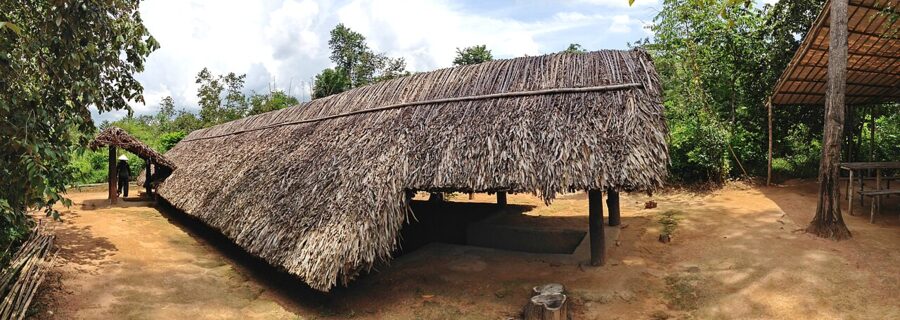
A visit follows a set loop: a briefing and the documentary in a half-buried, thatched hall, the entrance demonstration, the trap displays, the M41, a trench with firing posts, and then the crawl. One stretch passes right under Provincial Road 15. Expect about two hours.
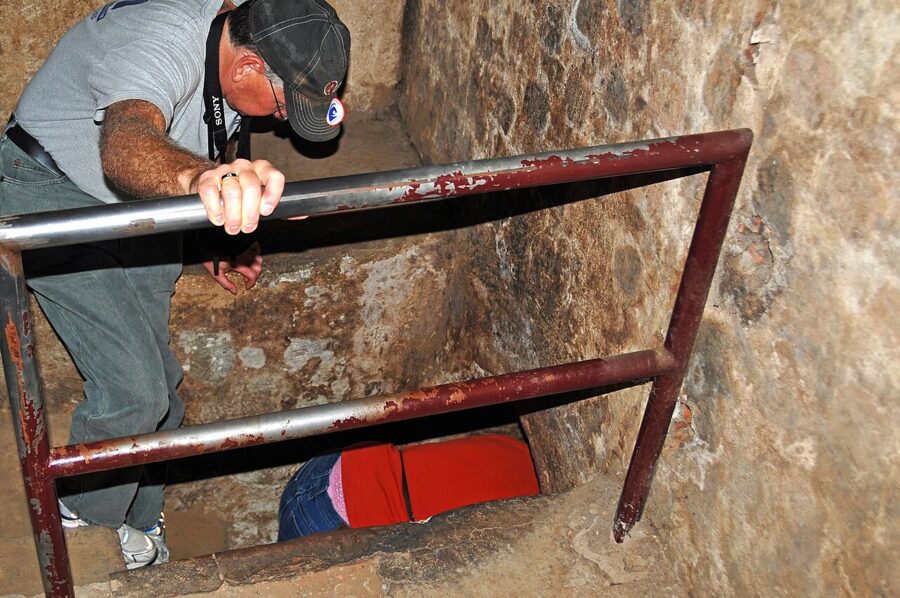

The drawback is the crowd. Bến Đình takes the bulk of the city’s tour buses, and from mid-morning until early afternoon the tunnel mouths have queues. Arrive at opening time or after 2pm and it is a different place.
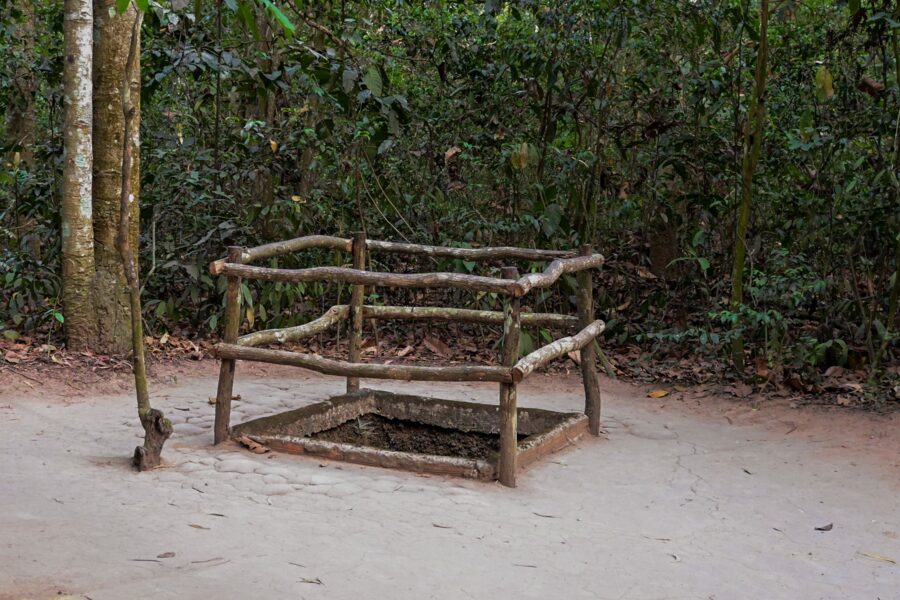
Bến Dược: deeper tunnels, and the temple
Bến Dược, in Phú Hiệp hamlet of what is now An Nhơn Tây commune, was the hidden headquarters of the regional command for Saigon, Chợ Lớn and Gia Định. It is the larger and older relic: classified a national site in 1979, a quarter of a century before Bến Đình. The tunnel area covers 8.4 hectares on high ground with the Saigon River to the north and a stream wrapping round its other sides.
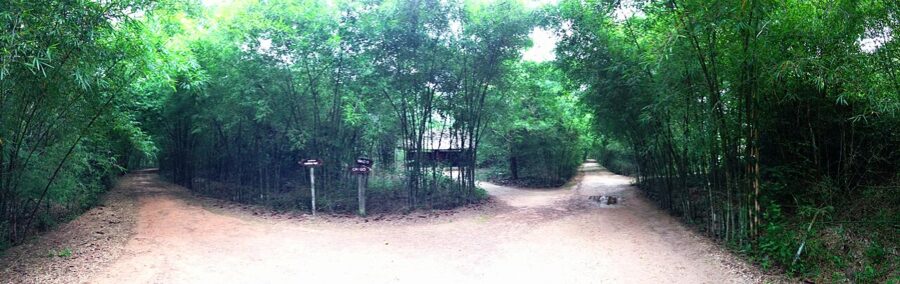

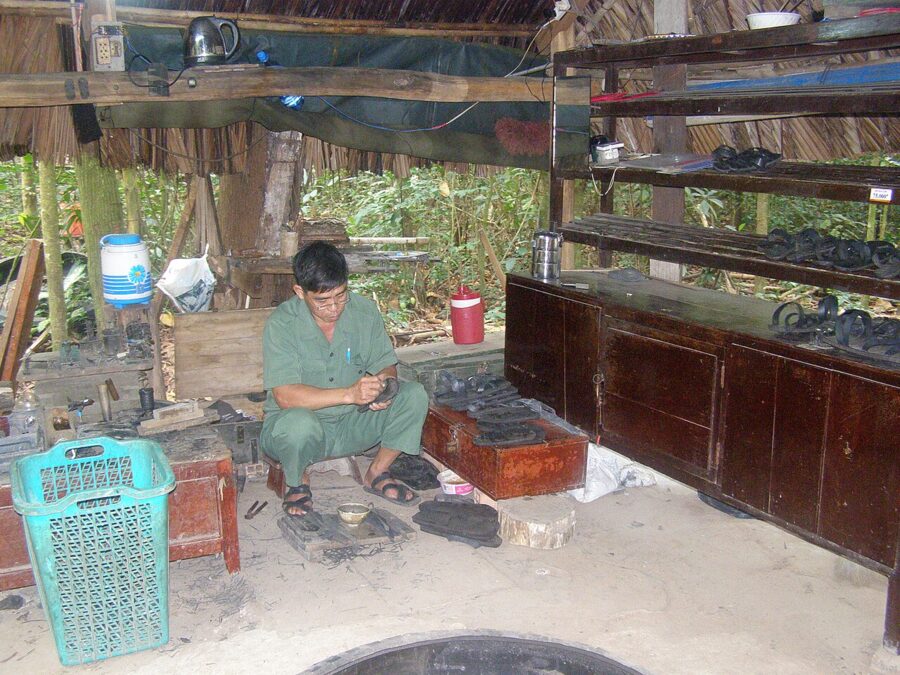
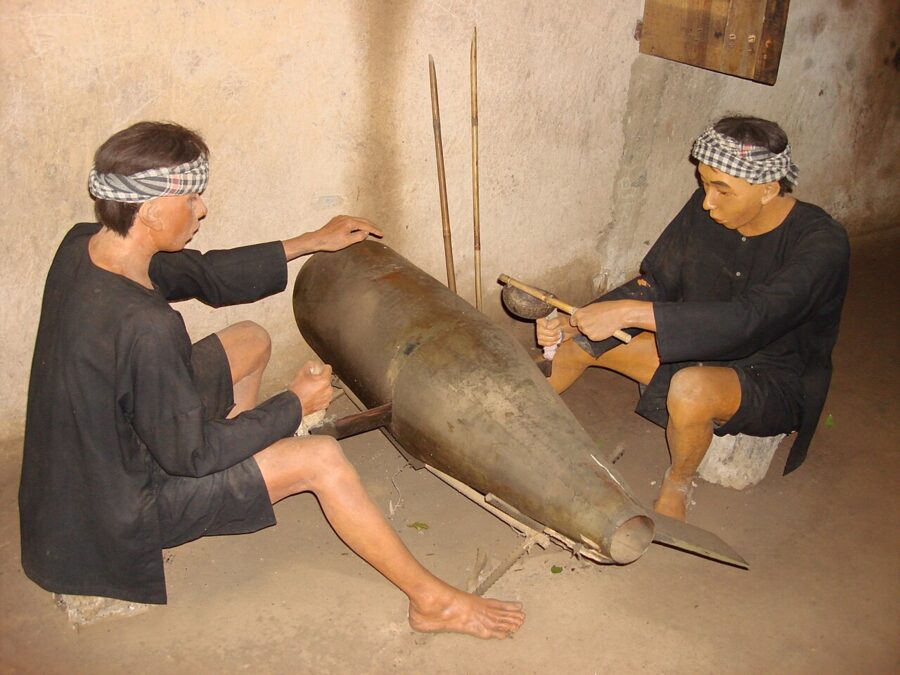
The tunnels here are deeper and the route underground is longer. Besides the main passage you see the commanders’ shelters, a meeting room, the surgery, an A-frame bunker built to survive near misses, storerooms, a well, the Hoàng Cầm kitchen and a workshop for uniforms and tire sandals. Before the ticket gate stands an open-air display of American bombs and the weapons made to answer them.
It is quieter, at least for foreigners; Vietnamese groups fill it on public holidays. With a full day or a car, this is the better of the two for understanding how the system worked; with only a morning, Bến Đình does the job.
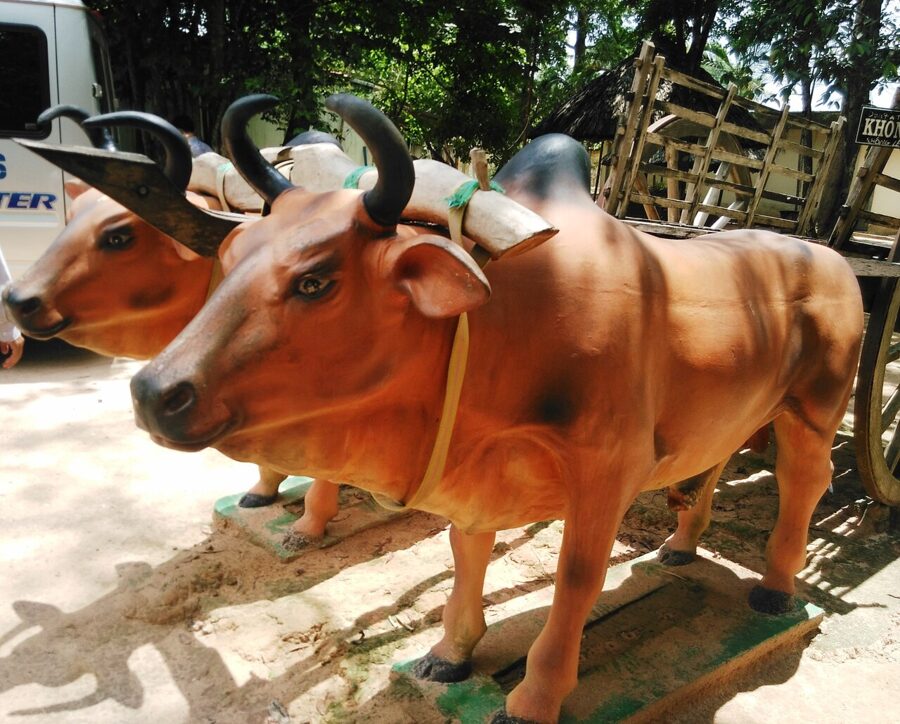
The memorial temple
A short walk through the forest from the tunnels stands the Bến Dược Memorial Temple (Đền tưởng niệm liệt sĩ Bến Dược), begun on 19 May 1993, Hồ Chí Minh’s 103rd birthday, and opened on 19 December 1995. Nearly every Vietnamese group that comes to Củ Chi stops here to light incense.
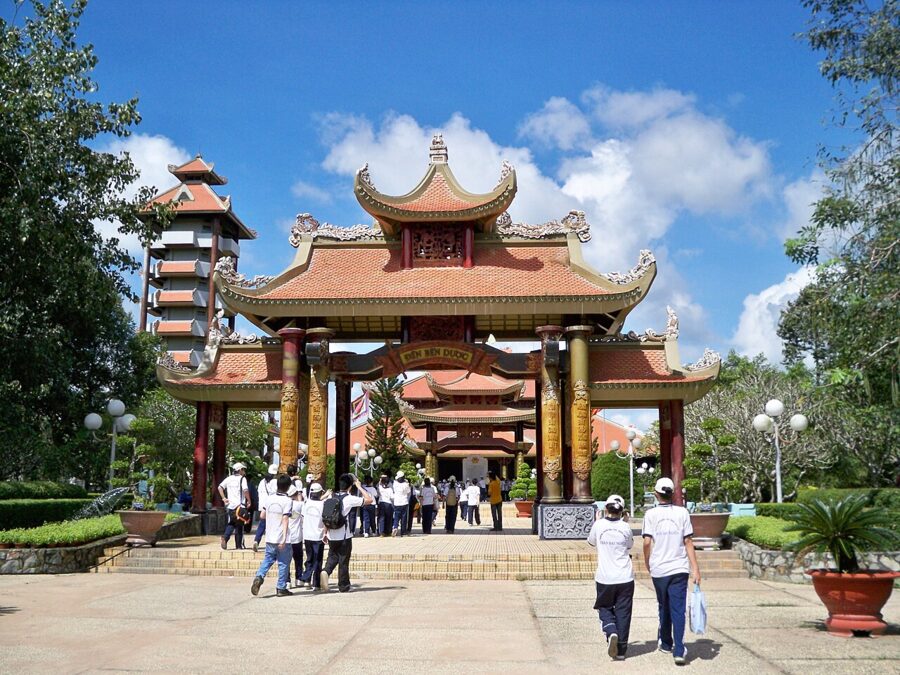

Inside the gate, a pavilion holds a 3.7-tonne stele cut from Marble Mountains stone near Đà Nẵng. It carries Đời đời ghi nhớ (Remember Forever), a prose poem by Viễn Phương chosen from 217 entries. Behind it is the main hall, with a statue of Hồ Chí Minh at the center of the altar.
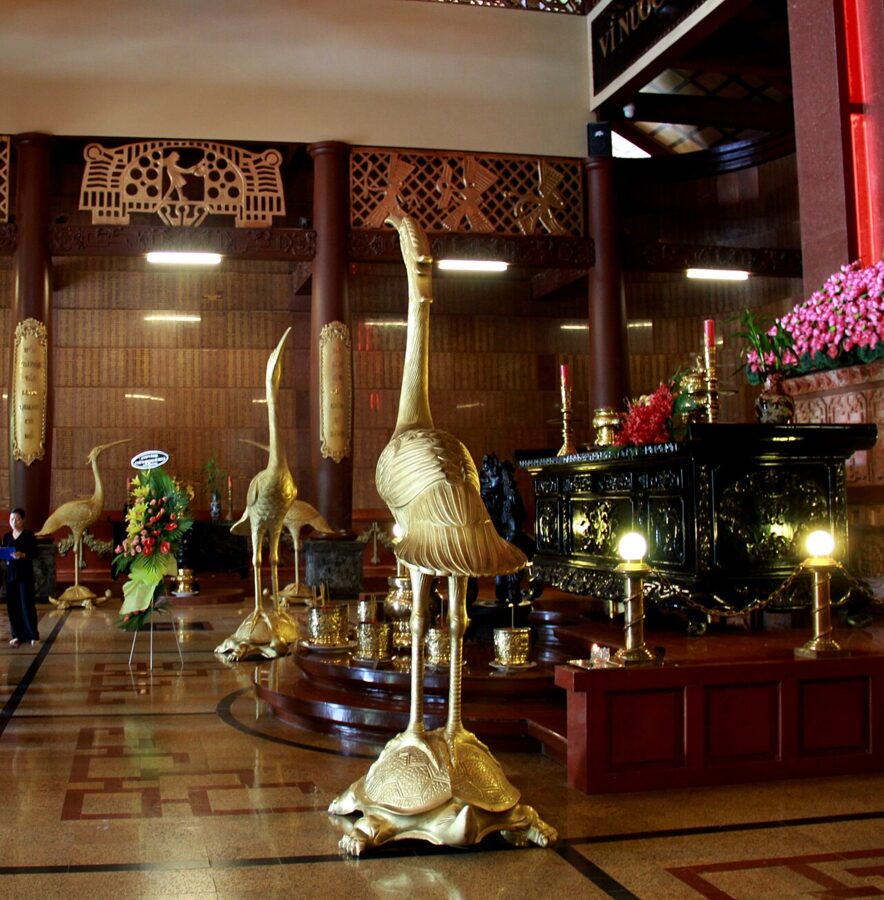

The walls of the U-shaped hall are lined with granite tablets carrying 45,666 names in gilded letters. More than 14,000 of them came from 40 other provinces and cities, and 800 have no known home village. Around three sides of the hall runs a ceramic mosaic that the management calls the largest in Vietnam, telling the national story from the clearing of the southern wilderness to the wars of the 20th century.

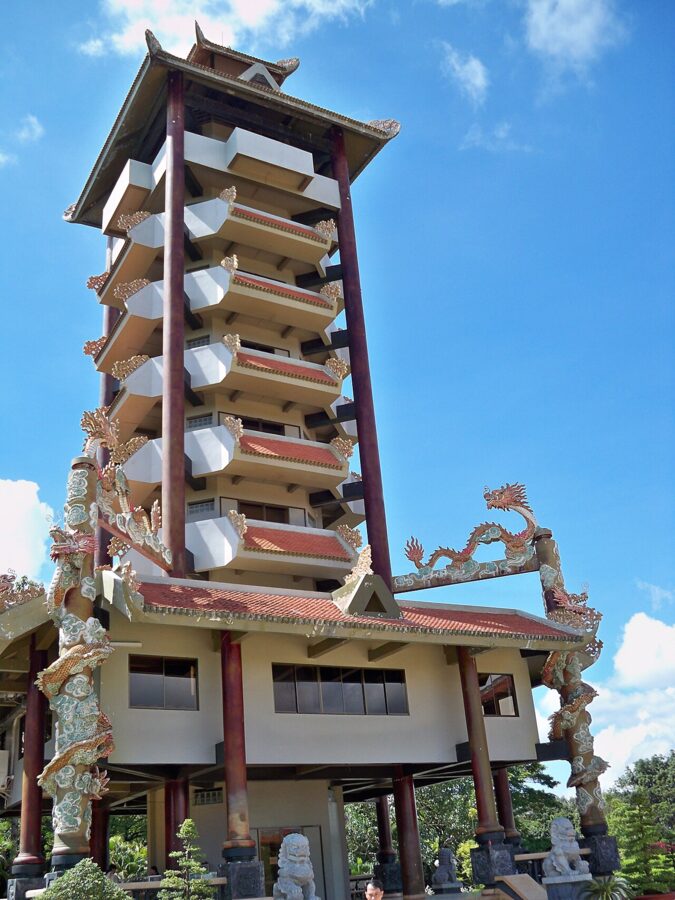
Behind the hall rises a nine-story tower, 39 m high, carved with reliefs of Củ Chi’s wartime life. On a clear day the upper floors look out over the river and the flat green country of the old Iron Triangle. Dress as you would for any temple: shoulders and knees covered, voice down, and take your hat off in the main hall.

The Liberated Zone and the night show
Past the temple is the Củ Chi Liberated Zone re-creation (Khu tái hiện Vùng giải phóng Củ Chi), a 38.5-hectare open-air set approved in 1998 and opened in stages from 2003. It walks you through three periods: the hopeful early 1960s, with farmhouses, a market and an aid station; the villages burning between 1965 and 1968; and the “white zone” of 1969 to 1972, when the surface was bombed bare and life moved below. It charges its own ticket.
Its center is a large model of Cedar Falls, built in 2010, with lights, sound, moving pieces and smoke, plus a short 3D film. Odder are the scale models of three national landmarks around a lake shaped like the East Sea (Biển Đông): Hà Nội’s One Pillar Pagoda, Huế’s Ngọ Môn gate and Saigon’s Nhà Rồng wharf building.
Once a month, on a Saturday evening close to the full moon, the zone stages a night program called Trăng Chiến Khu (Moon over the War Zone). From 6pm to 8:40pm actors re-create village life under the guerrillas, from digging by lamplight to the bombardment. It is performed in Vietnamese, and the dates are posted on the relic site’s website a few weeks ahead; the November 2026 show fell on the 21st.
| Bến Đình | Bến Dược | |
|---|---|---|
| Wartime role | Củ Chi district party committee base, 1968 to 1975 | Regional command for Saigon, Chợ Lớn and Gia Định |
| Where | Provincial Road 15, Nhuận Đức commune | Phú Hiệp hamlet, An Nhơn Tây commune |
| Tunnels | Shallower; widened crawl that passes under the road | Deeper and longer route; command shelters and surgery |
| Above ground | M41 tank, trap displays, firing range | Memorial temple, Liberated Zone, firing range, riverside restaurant |
| Crowds | Busy from mid-morning with tour groups | Quieter for foreigners; busy with Vietnamese groups on holidays |
| Time to allow | About two hours | Half a day if you include the temple and the zone |
The film, the traps and the gunfire
Every visit includes three things that make some people uneasy. None should put you off; each says something about how Vietnam remembers the war.
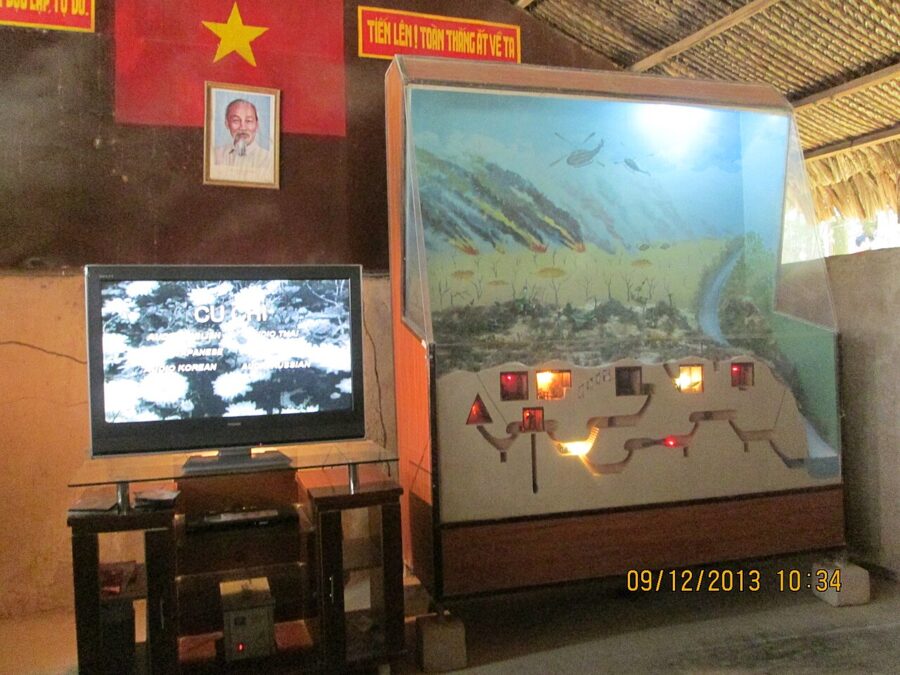
The film comes first. It is an old black-and-white documentary that tells Củ Chi’s war in the language of the time, praising local guerrillas who won the title of “American-killing hero” (dũng sĩ diệt Mỹ), a real distinction of the period, awarded according to the number of enemy killed. Some visitors find it shocking; some find it funny. It is better treated as a document in its own right: this is how the war was explained to the people fighting it.
Back in the city, the War Remnants Museum covers the same war through photographs and its cost to civilians.
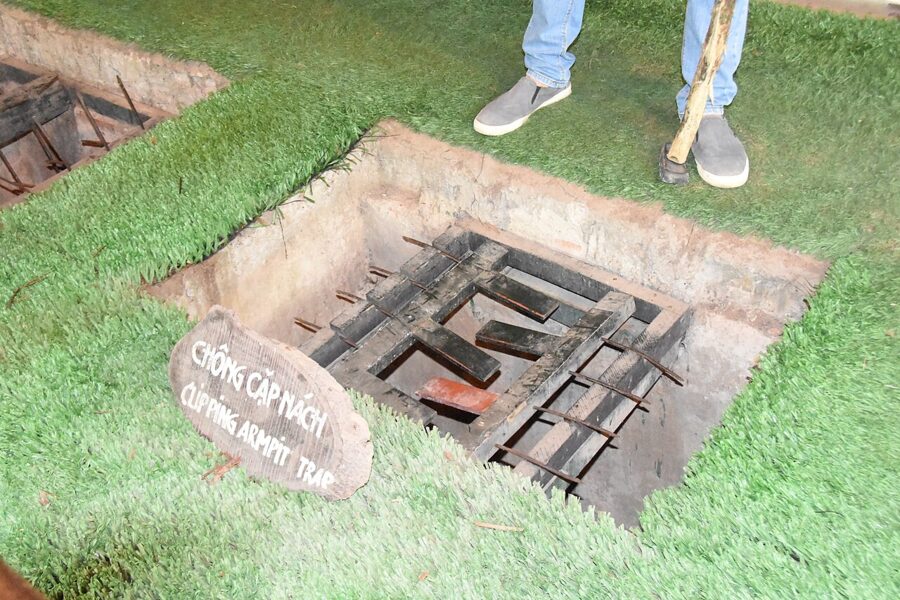

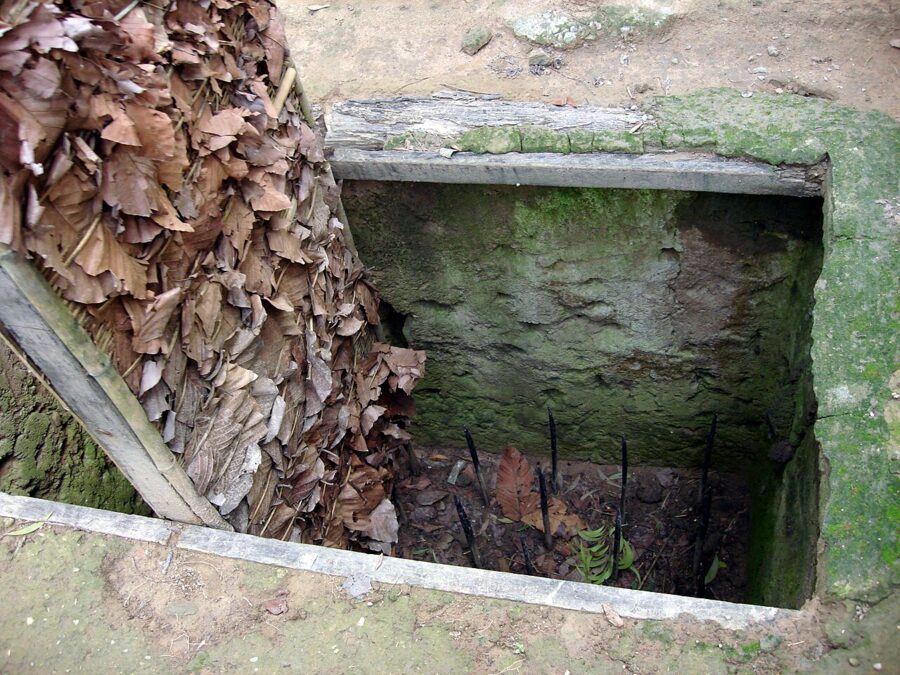
Next come the traps. The guides demonstrate pits lined with sharpened bamboo, swinging spiked doors and lids that tip a man onto stakes, often with a cheerful patter, and it can feel like a theme park.
Then remember that American and Australian soldiers walked into real versions of these, and that the people who built them were farmers defending their own villages. Both facts belong in the same picture.

Last is the firing range. Both sites have one where you can pay to fire wartime weapons, AK-47s and M16s among them, at targets shaped like animals. Whether that belongs at a war memorial is your call.
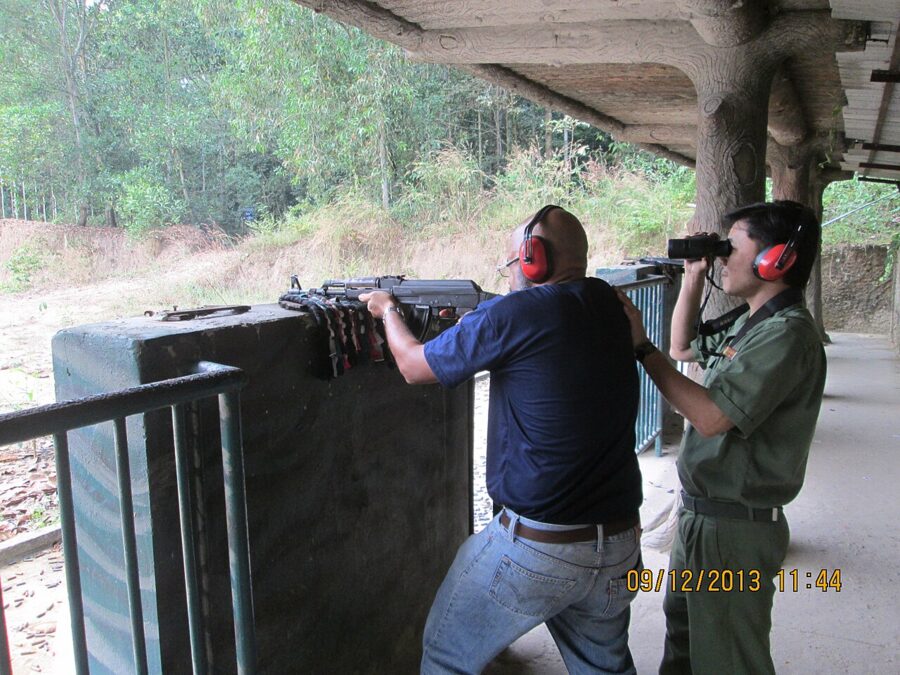
What nobody can avoid is the sound. The shots echo across the forest for most of the day, a strange accompaniment to a crawl through the dark.

Since April 2025 there is a fourth way into the story. Địa đạo: Mặt trời trong bóng tối (Tunnel: Sun in the Dark), directed by Bùi Thạc Chuyên, follows a 21-strong guerrilla squad at Bình An Đông during Cedar Falls in 1967. It was filmed in Củ Chi on a 250 m tunnel set, took 172.5 billion dong at the box office and stirred new interest in the sites among young Vietnamese. It is worth watching before you go.
Getting there
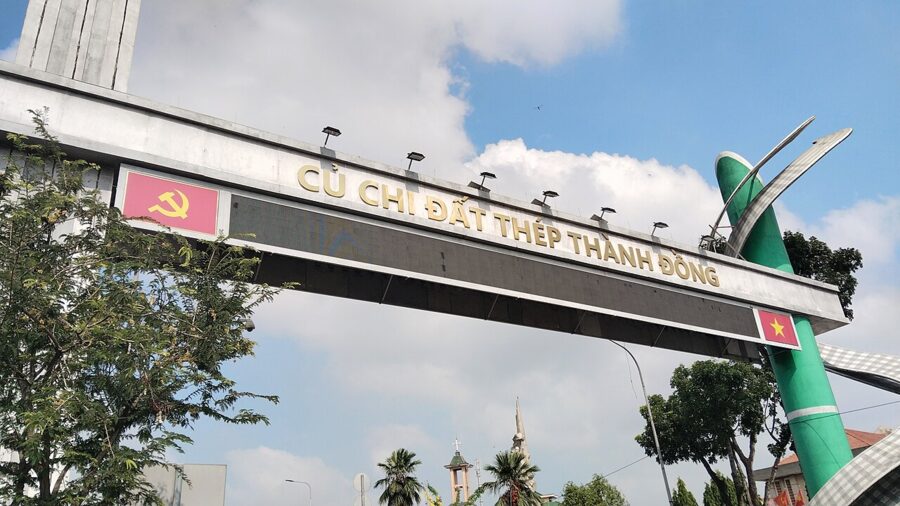
Both sites lie roughly 70 km northwest of central Saigon, and the drive is the biggest part of the day. Allow at least an hour and a half each way, more in the morning or evening rush. The road runs out along Trường Chinh, through the An Sương junction and Hóc Môn, then up Provincial Road 15; National Route 22 to Củ Chi town is the other way in.
On a tour
The simplest way is a half-day tour from District 1, with hotel pickup around 7am or around noon. Most go to Bến Đình and include transport, the entrance fee and a guide; some add lunch or a stop at a lacquerware workshop. Full-day versions pair the tunnels with the Cao Đài temple in Tây Ninh or the Mekong Delta, which means far more time on the road.
Before booking, check which site, the group size and the departure time. A tour that reaches Bến Đình at 9:30 arrives with every other tour; one that leaves at 6:30am gets you the quiet first hour.
By Grab or a hired car
A car from Grab or Be, or a car and driver booked through your hotel, is the most flexible option for two or more people. Arrange a return trip with the driver waiting, because a ride-hailing car can be hard to find out here in the afternoon. With your own car you can see Bến Dược and the temple in the morning and Bến Đình after the crowds thin, which is the best way to do both.
By public bus
The cheapest route goes to Bến Dược. Take bus 13 from the Saigon bus terminal at 23/9 Park, across the road from Bến Thành Market, to Củ Chi bus station, then change to bus 79, which ends at Đền Bến Dược. Allow two and a half to three hours each way.
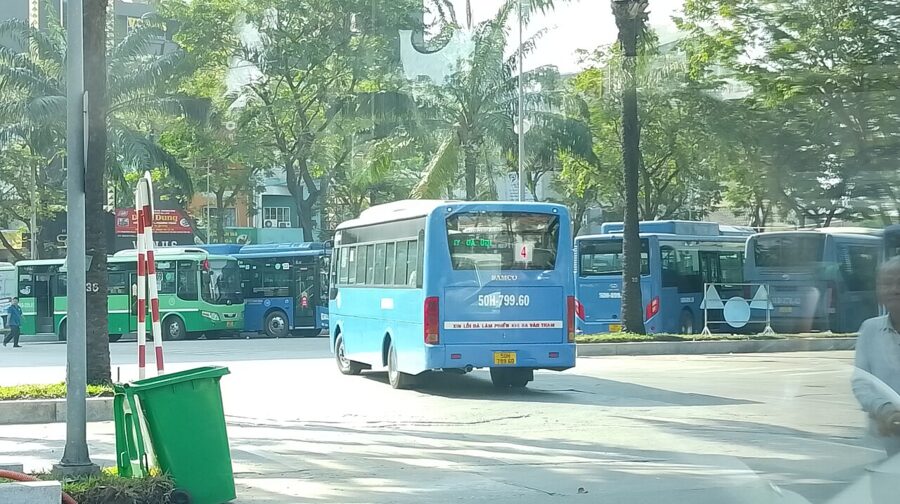
Fares on 134 city routes, these two included, are waived from 1 July to 31 December 2026. For Bến Đình, the simplest onward link from Củ Chi bus station is a Grab.
By river
The Saigon River runs past both sites, and a boat up from the downtown waterfront is the most pleasant way in.
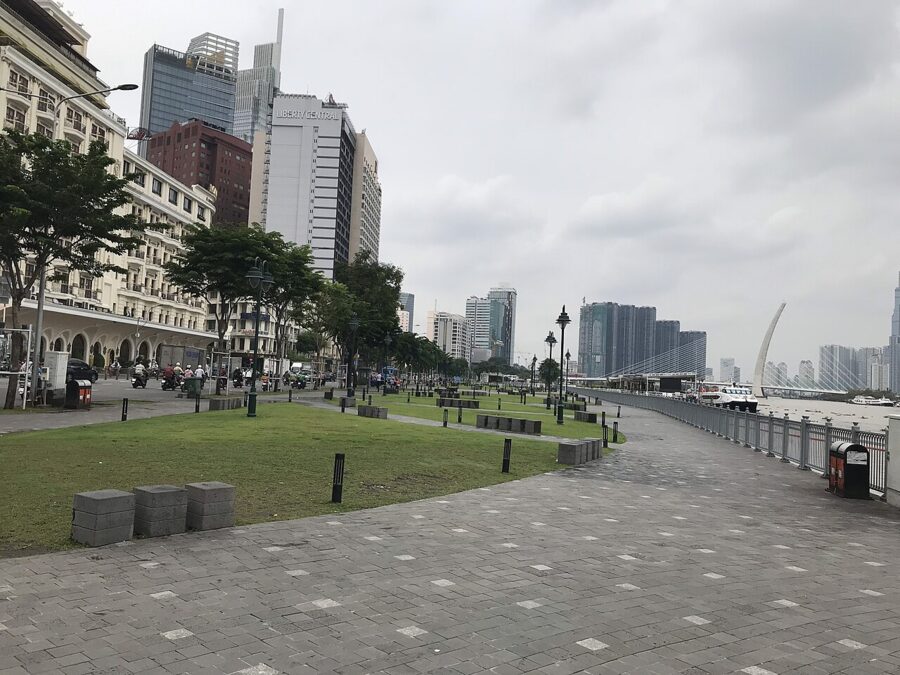

A scheduled boat from Bạch Đằng wharf was launched in 2020, and in June 2026 another operator announced fast boats and small cruise ships on the route, so check what is actually sailing before you plan around it. Otherwise the river trip means a private speedboat tour, which costs much more than a road tour and should be booked a day or two ahead.

Before you go
| Open | Daily, 7am to 5pm, both sites |
| Foreign visitors | 135,000₫ (about US$5.10): a 35,000₫ admission fee plus a 100,000₫ service and guide ticket, in force since 1 February 2026 |
| Vietnamese visitors | 35,000₫ (about US$1.35) |
| Liberated Zone re-creation | 85,000₫ (about US$3.20), since 1 January 2025 |
| Trăng Chiến Khu night program | 399,000₫ (about US$15), one Saturday a month, 6pm to 8:40pm |
| Address | Phú Hiệp hamlet, An Nhơn Tây commune, Hồ Chí Minh City (Bến Dược; formerly Củ Chi District); Bến Đình is on Provincial Road 15, Nhuận Đức commune |
The management’s February 2026 notice sets the foreign rate for the relic site as a whole and does not split it by site; tour prices usually include it. Bring cash in small notes for the ticket, the range and drinks.
What to wear and bring
Wear clothes you do not mind ruining: the tunnel floors are red earth, slick after rain, and your knees and palms will come out the color of the soil. Long, light trousers protect against the ground and mosquitoes, and closed shoes with grip beat sandals. Bring water, repellent, a hat and a small towel.
Leave the big bag in the car. You will want both hands free underground, and there is nowhere to put a backpack in a passage 62 cm wide. A phone with a flashlight helps in the darker stretches.
Claustrophobia, heat and rain
You do not have to go underground at all. The crawl is optional, and the exhibits, kitchen, temple and Liberated Zone make a full visit on their own. If you want to try, go in last, so nobody is pressing behind you, and take the first exit if the walls start to close in. Anyone with heart or breathing problems should stay on the surface; the air is hot and still.

The dry season, roughly December to April, is the most comfortable time, and the early morning is the coolest part of any day. From May to November afternoon storms roll in fast and the paths turn to mud. A shower is no reason to cancel, but put your phone in a plastic bag and plan to be back under cover by 3pm.
Food
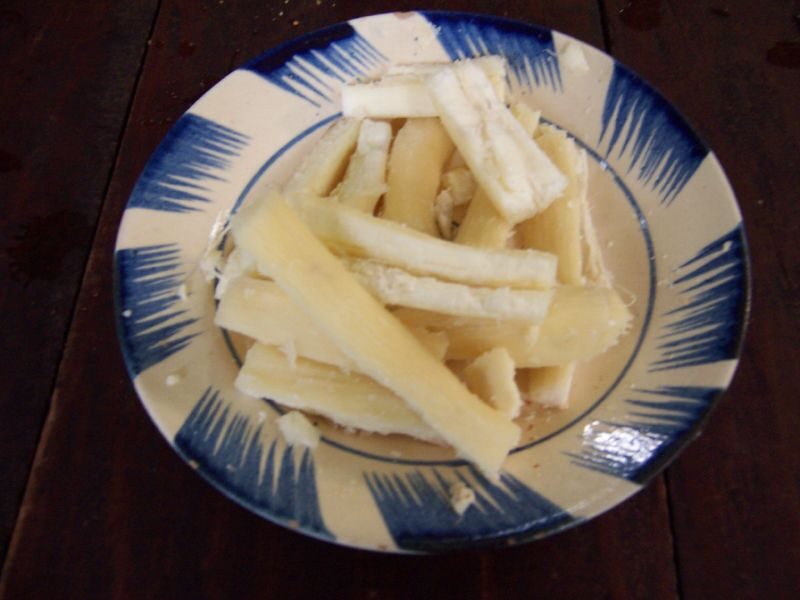
Everyone gets the cassava. At the Hoàng Cầm kitchen, guides hand out pieces of boiled cassava (khoai mì) to dip in salt with crushed peanuts, with a cup of tea: the food that kept people alive below. It is plain, filling and better than it sounds.

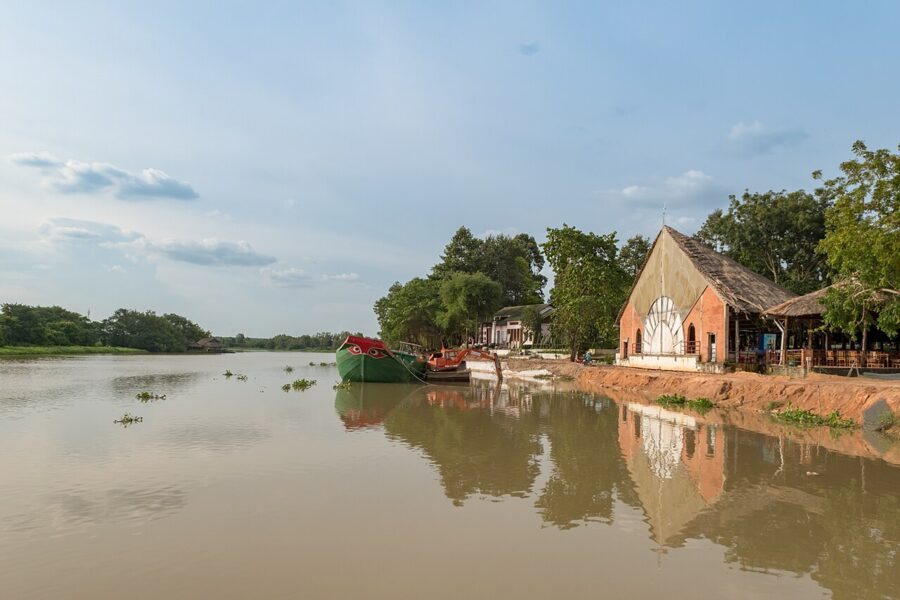
Both sites also have riverside restaurants serving southern country dishes; the one at Bến Dược sits on the bank of the Saigon River, looking across to rice fields on the far side.
If you are in a car, Củ Chi is known for bò tơ, young beef served boiled and rolled in rice paper with wild herbs, or grilled; the restaurants line National Route 22. It makes a good lunch on the way back, and a better one than most tour lunches.
And go early. The forest at Bến Dược just after seven, before the first buses, is the closest you will get to what the guerrillas heard from below: birds, the river, a motorbike on a distant road. Stand by a vent for a minute before you go down. Then lift the lid.