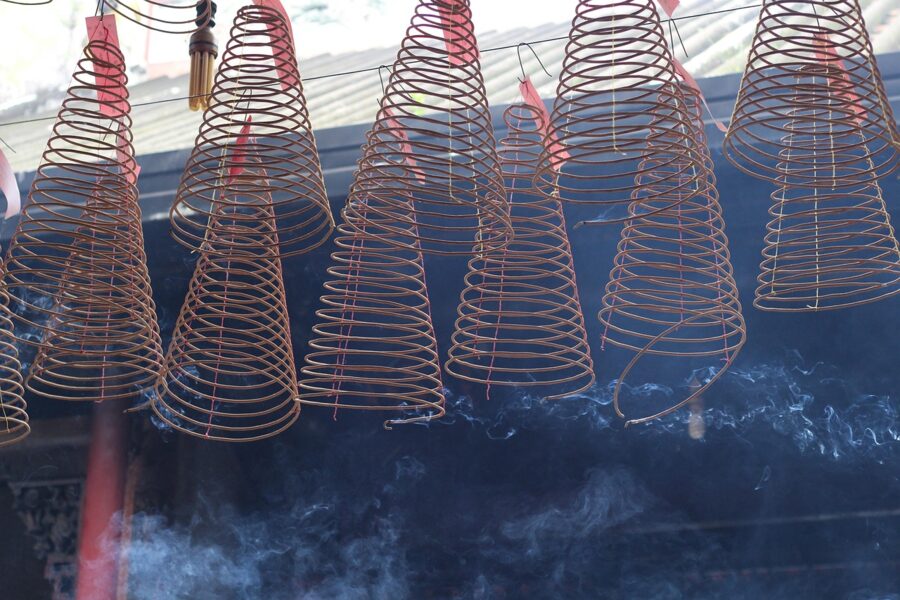
At seven in the morning the courtyard at 710 Nguyễn Trãi is already hazy. Coils of incense the size of lampshades hang from the rafters, each with a red paper tag at its center carrying a family name and a wish, and each burning slowly upward from its lowest ring. A woman in a sun hat lifts three sticks to her forehead, bows toward the back hall, and leaves before the motorbikes outside reach full volume. Two and a half centuries of Cantonese Saigon have done much the same thing in this spot.
The building has more names than most visitors expect. Signs and maps call it the Thiên Hậu Temple, Thien Hau Pagoda or Chùa Bà Thiên Hậu (the Pagoda of Lady Thiên Hậu); many Saigonese simply say Chùa Bà Chợ Lớn; its own charter name is the Tuệ Thành Assembly Hall (Hội quán Tuệ Thành, 穗城會館). It is not a Buddhist pagoda at all. It is a guildhall built by migrants from Guangzhou, with a sea goddess on the main altar, and it has been a recognized national monument of Vietnam since 7 January 1993.
Most people stay twenty minutes, take a photo of the coils and leave. Give it an hour instead. The roof carries a ceramic theater of gods, generals and foreign merchants made in 1908, the main hall holds a wooden statue said to be older than the building, and the walls are papered with the names of the people who still pay for its upkeep.
On this page
Who Thiên Hậu is: Mazu, the girl from Meizhou
The goddess on the main altar began as a real person, or close to one. Chinese tradition calls her Lin Moniang, “the silent girl”, from a fishing family on Meizhou Island off the coast of Fujian, and very little about her is documented. The earliest written trace of her cult is an inscription of 1150, which says that she could foretell good and bad fortune and that her neighbors built her a temple on the island after her death. Everything else came later, as the stories grew.
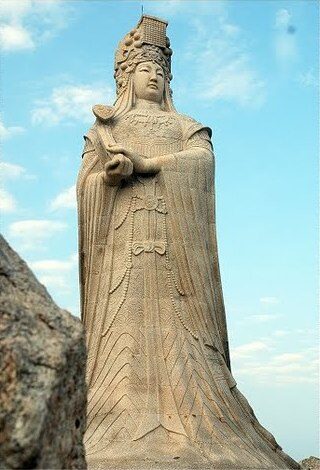

The best-known story is the one Chợ Lớn’s own tradition tells. Her father and brothers were caught at sea in a typhoon while she sat at her loom at home. She fell into a trance, went out over the water in spirit, and caught them: one brother in each hand and her father’s collar in her teeth. Then her mother called her name, she opened her mouth to answer, and her father was swept away.
Versions differ on who was lost and who survived, and on her dates. The common Chinese account puts her birth on the 23rd day of the third lunar month in 960 and her death at 27 or 28 in 987. Vietnamese accounts, following the Saigon scholar Vương Hồng Sển, give her birth year as 1044. Every version keeps the birthday, and that date runs the temple’s year.
From village spirit to Empress of Heaven
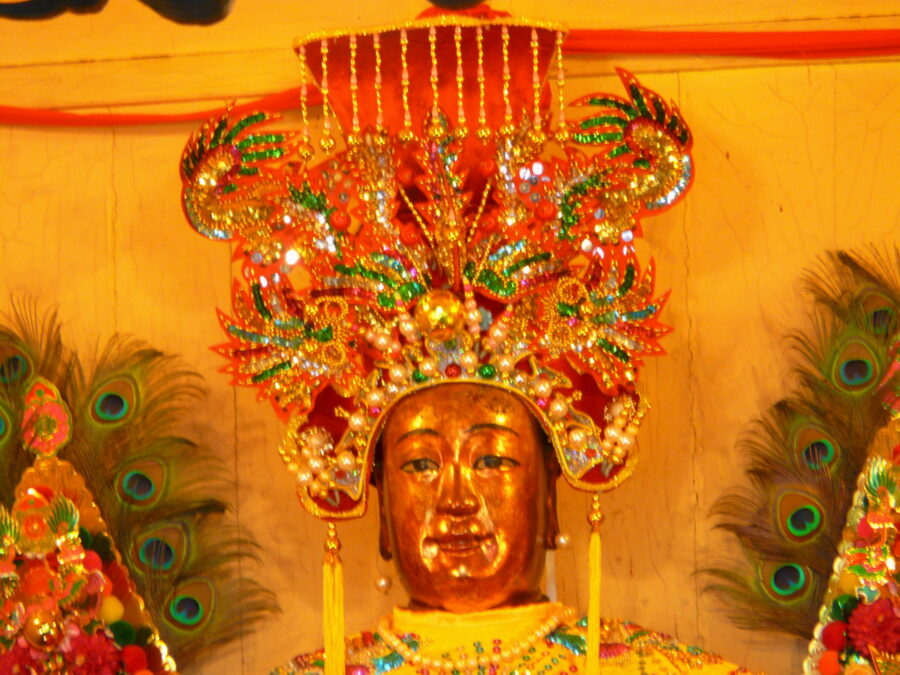
Sailors and merchants carried her from Fujian along the whole Chinese coast, and successive dynasties promoted her. The Song court gave her the title “Lady of Numinous Grace” in 1156; the Yuan made her a “Princess of Heaven” (Tianfei) in 1281; and in 1683, under the Kangxi Emperor of the Qing, she became Tianhou, “Empress of Heaven”. Thiên Hậu is simply the Vietnamese reading of 天后, the same name the Cantonese pronounce Tin Hau. Vietnamese temple tradition dates her elevation earlier, to the Song in 1110; the court records favor 1683.
Under any title she remained the goddess of people in boats. A junk crossing the South China Sea to the Mekong delta in the eighteenth century had nothing between it and a typhoon except its hull and its prayers, and Chinese junks commonly carried a small Mazu shrine on board. A traditional rule held that in an emergency you should call her Mazu, “mother”, and never by her court titles: hearing a formal title, the goddess might feel obliged to dress properly before answering.
For migrants she meant more than safe passage. A Cantonese trader who reached Saigon alive gave thanks to her at the first altar he could find, and a community that settled built her a permanent house. That is the origin of the hall on Nguyễn Trãi, and of at least six other Thiên Hậu temples and halls across the city.
The Cantonese of Chợ Lớn and the Tuệ Thành hall
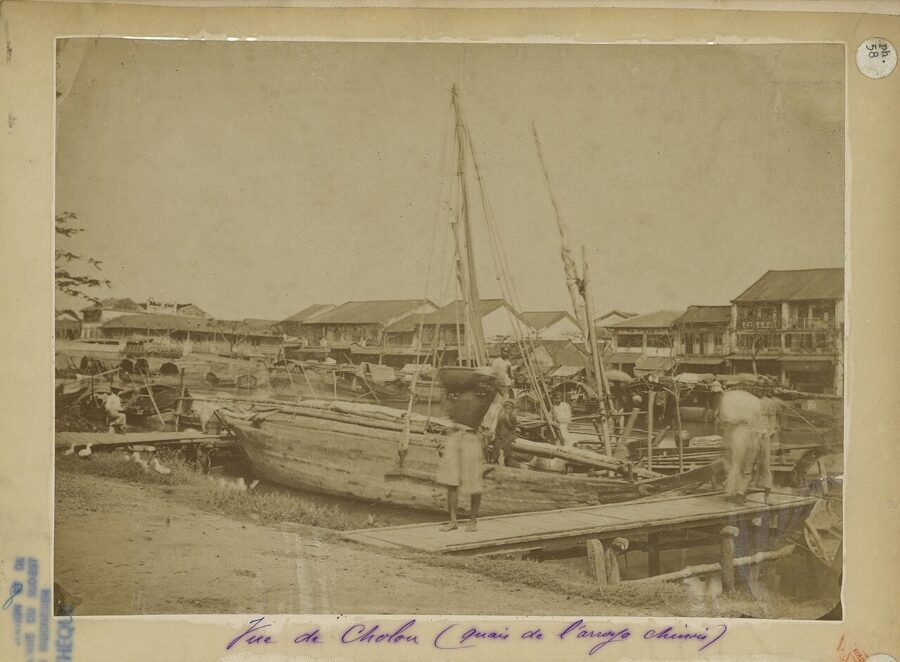
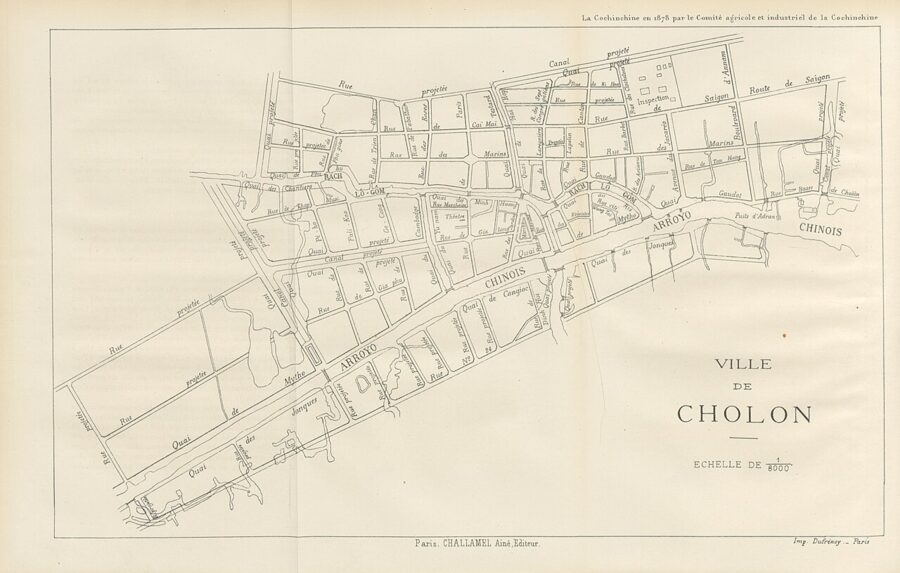
Tuệ Thành, “the city of rice ears”, is an old literary name for Guangzhou. The people who built this hall came from that city and its hinterland in the eighteenth century, part of a long movement of southern Chinese into the Mekong delta under the Nguyễn lords. By the time the French arrived, the Chinese town that grew up here was the commercial engine of the south; the French called it Cholon and the Chinese called it Dī’àn (Đề Ngạn in Vietnamese), “the embankment”.
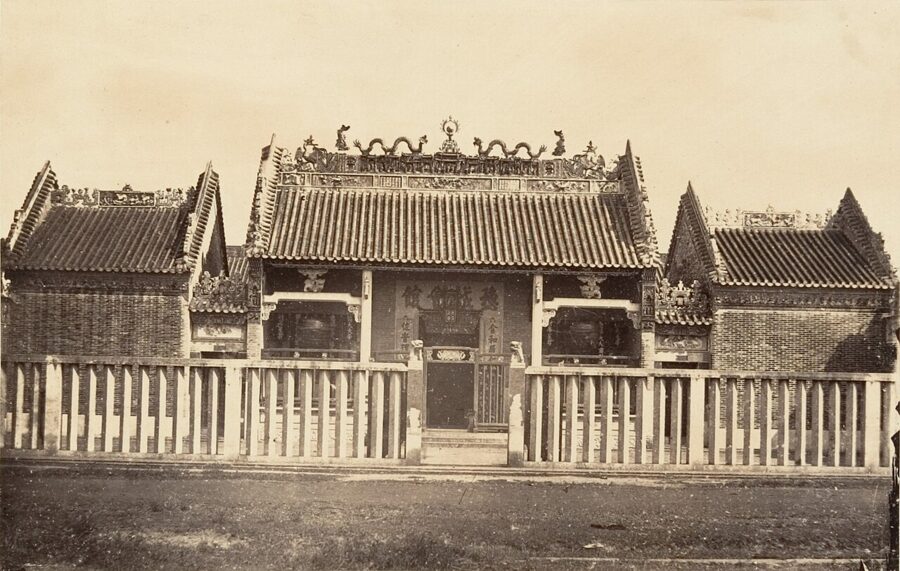
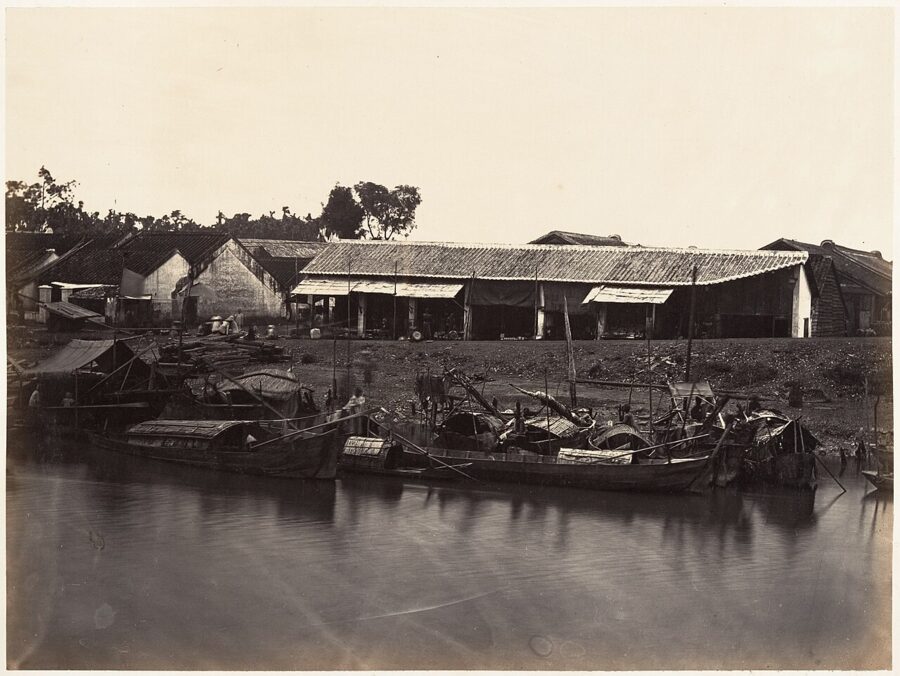
Nobody knows exactly when the hall was founded. No foundation record survives, and the date usually given, about 1760, is an estimate rather than an inscription. Documents kept in the temple describe Guangzhou merchants sailing south in the 1760s with a goddess shrine on every ship. Ships ran on the monsoon, so traders sometimes waited months in Saigon for the wind to turn, and some of them pooled money to build a hall where they could lodge and worship in the meantime.
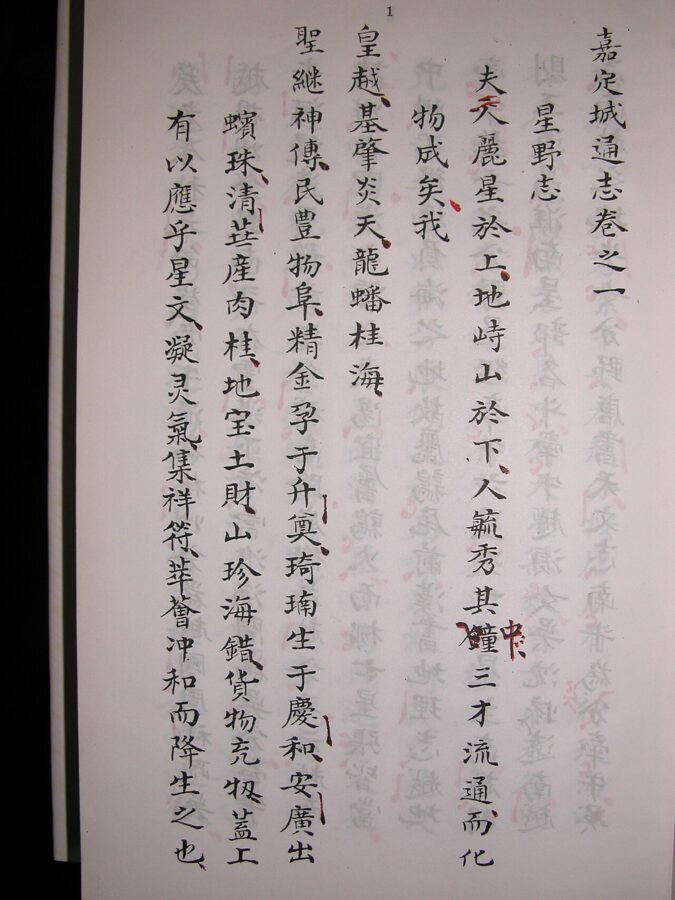
The earliest outside description comes from Trịnh Hoài Đức, a mandarin of Chinese descent whose gazetteer of the south, the Gia Định thành thông chí, was written around 1820. At that time “Saigon” meant this Chinese town, not today’s downtown. Describing its main street, he lists the temple of Guandi and three assembly halls at the north end, and then:
On the west side, in the middle of the main street, stands the temple of Thiên Hậu; near it, further west, the Ôn Lăng assembly hall; and at the south end of the main street, toward the west, the Chương Châu hall.
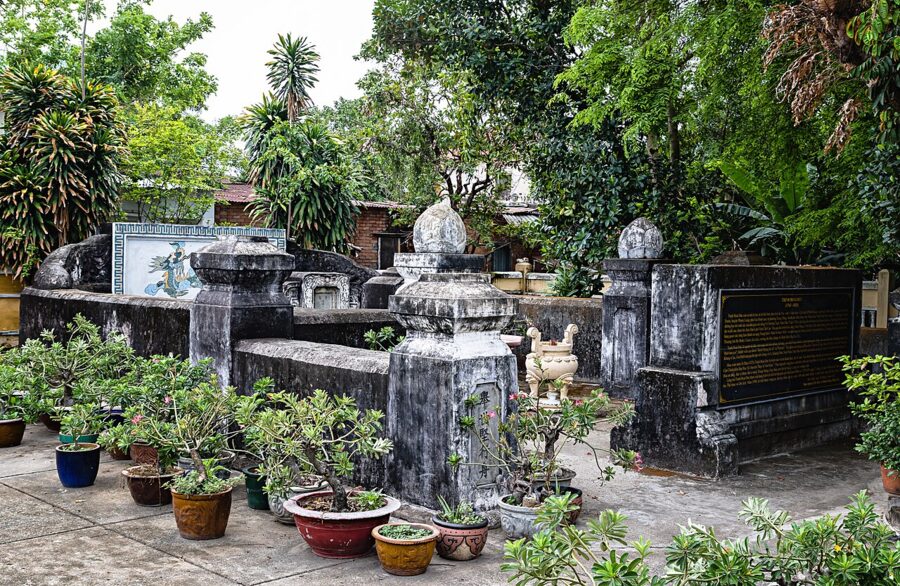

The building was repaired or enlarged in 1800, 1842, 1882, 1890 and 1916, with some accounts adding 1847. Stone steles in the front hall record the donors of several rounds by the reign years of Chinese emperors, so the hall’s paperwork reads like a Qing calendar: the great bronze bells are dated Qianlong 60 (1796) and Daoguang 10 (1830). The statue of the goddess is said to have been carved before the hall existed and worshipped first in Biên Hòa, up the Đồng Nai River, before being brought here in 1836.
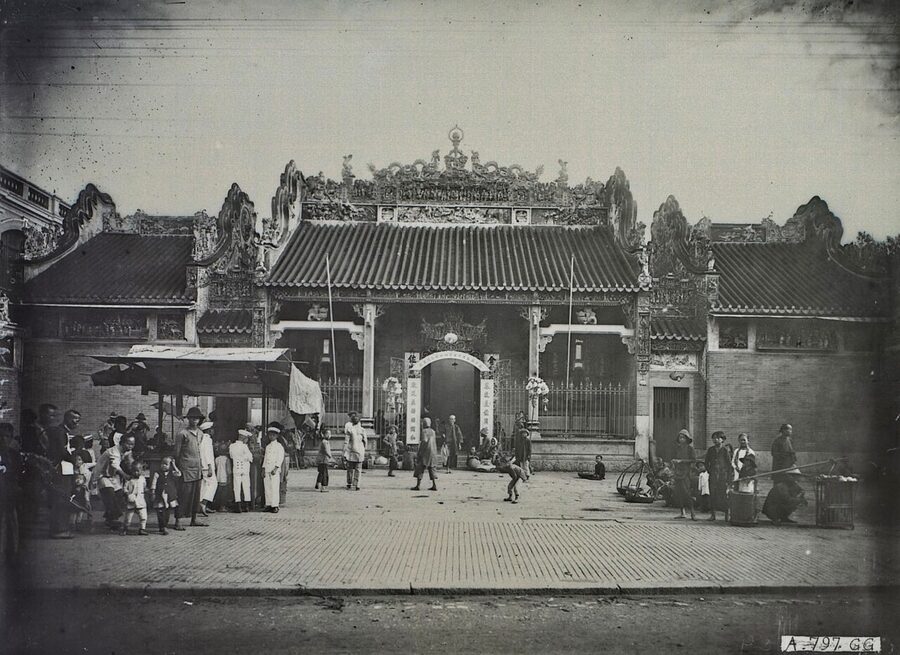
A hall like this was never only a temple. Under the Nguyễn emperors and then the French, the Chinese of the south were organized by dialect group into congregations, each responsible for its members’ taxes, disputes and good conduct. The Cantonese met here. Halls like this one settled disputes, looked after the sick and the dead and gave new arrivals somewhere to start, and this hall’s charitable work extended to a school and a hospital; today the Mạch Kiếm Hùng secondary school and Nguyễn Tri Phương Hospital are both associated with it.
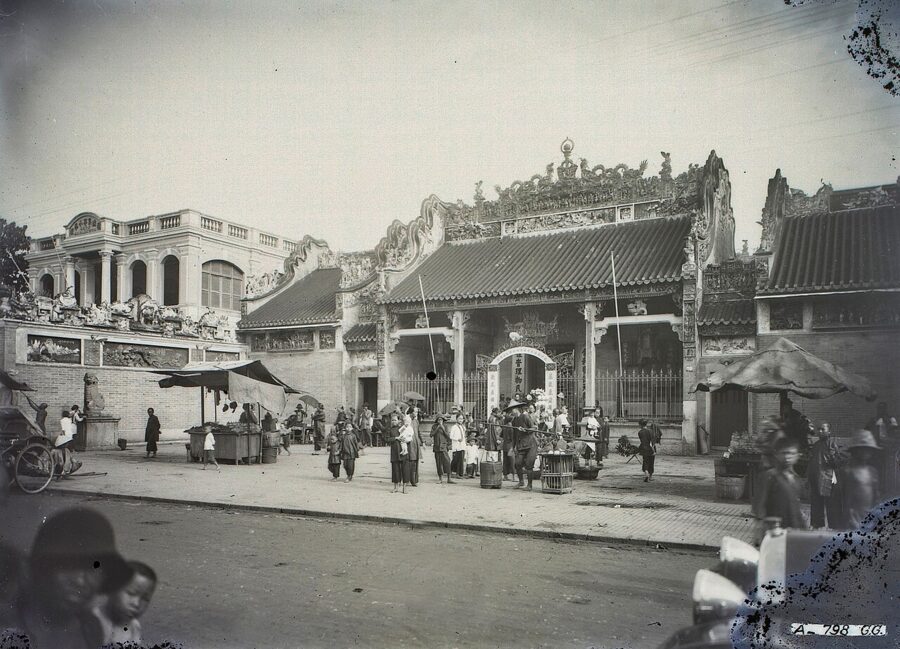
Cholon became a separate French municipality in 1865, was joined to Saigon administratively in 1931, and disappeared from the city’s official name in 1956. In July 2025 the name came back: the reorganization of Hồ Chí Minh City made “Chợ Lớn” the name of a new ward that takes in the old wards 11 to 14 of District 5, the temple’s own block included. Through all of it the hall kept its congregation, its festivals and its accounts.
Reading the building from the street
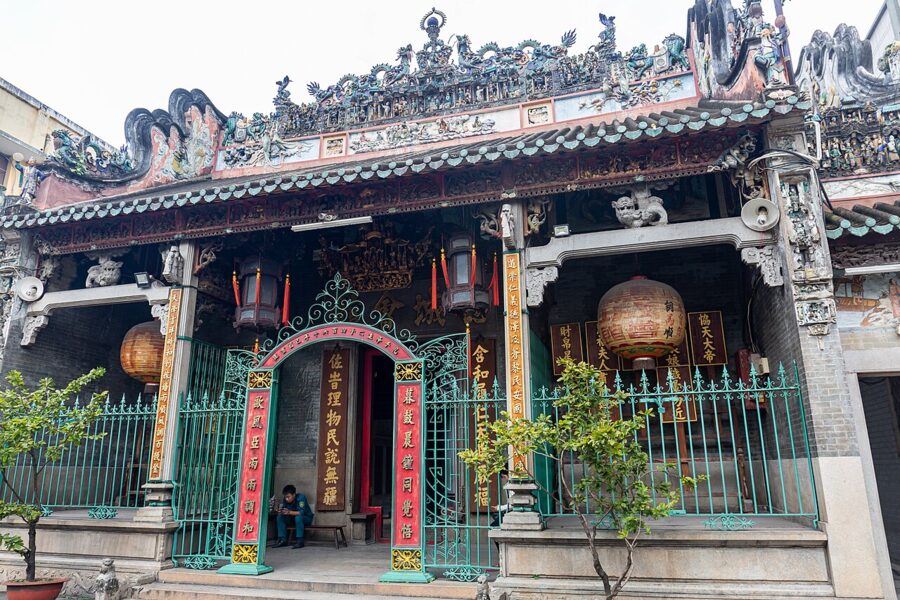
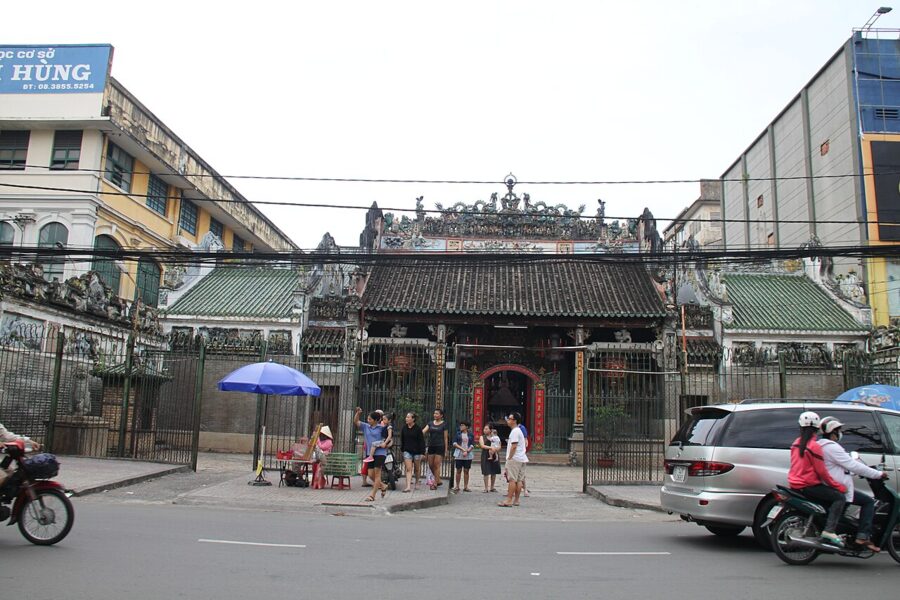
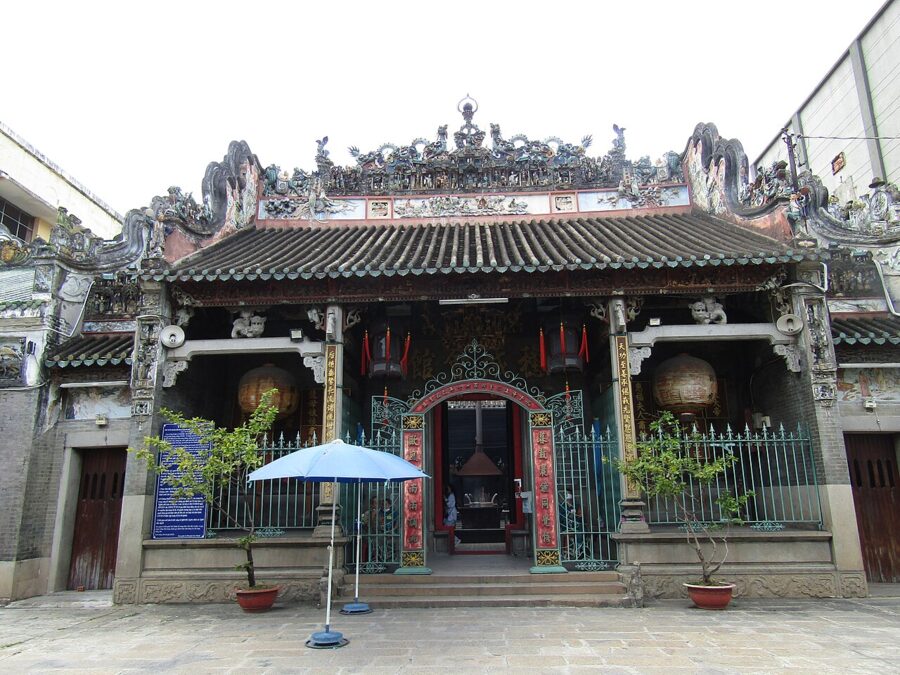
Stand on the opposite pavement before you go in. The plan behind that façade is the classic one for a Chinese assembly hall: four ranges of buildings joined in a rectangle, like the character 口, with three halls on the central axis (front, middle and main) and open-air light wells between them. The front is faced in stone, the columns at the entrance are stone too, and the main door is solid wood between a pair of couplets.
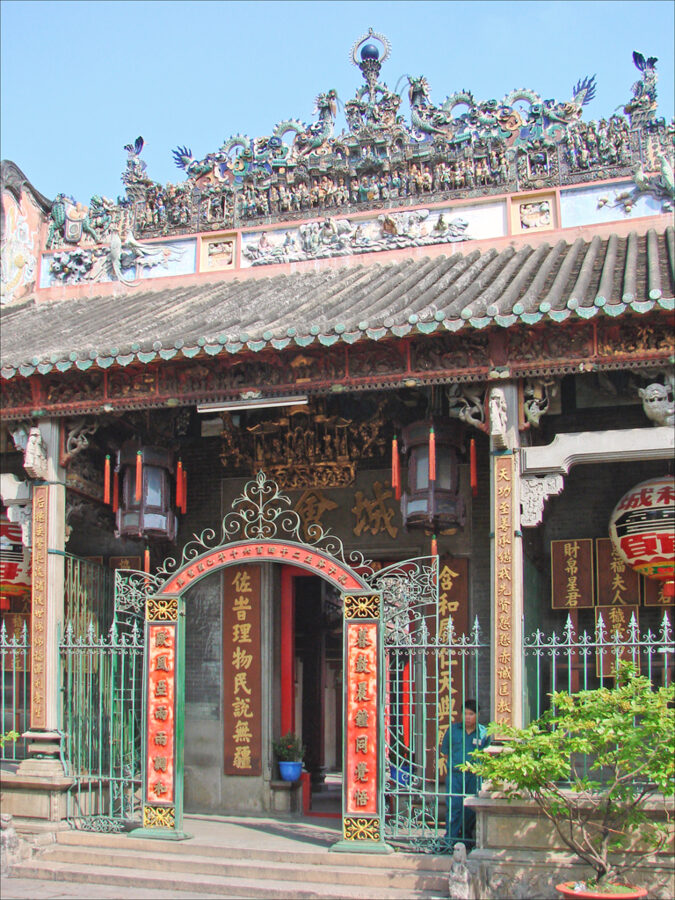

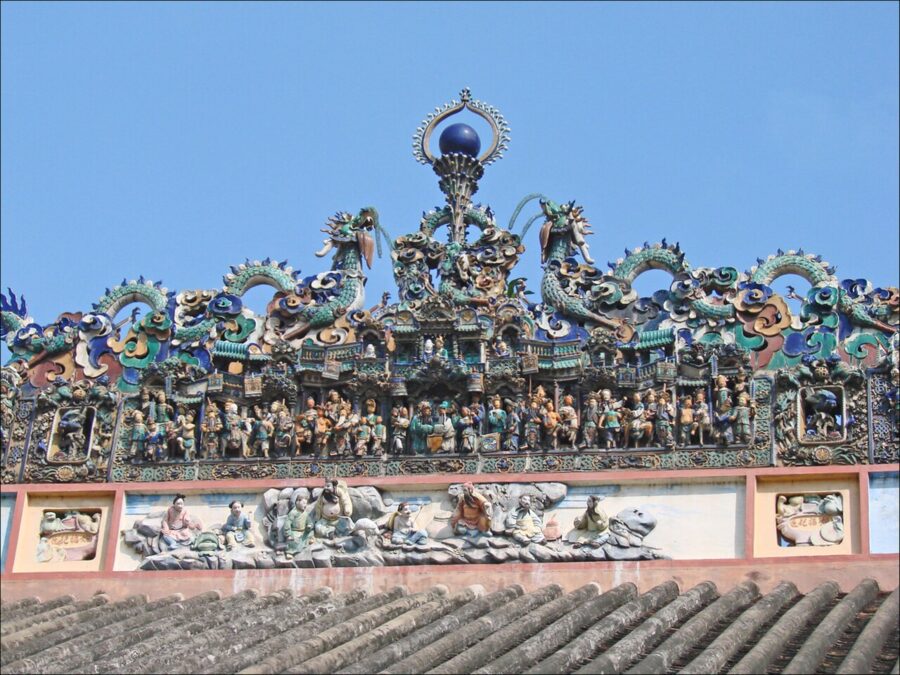
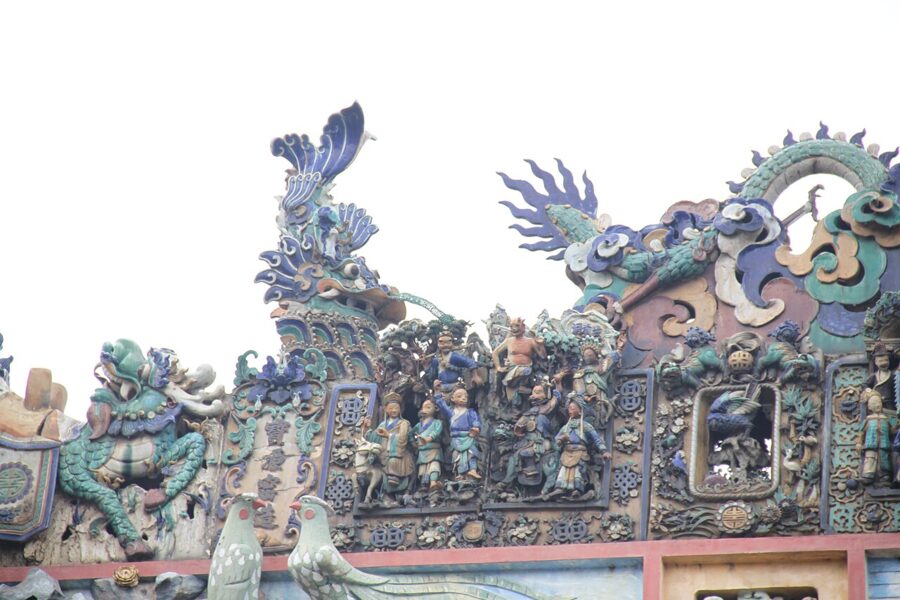
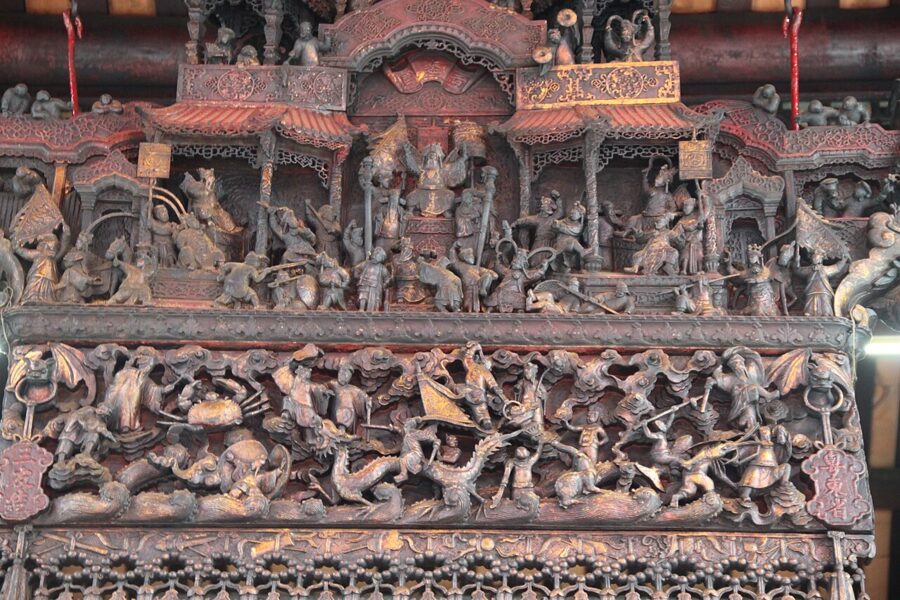
Then look up. The roof ridges are crowded with glazed ceramic figures, hundreds of them, made in 1908 by two kilns that Vietnamese sources name as Bửu Nguyên and Đồng Hòa. They are arranged in tiers. At the top, two dragons face a pearl; below them come the monk Xuanzang and his disciples from Journey to the West and scenes from Chinese legend; along the lowest band are the Eight Immortals.
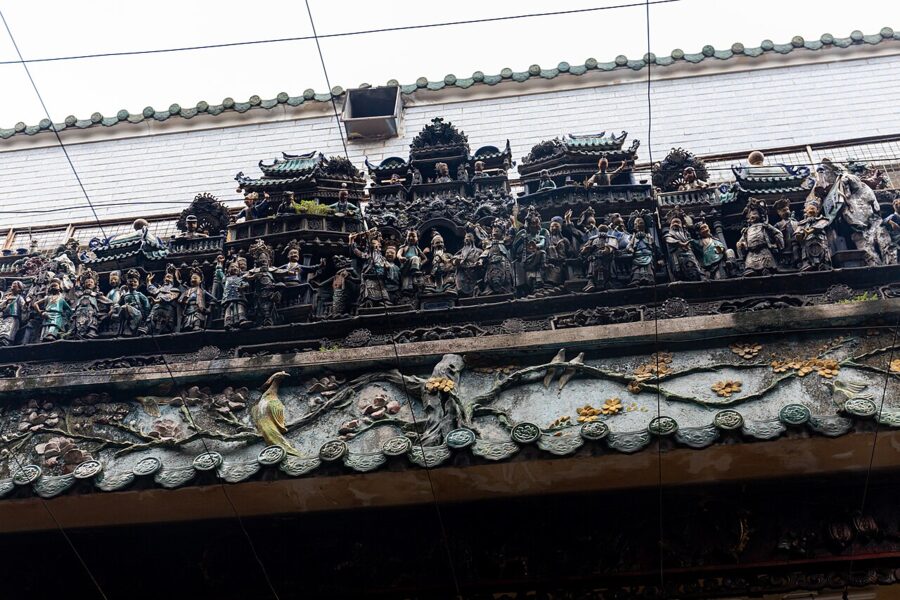

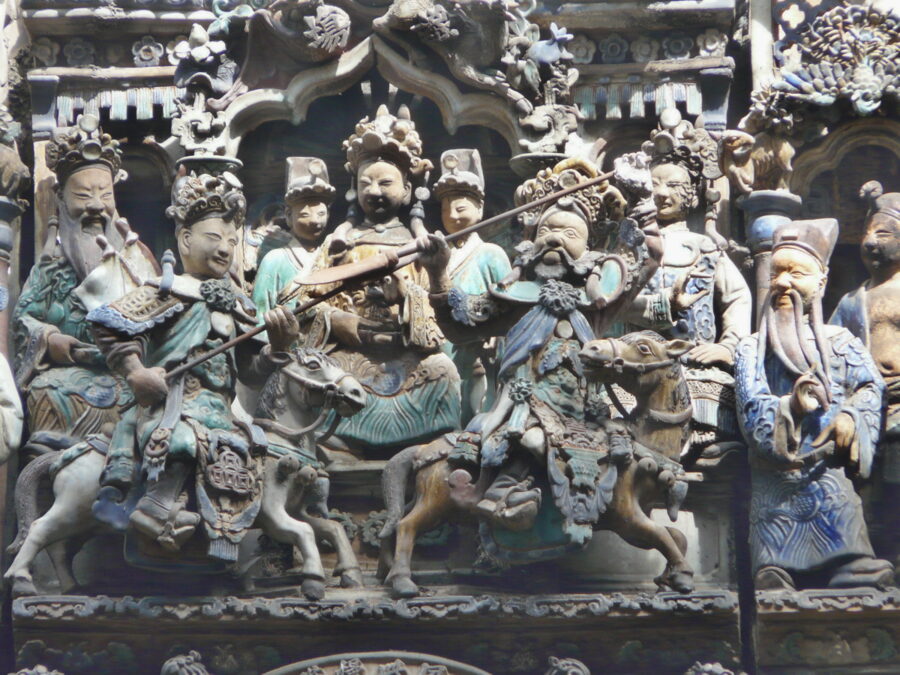
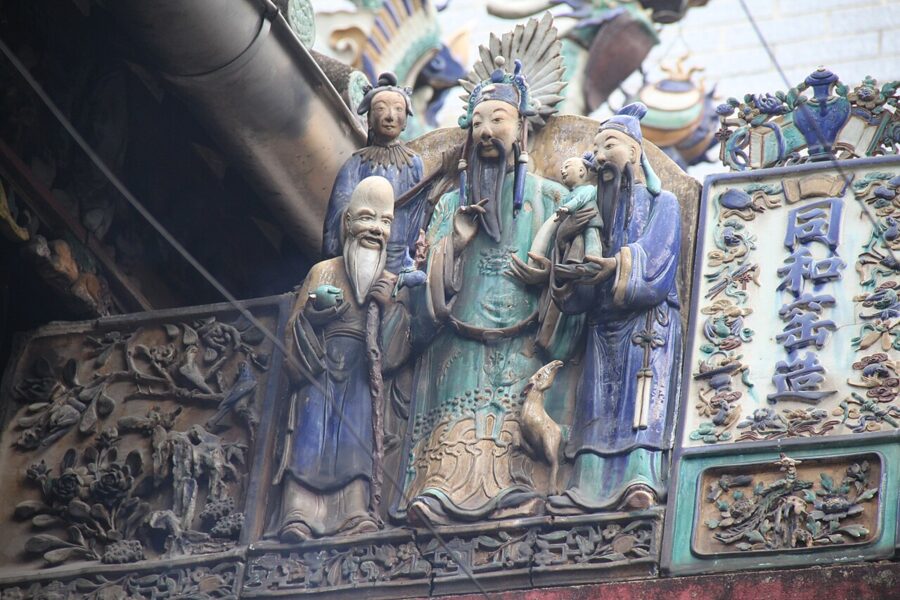
Much of the roof shows a Chinese city at play, or rather a Chinese city’s idea of a theater. Actors in stage armor fight on horseback; one scene shows the general Guan Yu of the Three Kingdoms dueling with his halberd; elsewhere the three star gods of longevity, fertility and prosperity stand in their robes. Look along the side ranges, too, for the Persian and European merchants and sailors who turn up among the crowd.
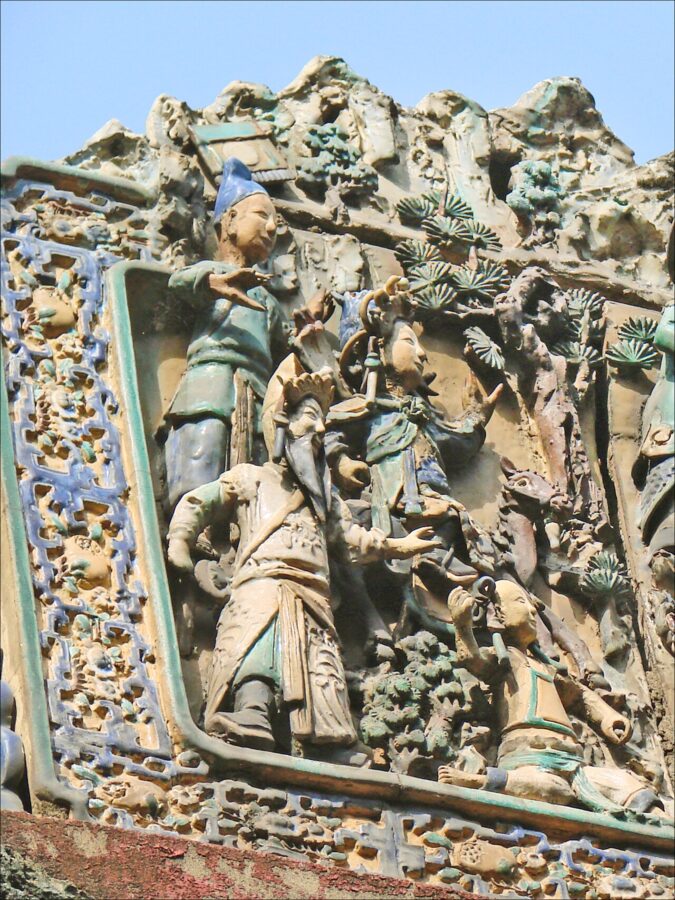

The roofline itself is a clue to who built the hall. A 2023 study by Lê Thị Minh Bắc of Nguyễn Tất Thành University compared the Thiên Hậu halls of the Cantonese, Hokkien and Hainanese congregations in the city. The Cantonese roof here is straight-edged, a gable style typical of Guangdong community buildings, while the Hokkien Hà Chương hall along the street curves its ridge like a boat. Even the dragons differ: these are slim, gently curved and longer in the body than any of their neighbors’.
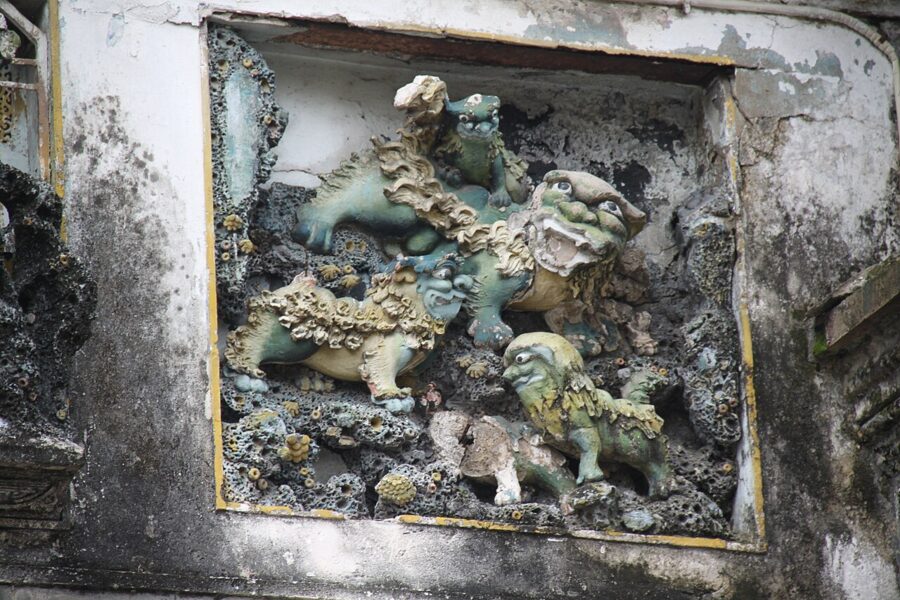
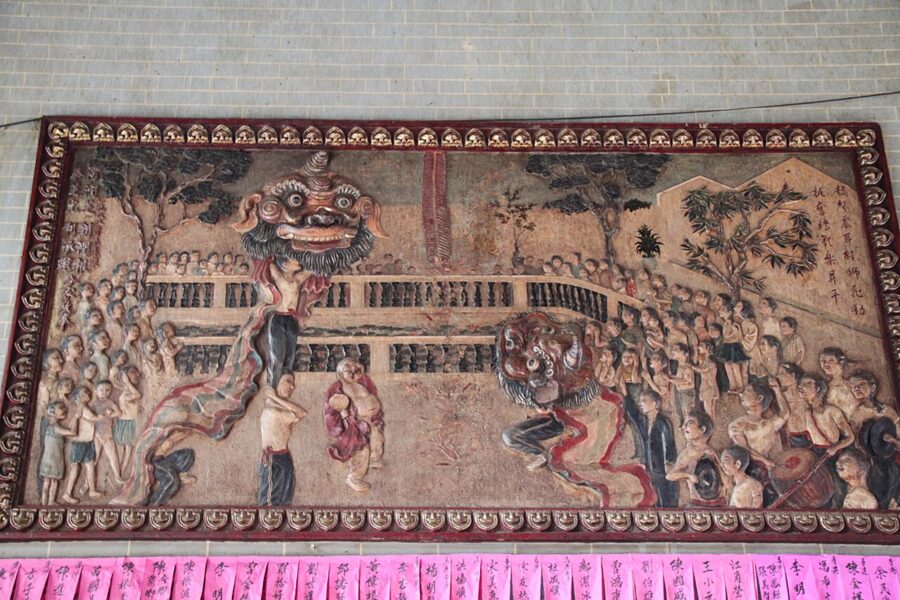
The walls take the story lower down. Set into the walls are relief panels of lions and other beasts in rocky grottoes, built up in ceramic and mortar. Other panels, painted in relief, show street festivals of the kind the temple still holds.
The courtyard and the coils
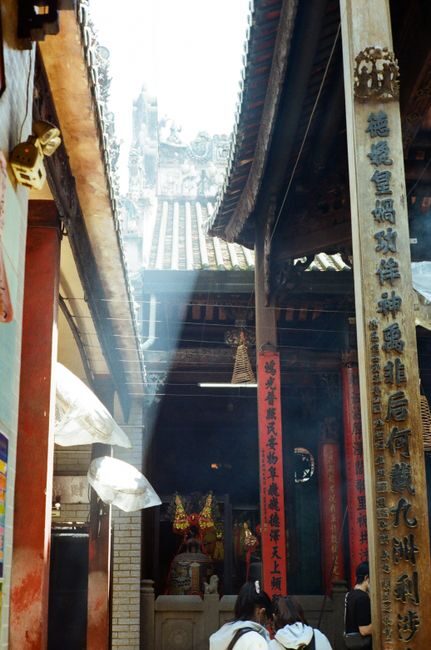
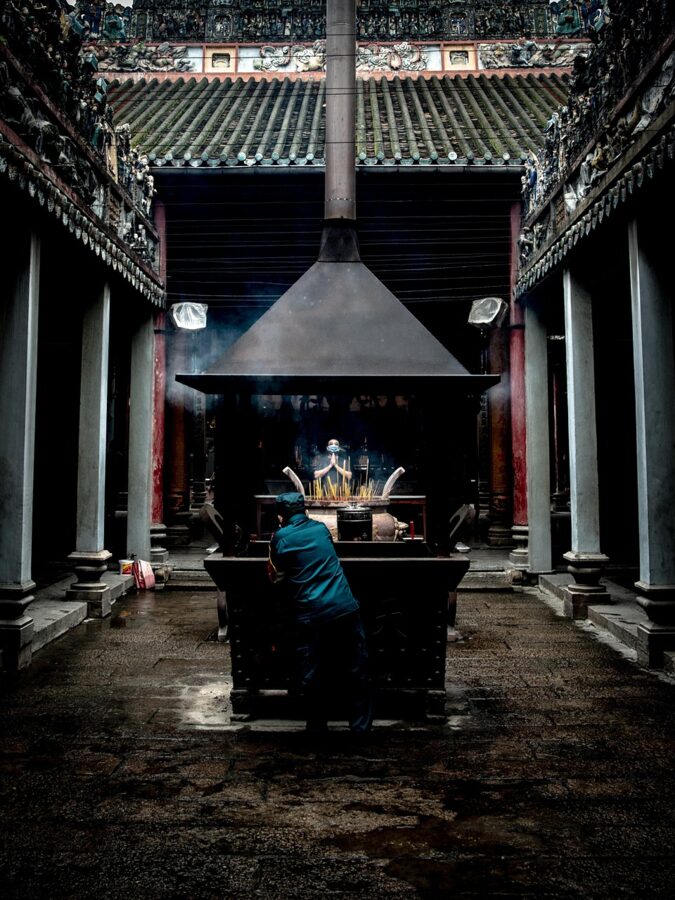
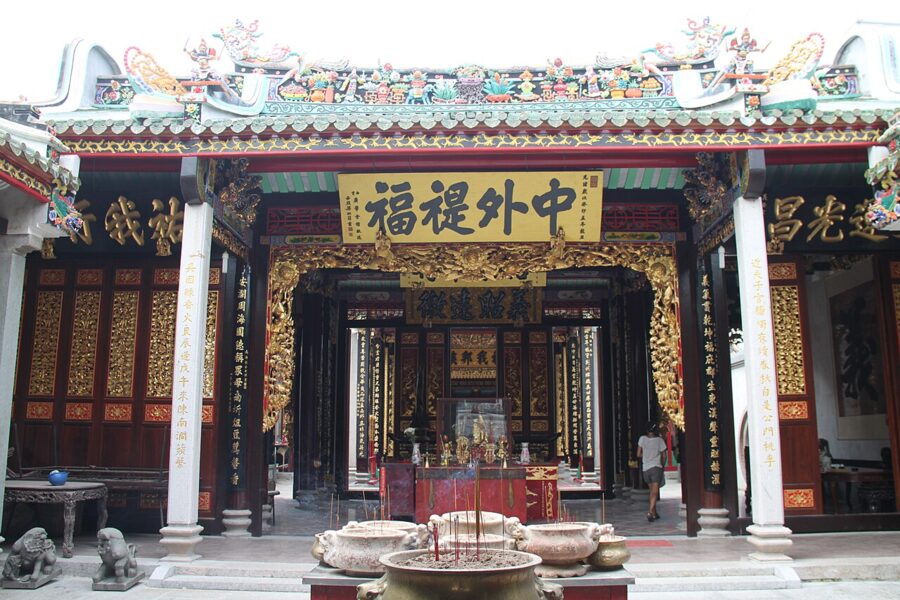
Inside the gate, the front hall opens straight into the heart of the place: a partly roofed courtyard with an open light well in the middle. The Vietnamese call it thiên tỉnh, the well of heaven. It lets daylight into the back hall and smoke out of the building, and it is the reason the temple does not choke on its own incense.
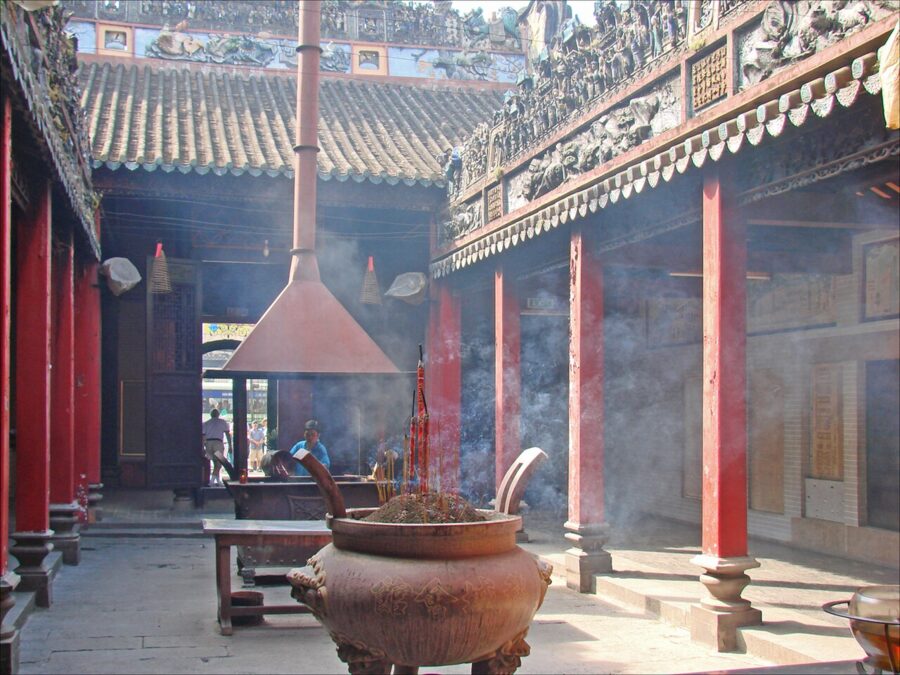

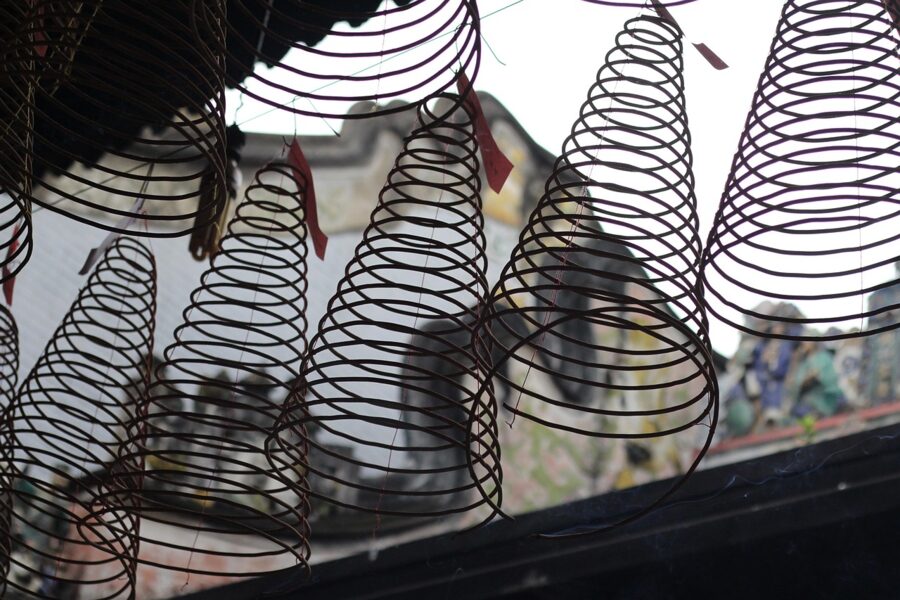
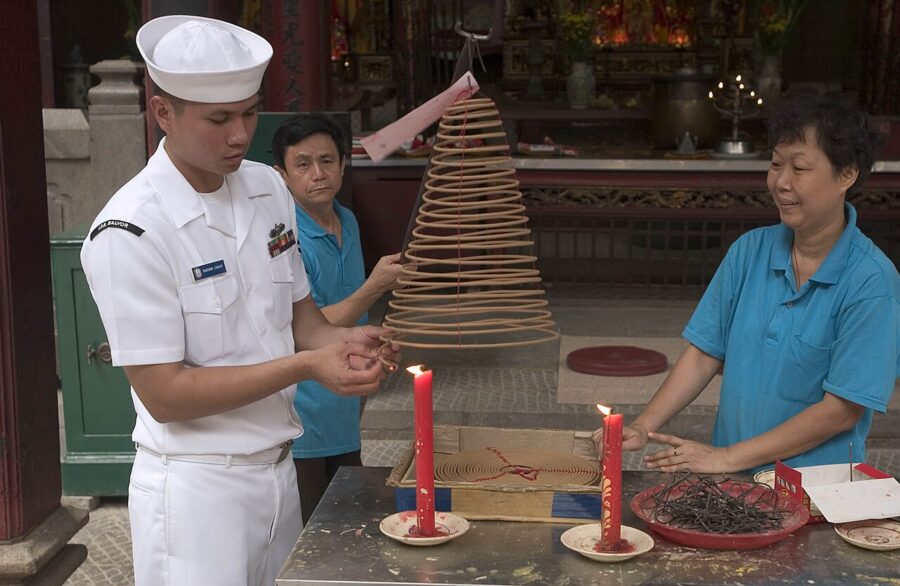
The coils hang in rows over this space. Each one is a single long stick of incense wound into a cone, hung by its tip and lit at the bottom, and a large coil will smolder for days. The red tag in the middle carries the name of the person who paid for it and a wish: health, a good year in business, a child’s exams. When a coil burns out, another takes its hook.
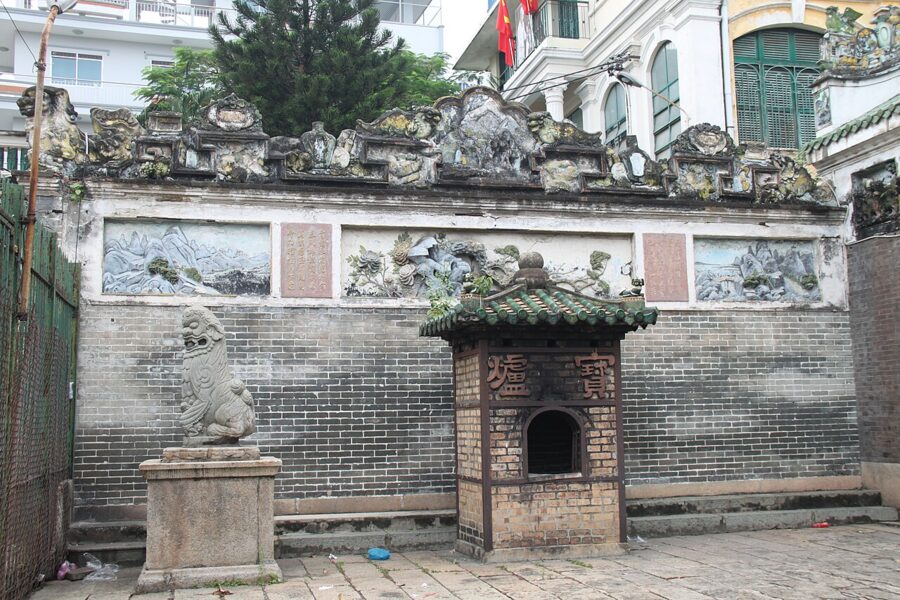
Off to the side of the halls is an older yard with a brick furnace for burning votive paper and a stone lion standing guard. The furnace is rarely used now; the newer brazier under the hood does the work. Walk to the back of the side aisle to find it.
Inside: the altars and who sits on them
The three halls on the axis each have a job. The front hall has two altars facing each other across the entrance, one for the god of the earth and good fortune, Phúc Đức Chánh Thần, and one for the gatekeeper, Môn Quan. A stone stele here tells Thiên Hậu’s legend, and large paintings show her appearing above the waves.
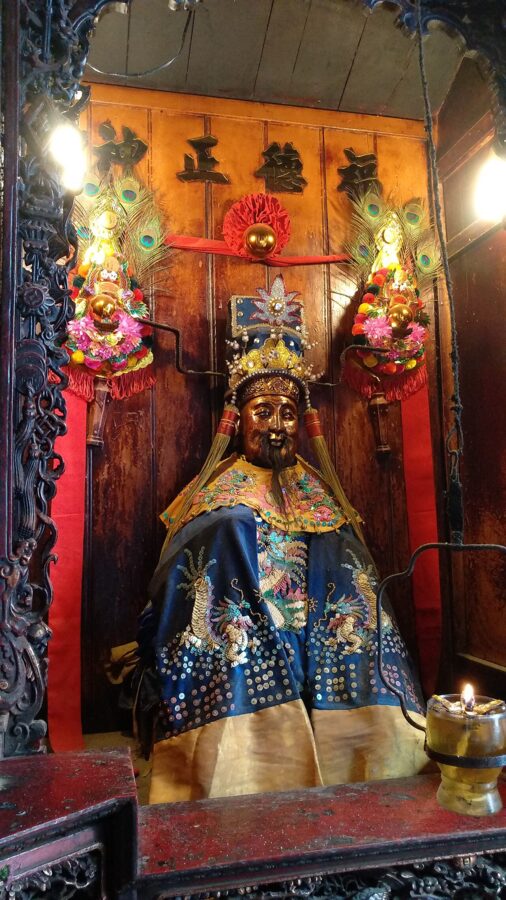

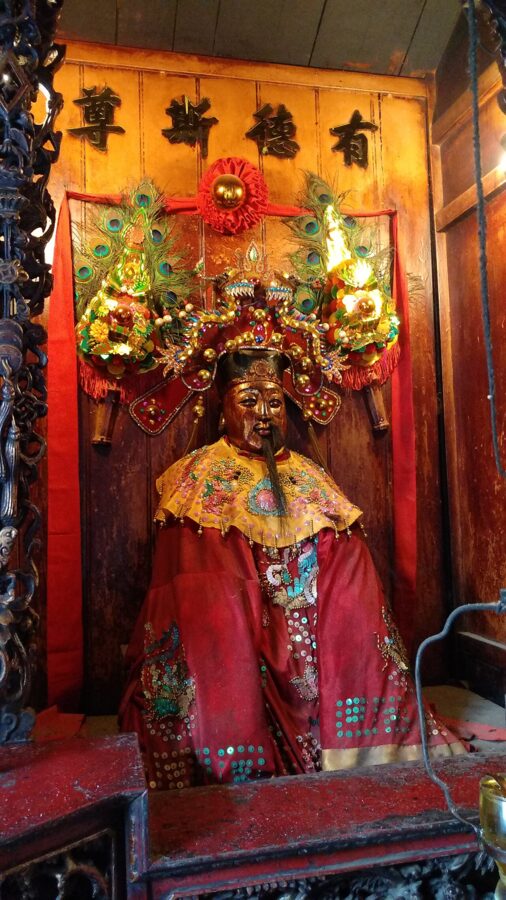

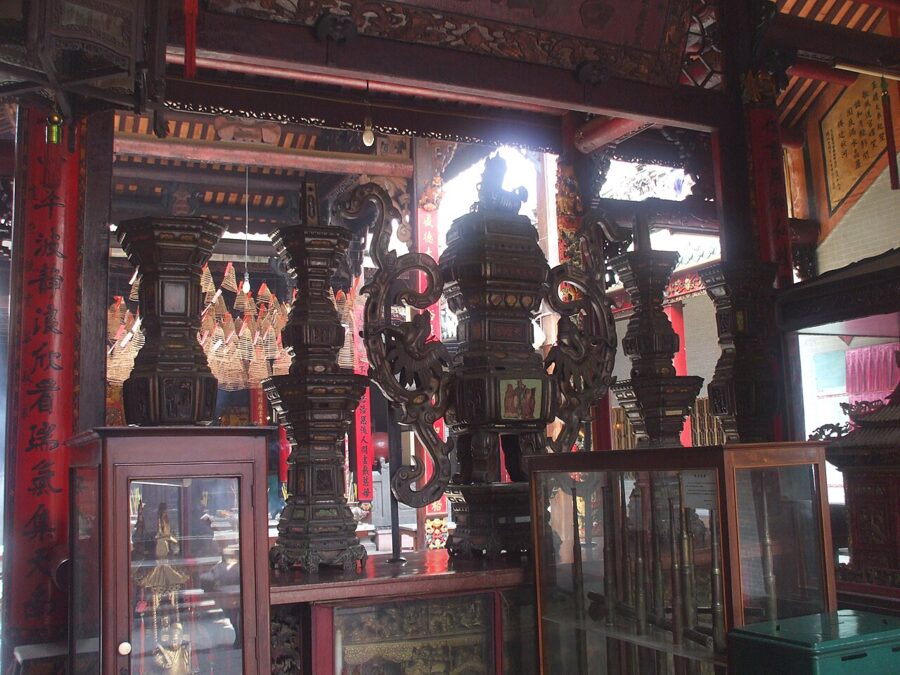
The middle hall holds a five-piece altar set cast in 1886, the twelfth year of the Guangxu Emperor. It is one of an estimated four hundred antiques in the hall, which by the management’s count include seven statues of gods, six stone statues, nine steles and four bronze incense burners.

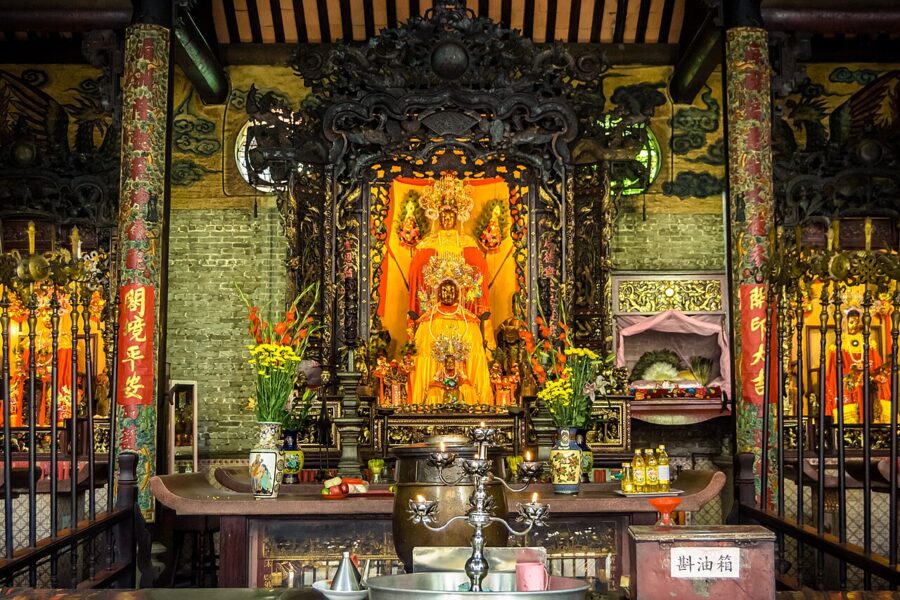
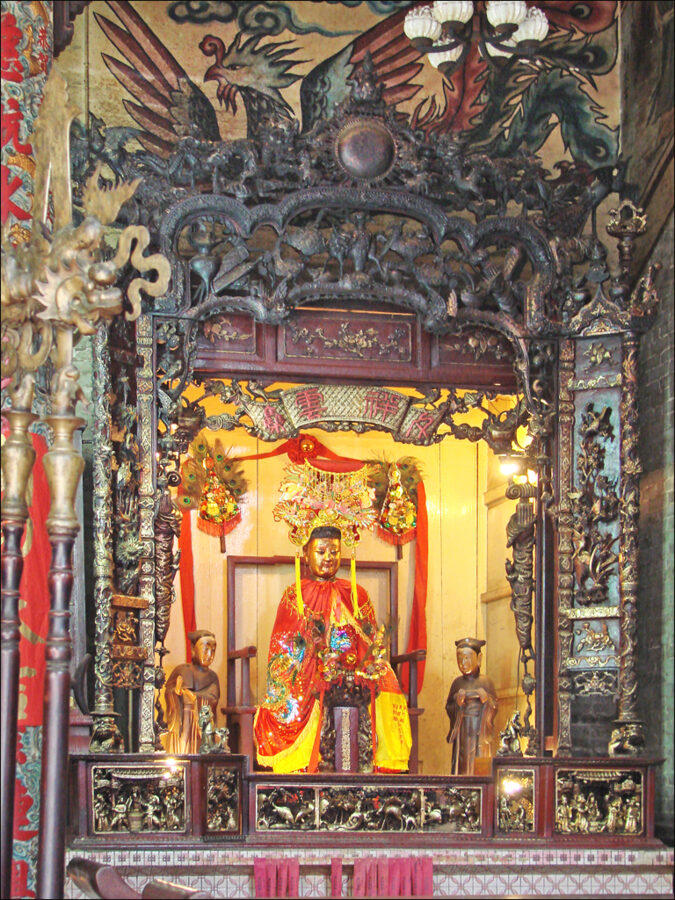
The main hall, the Thiên Hậu Cung, is where the goddess sits. Thiên Hậu is in the center, a wooden statue about a meter tall in an embroidered robe and beaded crown. She is flanked by Kim Hoa Nương Nương, the goddess women petition for children and safe births, and Long Mẫu Nương Nương, the Dragon Mother, whose statues are of painted papier-mâché. Side altars hold Guan Yu, the bodhisattva Kṣitigarbha (Địa Tạng) and the god of wealth.


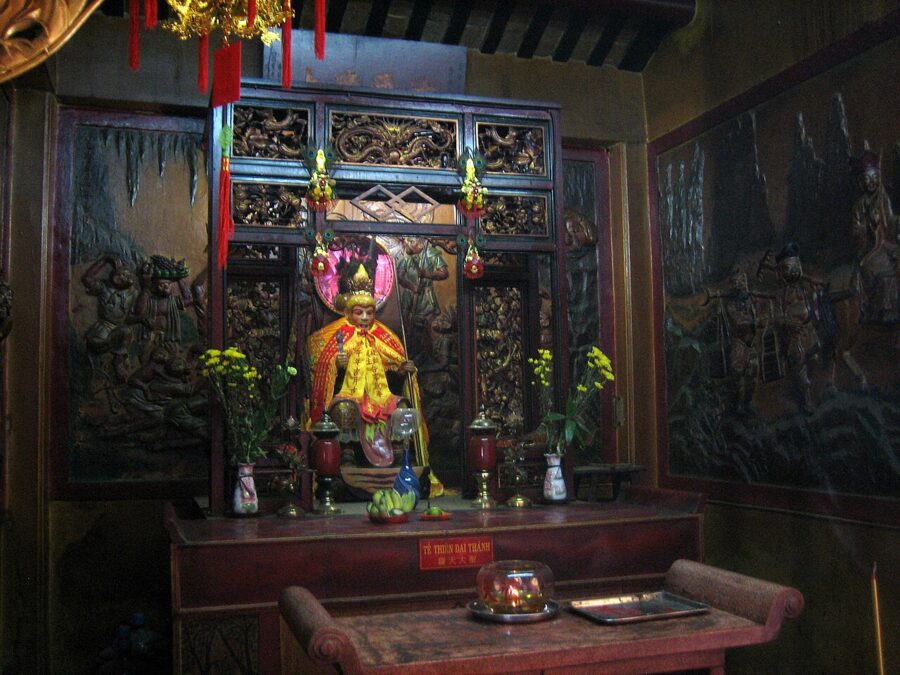
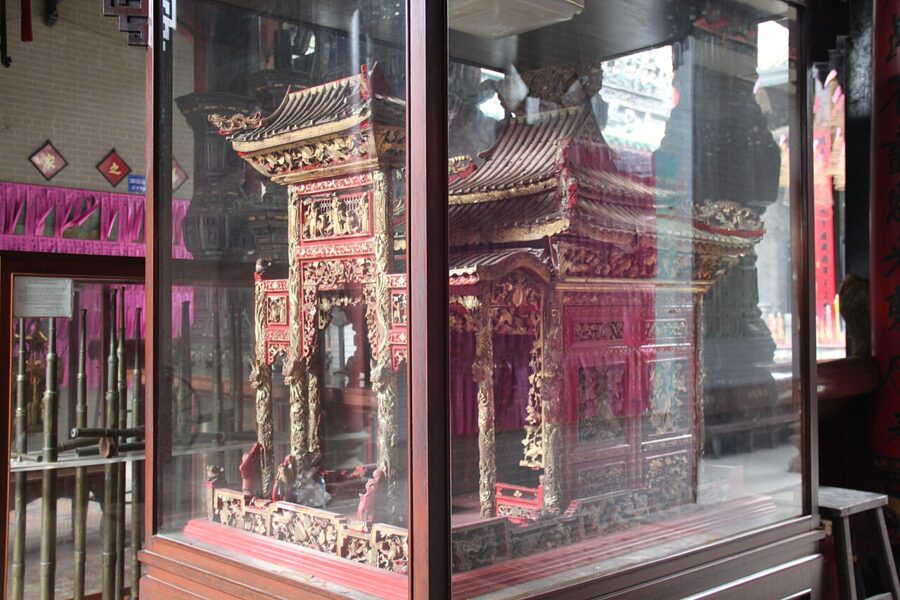
Smaller shrines fill the corners. One holds Sun Wukong, the Monkey King of Journey to the West, a figure the Teochew especially revere. In a glass case near the main hall stands a carved and lacquered palanquin, kept for the day the goddess is carried through the streets, along with a carved dragon boat that follows it in procession.

Two objects reward a slower look. The larger of the bronze bells, the one dated 1830, is said to be rung when a substantial donation is made. And in a glass case in the main hall, Vietnamese sources describe a notice of 1860 attributed to d’Ariès, the French commander in Saigon that year, ordering French and Spanish soldiers not to damage the place. The temple survived that war and every one after it.
What worshippers do
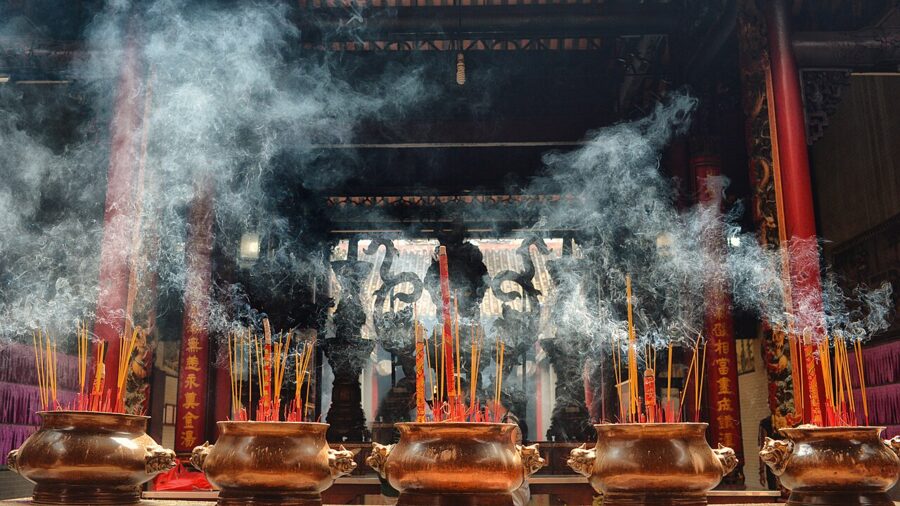
A typical visit follows a circuit. Worshippers buy incense at the counter, light it, bow to the earth god and the gatekeeper, plant sticks in the burners on the way through, and finish at the main altar with a longer prayer. Many add fruit, flowers or paper offerings. Some ask the goddess for a fortune, xin xăm, by shaking a cylinder of numbered bamboo sticks until one falls out, and the start of the lunar year is the favorite time to do it.
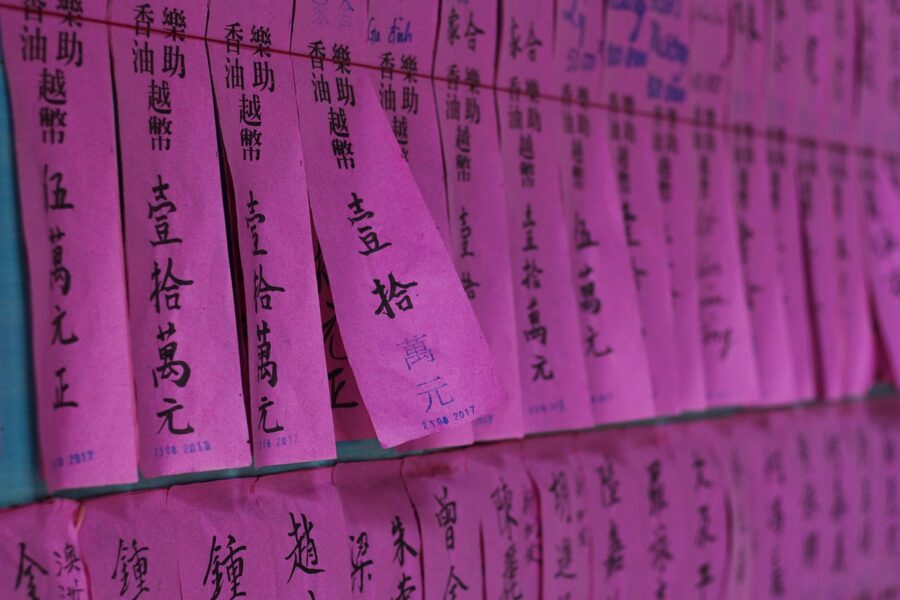
The pink paper that covers whole walls of the side corridors is the temple’s accounts made public. Each slip records a donor’s name and the sum given, in Chinese characters, and the corridors are lined with them. Read along a row and you see the congregation itself, the families and associations who still pay for the roof over the goddess.
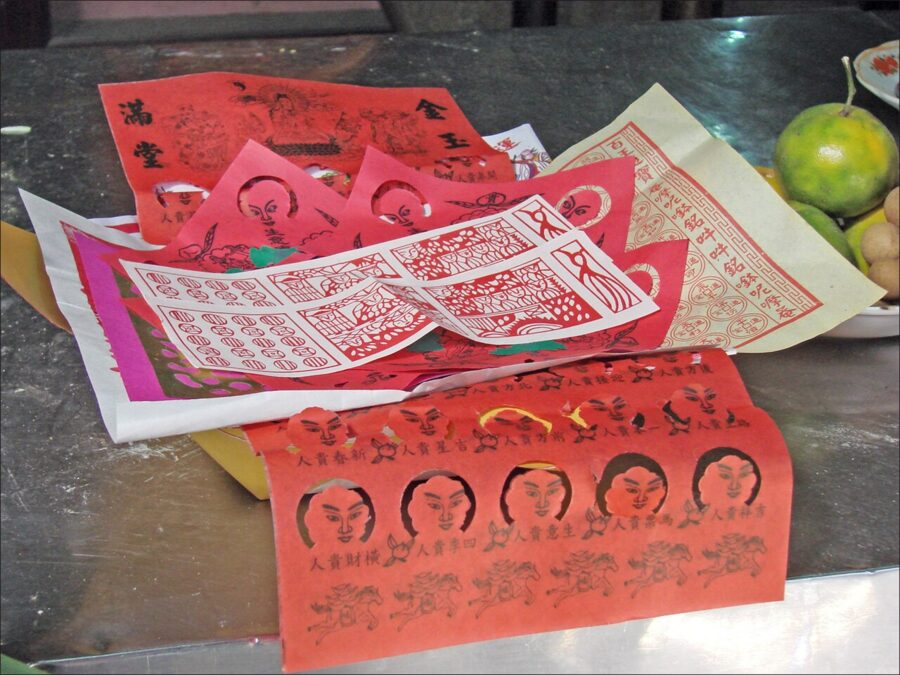

The busiest days are the first and fifteenth of every lunar month, when the courtyard fills early. If you want the temple at work, come on one of those mornings. If you want space and quiet, avoid them.
Festivals: the goddess’s birthday and Lunar New Year
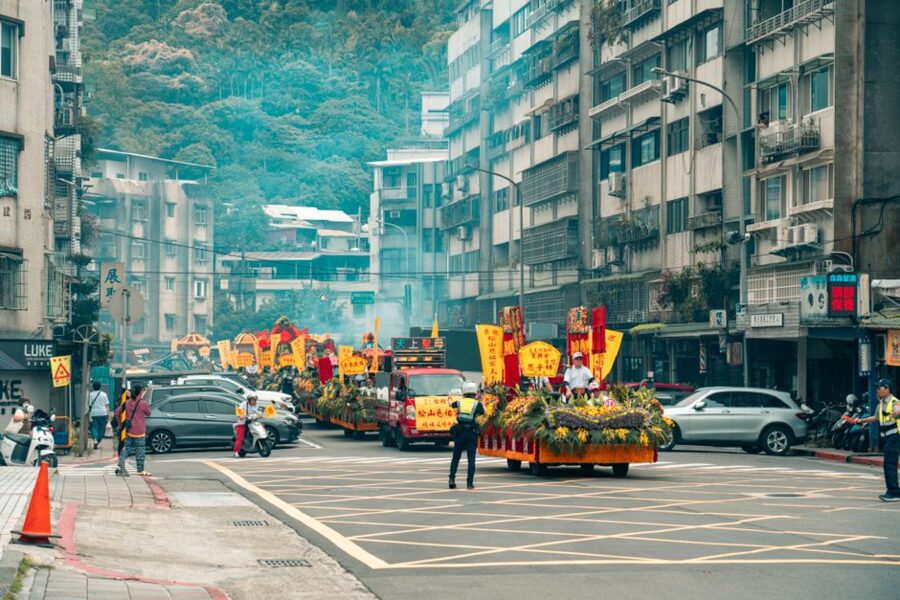
The main day of the temple’s year is Vía Bà, the goddess’s birthday, on the 23rd day of the third lunar month; in the Western calendar it falls between mid-April and mid-May. Celebrations run from the 22nd to the 24th. On the night before, the statue is ritually bathed, and on the morning of the 23rd she is carried out in her palanquin through the streets around the hall.
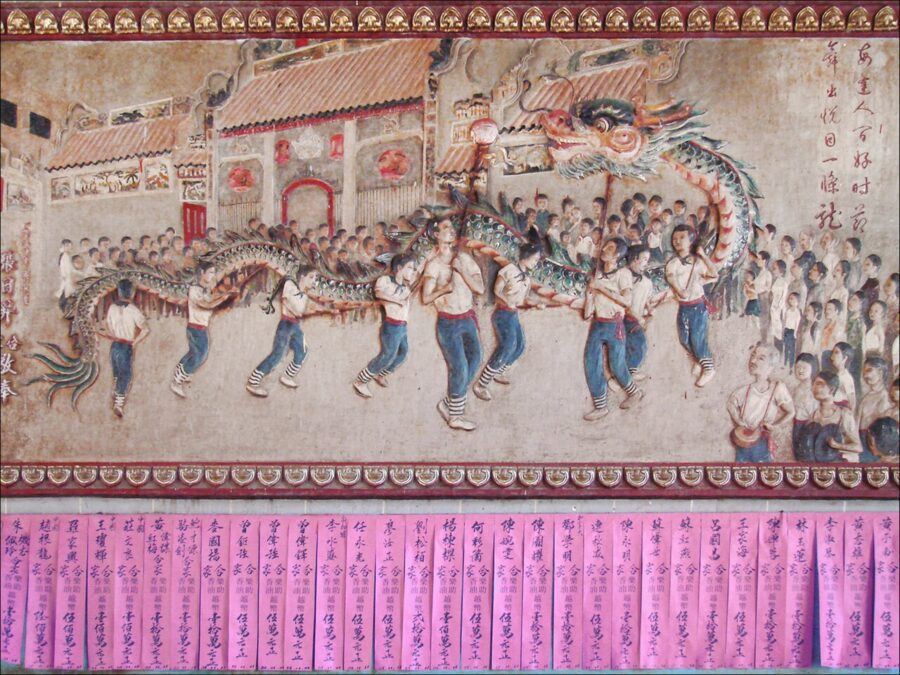

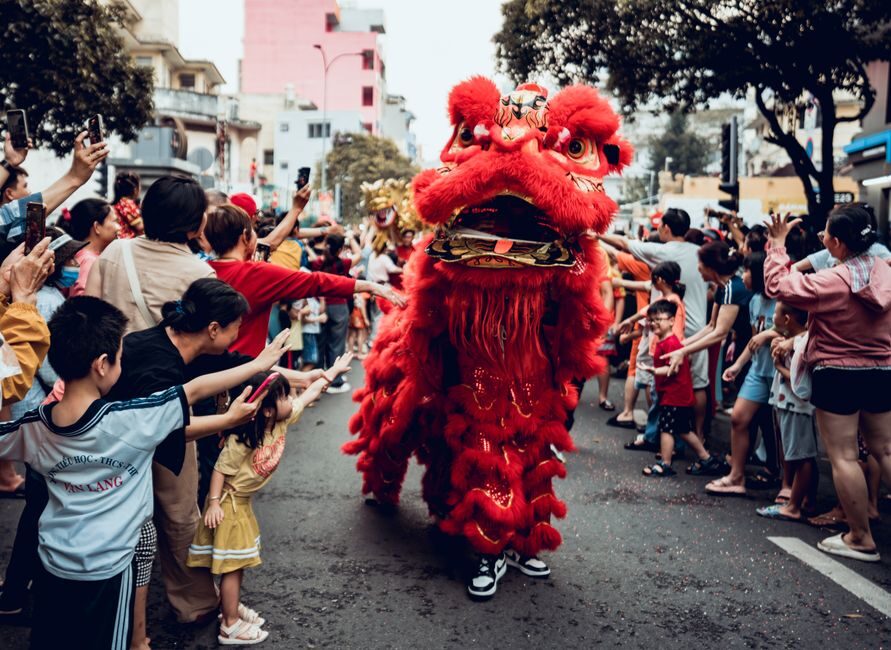
The procession follows the old pattern. Behind the palanquin come the carved dragon boat, red boards painted with the names of the gods worshipped in the hall, lion, unicorn and dragon dance troupes, and bands with drums and cymbals. Chinese and Vietnamese families crowd the hall. Exact times are set by the temple’s committee each year, so check locally before planning a trip around it.
Lunar New Year brings the second great rush. On the 28th day of the twelfth lunar month the hall holds its khai ấn, the opening of the seal. In 2026 it fell on 15 February: the rite started at 9am, and people had been queuing in the corridors since around 6am. Each person may bring up to five new cloths or towels to be stamped with a seal several centuries old reading “Bảo hộ an khang”, a blessing for protection, peace and health.
The head of the management board has explained that the ceremony is held before New Year’s Eve rather than after it to spread the crowds out. At the end, the organizers hand out red envelopes, each holding a symbolic 2,000₫ (well under US$0.10), about two thousand of them a year. A towel stamped here is kept for luck; one mother at the 2026 rite said hers would be used to wipe her child’s face.
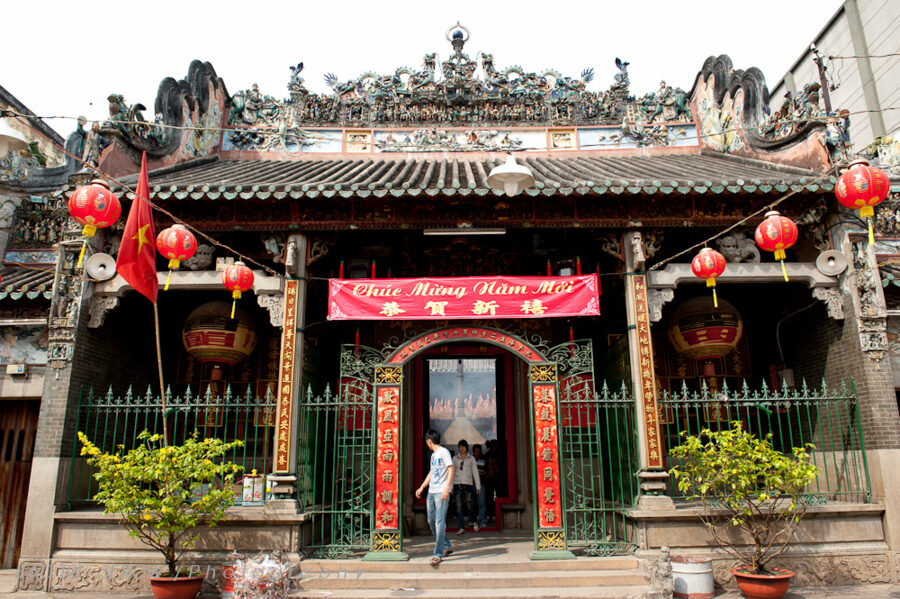

The hall is crowded through the Tết holiday as families come to pray for the year ahead, and again for the Lantern Festival, Nguyên Tiêu, on the fifteenth day of the first lunar month. The Lantern Festival is also one of the two great feast days at the Teochew hall next door.
The other assembly halls nearby
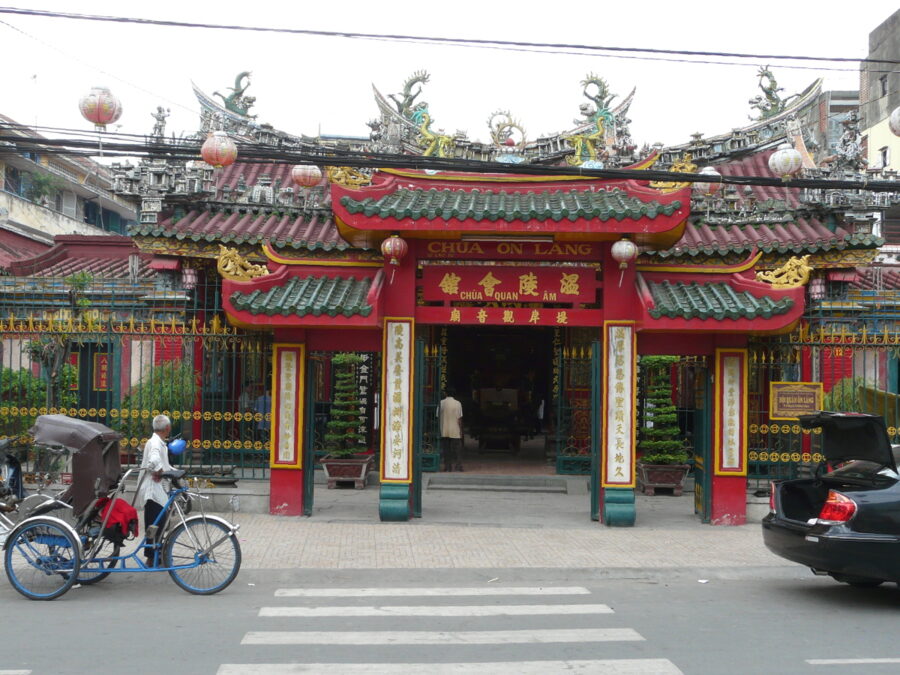
Thiên Hậu is one of a cluster, and the others are within an easy walk. About a hundred meters east at 678 Nguyễn Trãi is the Nghĩa An Assembly Hall (Hội quán Nghĩa An), the Teochew community’s hall, known as Chùa Ông after its main god, the red-faced Guan Yu; it is also a national monument, recognized in November 1993, and was restored between 2009 and 2014. A few minutes’ walk to the northwest, at 12 Lão Tử Street, the Ôn Lăng Assembly Hall (Hội quán Ôn Lăng), better known as the Quan Âm Pagoda, belongs to the Hokkien community from Quanzhou; its management board dates it to 1740 on the evidence of an 1869 stele.
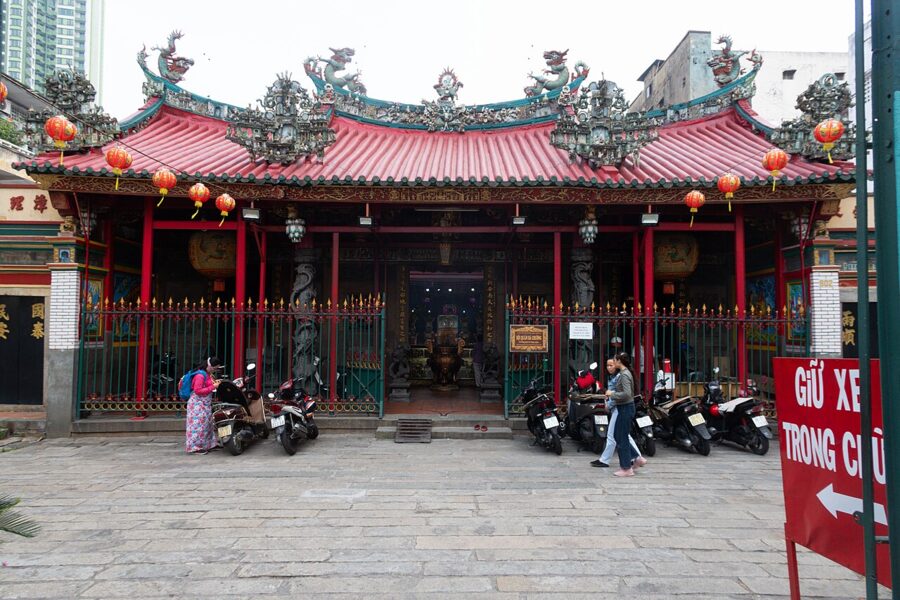
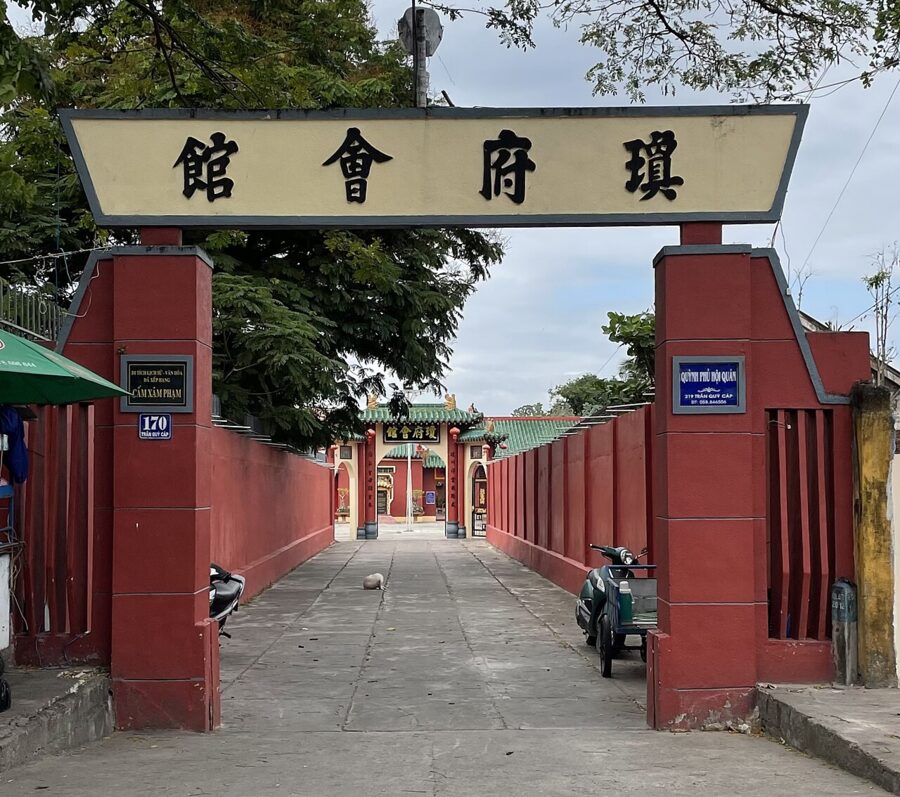
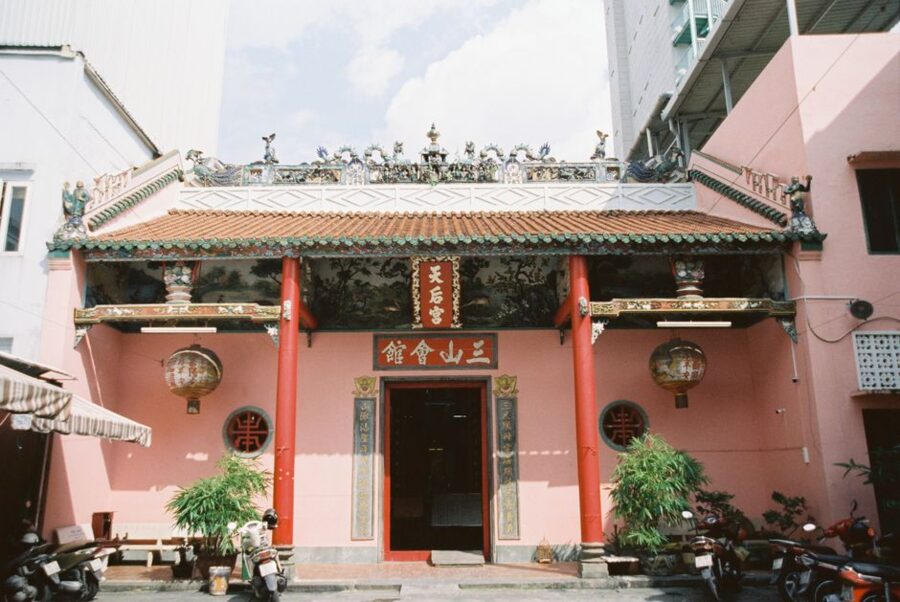
Three more halls keep a Thiên Hậu altar of their own. The Tam Sơn hall (Hội quán Tam Sơn) at 118 Triệu Quang Phục, just south of the temple, was built by Hokkien from Fuzhou and is known for its altar to Kim Hoa, to whom women pray for children. The Hà Chương hall at 802 Nguyễn Trãi, about 350 meters west, belongs to Hokkien from Zhangzhou, and the Quỳnh Phủ hall at 276 Trần Hưng Đạo to the Hainanese. A morning walk taking in all five costs nothing but time and a few donations.


How to visit
| Address | 710 Nguyễn Trãi Street, Chợ Lớn Ward (old District 5), Hồ Chí Minh City |
|---|---|
| Hours | Daily, about 6:30am to 4:30pm in listings dated 2026; one lists a midday break from 11:30am to 1pm. Hours lengthen on festival days and shift over Tết. |
| Entry | Free; donations are voluntary. Incense, offerings and sponsored coils are paid for at the counter. |
| Dress | Shoulders and knees covered; no very short shorts or sheer tops. |
| Photography | Allowed; no drones, no flash inside, and ask before photographing people at prayer. |
| Time to allow | 45 minutes to an hour; half a day with the other halls and Bình Tây Market |
The hours above come from guides published in 2026, and they do not agree to the half hour. Come in the morning and you will not be caught out: the temple opens early and the light in the courtyard is best before ten. Late afternoon is the riskiest time to arrive.

Getting there
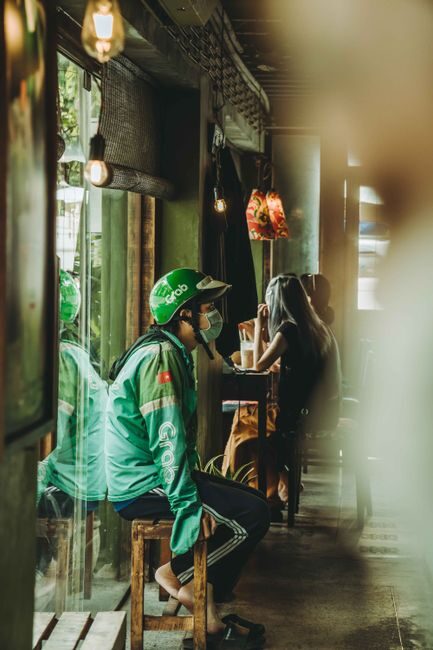
Chợ Lớn lies about five kilometers west of the city center, and the simplest way there is by Grab or Be. A car from the streets around Bến Thành Market takes 20 to 25 minutes outside rush hour and about twice that at rush hour; a motorbike taxi is quicker and cheaper. Ask for “Chùa Bà Thiên Hậu, 710 Nguyễn Trãi” so the driver does not take you to one of the other Thiên Hậu temples in the city.
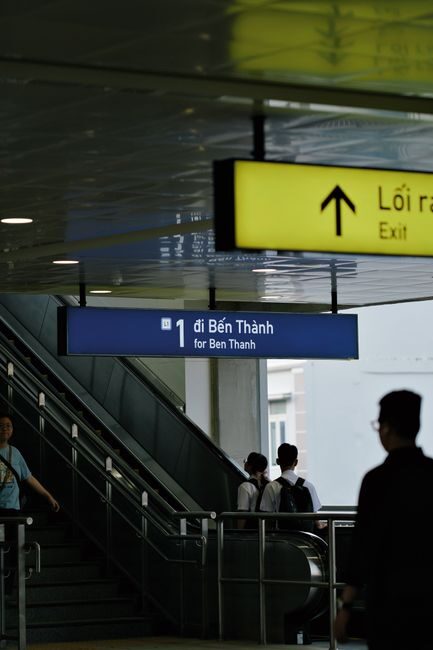
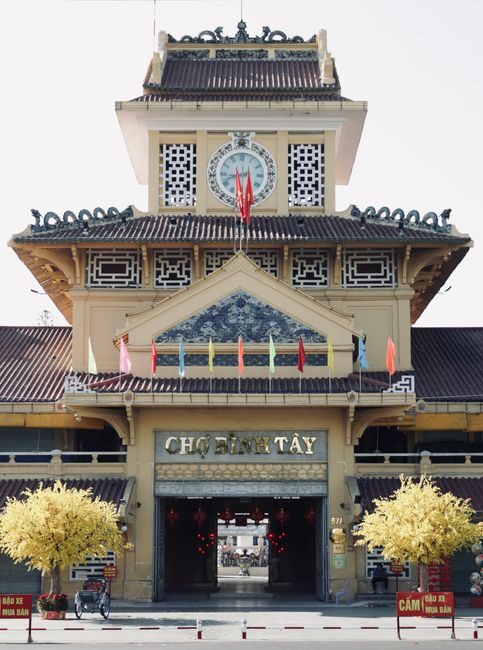
Metro Line 1 does not help here; its western terminus is Bến Thành. City buses run along Nguyễn Trãi, but route numbers change, so check a transit app on the day rather than trusting a printed list. If you are already in Chợ Lớn, the temple is about 1.5 kilometers, a 20-minute walk, northeast of Bình Tây Market.
Temple manners
Behave as you would in any working place of worship. Walk around people who are praying, not between them and the altar, and keep your voice down in the main hall. Do not touch the statues or the offerings, and do not lean over the offering tables for a photograph.
Shoes stay on, unlike in many Buddhist pagodas. If you want to take part, buy a bundle of incense at the counter, light it from the candle provided, and follow the people ahead of you; nobody minds a foreigner doing it slowly. A small note in the donation box is the usual thanks.
Combining it with the rest of Chợ Lớn
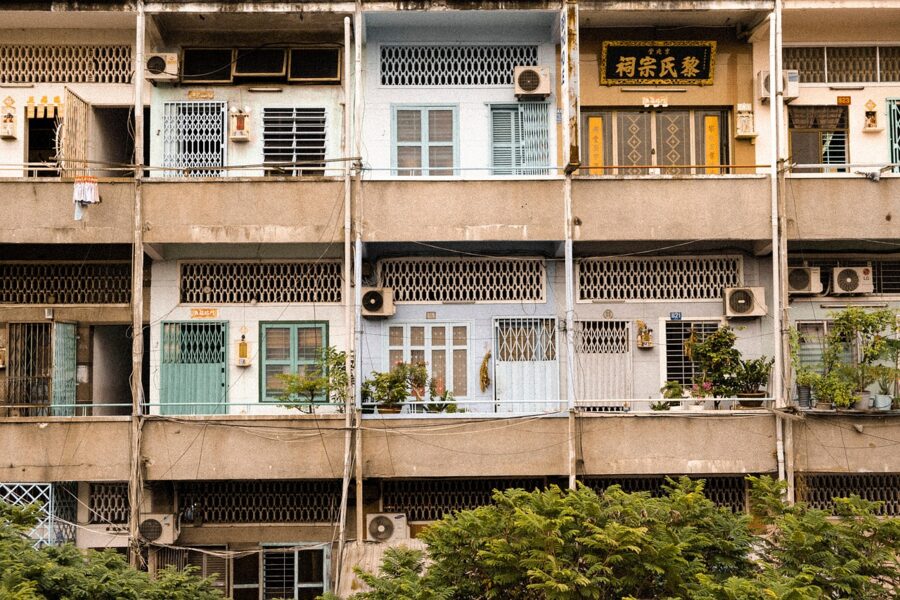
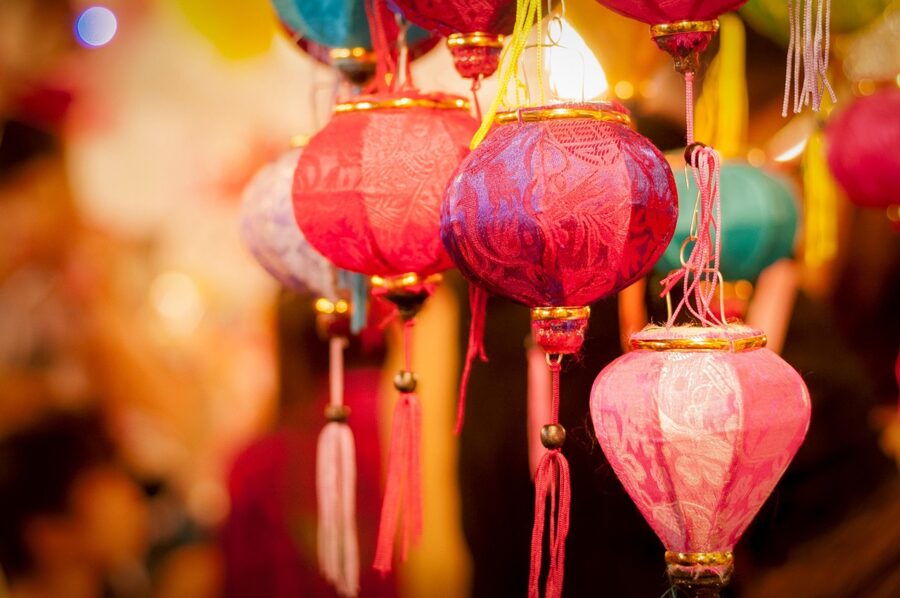
The natural half-day starts at Bình Tây Market around 8am, walks northeast to the Thiên Hậu Temple, and then takes in the Nghĩa An and Ôn Lăng halls within a few hundred meters. Lương Nhữ Học, the street just west of the temple, is lined with lantern shops and turns red and gold before the Mid-Autumn Festival. For lunch, Hà Tôn Quyền Street, about 1.5 kilometers northwest, is known across the city for Cantonese wonton noodles and dumplings, mì and sủi cảo.
Whatever else you do, end back in the courtyard for a minute. Stand under the coils, look up through the light well at the ceramic crowd on the roof, and watch someone hang a new spiral on an empty hook.